
Introduction
When sourcing custom embroidered patches for uniforms, military and police applications, outdoor gear, sports teams, corporate branding, clubs, or promotional products, price is only one part of the purchasing decision. Embroidered patch quality can directly affect appearance, durability, brand consistency, and even the overall impression of the finished product. For overseas buyers placing hundreds or thousands of patches per order, small quality differences can become significant once production moves from an approved sample to bulk manufacturing.
A high-quality embroidered patch is not determined by one factor alone. Buyers should evaluate the combination of stitch density, embroidery coverage, thread quality, color accuracy, artwork reproduction, border finishing, backing materials, shape consistency, and production control. A patch may look acceptable in a photograph but reveal loose threads, uneven borders, distorted lettering, puckering, or inconsistent colors when inspected closely.
This is particularly important when comparing an OEM embroidered patch manufacturer with a trading company or sourcing intermediary. A manufacturer with direct control over digitizing, embroidery machines, thread selection, production parameters, finishing, and inspection can respond more effectively when adjustments are required.
For B2B buyers, understanding these quality factors also makes supplier comparisons more meaningful. Instead of simply asking, “What is your price per patch?”, buyers can evaluate whether quotations are based on comparable materials, embroidery specifications, finishing standards, and quality-control requirements.
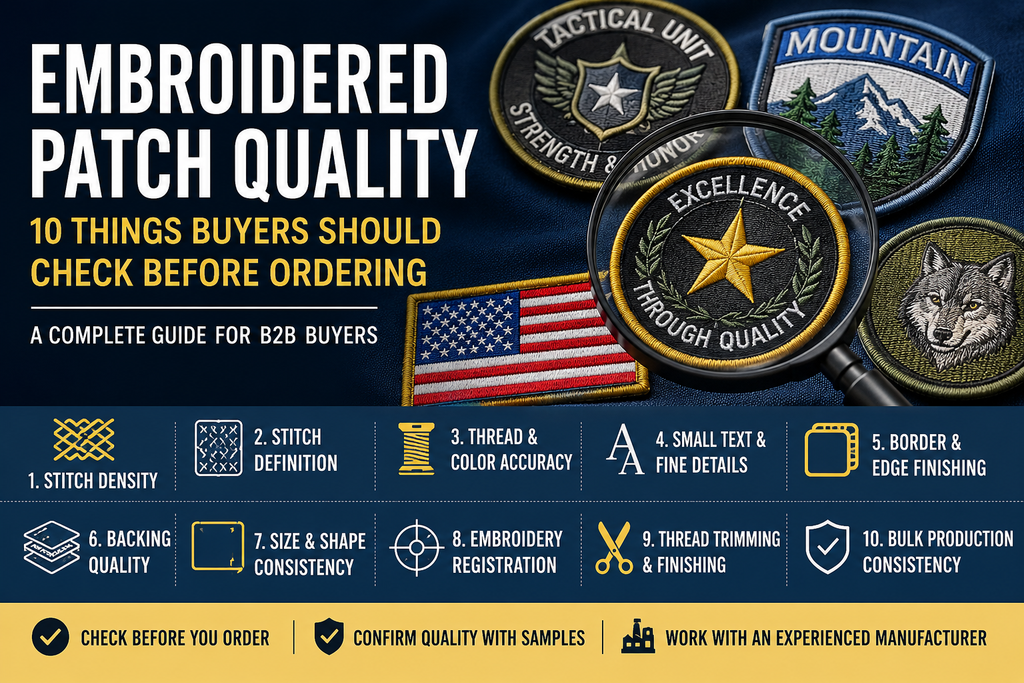
This guide explains 10 important factors buyers should check when evaluating custom embroidered patch quality, helping procurement teams, brands, uniform suppliers, distributors, organizations, and other professional buyers make more informed sourcing decisions before approving bulk production.
What Defines High-Quality Embroidered Patch Quality?
High-quality embroidered patches are the result of several production elements working together rather than simply using more stitches or thicker embroidery. The finished patch should reproduce the approved artwork clearly, maintain a consistent shape, provide suitable embroidery coverage, use stable materials, and have clean finishing around both the front and back. For OEM buyers, consistency is especially important because the goal is not to produce one attractive sample—it is to reproduce the approved quality reliably across an entire production batch.
Embroidery Density and Stitch Coverage
Embroidery density is one of the first characteristics buyers notice when examining embroidered patch quality. Proper stitch coverage should create a solid and professional surface without unnecessary gaps that expose the underlying fabric. However, increasing density without considering the fabric, patch size, stitch direction, and artwork structure does not automatically create a better patch.
If embroidery is too sparse, the base material may become visible between stitches and the design can appear inexpensive or unfinished. On the other hand, excessively dense embroidery can create unnecessary stiffness, increase stitch count and production time, and potentially cause puckering or distortion. Experienced embroidery production therefore requires a balance between coverage, stability, appearance, and efficiency.
Different sections of the same design may also require different stitch structures. Large background areas, small letters, borders, narrow lines, and detailed logos cannot always be digitized using identical settings. Professional embroidery digitizing determines how stitches should be arranged to reproduce the artwork while maintaining structural stability.
For buyers, the key question should therefore not simply be “How many stitches does this patch have?” Instead, evaluate whether the stitches provide appropriate coverage, whether the surface looks uniform, and whether the embroidery remains clean around detailed areas.
Clean Details and Accurate Artwork Reproduction
Artwork reproduction is another critical indicator of custom embroidered patch quality. A professional embroidered patch should preserve the important visual characteristics of the approved design, including logos, symbols, lettering, proportions, and recognizable details.
Embroidery, however, is fundamentally different from digital printing. Thread has physical thickness, stitches require space, and very small elements cannot always be reproduced exactly as they appear on a computer screen. This means professional production sometimes requires artwork optimization rather than literal reproduction.
For example, extremely thin lines may need to be slightly widened, tiny gaps may require adjustment, and very small lettering may need simplification to remain readable after embroidery. These modifications should preserve the visual identity of the original artwork while making the design technically suitable for embroidery.
Buyers should inspect whether letters remain legible, outlines are properly aligned, circular elements remain symmetrical, and small design elements are recognizable. When comparing suppliers, these details can reveal significant differences in digitizing experience and production control.
💡 Buyer Tip: When evaluating a sample, compare the embroidered patch with the approved artwork side by side. Focus on important logos, lettering, proportions, spacing, and recognizable design details rather than expecting thread to reproduce every pixel of digital artwork.
Material, Fabric, and Thread Quality
Even excellent digitizing cannot compensate for unsuitable materials. The base fabric, embroidery thread, backing materials, and finishing components all influence the appearance and durability of a finished patch.
Polyester embroidery thread is commonly used for commercial and industrial embroidered patches because it provides good strength, color consistency, and resistance to normal wear. Thread quality also influences sheen, stitch definition, and how consistently the embroidery machine can operate during production.
The base fabric must provide sufficient stability for the selected embroidery density. If the material is too weak or incompatible with the stitch structure, the patch may become distorted or develop puckering. Likewise, backing materials should be selected according to the intended application, whether the buyer requires sew-on patches, hook-and-loop backing, iron-on backing, adhesive backing, or another attachment method.
For professional OEM orders, material selection should therefore be considered as part of the complete manufacturing specification rather than as an isolated purchasing decision. A reliable embroidered patch manufacturer should evaluate the interaction between artwork, embroidery density, fabric, thread, backing, border construction, and intended use before bulk production begins.
📊 Table: Key Characteristics of High-Quality Embroidered Patches
| Quality Factor | What Buyers Should Check | Potential Warning Signs |
|---|---|---|
| Stitch Coverage | Consistent and appropriate embroidery coverage | Visible gaps or excessive density |
| Artwork Reproduction | Accurate proportions and recognizable details | Distorted logos or missing details |
| Lettering | Clear and readable text | Filled gaps or unclear characters |
| Thread Quality | Consistent appearance and clean stitching | Frequent breaks or uneven surface |
| Base Fabric | Stable shape and suitable support | Puckering or deformation |
| Border | Clean and consistent edge | Uneven width or loose threads |
| Color | Consistent with approved selection | Unexpected color variation |
| Overall Finish | Clean front and back | Excess thread or poor trimming |
📖 Extended Reading
- OEM Embroidered Patch Manufacturer: Complete Buyer Guide
- Custom Embroidered Patches Cost: Complete Buyer Guide
- Custom Embroidered Patches MOQ: What Buyers Need to Know
Check the Stitch Density and Embroidery Coverage
Stitch density and embroidery coverage are two of the most important factors buyers should examine when evaluating embroidered patch quality. They influence not only how solid and professional a patch looks, but also its flexibility, dimensional stability, production time, and overall cost. A common misunderstanding is that a patch with more stitches must automatically be higher quality. In professional embroidery manufacturing, however, quality depends on whether the stitch density is appropriate for the artwork, patch size, base fabric, thread, and intended application.
For B2B buyers comparing samples from different embroidered patch manufacturers, stitch count alone therefore provides limited information. Two patches with similar dimensions may have very different stitch counts because of differences in embroidery coverage, lettering, background fill, design complexity, and digitizing methods. A well-engineered embroidery file should provide sufficient coverage while avoiding unnecessary stitches that add production time without improving the finished result.
Why Stitch Density Matters
Stitch density refers to how closely embroidery stitches are positioned within a defined area. When density is properly controlled, the embroidered surface appears solid, consistent, and visually clean. The underlying fabric should not show through areas intended to have full embroidery coverage, while individual shapes, outlines, and colors should remain clearly defined.
If stitch density is too low, gaps may appear between threads and the base fabric can become visible. This can make the patch look unfinished, especially in large fill areas or solid-color sections. Sparse embroidery may also reduce the visual depth and richness buyers typically expect from high-quality embroidered patches.
However, increasing density too aggressively creates a different set of problems. Excessive stitches place additional tension on the fabric and can contribute to puckering, stiffness, distortion, thread breaks, or uneven surfaces. Dense designs also require longer machine running times, which can affect production cost and lead time.
This is why experienced digitizing is important. Stitch direction, underlay, density, pull compensation, sequencing, and the interaction between adjacent embroidery areas must be considered together. A professional manufacturer adjusts these parameters according to the actual design rather than applying one universal density setting to every patch.
Does a Higher Stitch Count Always Mean Better Quality?
No. A higher stitch count does not automatically mean better embroidered patch quality.
Stitch count is primarily a production measurement indicating the approximate number of stitches required to complete an embroidery design. It can provide useful information about production complexity and machine time, but it should not be treated as a standalone quality rating.
For example, a large patch containing several fully embroidered background areas may naturally require significantly more stitches than a smaller patch with open fabric areas. Likewise, two patches of identical size can have different stitch counts because one design contains detailed lettering, multiple filled areas, borders, or overlapping elements.
Unnecessary stitches can actually reduce quality. Excessive density may cause the patch to become overly rigid or create fabric distortion. It can also increase embroidery machine time, thread consumption, and production costs without producing a meaningful visual improvement.
For this reason, professional buyers should evaluate the relationship between stitch count and the actual design rather than requesting the highest possible stitch count. The goal is optimized embroidery: enough stitches to achieve clean coverage, stable construction, and accurate artwork reproduction without creating unnecessary density.
💡 Buyer Tip: When comparing quotations, do not choose a supplier simply because it claims to use more stitches. Ask whether the stitch count is optimized for the artwork, embroidery coverage, fabric stability, and required level of detail.
Balancing Stitch Density, Detail, and Fabric Stability
Achieving consistent custom embroidered patch quality requires balancing three closely connected factors: density, detail, and stability. Increasing one factor can influence the others, which is why embroidery digitizing requires technical judgment rather than simply converting artwork into stitches.
Small lettering provides a good example. If too much thread is concentrated within a very small area, the spaces inside letters can close and make the text difficult to read. Reducing density may improve clarity, but reducing it too much can expose the base fabric. Similar trade-offs occur with narrow lines, small icons, layered colors, and highly detailed logos.
Fabric stability must also be considered. During embroidery, thousands of needle penetrations and thread movements create mechanical tension. The digitizing sequence, stitch direction, underlay, stabilizer, and embroidery density all influence how the fabric reacts. Poorly balanced settings may cause edges to curl, circular patches to lose their shape, or straight lines to become distorted.
This becomes particularly important for bulk embroidered patches. A sample should not only look good individually; its construction should also be suitable for repeatable production. Manufacturers need stable machine settings and properly engineered embroidery files so that quality remains consistent throughout larger production quantities.
For buyers, the best evaluation method is therefore visual and structural rather than numerical. Examine whether the embroidery provides complete coverage, whether fine details remain clear, whether the patch lies reasonably flat, and whether the finished dimensions and shape remain consistent with the approved sample.
📊 Table: Embroidery Density vs Patch Quality
| Embroidery Condition | Appearance | Potential Impact | Buyer Evaluation |
|---|---|---|---|
| Density Too Low | Base fabric may show through | Weak visual coverage | Check large fill areas carefully |
| Proper Density | Solid and consistent surface | Balanced appearance and stability | Preferred production result |
| Density Too High | Very thick or rigid surface | Puckering, distortion, longer production time | More stitches are not always better |
| Poor Density Balance | Uneven coverage between areas | Inconsistent details and texture | Compare different sections of the patch |
| Optimized Density | Coverage matched to artwork and fabric | Better repeatability in bulk production | Evaluate together with the approved sample |
📖 Extended Reading
- High-Density Embroidery & Stitch Count: What Buyers Should Know
- How to Design Artwork for Embroidery
- Complete Guide to Embroidered Patches
Inspect Thread Quality and Color Accuracy
Thread selection has a direct influence on embroidered patch quality, affecting color appearance, stitch definition, durability, production stability, and the consistency of finished patches across a bulk order. For professional buyers, thread should not be evaluated only by whether the color looks attractive. The quality of the embroidery thread, its compatibility with industrial embroidery equipment, color consistency, and the total number of colors required by the artwork can all influence the final result.
Color accuracy is particularly important for corporate logos, uniforms, military and police patches, sports teams, organizations, and branded merchandise where specific colors may form part of an established visual identity. During the sampling stage, buyers should therefore confirm thread colors carefully and use the approved sample as an important reference for mass production. When repeat orders are expected, maintaining clear production records can also help improve consistency between different manufacturing batches.
Why Embroidery Thread Quality Matters
Embroidery thread is subjected to continuous mechanical stress during high-speed industrial production. Thousands of stitches may be required for a single patch, and bulk orders can involve millions of individual stitches across an entire production run. Thread quality therefore affects both the appearance of the finished product and the stability of the manufacturing process.
High-quality embroidery thread should provide consistent thickness, reliable tensile performance, stable coloration, and a clean surface appearance. Polyester embroidery thread is widely used for commercial embroidered patches because it provides a useful balance of durability, color performance, and production reliability.
Lower-quality or inconsistent thread can contribute to thread breaks, irregular stitch formation, uneven surface appearance, or differences between production batches. Frequent thread breaks can also interrupt machine operation and require additional operator intervention, potentially affecting production efficiency.
At Artist Embroidery, professional embroidery thread selection is considered together with digitizing, machine settings, fabric, stitch density, and the requirements of the finished patch. For additional information about professional embroidery thread manufacturing, buyers can refer to FuFu’s Thread – Professional Embroidery Threads.
For buyers, thread quality is therefore more than a material specification. It forms part of the complete production system required to achieve consistent custom embroidered patch quality.
How Thread Colors Affect Patch Appearance
Choosing the correct embroidery thread colors is essential when reproducing logos, emblems, flags, uniforms, brand graphics, or other color-sensitive artwork. Even when the embroidery structure is technically excellent, incorrect color selection can make a finished patch look noticeably different from the buyer’s intended design.
One important consideration is that colors displayed on a monitor are produced using light, while embroidery colors are created using physical thread. As a result, RGB or CMYK artwork values cannot always be translated perfectly into embroidery thread colors. Screen calibration, lighting conditions, thread sheen, neighboring colors, and the direction of the stitches can all influence how a color appears.
For this reason, professional embroidery manufacturers normally select the closest suitable thread color based on the available thread color range and the buyer’s requirements. When color accuracy is particularly important, the selected colors should be confirmed during sampling before mass production begins.
Buyers should also remember that thread has texture and reflects light differently depending on stitch direction. The same thread color may appear slightly lighter or darker when viewed from different angles. This does not necessarily indicate a production defect.
For repeat OEM orders, retaining the approved specifications and thread color references is especially valuable. It allows the manufacturer to reproduce future orders more consistently rather than selecting colors again from the beginning.
💡 Buyer Tip: If a corporate or organizational color is especially important, provide the manufacturer with the clearest available color reference and confirm the selected embroidery thread during the sample approval stage.
Why More Thread Colors Can Increase Production Cost
The number of thread colors used in an embroidered patch can affect both design complexity and production cost. In general, the more embroidery colors a design requires, the higher the production cost may become, especially when a patch contains many separate color sections or requires additional production handling.
Each thread color must be prepared and assigned to the appropriate embroidery sequence. Although modern multi-head industrial embroidery machines can accommodate multiple thread colors, additional colors still increase production complexity. Depending on the design and machine configuration, more colors may require additional thread setup, machine preparation, monitoring, and color changes.
This is particularly relevant when buyers request designs containing numerous small color areas. A design using ten or more thread colors may require more production management than a similar patch using four or five colors, even if the physical dimensions are identical.
However, reducing colors purely to achieve the lowest price is not always the best solution. Important logo colors, national flag colors, identification elements, or visual distinctions may be essential to the design. The objective should be to balance artwork accuracy with production efficiency.
An experienced embroidered patch manufacturer can review the artwork and identify whether certain visually similar colors can be consolidated without significantly changing the design. When appropriate, this can simplify production and potentially reduce cost. When all colors are necessary, buyers should expect the quotation to reflect the additional production complexity.
Therefore, when comparing custom embroidered patch quotations, buyers should not evaluate size and quantity alone. Thread color count is another specification that can influence pricing, together with stitch count, embroidery coverage, backing, border type, patch dimensions, order quantity, and other production requirements.
💡 Buyer Tip: Before requesting a bulk quotation, confirm which thread colors are essential to the design. Simplifying unnecessary color variations can make production more efficient, while essential brand or identification colors should remain unchanged.
📊 Table: Thread Quality and Color Factors Buyers Should Evaluate
| Factor | What Buyers Should Check | Why It Matters |
|---|---|---|
| Thread Quality | Consistent thickness and clean appearance | Supports stable embroidery and finishing |
| Thread Color | Suitable match to approved artwork | Maintains visual and brand consistency |
| Color Consistency | Similar appearance throughout the production batch | Important for bulk and repeat orders |
| Number of Colors | Total thread colors required by the design | More colors can increase production complexity and cost |
| Thread Sheen | Appearance under different lighting and viewing angles | Can influence perceived color |
| Approved Color Reference | Confirmed colors during sampling | Helps maintain consistency during mass production |
| Repeat-Order Records | Previously approved thread specifications | Improves consistency for future orders |
📖 Extended Reading
- Custom Embroidered Patches Cost: Complete Buyer Guide
- Company Embroidered Logo: How Custom Patches Strengthen Brand Impact
- Flag Embroidered Patches: OEM Guide for Custom Flag Patches
Examine Small Details, Text, and Fine Lines
Small lettering, thin lines, miniature symbols, and complex logo details are some of the most challenging elements to reproduce consistently in embroidery. Unlike printing, embroidery uses physical thread and needle penetration to build an image on fabric. Every line requires sufficient space for stitches, and every letter must remain open enough to be readable after the thread is placed. For this reason, evaluating fine details is an important step when buyers inspect embroidered patch quality, especially for military and police insignia, company logos, name patches, club emblems, sports patches, and other designs containing text or intricate graphics.
A professional manufacturer should not simply convert every element of the original artwork into stitches without considering embroidery limitations. Instead, the artwork and digitizing should be optimized for the actual patch size. Slight adjustments to line thickness, spacing, lettering, outlines, or tiny graphic elements may be necessary to achieve a cleaner finished result. The objective is not to unnecessarily change the buyer’s design, but to preserve its visual identity while making it suitable for embroidery production.
Minimum Letter Size for Embroidery
Lettering is one of the easiest areas for buyers to use when evaluating custom embroidered patch quality. Well-produced text should appear balanced, recognizable, and readable at the intended viewing distance. However, there is no single minimum letter size that guarantees perfect embroidery for every design.
The practical limit depends on several factors, including font style, uppercase or lowercase letters, stroke thickness, spacing between characters, thread type, fabric, stitch direction, and the total size of the patch. A simple bold uppercase font can usually be reproduced more clearly at a small size than a decorative script font containing narrow strokes and complex curves.
For example, letters such as “E,” “A,” “R,” and “B” contain internal spaces that must remain sufficiently open after embroidery. If the characters are made too small, thread can visually fill these spaces and reduce readability. Very narrow gaps between adjacent letters can also disappear once stitches are added.
This is why experienced embroidery digitizing involves more than selecting a font and entering text. Stitch direction, density, underlay, pull compensation, and spacing may need to be adjusted according to the actual dimensions of the lettering.
For B2B buyers, the safest approach is to evaluate small text on a physical sample whenever readability is critical. What appears perfectly clear in vector artwork at 200% zoom may behave differently when reproduced with real embroidery thread at the final production size.
💡 Buyer Tip: If small lettering is essential to the design, avoid judging it only from a digital embroidery preview. Confirm readability on the actual-size embroidered sample before approving bulk production.
Why Fine Details Can Be Difficult to Reproduce
Embroidery has physical limitations that do not exist in digital artwork or high-resolution printing. A vector line can theoretically be extremely thin, but embroidery thread has actual thickness and stitches require enough space to form correctly. When multiple tiny elements are positioned close together, their stitches may overlap visually or compete for limited space.
This becomes particularly noticeable in highly detailed logos, animal illustrations, aircraft designs, seals, badges, crests, and emblems containing multiple outlines. If every tiny element is reproduced literally, the finished patch can become crowded and difficult to read.
Another challenge is the interaction between neighboring stitch areas. Embroidery creates tension as thread is repeatedly inserted into the fabric. This can cause small elements to shift slightly compared with their positions in the original artwork. Professional digitizing compensates for these physical characteristics by adjusting stitch direction, sequence, overlap, and compensation.
The size of the patch also changes what is technically practical. A detailed logo that works well on a 100 mm patch may lose clarity when reduced to 50 mm because the same visual information must fit into half the available space.
When evaluating embroidery stitch quality, buyers should therefore look at whether the manufacturer has preserved the important visual characteristics rather than whether every microscopic detail from the source file has been reproduced. Clean simplification is often a sign of better embroidery engineering than forcing excessive detail into an unsuitable space.
When Artwork Should Be Simplified for Embroidery
Artwork simplification may be necessary when the original design contains details that are too small, thin, complex, or closely spaced for reliable embroidery production. This should be viewed as technical optimization rather than a reduction in quality.
Common adjustments include increasing the thickness of narrow lines, enlarging small lettering, opening spaces between elements, removing extremely tiny details, reducing unnecessary outlines, or combining visual elements that would otherwise overlap after stitching.
The key is determining which details define the identity of the design. Important elements such as brand names, unit numbers, national symbols, organization names, aircraft silhouettes, or recognizable logo features should receive priority. Less important decorative details can sometimes be simplified to improve overall clarity.
For OEM production, this process becomes particularly important because an embroidery design must be repeatable. A sample that barely reproduces an extremely small detail under ideal conditions may not provide the production tolerance required for hundreds or thousands of pieces. Designing within realistic embroidery limits helps improve consistency across the entire order.
Buyers should also consider patch dimensions early in the design process. If every detail must remain exactly as shown in the original artwork, increasing the physical patch size may provide more room for embroidery. If the dimensions cannot change, selective simplification may produce the better result.
A professional embroidered patch manufacturer should be able to identify these potential issues before mass production and discuss practical adjustments with the buyer during artwork review and sampling.
💡 Buyer Tip: When a manufacturer recommends simplifying a very small detail, compare the proposed adjustment at the patch’s actual production size. A simplified design often looks cleaner and more accurate when embroidered than an overly complex version.
📊 Table: Artwork Details and Embroidery Limitations
| Design Element | Potential Embroidery Issue | Recommended Consideration |
|---|---|---|
| Small Lettering | Characters may become unclear | Use simpler fonts or increase size |
| Thin Lines | Lines may disappear or become inconsistent | Increase line thickness where necessary |
| Tight Spacing | Adjacent stitches may visually merge | Increase spacing between elements |
| Tiny Internal Spaces | Thread may close open areas | Simplify or enlarge the feature |
| Complex Outlines | Excessive stitches may create a crowded appearance | Reduce unnecessary outlines |
| Highly Detailed Graphics | Details may lose definition at small sizes | Prioritize recognizable elements |
| Small Patch Size | Limited area for detailed embroidery | Simplify artwork or consider a larger patch |
| Layered Elements | Stitch overlap may affect alignment | Optimize stitch sequence and digitizing |
📖 Extended Reading
- How to Design Artwork for Embroidery
- Police Name Patch: Custom Embroidery Guide for Uniform Applications
- Fighter Jet Embroidered Patches: Design and OEM Production Guide
Check the Patch Border and Edge Finish
The border is one of the most visible finishing details when evaluating embroidered patch quality. Even when the central embroidery is clean and accurate, an uneven edge, loose thread, inconsistent border width, or poorly finished contour can make the entire patch look less professional. For B2B buyers ordering custom patches for uniforms, military and police applications, outdoor equipment, sports teams, clubs, corporate branding, or retail products, the edge finish should therefore be inspected as carefully as the embroidered artwork itself.
The correct border method depends on the patch shape, artwork, base material, and intended appearance. Traditional merrowed borders work especially well for many standard shapes, while heat-cut or laser-cut edges are often better suited to irregular contours and designs where the embroidery needs to extend close to the outer edge. Rather than assuming one border method is always superior, buyers should determine whether the selected finishing technique is appropriate for the design and whether it can be produced consistently throughout the bulk order.
What Makes a Clean Merrowed Border?
A merrowed border is a traditional overlocked edge commonly associated with embroidered patches. It creates a raised, rounded frame around the perimeter and can provide the classic appearance many buyers expect from uniform, club, scout, military-style, and promotional patches.
When inspecting a merrowed border, buyers should check whether the border width remains reasonably consistent around the entire patch. The stitching should appear dense and continuous without obvious gaps, loose loops, exposed fabric, or irregular sections. Corners and curved areas deserve particular attention because these sections can reveal inconsistencies more easily than straight edges.
The shape of the patch also matters. Merrowed borders are generally best suited to relatively simple shapes such as circles, rectangles, squares, shields, and other contours that allow the edge stitching to follow the perimeter smoothly. Extremely complex shapes, sharp internal corners, or narrow protruding sections may not be ideal for this finishing method.
Buyers should also examine the relationship between the embroidered design and the border. Important text or graphic elements should not appear crowded against the outer edge, and the border should complement the artwork rather than visually overpower it.
For bulk production, consistency is especially important. One attractive sample is not enough if border thickness or overall dimensions vary significantly between pieces. A reliable embroidered patch manufacturer should control cutting, positioning, edge finishing, and final inspection so that the approved appearance can be reproduced consistently.
Heat-Cut and Laser-Cut Edge Quality
Heat-cut and laser-cut finishing methods are particularly useful for custom embroidered patches with irregular shapes, detailed external contours, or designs where a traditional raised merrowed border is not appropriate. These techniques allow the patch to follow more complex outlines and can create a flatter, cleaner visual profile.
With synthetic base materials, controlled heat can help seal the cut edge and reduce fraying. Laser cutting offers additional precision for complex contours and is commonly used where accurate cutting around detailed shapes is required. However, equipment alone does not guarantee good custom embroidered patch quality. Cutting parameters, artwork preparation, material selection, positioning, and operator experience all influence the final result.
Buyers should inspect whether the outer contour follows the approved design accurately and whether the edge appears clean when viewed from both the front and back. Warning signs may include excessive darkening, melted-looking areas, irregular contours, visible fraying, inconsistent spacing between embroidery and the cut edge, or accidental cutting into important embroidered elements.
The distance between the embroidery and cutting path is also important. If the cut line is positioned too close to the stitches, the edge may become unstable or damage the embroidery. If too much base fabric remains visible, the finished patch may look poorly trimmed.
Laser cutting is especially useful for complex patch shapes, but it should be treated as part of a controlled production process rather than simply as an automated finishing step. Buyers interested in how this technology is applied in embroidery manufacturing can also review Artist Embroidery’s guide to laser cutting.
Choosing the Right Border for Different Patch Shapes
Selecting the appropriate border method begins with the geometry of the patch. Standard shapes such as circles, squares, rectangles, and many shield designs are often compatible with merrowed borders, while irregular silhouettes may benefit from heat-cut or laser-cut finishing.
The desired visual style also matters. A raised merrowed border creates a traditional patch appearance and clearly frames the design. A heat-cut or laser-cut edge can provide a flatter profile and allow the artwork to follow more detailed external contours.
Buyers should consider the intended application as well. Uniform patches may require a traditional appearance, while fashion products, branded accessories, complex logo patches, and custom shapes may benefit from a more precise contour-cut finish. The backing method can also influence construction decisions because sew-on, hook-and-loop, iron-on, and adhesive applications may have different finishing requirements.
For OEM buyers, the best approach is to discuss border construction during the artwork review stage rather than after the sample has already been produced. A manufacturer can evaluate the shape, embroidery placement, base material, backing, and intended use before recommending the most suitable finishing method.
💡 Buyer Tip: Do not select a border method based only on appearance. Provide the manufacturer with the final patch shape and application requirements so the edge construction can be considered together with embroidery, backing, and production stability.
📊 Table: Merrowed vs Heat-Cut vs Laser-Cut Borders
| Border / Edge Type | Best Suited For | Main Characteristics | What Buyers Should Check |
|---|---|---|---|
| Merrowed Border | Circles, rectangles, shields and standard shapes | Raised, traditional embroidered edge | Consistent width, dense stitching and clean corners |
| Heat-Cut Edge | Custom shapes and synthetic materials | Flat edge with heat-sealed finishing | Clean contour and minimal visible base fabric |
| Laser-Cut Edge | Detailed or irregular external shapes | Precise contour cutting | Accurate shape and clean cutting path |
| Complex Contour Edge | Logos and unusual silhouettes | Follows the artwork more closely | Stability around narrow or detailed areas |
📖 Extended Reading
- Laser Cutting in Embroidery: Precision for Custom Patch Production
- Scout Embroidered Badges Guide: Design and Production Considerations
- Military, Police & Firefighter Embroidered Patches Guide
Evaluate the Backing Material and Attachment
The backing system is an important part of embroidered patch quality because it determines how the finished patch will be attached, removed, washed, or used on the final product. A patch may have excellent embroidery on the front, but an unsuitable or poorly applied backing can still create problems during actual use. For B2B buyers, the correct backing should therefore be selected according to the application rather than simply choosing the most familiar or lowest-cost option.
Custom embroidered patches can be produced with several backing configurations, including hook-and-loop, iron-on, adhesive, sew-on, and other specialized options. Each method offers different advantages in terms of permanence, convenience, removability, and compatibility with the target material. Uniform suppliers, military and police organizations, outdoor brands, apparel companies, promotional product distributors, and other buyers may therefore require different backing specifications even when the embroidered design itself is similar.
Backing selection can also influence custom embroidered patch cost, production steps, and lead time. Buyers should define the intended application during the quotation stage so the manufacturer can recommend a suitable construction before sampling and bulk production.
Velcro Backing Quality
Hook-and-loop backing, commonly referred to by buyers as Velcro backing, is widely used for patches that need to be attached and removed repeatedly. Typical applications include military uniforms, police and security uniforms, tactical equipment, outdoor gear, bags, workwear, and interchangeable identification patches.
When evaluating hook-and-loop backing quality, buyers should first check whether the backing is securely attached to the embroidered patch. The material should follow the shape of the patch accurately without excessive overhang, uneven trimming, or poorly aligned edges. The stitching or attachment method should also be clean and stable.
Another important consideration is whether the order requires only the hook side attached to the patch or a complete hook-and-loop set. These are different specifications and can affect both production and pricing. Buyers should therefore clearly state their requirements when requesting a quotation.
For patches intended for frequent removal, the backing should maintain reliable engagement during normal use while still allowing the patch to be removed when required. The final performance also depends on the matching loop material used on the garment or equipment.
For bulk orders, consistency matters just as much as attachment strength. The backing should be positioned uniformly across the production batch so the shape and dimensions of the finished patches remain consistent.
💡 Buyer Tip: When requesting hook-and-loop patches, specify whether you need the hook side only or a complete hook-and-loop set. This avoids specification differences when comparing quotations from multiple suppliers.
Iron-On Backing Quality
Iron-on backing is designed to attach a patch to compatible fabric using heat and pressure. It is popular for apparel, promotional products, fashion applications, clubs, events, and consumer products because it can simplify installation without requiring immediate sewing.
However, the performance of an iron-on patch depends on more than the adhesive layer itself. Application temperature, pressure, heating time, garment material, fabric coatings, surface texture, and end-use conditions can all influence bonding performance.
When evaluating high-quality embroidered patches with iron-on backing, buyers should inspect whether the adhesive layer is applied evenly across the back of the patch. Uneven coverage can lead to inconsistent bonding. The backing should also remain clean during handling and should not negatively affect the appearance of the embroidered front.
It is equally important to recognize that not every textile is suitable for heat application. Heat-sensitive synthetic fabrics, coated materials, waterproof textiles, or specialty garments may react poorly to the temperatures required for bonding. In these situations, sew-on or hook-and-loop attachment may be more appropriate.
For products expected to undergo frequent washing or demanding use, buyers should discuss the application conditions with the manufacturer before choosing the backing. Depending on the garment and end-use requirements, additional sewing around the patch perimeter may provide greater long-term security.
Adhesive and Other Patch Backing Options
Temporary adhesive backing provides another attachment option for applications where patches need to be positioned or used for a limited period. It can be useful for certain promotional displays, temporary identification, packaging presentations, or applications where permanent attachment is unnecessary.
Unlike iron-on backing, pressure-sensitive adhesive does not normally require heat activation. However, adhesion can vary considerably depending on the surface material, texture, cleanliness, temperature, and duration of use. Buyers should therefore avoid assuming that an adhesive suitable for one application will perform identically on every surface.
The simplest alternative is a traditional sew-on patch. Without an additional attachment system, the embroidered patch can be sewn directly onto the garment or product. This method remains highly practical for uniforms, jackets, bags, workwear, and products where permanent attachment is preferred.
Different backing systems also affect manufacturing cost. Hook-and-loop materials, iron-on adhesive layers, pressure-sensitive adhesives, and additional components introduce different material and processing requirements. Therefore, backing should be included when buyers compare quotations for OEM embroidered patches rather than comparing only patch size and embroidery coverage.
A professional manufacturer should review the final application before recommending a backing method. Understanding whether the patch will be permanently sewn onto a garment, repeatedly removed from a uniform, heat-applied to apparel, or temporarily attached can help avoid unsuitable specifications before mass production.
💡 Buyer Tip: Tell your manufacturer where and how the patch will be used, not just which backing you think you need. The intended garment, surface, washing requirements, and whether the patch must be removable can influence the most suitable attachment method.
📊 Table: Embroidered Patch Backing Quality Comparison
| Backing Type | Typical Applications | Main Advantage | Key Buyer Consideration |
|---|---|---|---|
| Sew-On | Uniforms, jackets, bags, workwear | Simple and durable permanent attachment | Requires sewing |
| Hook-and-Loop | Military, police, tactical and outdoor equipment | Removable and replaceable | Confirm hook only or complete set |
| Iron-On | Apparel, promotional products, fashion items | Convenient heat application | Fabric must tolerate required heat |
| Adhesive | Temporary applications and positioning | Quick attachment without sewing | Bonding depends on surface and use |
| Custom / Specialized | Specific OEM applications | Can be matched to product requirements | Discuss application before production |
📖 Extended Reading
- Embroidered Patch Backing Comparison Guide
- Velcro Embroidered Patches Guide
- Outdoor Activity Embroidered Patches: Applications and Design Guide
Check Color Consistency Across Bulk Production
Color consistency is an important part of embroidered patch quality, especially for B2B buyers ordering hundreds or thousands of patches for uniforms, corporate branding, military and police applications, sports teams, clubs, promotional products, or repeat programs. Once a sample has been approved, buyers generally expect the bulk production to maintain the same overall visual appearance, including the selected thread colors, embroidery structure, dimensions, and finishing specifications.
However, evaluating color consistency requires an understanding of how embroidery differs from printing. Embroidery uses physical thread with texture and sheen, so the perceived color can change slightly depending on lighting conditions, viewing angle, stitch direction, and surrounding colors. For this reason, professional color control should focus on maintaining the approved thread specifications and production settings rather than attempting to reproduce a screen color without a physical reference.
For repeat OEM orders, color management becomes even more important. Maintaining clear records of approved thread colors and production specifications can help reduce unnecessary variation between orders and make future production more efficient.
Sample vs Mass Production Color Consistency
The approved sample should serve as one of the primary references for bulk production. During sampling, buyers can evaluate the actual embroidery rather than relying only on digital artwork or photographs. This allows them to confirm thread colors, stitch appearance, lettering, border construction, backing, dimensions, and overall custom embroidered patch quality before mass production begins.
Once the sample is approved, the manufacturer should follow the confirmed specifications during bulk production. Using the same designated thread colors is particularly important for logos, flags, unit insignia, school emblems, corporate identity programs, and other applications where color consistency is essential.
Buyers should also understand that comparing a physical patch directly with a computer monitor can be misleading. Screens display RGB light, while embroidery thread reflects ambient light. A thread may therefore appear slightly different under daylight, warm indoor lighting, cool white lighting, or photography.
For important color-sensitive projects, physical evaluation is more reliable than judging photographs alone. If a buyer requires a specific corporate or organizational color, providing a recognized color reference can help the manufacturer identify the closest available embroidery thread.
Consistency does not mean that every physical thread will appear mathematically identical under every lighting condition. The practical objective is to maintain controlled thread selection and manufacturing specifications so that patches within the production batch present a consistent overall appearance.
💡 Buyer Tip: Keep an approved physical sample whenever possible, especially for repeat orders. It provides a more useful production reference than comparing a new patch only with photographs from a previous order.
Managing Multi-Color Embroidery
Multi-color designs require additional production planning because each color must be assigned to the correct embroidery sequence and positioned accurately relative to neighboring design elements. As the number of colors increases, maintaining clean transitions and correct registration becomes increasingly important.
This is particularly noticeable in designs containing small text, multiple outlines, flags, detailed logos, aircraft, animals, crests, and other graphics where several colors meet within a limited area. If digitizing or registration is poorly controlled, small gaps, overlaps, or misaligned color boundaries may become visible.
Professional embroidery digitizing determines not only where each color appears but also the sequence in which different areas are stitched. Stitch order can influence registration because the fabric is subjected to tension throughout the embroidery process. Proper underlay, compensation, stitch direction, density, and sequencing help maintain alignment as the design develops.
Buyers should therefore inspect more than whether all requested colors are present. They should also evaluate whether adjacent color sections meet cleanly, whether outlines remain properly positioned, and whether small multi-color elements retain their intended appearance.
The number of thread colors can also influence production cost. More colors generally increase production complexity and can result in a higher price, particularly when additional color setup or changes are required. For this reason, buyers should retain essential colors while avoiding unnecessary variations that add complexity without meaningful visual benefit.
Why Approved Thread Colors Matter for Repeat Orders
Repeat orders are common in B2B embroidery programs. Uniform suppliers may reorder identification patches throughout the year, brands may replenish inventory, sports organizations may require the same emblem for multiple seasons, and distributors may place recurring orders for established designs.
Maintaining approved thread color information helps improve consistency across these production cycles. Instead of selecting colors again for every order, the manufacturer can reference the previously approved production specifications.
This is particularly valuable when a design contains several similar shades. For example, dark navy and black, multiple shades of gray, or closely related reds can look similar in photographs but produce noticeably different results when embroidered side by side. Recording the approved thread selection reduces ambiguity during future production.
Buyers should also inform the manufacturer when an existing design has been modified. Even a small logo or artwork change may affect digitizing, color placement, stitch count, or production sequence. Treating a modified design as identical to a previous order can create unnecessary misunderstandings.
For long-term OEM relationships, consistent production records can therefore become an important part of embroidery quality control. Thread references, approved artwork, dimensions, backing specifications, border construction, and sample records work together to create a repeatable manufacturing standard.
💡 Buyer Tip: For recurring orders, reference the previous purchase order, approved sample, or product code whenever possible. This gives the manufacturer a clearer production reference and helps reduce specification differences between batches.
📊 Table: Color Control During Embroidered Patch Production
| Production Stage | Color Control Point | What Buyers Should Confirm |
|---|---|---|
| Artwork Review | Required colors identified | Essential brand and design colors |
| Thread Selection | Suitable embroidery thread chosen | Closest acceptable physical thread color |
| Sampling | Actual colors embroidered | Approve the physical sample before bulk production |
| Bulk Production | Approved thread specifications followed | Consistency across the production batch |
| Quality Inspection | Finished patches compared | Check obvious color or registration differences |
| Repeat Orders | Previous specifications referenced | Provide prior order or approved sample information |
| Artwork Revision | Changed colors identified | Confirm whether new sampling is necessary |
📖 Extended Reading
- Sports Team Embroidered Badges Guide
- Company Embroidered Logo: Brand Impact with Custom Patches
- Taiwan vs China Embroidered Patch Manufacturers: Which One Is Better in 2026?
Look for Common Embroidered Patch Quality Defects
Understanding common defects is one of the most practical ways for buyers to evaluate embroidered patch quality before approving a sample or accepting a bulk order. Even when the artwork looks correct at first glance, closer inspection may reveal loose threads, incomplete trimming, puckering, distorted shapes, uneven borders, misaligned colors, or inconsistent stitch coverage. These issues can affect not only appearance but also the consistency expected from professional OEM production.
For B2B buyers, the goal should not be to search for microscopic differences between individual stitches. Embroidery is a textile manufacturing process, and minor natural variation can occur. Instead, buyers should focus on defects that noticeably affect the approved appearance, dimensions, readability, structural stability, or usability of the patch. Understanding the possible causes of these problems also makes it easier to communicate with an embroidered patch manufacturer and determine whether an issue originates from artwork preparation, digitizing, machine settings, materials, cutting, finishing, or final inspection.
Loose Threads and Poor Thread Trimming
Loose or untrimmed threads are among the easiest defects to identify during a patch quality inspection. Small thread tails can remain after embroidery or color changes, particularly around lettering, detailed graphics, and areas containing many separate embroidery elements.
A limited amount of trimming is a normal part of embroidery finishing, but obvious loose threads should be removed before packing and shipment. Long thread tails, tangled thread, unsecured stitching, or excessive connecting threads between separate design elements can make the patch appear unfinished.
Thread trimming should also be performed carefully. Cutting too close to important stitches can potentially affect the embroidery, while insufficient trimming leaves unnecessary thread visible on the finished product. The objective is a clean appearance without damaging the stitch structure.
Buyers should inspect both the front and back of a sample. The front should be visually clean, while the reverse side should show controlled construction appropriate to the backing method. A patch with hook-and-loop or another backing material may naturally hide much of the reverse embroidery, whereas an unbacked sew-on patch allows buyers to inspect the stitch structure more directly.
In bulk production, final inspection and finishing procedures become especially important because a small trimming issue repeated across hundreds of pieces can create unnecessary rework for the buyer.
Fabric Puckering and Embroidery Distortion
Puckering occurs when the fabric around an embroidered area becomes wrinkled, pulled, or uneven instead of remaining reasonably flat. It can be caused by several interacting factors, including excessive stitch density, unsuitable stabilization, incorrect thread tension, stitch direction, fabric characteristics, or poorly optimized digitizing.
Distortion can appear in other forms as well. A circular patch may become slightly oval, a straight edge may curve, lettering may shift, or a logo may lose its intended proportions. These issues can become more noticeable in designs with dense embroidery or multiple overlapping stitch areas.
Professional embroidery production attempts to control these effects through proper digitizing, underlay, pull compensation, material selection, machine settings, and production handling. This is another reason why simply increasing stitch density does not automatically improve custom embroidered patch quality. Excessive embroidery can increase mechanical stress on the base fabric and potentially make distortion worse.
When inspecting a sample, buyers should place the patch on a flat surface and examine its overall shape. The design should maintain the intended proportions, and significant wrinkles or deformation should not interfere with its appearance or application.
💡 Buyer Tip: Inspect the patch both while holding it and while it is lying flat. Some shape or surface issues are much easier to identify when the patch is viewed on a flat surface.
Uneven Borders and Misaligned Embroidery
Border consistency is particularly important because the outer edge defines the finished shape of the patch. An uneven merrowed border, inaccurate laser-cut contour, inconsistent edge distance, or visibly asymmetric shape can make otherwise clean embroidery look poorly manufactured.
Buyers should check whether the border width remains reasonably consistent and whether the embroidered design is positioned correctly inside the finished shape. Circular patches provide a useful example: if the central logo is noticeably off-center or the distance between the design and border changes significantly around the circumference, the problem becomes visually obvious.
Misalignment can also occur between different embroidered colors. When outlines and filled areas do not register correctly, unwanted gaps or overlaps may appear. Small registration differences can be particularly visible around lettering, thin outlines, flags, detailed emblems, and contrasting colors.
These issues can originate from digitizing, fabric movement, hooping or framing, machine settings, cutting alignment, or other production variables. Quality control should therefore evaluate the finished patch as a complete product rather than inspecting individual embroidery elements in isolation.
For bulk orders, buyers should also consider consistency across multiple pieces. If dimensions, border widths, or design positioning vary noticeably from patch to patch, the production process may require additional control.
Inconsistent Stitch Coverage
Inconsistent coverage occurs when some areas of the embroidery appear solid while others reveal excessive base fabric, irregular stitch spacing, or uneven surface texture. This can reduce the visual quality of large fill areas and make colors appear less uniform.
Coverage problems may result from digitizing settings, stitch direction, density, thread tension, base fabric, or the interaction between adjacent embroidery areas. Designs containing large solid backgrounds can make these inconsistencies particularly easy to see.
However, buyers should distinguish between intentional stitch structures and actual defects. Different areas of a design may use different stitch types or directions to create visual definition. Changes in thread reflection can therefore make one section appear lighter or darker even when the same thread color is used.
The appropriate question is whether the finished embroidery matches the intended design and approved sample—not whether every section has exactly the same visual texture.
For professional embroidery quality control, inspectors should evaluate coverage, registration, trimming, shape, border finishing, backing, dimensions, and overall appearance together. This broader approach helps identify defects that could affect customer acceptance while avoiding unnecessary rejection of normal characteristics inherent to textile embroidery.
💡 Buyer Tip: Before approving mass production, agree on the important visual and dimensional requirements with the manufacturer. A clearly approved sample provides a much stronger quality reference than subjective descriptions such as “premium” or “high quality.”
📊 Table: Common Embroidered Patch Defects and Possible Causes
| Quality Issue | What Buyers May Notice | Possible Production Factors | What to Check |
|---|---|---|---|
| Loose Threads | Visible thread tails | Incomplete finishing or trimming | Front and edge finishing |
| Excess Connecting Threads | Threads between separate elements | Digitizing or trimming process | Small lettering and detailed areas |
| Puckering | Wrinkled or uneven fabric | Density, tension, stabilization or digitizing | Lay patch on a flat surface |
| Shape Distortion | Circle or outline appears uneven | Fabric tension or production handling | Compare dimensions and shape |
| Uneven Border | Border width varies noticeably | Edge finishing or alignment | Inspect entire perimeter |
| Color Misregistration | Gaps or overlaps between colors | Digitizing, fabric movement or alignment | Check contrasting color boundaries |
| Poor Stitch Coverage | Base fabric visible unintentionally | Density, thread or digitizing settings | Inspect large fill areas |
| Inconsistent Bulk Pieces | Noticeable variation between patches | Production or finishing control | Compare multiple random pieces |
📖 Extended Reading
- Embroidered Badge Durability Guide
- Embroidered Badges vs Printed Badges: Comparison Guide
- OEM Embroidered Patch Manufacturer vs Trading Company
Why Embroidery Machines and Production Control Matter
Professional embroidery equipment plays an important role in maintaining consistent embroidered patch quality, particularly when manufacturers need to produce hundreds or thousands of patches according to an approved specification. Industrial embroidery machines are designed for continuous production, multi-color embroidery, and repeatable stitch placement, but the machine itself is only one part of the manufacturing process. Digitizing quality, thread selection, machine settings, operator experience, maintenance, material preparation, and inspection all contribute to the final result.
For overseas B2B buyers, understanding this relationship is useful when evaluating potential suppliers. A factory equipped with industrial embroidery machines has direct control over an important stage of production, but equipment ownership alone does not automatically guarantee high-quality embroidered patches. The manufacturer must also know how to optimize embroidery files, prepare machines correctly, monitor production, identify abnormalities, and maintain consistency throughout a bulk order. This combination of industrial embroidery technology and production control is what ultimately supports repeatable OEM manufacturing.
Industrial Embroidery Equipment and Production Stability
Industrial multi-head embroidery machines allow manufacturers to produce multiple patches simultaneously using the same embroidery program. This is particularly valuable for bulk OEM orders because identical designs can be repeated across multiple machine heads while maintaining consistent stitch sequences, thread colors, and embroidery settings.
Compared with small-scale or hobby embroidery equipment, industrial machines are designed for higher production volumes and longer operating periods. They can accommodate multiple thread colors and execute complex embroidery programs containing thousands or tens of thousands of stitches.
However, production stability still depends on how the equipment is used. Thread tension, needle condition, machine speed, framing, material stability, thread path, and other variables can influence embroidery performance. If these factors are not properly controlled, even advanced equipment may produce thread breaks, registration problems, inconsistent stitches, or other defects.
At Artist Embroidery, industrial embroidery equipment forms part of the production process used for custom OEM patch manufacturing. Buyers interested in the technology behind professional embroidery equipment can also refer to Tajima Group – Industrial Embroidery Technology.
For B2B sourcing, seeing actual production equipment and factory operations can provide additional information when determining whether a supplier directly manages embroidery manufacturing rather than relying entirely on outsourced production.
Machine Calibration and Operator Experience
Industrial embroidery machines require proper setup and ongoing production monitoring. Before and during production, operators may need to consider needle condition, thread tension, embroidery speed, thread routing, frame positioning, material preparation, and other machine-related factors.
These settings cannot always be identical for every design. A large patch with extensive fill embroidery may behave differently from a small name patch containing narrow lettering. Likewise, a design with many thread colors and detailed outlines can require different production considerations from a simple two-color logo.
Experienced operators can recognize warning signs during production. Repeated thread breaks, unusual stitch formation, fabric movement, registration problems, or inconsistent tension may indicate that adjustments are necessary. Identifying these issues early is particularly important during large production runs because a small problem can otherwise be repeated across many pieces.
Machine maintenance also contributes to production stability. Needles, thread paths, moving components, and other machine systems experience wear during continuous operation. Routine maintenance and appropriate component replacement help keep equipment operating consistently.
This demonstrates why embroidery quality control should begin during production rather than only after all patches have been completed. Monitoring machine performance allows potential issues to be corrected earlier and reduces the risk of discovering widespread defects during final inspection.
💡 Buyer Tip: When evaluating an OEM supplier, do not ask only what embroidery machine brand they use. Ask how production is monitored, how samples are approved, and how the factory controls consistency during bulk manufacturing.
Why Equipment Alone Does Not Guarantee Quality
Advanced embroidery equipment provides manufacturers with important production capabilities, but it cannot independently determine whether the finished patch will meet the buyer’s expectations. The embroidery machine executes instructions contained in the digitized embroidery file. If those instructions are poorly prepared, the machine can reproduce the same problem very accurately across an entire production batch.
For example, excessive stitch density in the embroidery file can create unnecessary stiffness or puckering. Poor compensation can cause outlines to shift away from filled areas. Incorrect stitch sequencing can increase fabric movement, while unsuitable small lettering can remain unreadable regardless of the quality of the machine.
Materials also influence the result. Thread, base fabric, stabilizer, backing, and border construction must work together with the embroidery settings. A technically capable machine cannot compensate for an unsuitable material specification.
Human judgment therefore remains an important part of professional custom embroidered patch quality. Digitizers must translate artwork into a technically appropriate stitch structure, operators must prepare and monitor production, and inspectors must evaluate whether finished patches meet the approved requirements.
This is especially important when comparing an embroidered patch manufacturer with a sourcing intermediary. Direct production capabilities can give a manufacturer greater visibility and control over machine settings, troubleshooting, production scheduling, and corrective adjustments. However, buyers should still evaluate the complete manufacturing system rather than relying solely on equipment photographs or machine specifications.
The strongest quality indicator is the combination of appropriate industrial equipment, experienced personnel, controlled specifications, an approved sample, stable production procedures, and final quality inspection.
💡 Buyer Tip: Factory equipment is useful evidence of manufacturing capability, but the approved sample and the supplier’s quality-control process remain more important indicators of the finished product buyers will actually receive.
📊 Table: Factors That Affect Industrial Embroidery Quality
| Production Factor | Why It Matters | Potential Issue if Poorly Controlled |
|---|---|---|
| Embroidery Machine | Executes the digitized stitch program | Inconsistent operation or production interruptions |
| Digitizing | Defines stitch structure, sequence and density | Distortion, poor coverage or unclear details |
| Thread Tension | Influences stitch formation | Loose or uneven embroidery |
| Needle Condition | Affects stitch penetration and thread performance | Thread breaks or inconsistent stitching |
| Machine Settings | Must suit the design and material | Unstable embroidery or unnecessary production issues |
| Operator Experience | Helps identify and correct abnormalities | Defects may continue throughout the production run |
| Material Preparation | Supports stable embroidery | Puckering, movement or distortion |
| Machine Maintenance | Supports reliable production | Reduced consistency and increased downtime |
| In-Process Monitoring | Detects issues before production is completed | Repeated defects across bulk quantities |
| Final Inspection | Confirms finished patch quality | Defective pieces may reach the buyer |
📖 Extended Reading
- OEM Embroidered Patch Manufacturer: Complete Buyer Guide
- High-Density Embroidery & Stitch Count
- Taiwan vs China Embroidered Patch Manufacturers: Which One Is Better in 2026?
Why Buyers Should Approve a Sample Before Mass Production
Sample approval is one of the most important steps in controlling embroidered patch quality before an OEM order moves into mass production. Digital artwork, embroidery simulations, and specifications can help buyers understand how a patch is expected to look, but they cannot completely replace the value of reviewing an actual embroidered sample. Thread has physical thickness, sheen, and texture, while fabric responds to thousands of needle penetrations during embroidery. These characteristics mean that a design can appear slightly different when converted from artwork into a real embroidered product.
For B2B buyers, the pre-production sample establishes a practical reference for the manufacturer and customer. It allows both parties to confirm dimensions, thread colors, embroidery coverage, lettering, fine details, border construction, backing, and overall appearance before hundreds or thousands of pieces are produced. If adjustments are required, making them during the sampling stage is generally more efficient than discovering a problem after bulk production has been completed.
A clear sample approval process is therefore not simply an additional purchasing step. It is an important part of embroidery quality control and can reduce misunderstandings between the buyer and manufacturer.
What to Check on a Pre-Production Sample
When receiving a pre-production sample, buyers should evaluate the patch systematically rather than checking only whether the overall design “looks right.” Several individual elements contribute to the finished custom embroidered patch quality, and each should be reviewed before approval.
Start with the overall dimensions and shape. Confirm that the width, height, and external contour correspond with the agreed specifications. For circular, rectangular, shield-shaped, or irregular patches, check whether the shape appears balanced and whether the embroidered design is properly positioned inside the border.
Next, inspect the thread colors and embroidery coverage. Buyers should confirm whether the selected colors are acceptable and whether large embroidered areas provide sufficient coverage without unnecessary gaps. Small text, thin lines, and detailed elements should be checked carefully because these areas are more sensitive to embroidery limitations.
The border and backing should also match the quotation and order specification. If a merrowed border was requested, examine its width and consistency. If the patch uses a laser-cut or heat-cut edge, check whether the external contour is clean. For hook-and-loop, iron-on, adhesive, or other backing systems, verify that the correct option has been applied.
Finally, examine the overall finishing. Look for obvious loose threads, distortion, puckering, misregistration, or other visible defects. This complete evaluation provides a much stronger approval standard than focusing on only one characteristic such as stitch count.
💡 Buyer Tip: Review the sample at its actual physical size. Enlarged photographs are useful for inspecting details, but they can make minor characteristics appear more significant than they would under normal use.
Sample Approval vs Bulk Production
Once the sample has been reviewed and approved, it becomes an important production reference for mass manufacturing. The manufacturer can use the confirmed embroidery file, thread colors, dimensions, materials, border type, backing, and other specifications when preparing the bulk order.
This does not mean buyers should expect every individual stitch on every patch to be microscopically identical. Embroidery is a textile manufacturing process, and minor production variation can occur. The practical objective is for bulk production to remain consistent with the approved specifications and overall appearance of the sample.
This distinction is important for professional sourcing. An approved sample helps define what both parties consider acceptable embroidered patch quality, reducing reliance on subjective descriptions such as “premium quality,” “perfect embroidery,” or “high density.” A physical reference is easier to evaluate than an undefined expectation.
If buyers request modifications after approving the sample, the manufacturer may need to revise the embroidery file, change thread colors, adjust dimensions, or produce another sample. These changes can affect production scheduling, cost, and custom embroidered patch lead time, particularly if bulk production has already been arranged.
For this reason, buyers should complete internal approval carefully. If several departments, brand managers, designers, or end customers are involved, it is generally better to consolidate feedback during sampling instead of sending multiple rounds of changes after production approval.
What Should Be Confirmed Before Production Starts?
Before mass production begins, the buyer and manufacturer should have a clear understanding of the final product specification. At minimum, this normally includes the approved artwork, patch dimensions, quantity, thread colors, embroidery construction, border type, backing option, and any special packaging or finishing requirements.
Quantity is particularly important because it affects production planning and pricing. Likewise, backing specifications should be stated precisely. For example, a buyer requesting hook-and-loop patches should confirm whether the requirement is for the hook side attached to the patch only or for a complete hook-and-loop set.
If the order includes multiple designs, sizes, color versions, or packaging configurations, each variation should be clearly identified. Product codes or design references can help reduce confusion when managing larger OEM programs.
Shipping requirements should also be discussed before production is completed. Although transportation is separate from embroidery manufacturing itself, delivery destination, packaging method, and required shipping schedule can affect the overall project timeline.
For repeat orders, buyers should reference the previous approved order whenever the specifications remain unchanged. If artwork or dimensions have been modified, those changes should be clearly identified so the manufacturer can determine whether new sampling is required.
A well-defined approval process allows the embroidered patch manufacturer to move into bulk production with fewer uncertainties. This improves communication, supports production consistency, and reduces the risk of costly corrections after manufacturing has begun.
💡 Buyer Tip: Avoid approving a sample with unresolved comments such as “almost correct” or “we may change this later.” Finalize important artwork, color, size, backing, and construction details before authorizing bulk production.
📊 Table: Pre-Production Sample Approval Checklist
| Inspection Item | What Buyers Should Confirm | Why It Matters |
|---|---|---|
| Patch Size | Width and height match specification | Ensures correct final application |
| Overall Shape | Contour and proportions are acceptable | Prevents shape inconsistencies |
| Artwork | Important elements match approved design | Maintains design identity |
| Small Text | Letters remain readable | Critical for names and identification |
| Thread Colors | Selected colors are approved | Supports brand and batch consistency |
| Stitch Coverage | Embroidery appears appropriately covered | Influences overall appearance |
| Fine Details | Important small elements remain recognizable | Confirms embroidery feasibility |
| Border | Correct type and clean finishing | Defines the finished patch edge |
| Backing | Correct attachment option is applied | Ensures compatibility with intended use |
| Overall Finish | No significant loose threads, puckering or misalignment | Establishes the quality reference |
| Quantity | Final production quantity confirmed | Supports production planning |
| Packaging / Shipping | Special requirements communicated | Reduces final-stage changes |
📖 Extended Reading
- Custom Embroidered Patches Lead Time: Complete Buyer Guide
- How to Order Custom Embroidered Patches
- Custom Embroidered Patches MOQ: What Buyers Need to Know
Embroidered Patch Quality Control Checklist for Buyers
A structured inspection checklist gives B2B buyers a more reliable way to evaluate embroidered patch quality than judging a patch only by its overall appearance. Whether a buyer is reviewing a pre-production sample, inspecting a shipment, comparing several suppliers, or preparing a repeat order, the same core quality factors can be checked systematically. This is particularly useful for procurement teams, uniform suppliers, distributors, brands, military and police organizations, sports teams, and companies managing recurring OEM patch programs.
The objective of a quality checklist is not to demand that every individual stitch be visually identical. Embroidery is a textile manufacturing process, and minor natural variations can occur. Instead, buyers should determine whether the finished patches remain consistent with the approved artwork, sample, dimensions, colors, materials, and construction requirements. The most useful inspection therefore combines visual appearance with practical production specifications.
The following 10-point embroidered patch quality checklist summarizes the major factors buyers should review before approving a sample or accepting bulk production.
1. Check Stitch Density and Embroidery Coverage
Begin by examining the overall embroidery surface. Areas intended to have solid embroidery coverage should appear sufficiently filled without obvious and unintended gaps exposing the base fabric. At the same time, the patch should not appear excessively stiff, distorted, or overloaded with unnecessary stitches.
Different sections of a design may intentionally use different stitch directions or structures, so buyers should not expect every area to have an identical surface texture. The important question is whether the embroidery coverage supports the intended appearance of the artwork.
Large fill areas are particularly useful for evaluating consistency because insufficient density or irregular stitch formation is often easier to identify there.
2. Inspect Stitch Definition and Surface Appearance
After checking coverage, examine whether the stitches appear clean and controlled. Thread should form a reasonably consistent embroidery surface without obvious loops, excessive thread buildup, or irregular sections that distract from the design.
Stitch direction can intentionally create visual texture and changes in light reflection, so differences in sheen should not automatically be treated as defects. Instead, buyers should look for abnormalities that noticeably affect the appearance compared with the approved sample.
This inspection is especially important for high-quality embroidered patches containing large solid areas, detailed logos, or contrasting thread colors.
3. Confirm Thread Quality and Color Accuracy
Check whether the thread colors correspond with the approved selection. For brand logos, national flags, uniform identification, team emblems, and organizational patches, color consistency can be particularly important.
Whenever possible, compare the finished patch with an approved physical sample or confirmed thread reference rather than relying solely on a computer monitor. Embroidery thread reflects light differently from digital colors, and its appearance can change under different lighting conditions.
For bulk orders, buyers should also compare several randomly selected patches to identify any obvious color differences within the production batch.
4. Review Small Text and Fine Details
Small lettering and intricate graphics are among the most technically challenging parts of embroidery. Buyers should confirm that important text remains readable and that essential design elements are recognizable at the patch’s actual size.
Look closely at internal spaces in letters, narrow lines, small numbers, outlines, and areas where several colors meet. These details should remain consistent with the approved sample without excessive merging or distortion.
However, buyers should remember that embroidery cannot reproduce unlimited digital detail. A properly optimized design may intentionally simplify very small elements to create a cleaner embroidered result.
5. Examine the Border and Edge Finish
Inspect the entire perimeter of the patch. For a merrowed border, check whether the border appears continuous and reasonably consistent in width. For heat-cut or laser-cut patches, examine whether the external contour follows the intended shape and whether excessive base fabric remains visible.
Special attention should be given to corners, curves, narrow sections, and irregular contours because these areas can reveal finishing inconsistencies more easily.
The border should also maintain an appropriate distance from important text and graphic elements so the finished patch looks balanced.
6. Verify the Backing Specification
Confirm that the backing matches the approved order specification. A hook-and-loop patch should have the correct component attached, while iron-on, adhesive, sew-on, or other backing options should correspond with the intended application.
Backing should be positioned cleanly and should not significantly distort the patch. For hook-and-loop orders, buyers should also verify whether the purchase specification requires the hook side only or a complete hook-and-loop set.
This step is easy to overlook because most visual attention is focused on the embroidered front, but incorrect backing can affect the actual usability of an otherwise well-produced patch.
7. Check Shape and Dimensional Consistency
Measure the patch dimensions and compare them with the approved specification. For bulk production, several randomly selected pieces can be compared to determine whether the overall shape and dimensions remain reasonably consistent.
Circular patches should remain visually balanced, rectangular patches should not appear noticeably skewed, and irregular shapes should follow the approved external contour.
Dimensional consistency is especially important when patches must fit predefined locations on uniforms, bags, garments, tactical equipment, or other products.
8. Inspect Embroidery Registration and Alignment
Registration refers to how accurately different embroidered elements align with one another. Buyers should check whether outlines match filled areas, whether different color sections meet cleanly, and whether the overall design is positioned correctly inside the patch.
Misregistration may create visible gaps or unwanted overlaps between colors. It can also make text, borders, and graphic elements appear shifted.
Highly contrasting colors make registration issues easier to identify, so buyers should inspect these boundaries carefully when evaluating embroidery quality control.
9. Check Trimming and Overall Finishing
Look for obvious loose threads, excessive connecting threads, unfinished areas, or other visible finishing issues. The front of the patch should appear clean, and the edge should be properly finished according to the selected border method.
Buyers should also inspect the back when appropriate. Although the appearance of the reverse side varies according to backing construction, obvious production problems should still be identified before shipment.
For large OEM orders, good final finishing reduces the need for the buyer to perform additional trimming or rework after receiving the products.
10. Compare Multiple Pieces from Bulk Production
A single patch cannot fully represent the consistency of a large production order. When inspecting bulk quantities, buyers should compare multiple pieces selected from different parts of the shipment rather than examining only one example.
Check whether thread colors, dimensions, embroidery placement, borders, backing, and overall finishing remain reasonably consistent. This is particularly important for orders containing hundreds or thousands of pieces because production consistency is one of the main differences between a successful sample and reliable mass manufacturing.
The approved sample should remain the primary reference. If several inspected pieces show the same noticeable difference from that reference, buyers can discuss the issue with the manufacturer before the products move further through distribution or assembly.
💡 Buyer Tip: Keep the approved sample, artwork, order specification, and thread references together whenever possible. These provide objective comparison points and make future repeat orders easier to manage.
📊 Table: 10-Point Embroidered Patch Quality Checklist
| # | Quality Check | What Buyers Should Inspect | Warning Signs |
|---|---|---|---|
| 1 | Stitch Density & Coverage | Solid, appropriate embroidery coverage | Visible unintended gaps or excessive stiffness |
| 2 | Stitch Definition | Clean and controlled embroidery surface | Loops, buildup or irregular stitching |
| 3 | Thread & Color | Approved colors and consistent appearance | Obvious color differences |
| 4 | Text & Fine Details | Readability and recognizable details | Closed letters or merged elements |
| 5 | Border & Edge | Consistent and clean perimeter | Uneven border or poor cutting |
| 6 | Backing | Correct backing specification | Wrong material or poor positioning |
| 7 | Size & Shape | Dimensions and overall geometry | Noticeable distortion or inconsistency |
| 8 | Registration | Alignment between colors and outlines | Gaps, overlaps or shifted elements |
| 9 | Finishing | Clean trimming and overall appearance | Loose or excessive connecting threads |
| 10 | Bulk Consistency | Compare multiple production pieces | Significant variation within the order |
📖 Extended Reading
- Embroidered Badge Durability Guide: What Buyers Should Know
- OEM Embroidered Patch Manufacturer vs Trading Company
- Custom Embroidered Patches Lead Time: Production & Delivery Guide
How Artist Embroidery Controls Embroidered Patch Quality
Consistent embroidered patch quality requires control throughout the manufacturing process rather than relying only on a final inspection after production is complete. For OEM orders, potential quality issues can originate at several stages—from artwork interpretation and embroidery digitizing to thread selection, machine setup, bulk production, border finishing, backing application, and packing. Identifying requirements early and maintaining consistent specifications throughout these stages helps reduce unnecessary variation and rework.
At Artist Embroidery, the production workflow begins with understanding the buyer’s artwork and product requirements before mass production. Patch dimensions, embroidery coverage, thread colors, border construction, backing, quantity, and intended application are reviewed as part of the project specification. The artwork is then converted into an embroidery program suitable for industrial production, followed by sampling and buyer confirmation before the approved specifications move into bulk manufacturing.
For overseas buyers, this direct production workflow provides an important advantage: quality requirements can be communicated through the manufacturing process rather than being treated only as purchasing information. The objective is to establish a clear reference during sampling and reproduce that approved standard as consistently as possible throughout mass production.
Artwork Review Before Production
Quality control begins before the embroidery machine starts running. Artwork that looks excellent on a computer screen may contain elements that are difficult to reproduce at the requested patch size, including extremely small lettering, thin lines, narrow gaps, complicated outlines, or excessive detail.
During artwork review, the design must therefore be considered from an embroidery-production perspective. Important factors include the finished dimensions, shape, lettering size, number of thread colors, embroidery coverage, border type, backing requirements, and the relationship between individual design elements.
If a design contains details that may not reproduce clearly, adjustments can be discussed before bulk manufacturing. This may include slightly increasing line thickness, opening small spaces, simplifying minor details, or adjusting embroidery construction while preserving the overall visual identity of the artwork.
The digitizing stage then translates the approved design into machine instructions. Stitch type, stitch direction, density, underlay, sequencing, and compensation can all influence the final custom embroidered patch quality. Proper preparation at this stage helps create a more stable foundation for sampling and subsequent mass production.
For buyers, early artwork review also reduces the likelihood of discovering fundamental design limitations after an order has already entered production.
Sample Confirmation Before Mass Production
After artwork preparation and embroidery digitizing, sampling provides a physical reference for evaluating the actual product. This stage allows the buyer to review characteristics that cannot be fully judged from digital artwork alone, such as thread texture, embroidery coverage, physical dimensions, small lettering, border appearance, backing construction, and overall finishing.
If modifications are required, they can be addressed before the bulk production stage. Depending on the requested change, this may involve adjusting thread colors, modifying embroidery density, refining lettering, changing dimensions, revising the border, or updating another production specification.
Once the sample is approved, the confirmed design and specifications provide the reference for mass production. This creates a clearer quality standard than relying on general descriptions such as “premium” or “high quality.”
Sample confirmation is particularly important for new OEM projects, detailed logos, color-sensitive designs, patches containing small text, and orders with specialized backing or finishing requirements.
💡 Buyer Tip: When approving a sample, provide consolidated feedback whenever possible. Confirming all required changes together helps reduce unnecessary revision cycles and keeps the production schedule clearer.
Production Monitoring During Bulk Manufacturing
After sample approval, the embroidery program moves into bulk manufacturing. At this stage, maintaining embroidered patch quality depends on consistent execution of the approved specifications and active production monitoring.
Industrial multi-head embroidery machines allow multiple pieces to be embroidered simultaneously, improving efficiency for larger OEM quantities. During production, however, machine operation still needs to be monitored. Thread breaks, needle condition, thread tension, material movement, registration, and other variables can affect embroidery performance.
When an abnormal condition is identified, production personnel can investigate and make appropriate adjustments rather than allowing the same problem to continue across a larger quantity. This is why in-process monitoring forms an important part of quality control.
Consistency also involves using the approved thread colors, embroidery program, materials, dimensions, and construction specifications. If an order contains multiple designs or versions, clear production identification helps prevent different specifications from being mixed.
For repeat orders, previous production information can also provide a useful reference. Maintaining consistent design files and specifications helps support continuity when buyers reorder established products.
Final Inspection Before Packing and Shipping
Final inspection provides another quality-control point after embroidery and finishing have been completed. The purpose is to identify noticeable production defects before patches are packed and shipped to the buyer.
Inspection can include overall appearance, thread trimming, embroidery coverage, color placement, dimensions, border finishing, backing, shape, and visible alignment. Different patch constructions may require different inspection priorities. For example, an irregular laser-cut patch requires attention to the external contour, while a hook-and-loop patch requires confirmation of the backing configuration.
The finished patches should also be compared with the approved production requirements to confirm that the correct design and specifications have been manufactured. This is especially important when an order contains multiple sizes, colors, or patch variations.
Packing represents the final stage before shipment. Patches should be organized according to the agreed order requirements so that the correct products and quantities can be prepared for delivery.
For professional buyers, this workflow demonstrates why embroidery quality control should be considered a process rather than a single inspection step. Artwork preparation, sampling, production monitoring, finishing, and final inspection each contribute to the consistency of the finished product.
📊 Table: Artist Embroidery Quality Control Workflow
| Production Stage | Main Quality-Control Focus | Buyer Benefit |
|---|---|---|
| Artwork Review | Size, details, colors and embroidery feasibility | Identifies potential issues before production |
| Embroidery Digitizing | Density, stitch direction, sequence and compensation | Creates a production-ready embroidery structure |
| Sample Production | Physical appearance and construction | Allows evaluation before bulk manufacturing |
| Sample Approval | Final specifications confirmed | Establishes a clear production reference |
| Bulk Embroidery | Machine operation and production consistency | Helps maintain approved specifications |
| In-Process Monitoring | Thread, registration and visible abnormalities | Allows issues to be identified during production |
| Border / Backing Finishing | Edge and attachment construction | Confirms required finished configuration |
| Final Inspection | Appearance, dimensions, trimming and overall finish | Helps identify defects before packing |
| Packing & Shipping Preparation | Product, quantity and order organization | Supports accurate final delivery |
📖 Extended Reading
- OEM Embroidered Patch Manufacturer: Complete Buyer Guide
- OEM Embroidered Patch Manufacturer vs Trading Company
- How to Order Custom Embroidered Patches
FAQ: About Embroidered Patch Quality
Buyers evaluating embroidered patch quality often have questions about stitch density, thread colors, artwork limitations, sampling, bulk production, and quality control. The following frequently asked questions address some of the most important considerations for brands, uniform suppliers, distributors, organizations, and other B2B buyers sourcing custom embroidered patches.
Q1. What Makes an Embroidered Patch High Quality?
A high-quality embroidered patch is the result of several production factors working together. These include appropriate stitch density, consistent embroidery coverage, suitable thread and base materials, accurate artwork reproduction, readable lettering, clean borders, correct backing, stable dimensions, and proper finishing.
Buyers should avoid judging quality based on a single specification such as stitch count. A patch with an extremely high stitch count is not necessarily better if excessive density causes stiffness, puckering, or distortion. Likewise, a visually attractive sample is not enough if the manufacturer cannot reproduce the same overall standard consistently during bulk production.
For professional OEM orders, embroidered patch quality should therefore be evaluated according to the complete product and manufacturing process.
Q2. How Can I Tell If an Embroidered Patch Is Good Quality?
Start by examining the patch at its actual size. Check whether the embroidery coverage looks consistent, important text is readable, thread colors are correct, the design is properly aligned, and the border is clean.
Next, place the patch on a flat surface to identify significant puckering or distortion. Inspect the perimeter for uneven finishing and check whether the backing matches the agreed specification. Loose threads, excessive connecting threads, obvious gaps between colors, or inconsistent cutting can indicate finishing or production issues.
For bulk orders, compare several randomly selected patches rather than inspecting only one piece. Consistency across multiple pieces is an important indicator of reliable OEM manufacturing.
Q3. Does a Higher Stitch Count Mean Better Quality?
Not necessarily. Stitch count indicates approximately how many stitches are required to produce the embroidery design, but it should not be treated as a quality score.
A larger patch, higher embroidery coverage, more detailed artwork, or complex lettering can naturally increase stitch count. However, adding unnecessary stitches can increase production time and cost while potentially creating excessive stiffness, puckering, or fabric distortion.
Professional embroidery digitizing aims to achieve the appropriate balance between coverage, detail, stability, and production efficiency. Buyers should therefore evaluate the finished result rather than simply requesting the highest possible stitch count.
Q4. What Causes Embroidered Patches to Wrinkle or Pucker?
Puckering can result from several interacting factors, including excessive embroidery density, unsuitable stabilization, incorrect thread tension, stitch direction, fabric characteristics, and embroidery digitizing.
Embroidery places mechanical tension on the base fabric as thousands of stitches are added. If the stitch structure and material are not properly balanced, the fabric may pull inward or become uneven around densely embroidered areas.
Professional digitizing, appropriate underlay, compensation, material selection, machine setup, and production monitoring can help control these effects. Buyers should inspect samples on a flat surface before approving mass production.
Q5. Why Do Small Letters Sometimes Look Unclear?
Embroidery thread has physical thickness, which limits how much information can be reproduced within a very small area. When letters become too small, internal spaces can close, narrow strokes can merge, and spacing between characters may become difficult to distinguish.
Font style also matters. Simple, bold lettering is generally easier to reproduce at small sizes than thin or decorative fonts.
If small text is important, the manufacturer may recommend increasing the lettering size, adjusting spacing, simplifying the font, or modifying the embroidery construction. Buyers should evaluate important text on a physical sample at the actual production size.
Q6. How Many Thread Colors Can an Embroidered Patch Use?
The practical number of thread colors depends on the artwork, embroidery machine configuration, production setup, patch size, and required level of detail. Industrial multi-color embroidery equipment can accommodate designs containing numerous colors, making complex logos, flags, emblems, and illustrations possible.
However, buyers should not add colors unnecessarily. Every additional color can increase production complexity, particularly when the artwork contains many small color sections or requires additional color changes.
The objective should be to retain the colors necessary for accurate design reproduction while avoiding unnecessary variations that do not meaningfully improve the finished patch.
Q7. Does Using More Thread Colors Increase the Price?
Yes. In general, using more thread colors can increase the production cost of custom embroidered patches.
Additional colors can require more thread preparation, production setup, machine management, and color changes. The exact effect on price depends on the design and production configuration, but buyers should expect highly multi-colored designs to potentially cost more than comparable patches using fewer colors.
Color count is only one pricing factor. Patch dimensions, quantity, stitch count, embroidery coverage, border type, backing, artwork complexity, and other specifications also influence the final quotation.
💡 Buyer Tip: Preserve colors that are important for logos, identification, or brand consistency, but consider consolidating unnecessary similar shades when production efficiency and cost are priorities.
Q8. Should I Request a Sample Before Bulk Production?
Yes, particularly for a new design or a large OEM order. A physical sample allows buyers to evaluate characteristics that cannot be fully confirmed from digital artwork alone.
These include actual thread colors, embroidery texture, stitch coverage, lettering readability, dimensions, border construction, backing, and overall finishing.
Once the sample is approved, it can serve as an important reference for mass production. If modifications are necessary, making them before bulk manufacturing is generally more efficient than correcting issues after hundreds or thousands of patches have already been produced.
Q9. How Can Buyers Check Patch Quality Before Shipping?
Buyers should establish clear product specifications and approve a sample before production. The manufacturer can then use the approved specifications as the reference during manufacturing and final inspection.
Important inspection points include stitch coverage, thread colors, small text, alignment, border finishing, dimensions, shape, backing, thread trimming, and overall appearance.
For larger orders, quality evaluation should involve multiple production pieces rather than relying on a single patch. Buyers can also discuss specific inspection requirements with the manufacturer before production if the project has special quality criteria.
Q10. Can Bulk Production Differ From the Approved Sample?
Minor natural variation can occur because embroidery is a textile manufacturing process. However, bulk production should remain consistent with the approved specifications and overall appearance of the confirmed sample.
Significant differences in thread colors, dimensions, backing, border construction, artwork, or embroidery appearance should not be treated as normal simply because the order quantity is larger.
This is why the approved sample is valuable: it creates a clearer reference for both the buyer and the embroidered patch manufacturer. Maintaining the approved embroidery program, thread specifications, materials, construction requirements, and production controls helps support consistency throughout mass production.
💡 Buyer Tip: Keep the approved physical sample for future reference, especially when you expect to place repeat orders for the same embroidered patch.
📊 Table: Embroidered Patch Quality FAQ Quick Reference
| Buyer Question | Key Point |
|---|---|
| What defines high quality? | Evaluate embroidery, materials, finishing and consistency together |
| Does more stitching mean better quality? | No; stitch density should be optimized for the design |
| Why does embroidery pucker? | Density, tension, material and digitizing can all contribute |
| Why is small text difficult? | Physical thread requires sufficient space |
| Can patches use many colors? | Yes, but design and production limitations should be considered |
| Do more colors cost more? | Generally yes, because production complexity increases |
| Is a sample necessary? | Strongly recommended before larger OEM orders |
| How should bulk quality be checked? | Compare multiple pieces with approved specifications |
| Can bulk patches vary slightly? | Minor textile variation can occur |
| What is the best quality reference? | The approved physical sample and confirmed specifications |
📖 Extended Reading
- Custom Embroidered Patches Cost: Complete Buyer Guide
- Custom Embroidered Patches MOQ: What Buyers Need to Know
- Custom Embroidered Patches Lead Time: Production & Delivery Guide
CTA: Order High-Quality Custom Embroidered Patches from a Taiwan Manufacturer
Choosing the right manufacturing partner is an important step when sourcing high-quality custom embroidered patches for commercial, uniform, military, police, sports, outdoor, promotional, or branded applications. Price, MOQ, and lead time are important purchasing considerations, but consistent embroidered patch quality ultimately depends on how effectively the manufacturer manages artwork preparation, embroidery digitizing, thread selection, sampling, production, finishing, and inspection.
For international B2B buyers, working directly with an experienced embroidered patch manufacturer in Taiwan can provide clearer communication throughout the manufacturing process. Instead of evaluating a supplier only by quotation price, buyers should consider whether the manufacturer can review embroidery feasibility, produce samples for confirmation, control industrial embroidery production, maintain approved specifications, and inspect finished patches before shipment.
Artist Embroidery focuses on OEM manufacturing for custom embroidered patches and related embroidery products. Different projects can be produced according to the buyer’s artwork, dimensions, quantity, embroidery requirements, thread colors, border type, backing, and intended application. Whether the project involves corporate logos, military and police patches, uniform insignia, sports team badges, scout patches, outdoor products, promotional patches, or other customized applications, the production specifications can be reviewed before sampling and bulk manufacturing.
Work Directly with an OEM Embroidered Patch Manufacturer
Direct communication with an OEM manufacturer can be particularly valuable when a project requires technical adjustments. Artwork that appears suitable on screen may contain lettering, lines, spacing, or details that need to be optimized for embroidery. By reviewing these factors before production, potential problems can be identified earlier.
Once the design requirements are confirmed, embroidery digitizing converts the artwork into production instructions for industrial embroidery equipment. A physical sample can then be used to evaluate the actual result before mass production begins.
This process creates a clearer path from buyer requirements to finished production:
Artwork Review → Embroidery Digitizing → Sample → Buyer Approval → Bulk Production → Quality Inspection → Packing & Shipping
For repeat orders, retaining approved specifications can also help improve consistency and simplify future production.
Working directly with a manufacturer does not mean buyers should stop evaluating quality. On the contrary, buyers should use the same standards discussed throughout this guide—including stitch coverage, thread colors, fine details, borders, backing, dimensions, and finishing—to evaluate both the sample and finished production.
Custom Production for Different Patch Requirements
There is no single specification that is suitable for every embroidered patch project. A military identification patch may prioritize clear lettering and hook-and-loop attachment, while a corporate logo patch may require accurate brand colors. A fashion or promotional patch may use an irregular contour, while a traditional uniform emblem may be better suited to a merrowed border.
Patch size, embroidery coverage, stitch count, number of thread colors, border construction, backing, and order quantity can all influence manufacturing requirements and price. Providing complete project information during the quotation stage therefore helps the manufacturer evaluate the order more accurately.
For new projects, buyers can prepare:
- Artwork or logo files
- Required patch dimensions
- Estimated order quantity
- Preferred backing
- Border requirements
- Required thread colors or color references
- Intended application
- Delivery destination
- Any special production or packaging requirements
The manufacturer can then review these specifications and determine whether any embroidery-related adjustments should be discussed before sampling.
💡 Buyer Tip: When requesting a quotation, provide the artwork, dimensions, quantity, and backing requirements together whenever possible. Complete specifications make it easier to evaluate production requirements and provide a more accurate quotation.
Start Your Custom Embroidered Patch Project
A successful OEM patch order begins with clear specifications and a realistic understanding of embroidery production. Buyers who evaluate custom embroidered patch quality before focusing solely on unit price are better positioned to compare suppliers on meaningful criteria.
Stitch density should be appropriate rather than simply maximized. Thread colors should be selected and approved carefully. Fine details should be designed within practical embroidery limits. Borders and backing should match the intended application. Most importantly, a physical sample should establish the reference before larger quantities enter production.
Artist Embroidery works with B2B buyers seeking custom embroidery manufacturing for different industries and applications. If you are preparing a new embroidered patch project, you can submit your artwork and production requirements for review.
Provide your artwork, required size, quantity, backing, and other specifications to begin the quotation and sampling process.
📊 Table: Information to Prepare for Your Custom Patch Inquiry
| Information | Example | Why It Helps |
|---|---|---|
| Artwork | AI, PDF, vector logo or clear image | Allows embroidery feasibility review |
| Patch Size | Width × height | Determines production dimensions |
| Quantity | 100, 500, 1,000+ pieces | Influences production planning and pricing |
| Thread Colors | Artwork reference or required colors | Supports color selection |
| Embroidery Coverage | Partial or high coverage | Influences stitch count and production |
| Border | Merrowed, heat-cut or laser-cut | Determines edge construction |
| Backing | Sew-on, hook-and-loop, iron-on, adhesive | Determines attachment requirements |
| Application | Uniform, outdoor gear, branding, etc. | Helps determine suitable construction |
| Destination | Country / region | Helps evaluate shipping requirements |
| Special Requirements | Packing, labeling or other instructions | Helps clarify the complete order specification |
📖 Extended Reading
- OEM Embroidered Patch Manufacturer: Complete Buyer Guide
- How to Order Custom Embroidered Patches
- Complete Guide to Embroidered Patches
Contact us
Artist Embroidery Corporation
📞 Tel: +886-2-8245-8989
🌐 Website: artistembroidery.com
📧 Email: service@artistembroidery.com
🏢 Office: 7 F., No. 21, Qiao’an St., Zhonghe Dist., New Taipei City 235026, Taiwan
🏭 Factory: No. 12, Zhiwa 2nd Rd., Shetou Township, Changhua County 511006, Taiwan
Made in Taiwan | OEM Embroidery Manufacturing for Global B2B Buyers
About the Author
Artist Embroidery Engineering Team
This guide was prepared by the engineering and sales specialists at Artist Embroidery, a Taiwan-based OEM embroidered patch manufacturer with extensive experience serving military, law enforcement, corporate, fashion, promotional, and industrial customers worldwide.
Our team specializes in custom embroidered patch manufacturing, embroidery digitizing, quality control, material selection, and international OEM production. Every recommendation in this guide is based on real manufacturing experience and practical knowledge gained from producing custom embroidered patches for global brands and organizations.
Last Updated: August 2026
 English
  Japanese
  Chinese
  Korean
  Spanish
  French
  Russian
  Portuguese
  German