
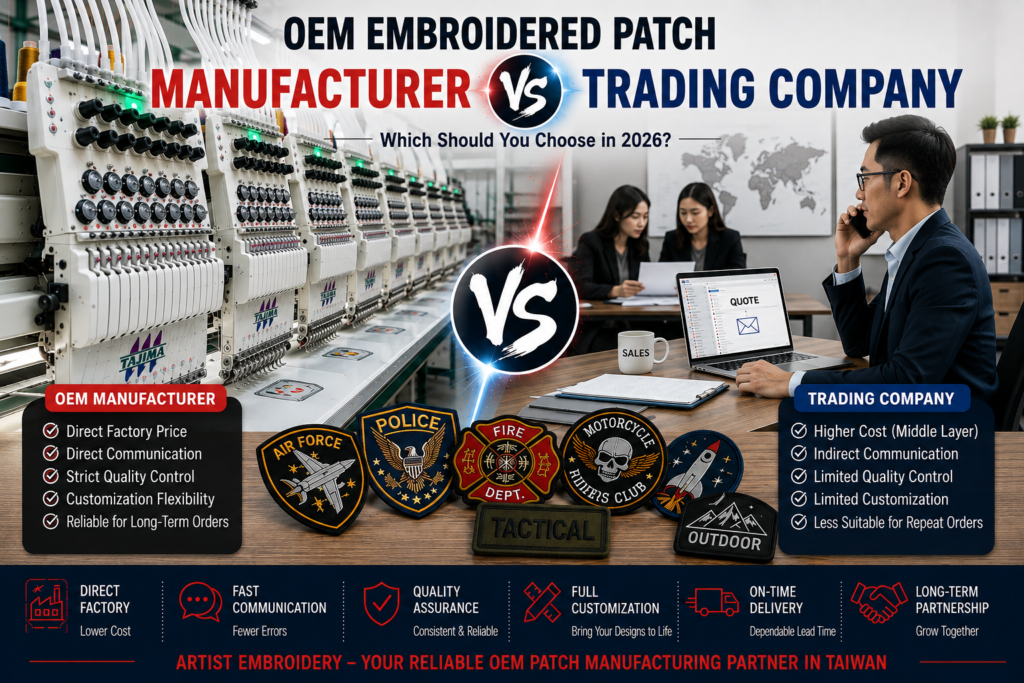
Choosing the right supplier is one of the most important decisions when sourcing custom embroidered patches. Many buyers compare prices without realizing that an OEM embroidered patch manufacturer and a trading company operate under very different business models. While both can provide custom patches, they differ significantly in production control, communication, quality assurance, customization capabilities, pricing transparency, and delivery reliability.
For businesses purchasing embroidered patches for military uniforms, law enforcement, corporate branding, sports clubs, aviation, fashion labels, or promotional merchandise, selecting the right partner directly affects product consistency and long-term costs. Working with the wrong supplier may result in unexpected delays, inconsistent quality, or limited customization options.
This guide explains the real differences between an OEM embroidered patch manufacturer and a trading company, helping you understand which option best suits your sourcing strategy. Whether you are placing your first order or looking for a long-term manufacturing partner, this comparison will help you make a confident and informed decision.
Introduction: Why Choosing the Right Supplier Matters
Finding the right supplier involves much more than comparing quotations. In today’s global supply chain, buyers have access to thousands of embroidered patch suppliers through online marketplaces, trade shows, and sourcing platforms. However, not every supplier actually manufactures the products they sell. Some companies own production facilities and manage every stage of manufacturing, while others work as intermediaries, coordinating orders between buyers and multiple factories.
Understanding this distinction is essential because it influences nearly every aspect of your purchasing experience. A direct OEM embroidered patch manufacturer typically offers greater production visibility, more consistent quality control, and stronger technical expertise. Since the factory handles digitizing, embroidery, inspection, and packaging internally, communication is more efficient and production issues can often be resolved quickly.
By contrast, a trading company usually focuses on sales and customer service while outsourcing manufacturing to partner factories. Although this model may provide flexibility and access to multiple production sources, it can also introduce additional communication layers, reduce transparency, and make quality consistency more difficult to maintain—especially for highly customized embroidered patches.
The right choice depends on your business priorities. Companies seeking long-term OEM partnerships, stable product quality, and competitive factory pricing often benefit from working directly with manufacturers. Businesses with small, mixed-product purchasing needs may find value in trading companies that consolidate multiple product categories under one supplier.
Understanding how these two business models differ will help you reduce sourcing risks, improve supply chain efficiency, and build stronger relationships with suppliers that align with your long-term business goals.
Why This Decision Can Impact Your Business
Choosing between an OEM embroidered patch manufacturer and a trading company affects much more than the initial purchase price. It influences your brand reputation, inventory planning, production schedules, and customer satisfaction over time. For companies that regularly reorder embroidered patches, consistency becomes one of the most valuable assets. Customers expect identical colors, precise embroidery, accurate dimensions, and reliable backing options every time they place an order.
When working directly with a manufacturer, artwork files, embroidery programs, production records, and quality standards are usually maintained within the same production system. This reduces variation between production batches and makes repeat orders faster and more accurate. Manufacturers can also provide technical recommendations regarding thread selection, stitch density, border styles, backing materials, and packaging solutions based on real production experience.
Trading companies may still deliver excellent service, but they rely on communication between multiple parties. Every additional step introduces opportunities for misunderstandings regarding specifications, color matching, delivery schedules, or quality expectations. While experienced trading companies carefully manage these risks, buyers should recognize that they generally have less direct control over the manufacturing process.
For growing brands, promotional product distributors, military contractors, uniform suppliers, and corporate buyers, establishing a long-term relationship with a trusted OEM embroidered patch manufacturer often provides greater stability, improved pricing over time, and stronger collaboration when developing new products or expanding into larger production volumes.
📊 Table: Why Supplier Choice Matters
| Business Factor | OEM Manufacturer | Trading Company |
|---|---|---|
| Production Control | Full control | Managed through partner factories |
| Communication | Direct with production team | Through sales representatives |
| Quality Consistency | High | Depends on factory coordination |
| Product Knowledge | Manufacturing expertise | Sales-focused expertise |
| Repeat Order Accuracy | Excellent | Varies by supplier |
| Cost Transparency | High | May include intermediary markup |
| Custom Development | Strong | Depends on manufacturing partners |
| Long-Term Partnership | Highly suitable | Suitable for mixed sourcing |
📖 Extended Reading
- OEM Embroidered Patch Manufacturer: Complete Buyer Guide for Custom Patches
- Taiwan vs China Embroidered Patch Manufacturers: Which One Is Better in 2026?
- How to Order Custom Embroidered Patches: Step-by-Step Guide
What Is an OEM Embroidered Patch Manufacturer?
An OEM embroidered patch manufacturer is a company that owns or directly manages its production facilities, allowing it to manufacture custom embroidered patches from raw materials to finished products. Unlike trading companies that outsource production, OEM factories oversee every critical manufacturing stage, including artwork evaluation, embroidery digitizing, material sourcing, embroidery production, edge finishing, backing application, quality inspection, packaging, and export logistics.
For international buyers, working directly with an OEM manufacturer means communicating with the people who actually produce the patches. This direct connection reduces misunderstandings, speeds up problem-solving, and provides greater flexibility when adjusting designs, materials, or production specifications. Whether you need military patches, police insignia, aviation badges, motorcycle club patches, fashion brand labels, or promotional embroidered emblems, an experienced OEM factory can recommend the most suitable production methods based on technical expertise rather than simply forwarding requests to another supplier.
Another major advantage is manufacturing consistency. Since the same production team maintains embroidery files, color references, machine settings, and quality standards, repeat orders are more accurate and efficient. This is especially valuable for organizations that require identical patches over multiple production runs, such as government agencies, sports leagues, corporate uniform programs, or retail brands.
Modern OEM embroidered patch manufacturers also invest heavily in advanced embroidery equipment, digital production management systems, and standardized quality control procedures. These investments improve production efficiency while ensuring stable quality across both small and large-volume orders. Buyers benefit from greater transparency throughout the manufacturing process, receiving more accurate production schedules, technical feedback, and real-time updates.
Choosing an OEM embroidered patch manufacturer is therefore more than selecting a supplier—it is establishing a long-term manufacturing partnership built on technical knowledge, production capability, and continuous quality improvement.
How Direct Factories Operate
A professional OEM embroidered patch manufacturer follows a structured production workflow designed to maintain efficiency and consistent quality. Every order begins with a design review, where experienced technicians evaluate artwork, dimensions, thread colors, border styles, backing options, and embroidery density. If improvements are needed to enhance stitch quality or production efficiency, the factory provides technical recommendations before production begins.
Once the design is approved, digitizing specialists convert the artwork into embroidery machine programs. This step is one of the most critical parts of manufacturing because stitch direction, density, underlay, and compensation settings directly affect the final appearance of the embroidered patch. Unlike intermediaries, OEM manufacturers have direct access to digitizers and embroidery technicians, allowing design revisions to be completed quickly without unnecessary communication delays.
Production then moves to industrial embroidery machines capable of producing consistent, high-quality stitching across large quantities. After embroidery, patches proceed through border finishing processes such as merrow borders, laser cutting, or heat cutting, depending on the product specifications. Various backing options—including hook and loop (Velcro®), iron-on adhesive, pressure-sensitive adhesive, plastic backing, or sew-on backing—are then applied according to customer requirements.
Every production batch undergoes quality inspection before packaging. Dimensions, embroidery accuracy, thread trimming, backing adhesion, border quality, and color consistency are checked to ensure each patch meets customer specifications. Finally, the patches are counted, packaged, and prepared for international shipment.
This vertically integrated workflow gives buyers greater confidence in product quality, delivery schedules, and repeat-order consistency while reducing many of the risks commonly associated with outsourced production.
Professional OEM embroidered patch manufacturers also invest in advanced embroidery equipment to improve precision, consistency, and production efficiency. Many leading factories utilize industrial embroidery machines from manufacturers such as Tajima, whose equipment is widely recognized for producing high-quality embroidery across military, corporate, and fashion applications.
📊 Table: Typical OEM Embroidered Patch Manufacturing Process
| Production Stage | OEM Manufacturer Responsibility | Buyer Benefit |
|---|---|---|
| Artwork Review | Evaluate design feasibility | Fewer production issues |
| Digitizing | Create embroidery program | Better stitch quality |
| Material Selection | Threads, twill, backing | Consistent product performance |
| Embroidery Production | Direct factory manufacturing | Stable quality and efficiency |
| Border Finishing | Merrow, laser cut, heat cut | Professional appearance |
| Backing Application | Velcro®, iron-on, adhesive, sew-on | Customized functionality |
| Quality Inspection | 100% production checks | Lower defect rate |
| Packaging & Shipping | Export-ready packaging | Reliable international delivery |
📖 Extended Reading
- OEM Embroidered Patch Manufacturer: Complete Buyer Guide for Custom Patches
- Tajima Group – Industrial Embroidery Technology
- Taiwan vs China Embroidered Patch Manufacturers: Which One Is Better in 2026?
What Is a Trading Company?
While an OEM embroidered patch manufacturer owns or directly manages production facilities, a trading company primarily acts as an intermediary between buyers and manufacturers. Instead of producing embroidered patches themselves, trading companies receive customer inquiries, identify suitable factories, coordinate production, monitor order progress, and arrange shipping. For many international buyers, trading companies provide a convenient one-stop sourcing solution, especially when purchasing multiple product categories from different manufacturers.
In the embroidered patch industry, trading companies often maintain partnerships with several factories that specialize in different production techniques. For example, one factory may focus on embroidered patches, another on woven labels, and another on PVC patches or promotional products. This network allows trading companies to offer a broad product portfolio without investing in manufacturing equipment or production staff.
Because they manage supplier relationships, trading companies can sometimes provide flexible solutions for buyers with small order quantities or mixed-product sourcing requirements. Rather than communicating with several individual factories, buyers work with a single sales representative who coordinates the entire purchasing process. This can simplify procurement, particularly for companies that value convenience over direct factory communication.
However, since trading companies rely on external manufacturers, they typically have less direct control over production. Questions about embroidery density, thread selection, machine settings, or production adjustments often require additional communication with the factory before accurate answers can be provided. As a result, technical discussions and production changes may take longer compared to working directly with an OEM embroidered patch manufacturer.
For buyers, understanding the role of a trading company is essential. Trading companies are not inherently better or worse than manufacturers—they simply serve a different purpose within the supply chain. The best choice depends on your sourcing priorities, order volume, customization requirements, and long-term business objectives.
How Trading Companies Source Products
A trading company typically begins by evaluating the customer’s design, specifications, quantity, and delivery requirements. Based on these factors, it selects one of its partner factories that best matches the project’s technical needs and production capacity. Throughout the manufacturing process, the trading company acts as the primary communication channel, relaying information between the buyer and the factory.
Many experienced trading companies perform valuable services beyond simple order placement. They may inspect products before shipment, consolidate goods from multiple factories into a single export shipment, assist with customs documentation, and coordinate international logistics. Buyers sourcing embroidered patches alongside apparel, bags, accessories, or promotional products often appreciate this convenience because it reduces the complexity of dealing with multiple suppliers.
Despite these advantages, buyers should recognize that every additional communication layer increases the possibility of delays or misunderstandings. If a customer requests changes to thread colors, border styles, backing options, or artwork after production has begun, the trading company must first communicate these revisions to the factory before confirming feasibility. This process naturally takes longer than communicating directly with factory engineers or production managers.
Another consideration is pricing transparency. Since trading companies add their own service margin, buyers may pay a higher unit price than if they purchased directly from an OEM embroidered patch manufacturer. While this additional cost often reflects project management, sourcing expertise, and logistics coordination, it is an important factor for businesses placing large or recurring orders.
Ultimately, trading companies provide value by simplifying procurement and offering broader sourcing capabilities. However, for businesses focused on long-term quality consistency, technical collaboration, and direct production control, an OEM manufacturer often offers greater strategic advantages.
📊 Table: Typical Trading Company Workflow
| Process Stage | Trading Company Role | Buyer Experience |
|---|---|---|
| Customer Inquiry | Collect requirements | Single point of contact |
| Supplier Selection | Choose partner factory | Factory usually not disclosed |
| Quotation | Add service pricing | One consolidated quotation |
| Production Coordination | Monitor factory progress | Indirect production updates |
| Quality Inspection | May perform pre-shipment inspection | Depends on company standards |
| Logistics | Arrange export and shipping | Simplified international delivery |
| After-sales Service | Handle customer communication | Centralized support |
📖 Extended Reading
- How to Order Custom Embroidered Patches: Step-by-Step Guide
- OEM Embroidered Patch Manufacturer: Complete Buyer Guide for Custom Patches
- Taiwan vs China Embroidered Patch Manufacturers: Which One Is Better in 2026?
OEM Manufacturer vs Trading Company: Key Differences
Now that we’ve defined both business models, it’s time to compare them side by side. While an OEM embroidered patch manufacturer and a trading company may both deliver custom embroidered patches, the way they operate behind the scenes is fundamentally different. These differences affect pricing, production efficiency, quality consistency, customization capabilities, communication speed, and long-term business relationships.
Many first-time buyers focus solely on the quotation they receive. However, the lowest price is not always the lowest total cost. Delayed production, inconsistent embroidery quality, inaccurate colors, or repeated communication errors can ultimately cost far more than a slightly higher factory price. Experienced buyers evaluate suppliers based on overall value rather than price alone.
For businesses ordering embroidered patches on a recurring basis, choosing the right supplier can significantly improve operational efficiency. Direct manufacturers typically offer better production transparency and stronger technical support, while trading companies often provide broader sourcing flexibility and consolidated purchasing services.
The following comparisons highlight the key differences buyers should consider before selecting a supplier.
Price Comparison
One of the first factors buyers evaluate is pricing. Since OEM embroidered patch manufacturers produce the patches themselves, there are generally fewer intermediaries involved. This often results in lower unit costs, particularly for medium and high-volume orders.
Trading companies usually purchase products from manufacturing partners and add a service margin to cover sourcing, communication, quality coordination, administration, and logistics. While this additional cost may be justified for buyers who require multiple product categories or consolidated shipments, it typically increases the final purchase price.
It’s also important to consider long-term pricing stability. OEM manufacturers often offer better pricing as order volumes increase because they control production costs directly. Repeat customers may also benefit from existing embroidery programs, material inventory, and streamlined production processes that reduce setup time.
For businesses planning continuous purchasing, direct factory relationships generally provide better long-term cost efficiency than relying on intermediaries.
Quality Control
Quality consistency is another major difference between an OEM manufacturer and a trading company.
An OEM embroidered patch manufacturer performs quality inspections throughout the production process. Because production managers, embroidery operators, and quality inspectors work within the same facility, issues such as incorrect thread colors, embroidery density, border quality, or backing installation can be identified and corrected immediately.
Trading companies often conduct final inspections before shipment, but they usually cannot monitor every stage of production. If defects are discovered, communication with the factory may require additional time before corrective actions are implemented.
For products requiring strict quality standards—such as military insignia, police patches, aviation emblems, or premium retail branding—working directly with the manufacturer generally provides greater consistency and accountability.
Thread quality is another key factor affecting the durability and appearance of embroidered patches. Professional manufacturers often select premium embroidery threads with excellent colorfastness and abrasion resistance. Suppliers such as FuFu’s Thread are recognized within the embroidery industry for producing high-quality threads used in demanding commercial and industrial applications.
Communication Efficiency
Clear communication is essential when producing custom embroidered patches. Small misunderstandings regarding dimensions, Pantone colors, stitch coverage, or backing types can lead to costly production errors.
When working directly with an OEM manufacturer, buyers often communicate with experienced sales engineers or project managers who have direct access to digitizers and production teams. Technical questions can usually be answered quickly because the decision-makers are located within the same organization.
With a trading company, information typically passes through multiple parties before reaching the factory. While professional trading companies work hard to minimize delays, additional communication steps naturally increase response times and the possibility of information being interpreted differently.
This difference becomes especially important for highly customized designs or projects that require frequent revisions during product development.
Customization Capabilities
Customization is one of the greatest strengths of working directly with an OEM embroidered patch manufacturer.
Factories understand the technical limitations and possibilities of embroidery production. They can recommend improvements to artwork, optimize stitch density, suggest appropriate border styles, and advise on backing materials that best suit the intended application.
Because these recommendations come directly from production specialists, buyers often achieve better embroidery quality while avoiding unnecessary production problems.
Trading companies can certainly facilitate customized orders, but their recommendations depend on information received from partner factories. Complex technical discussions or multiple design revisions may therefore require additional coordination before final approval.
For brands developing unique embroidered products or highly detailed logo patches, direct collaboration with factory specialists usually produces better results.
Lead Time and Production Scheduling
Production scheduling directly affects inventory planning and customer satisfaction.
OEM manufacturers typically manage production schedules internally. Since they control machine capacity, staffing, and workflow planning, they can provide more accurate lead time estimates and respond more quickly to urgent production requests when capacity allows.
Trading companies must coordinate production schedules with external factories. If one factory experiences delays or reaches full capacity, alternative arrangements may be necessary, potentially extending delivery times.
Although experienced trading companies maintain strong supplier networks to reduce these risks, direct manufacturers generally provide greater production visibility and schedule reliability for ongoing orders.
📊 Table: OEM Manufacturer vs Trading Company Comparison
| Comparison Factor | OEM Embroidered Patch Manufacturer | Trading Company |
|---|---|---|
| Pricing | Factory-direct pricing | Includes service margin |
| Quality Control | Direct production supervision | Depends on partner factory |
| Communication | Direct with production team | Through intermediary |
| Technical Expertise | Manufacturing specialists | Sales and sourcing specialists |
| Customization | Extensive | Depends on factory coordination |
| Production Visibility | High | Moderate |
| Lead Time Accuracy | More predictable | Depends on supplier network |
| Repeat Order Consistency | Excellent | Varies by factory |
| Cost Transparency | High | Moderate |
| Best For | Long-term OEM partnerships | Multi-product sourcing |
📖 Extended Reading
- OEM Embroidered Patch Manufacturer: Complete Buyer Guide for Custom Patches
- Taiwan vs China Embroidered Patch Manufacturers: Which One Is Better in 2026?
- FuFu’s Thread – Professional Embroidery Threads
Pros and Cons of Working with an OEM Manufacturer
For many businesses, partnering directly with an OEM embroidered patch manufacturer offers significant advantages beyond competitive pricing. Because the manufacturer controls the entire production process, buyers gain direct access to technical expertise, production resources, and quality management systems. This level of transparency is especially valuable for companies that require consistent quality, customized products, and reliable long-term supply.
However, working with an OEM factory is not the ideal solution for every buyer. Depending on your purchasing volume, sourcing strategy, and product mix, there may be situations where a trading company provides greater convenience. Understanding both the strengths and limitations of an OEM manufacturer allows buyers to select the sourcing model that best aligns with their business objectives.
For companies building their own brand, supplying government agencies, manufacturing uniforms, or distributing promotional products, an OEM partnership often creates a stronger competitive advantage over time. The closer relationship with the production team enables continuous product improvement, better cost management, and faster decision-making throughout the manufacturing process.
The following sections outline the primary benefits and considerations when choosing to work directly with an OEM embroidered patch manufacturer.
When a Factory Is the Better Choice
An OEM embroidered patch manufacturer is generally the best option when buyers prioritize product quality, repeat-order consistency, and long-term business growth. Since manufacturers oversee production from start to finish, they can maintain tighter control over every stage of the manufacturing process.
One of the greatest advantages is direct technical communication. Instead of relaying questions through multiple intermediaries, buyers can discuss embroidery techniques, backing options, border styles, stitch density, and production feasibility directly with factory specialists. This not only improves communication efficiency but also reduces the risk of production errors.
Another major benefit is cost optimization. Although initial quotations may appear similar, manufacturers often provide better pricing over time because they eliminate intermediary markups. As order volumes increase, factories can optimize production planning, reuse embroidery programs, reduce setup costs, and negotiate material purchasing more effectively. These efficiencies are often passed on to long-term customers through more competitive pricing.
OEM manufacturers also excel at managing repeat orders. Once embroidery files, thread color references, machine settings, and inspection standards have been established, future production runs can maintain a high level of consistency. This is particularly important for organizations such as military units, police departments, airlines, sports teams, universities, and multinational corporations where visual consistency is essential.
Despite these advantages, buyers should also understand the potential limitations. Some OEM factories specialize in embroidered patches and may not offer unrelated promotional products. Buyers seeking to purchase patches alongside apparel, bags, pins, lanyards, and packaging from a single supplier may find that a trading company offers greater convenience through consolidated sourcing.
Ultimately, the decision depends on whether your priority is manufacturing expertise or procurement convenience. If embroidered patches are a core product within your business, working directly with an experienced OEM manufacturer is usually the most strategic long-term investment.
📊 Table: Advantages and Considerations of Working with an OEM Manufacturer
| Factor | Advantages | Considerations |
|---|---|---|
| Pricing | Factory-direct pricing with fewer intermediary costs | Best value often achieved through repeat or larger orders |
| Quality Control | Direct supervision throughout production | Quality depends on the manufacturer’s management system |
| Technical Support | Access to production engineers and digitizing specialists | Communication may focus primarily on embroidery products |
| Product Customization | Extensive design flexibility and manufacturing expertise | Specialized within factory production capabilities |
| Repeat Orders | High consistency using stored production data | Requires long-term partnership for maximum benefit |
| Lead Time | More accurate scheduling and production visibility | Factory capacity may affect peak-season availability |
| Supply Chain Transparency | Full visibility into manufacturing process | Less suitable for buyers sourcing many unrelated products |
| Long-Term Partnership | Strong collaboration and continuous improvement | Requires ongoing relationship building |
📖 Extended Reading
- OEM Embroidered Patch Manufacturer: Complete Buyer Guide for Custom Patches
- How to Order Custom Embroidered Patches: Step-by-Step Guide
- Taiwan vs China Embroidered Patch Manufacturers: Which One Is Better in 2026?
Pros and Cons of Working with a Trading Company
Although many buyers prefer working directly with an OEM embroidered patch manufacturer, trading companies continue to play an important role in the global sourcing industry. For certain purchasing scenarios, they offer flexibility and convenience that may outweigh the benefits of factory-direct cooperation.
A trading company is particularly valuable when buyers need to source multiple product categories from different manufacturers. Instead of coordinating with several factories, buyers can communicate with one supplier who manages quotations, production schedules, quality inspections, export documentation, and international shipping. This centralized approach reduces administrative workload and simplifies procurement.
For example, a promotional products distributor may require embroidered patches, woven labels, PVC patches, keychains, apparel, and packaging from different factories. A trading company can consolidate these items into one shipment, saving time and reducing logistics complexity.
However, because trading companies do not usually own production facilities, they rely on external manufacturing partners. This means buyers often have less visibility into the production process and fewer opportunities to communicate directly with technical specialists. As a result, response times for engineering questions or production changes may be longer than when working directly with an OEM factory.
Understanding these trade-offs helps buyers determine whether a trading company aligns with their purchasing strategy.
When a Trading Company Makes Sense
A trading company is often the right choice when procurement efficiency is more important than direct production control.
For businesses purchasing a wide range of promotional products, managing numerous suppliers can become time-consuming. A trading company simplifies this process by acting as a single point of contact for quotations, production updates, quality coordination, and shipping arrangements. Buyers benefit from reduced administrative effort while maintaining access to multiple manufacturing resources.
Trading companies can also be advantageous for companies entering a new market or sourcing unfamiliar products. Experienced sourcing specialists often have established relationships with reliable factories and understand local manufacturing capabilities. This knowledge can help buyers identify suitable suppliers without investing significant time in supplier research.
Another advantage is flexibility. If one factory cannot meet production requirements due to capacity constraints or technical limitations, the trading company may transfer the order to another qualified supplier within its network. This flexibility can reduce sourcing risks during periods of high demand.
Despite these benefits, buyers should recognize that every additional layer in the supply chain introduces potential challenges. Information must pass between the buyer, the trading company, and the factory, increasing the possibility of communication delays or misunderstandings. In addition, pricing may include service fees that are not present when purchasing directly from a manufacturer.
For companies placing recurring orders of custom embroidered patches, these additional costs and communication layers may outweigh the convenience offered by a trading company. In such cases, building a long-term relationship with an OEM embroidered patch manufacturer often provides greater value over time.
💡 Expert Tip
A trading company is an excellent sourcing partner when you need to purchase multiple product categories from different factories. However, if custom embroidered patches are one of your core products, establishing a direct partnership with an OEM embroidered patch manufacturer typically results in better communication, stronger quality consistency, and lower long-term procurement costs.
📊 Table: Advantages and Considerations of Working with a Trading Company
| Factor | Advantages | Considerations |
|---|---|---|
| Product Range | Access to multiple product categories | May not specialize in embroidered patches |
| Procurement | One supplier for multiple factories | Less direct production visibility |
| Logistics | Consolidated shipping and documentation | Longer communication chain |
| Supplier Network | Flexible factory selection | Factory may change between orders |
| Technical Support | General sourcing knowledge | Limited direct manufacturing expertise |
| Pricing | Convenient bundled sourcing | Usually includes intermediary markup |
| Quality Control | May perform final inspections | Limited control during production |
| Best Fit | Multi-product purchasing | Less suitable for long-term OEM manufacturing |
📖 Extended Reading
- OEM Embroidered Patch Manufacturer: Complete Buyer Guide for Custom Patches
- How to Order Custom Embroidered Patches: Step-by-Step Guide
- Taiwan vs China Embroidered Patch Manufacturers: Which One Is Better in 2026?
How to Identify Whether Your Supplier Is Really a Factory
One of the biggest challenges for international buyers is determining whether a supplier is a genuine OEM embroidered patch manufacturer or simply a trading company. Many suppliers present themselves as “manufacturers” on their websites or online marketplaces, even when production is outsourced to third-party factories. While this is not necessarily dishonest—some trading companies work closely with trusted manufacturing partners—it is important for buyers to understand who is actually producing their embroidered patches.
Knowing the supplier’s business model allows buyers to set realistic expectations regarding pricing, production flexibility, quality control, and communication. Direct factories typically provide greater transparency because they manage the manufacturing process themselves. Trading companies, on the other hand, may focus more on sourcing, coordination, and customer service.
Fortunately, buyers do not need to visit a factory in person to evaluate whether a supplier is genuinely involved in manufacturing. By asking the right questions and reviewing supporting evidence, it is usually possible to understand how the supplier operates before placing an order.
The following checklist can help buyers make informed sourcing decisions while reducing the risk of unexpected production issues.
Questions Every Buyer Should Ask
Before choosing a supplier, ask questions that reveal how much control they have over the manufacturing process. Honest suppliers—whether they are OEM manufacturers or trading companies—should be able to answer these questions clearly and provide supporting information when appropriate.
1. Do you own or directly operate your embroidery production facility?
This is the most straightforward question. A genuine OEM manufacturer should clearly explain its production capabilities and factory operations.
2. Can you provide photos or videos of your production line?
Many professional manufacturers are willing to share images or videos of their embroidery machines, quality inspection area, and packaging process. This helps buyers better understand the production environment.
3. Is embroidery digitizing performed in-house?
In-house digitizing allows manufacturers to optimize stitch quality and make design adjustments more efficiently during production.
4. Who performs quality inspections?
Ask whether inspections are conducted by the factory’s own quality control team or by an external party after production.
5. Will I communicate directly with your production team if technical issues arise?
Direct access to production specialists often results in faster problem-solving and more accurate technical discussions.
6. Can you guarantee consistency for repeat orders?
Manufacturers usually retain embroidery programs, thread references, and production records to ensure future orders match previous production.
7. Can you explain your production workflow?
A genuine manufacturer should be able to clearly describe each stage of production—from artwork review and digitizing to embroidery, finishing, inspection, packaging, and shipping.
None of these questions are intended to eliminate trading companies from consideration. Instead, they help buyers understand exactly what type of supplier they are working with so they can make sourcing decisions based on accurate information.
💡 Expert Tip
Rather than asking “Are you a factory?”, ask suppliers to explain their production process. Genuine manufacturers can usually describe each manufacturing stage in detail because they manage it every day. The depth and clarity of their answers often reveal far more than a simple “yes” or “no.”
📊 Table: Factory Verification Checklist
| Question | OEM Manufacturer | Trading Company |
|---|---|---|
| Own production facility | ✅ Usually Yes | ❌ Usually No |
| In-house embroidery machines | ✅ Yes | ❌ No |
| In-house digitizing | ✅ Common | ⚠ Depends on partners |
| Direct production communication | ✅ Yes | ⚠ Usually indirect |
| Internal quality inspection | ✅ Yes | ⚠ Often final inspection only |
| Consistent repeat-order records | ✅ Strong | ⚠ Depends on factory |
| Production workflow knowledge | ✅ Detailed | ⚠ Varies by sourcing experience |
📖 Extended Reading
- OEM Embroidered Patch Manufacturer: Complete Buyer Guide for Custom Patches
- How to Order Custom Embroidered Patches: Step-by-Step Guide
- Taiwan vs China Embroidered Patch Manufacturers: Which One Is Bㄋetter in 2026?
Which Option Is Better for Custom Embroidered Patches?
After comparing the strengths and limitations of both sourcing models, one conclusion becomes clear: there is no universal answer for every buyer. The right choice depends on your purchasing objectives, product requirements, order volume, and long-term business strategy.
If your primary goal is to purchase custom embroidered patches as part of a long-term business, partnering directly with an OEM embroidered patch manufacturer is generally the better investment. Direct manufacturers provide stronger quality control, factory-direct pricing, faster technical communication, and greater consistency for repeat orders. These advantages become increasingly valuable as your business grows and requires reliable production over many years.
On the other hand, if you purchase many different promotional products from multiple industries and prefer managing a single supplier, a trading company may offer greater convenience. By coordinating production across several factories, trading companies simplify procurement and reduce the administrative burden of working with multiple manufacturers.
The most successful buyers evaluate suppliers based not only on price, but also on production capability, communication efficiency, quality management, and long-term reliability. A supplier who consistently delivers accurate products on time often provides far greater value than one offering the lowest quotation.
For companies whose embroidered patches represent an important part of their brand identity, investing in a trusted OEM manufacturing partner usually produces better long-term business outcomes.
Choosing Based on Your Order Size and Business Goals
Different buyers have different sourcing priorities. A startup ordering promotional patches for a one-time event has very different needs from a uniform manufacturer supplying thousands of embroidered patches every year.
Small businesses with occasional orders may appreciate the flexibility of a trading company, especially when purchasing several unrelated products. However, companies planning continuous production should prioritize suppliers that can maintain consistent embroidery quality, retain production records, and provide ongoing engineering support.
For government agencies, military organizations, police departments, airlines, universities, motorcycle clubs, fashion brands, and corporate uniform suppliers, repeat-order consistency is often critical. Working directly with an OEM embroidered patch manufacturer helps ensure that colors, dimensions, stitch density, backing materials, and border styles remain consistent across future production runs.
Buyers should also consider the future rather than only the first order. A supplier capable of supporting product development, production expansion, and continuous quality improvement becomes a valuable business partner rather than simply a vendor.
Ultimately, selecting the right sourcing model is about aligning your supplier’s strengths with your organization’s long-term objectives.
💡 Expert Tip
When evaluating suppliers, think beyond today’s quotation.
Ask yourself:
- Will this supplier still meet my needs after 50 orders?
- Can they maintain identical quality next year?
- Can they support larger production volumes as my business grows?
- Do I trust them as a long-term manufacturing partner?
The answers to these questions often have a greater impact on your business than saving a few cents per patch on your first order.
⭐ Quick Decision Guide
| If You Need… | Recommended Choice |
|---|---|
| Lowest long-term manufacturing cost | ✅ OEM Manufacturer |
| Factory-direct communication | ✅ OEM Manufacturer |
| Consistent repeat orders | ✅ OEM Manufacturer |
| Advanced customization | ✅ OEM Manufacturer |
| Engineering support | ✅ OEM Manufacturer |
| Multiple product categories | ✅ Trading Company |
| One-stop sourcing | ✅ Trading Company |
| Consolidated international shipping | ✅ Trading Company |
| Small mixed-product purchases | ✅ Trading Company |
| Long-term strategic partnership | ✅ OEM Manufacturer |
📊 Table: Best Choice by Buyer Type
| Buyer Type | Recommended Supplier | Reason |
|---|---|---|
| Startup Brand | OEM Manufacturer | Scalable growth and product consistency |
| Promotional Products Distributor | Trading Company | Multiple product sourcing |
| Fashion Brand | OEM Manufacturer | High customization and quality |
| Military & Government | OEM Manufacturer | Strict quality control and repeatability |
| Police & Uniform Supplier | OEM Manufacturer | Consistent specifications |
| Sports Team | OEM Manufacturer | Accurate repeat production |
| Corporate Uniform Program | OEM Manufacturer | Long-term supply stability |
| Event Organizer | Trading Company | Flexible one-time procurement |
| Wholesale Distributor | OEM Manufacturer | Better pricing for volume orders |
| Global Importer | Depends on sourcing strategy | Balance between convenience and control |
📖 Extended Reading
- OEM Embroidered Patch Manufacturer: Complete Buyer Guide for Custom Patches
- Taiwan vs China Embroidered Patch Manufacturers: Which One Is Better in 2026?
- How to Order Custom Embroidered Patches: Step-by-Step Guide
FAQ: About OEM Manufacturers and Trading Companies
Choosing between an OEM embroidered patch manufacturer and a trading company often raises additional questions, especially for first-time buyers. Below are answers to some of the most common questions international customers ask before placing an order.
Q1. What is the main difference between an OEM embroidered patch manufacturer and a trading company?
An OEM embroidered patch manufacturer owns or directly manages the production process, while a trading company coordinates production through partner factories. Manufacturers typically offer greater production transparency, direct technical communication, and more consistent quality for repeat orders.
Q2. Which option is usually more cost-effective?
For medium and large-volume orders, an OEM manufacturer often provides better long-term pricing because there are fewer intermediary costs. Trading companies may charge additional service fees for sourcing, coordination, and logistics management.
Q3. Are trading companies less reliable than manufacturers?
Not necessarily. Many experienced trading companies maintain strong relationships with reputable factories and provide excellent customer service. The key is understanding their role in the supply chain and choosing the model that best fits your sourcing needs.
Q4. Which supplier offers better customization?
OEM manufacturers generally provide greater customization because buyers can communicate directly with production specialists regarding embroidery techniques, backing options, border styles, and design optimization.
Q5. How can I verify that a supplier is a genuine factory?
Ask about their production process, embroidery equipment, in-house digitizing capabilities, quality inspection procedures, and whether they can provide factory photos or videos. Genuine manufacturers are usually transparent about their production capabilities.
Q6. Is an OEM manufacturer better for repeat orders?
Yes. Because manufacturers retain embroidery programs, production specifications, thread references, and quality records, they can usually reproduce products with greater consistency across future production runs.
Q7. Can a trading company provide multiple product categories?
Yes. This is one of their biggest advantages. Trading companies often source embroidered patches alongside woven labels, PVC patches, apparel accessories, promotional items, and packaging from different factories.
Q8. Which option is better for small businesses?
It depends on purchasing goals. Small businesses requiring various promotional products may benefit from a trading company, while businesses planning long-term patch production often gain greater value from partnering directly with an OEM manufacturer.
Q9. Why do manufacturers sometimes have higher minimum order quantities (MOQs)?
Because factories optimize production efficiency based on machine setup, material preparation, and labor scheduling. Larger production batches help reduce manufacturing costs and improve productivity.
Q10. Which option does Artist Embroidery recommend?
For businesses where custom embroidered patches are an important part of their products or brand identity, we generally recommend working directly with an experienced OEM embroidered patch manufacturer. This approach provides stronger quality control, faster communication, greater customization, and more consistent long-term results.
💡 Expert Tip
There is no “perfect” sourcing model for every business. The best supplier is the one whose capabilities match your product requirements, quality expectations, and long-term growth strategy.
CTA: Work Directly with Artist Embroidery
Finding the right manufacturing partner is about more than comparing prices—it is about building a reliable relationship that supports your business for years to come. At Artist Embroidery, we specialize in OEM manufacturing for custom embroidered patches, serving customers worldwide with consistent quality, transparent communication, and flexible production solutions.
With decades of manufacturing experience, we support a wide range of industries, including military, law enforcement, aviation, sports teams, motorcycle clubs, fashion brands, corporate uniforms, promotional products, and government organizations. Our experienced production team manages every stage of the manufacturing process—from artwork evaluation and embroidery digitizing to quality inspection and international shipping.
Whether you need a small prototype, a large production run, or ongoing OEM manufacturing support, we are committed to delivering embroidered patches that meet your exact specifications and quality expectations.
Instead of simply supplying products, our goal is to become your long-term manufacturing partner.
Why Choose Artist Embroidery?
We combine advanced embroidery equipment with carefully selected premium embroidery materials to ensure every custom patch meets international quality standards.
- ✅ Direct OEM embroidered patch manufacturer
- ✅ Decades of embroidery manufacturing experience
- ✅ Advanced industrial embroidery equipment
- ✅ In-house production management
- ✅ Strict quality control procedures
- ✅ Fast international communication
- ✅ Competitive factory-direct pricing
- ✅ Flexible customization options
- ✅ Worldwide shipping
- ✅ Reliable long-term OEM partnership
📊 Table: Why Global Buyers Choose Artist Embroidery
| Our Strength | Customer Benefit |
|---|---|
| OEM Manufacturing | Factory-direct communication |
| Professional Digitizing | Optimized embroidery quality |
| Advanced Production Equipment | Consistent manufacturing |
| Strict Quality Inspection | Reliable repeat orders |
| International Export Experience | Smooth global delivery |
| Flexible OEM Solutions | Tailored production for every project |
Contact Artist Embroidery
Artist Embroidery Corporation
📞 Tel: +886-2-8245-8989
🌐 Website: artistembroidery.com
📧 Email: service@artistembroidery.com
🏢 Office: 7 F., No. 21, Qiao’an St., Zhonghe Dist., New Taipei City 235026, Taiwan
🏭 Factory: No. 12, Zhiwa 2nd Rd., Shetou Township, Changhua County 511006, Taiwan
About the Author
Artist Embroidery Engineering Team
This guide was prepared by the engineering and sales specialists at Artist Embroidery, a Taiwan-based OEM embroidered patch manufacturer with extensive experience serving military, law enforcement, corporate, fashion, promotional, and industrial customers worldwide.
Our team specializes in custom embroidered patch manufacturing, embroidery digitizing, quality control, material selection, and international OEM production. Every recommendation in this guide is based on real manufacturing experience and practical knowledge gained from producing custom embroidered patches for global brands and organizations.
Last Updated: August 2026
 English
  Japanese
  Chinese
  Korean
  Spanish
  French
  Russian
  Portuguese
  German