簡介
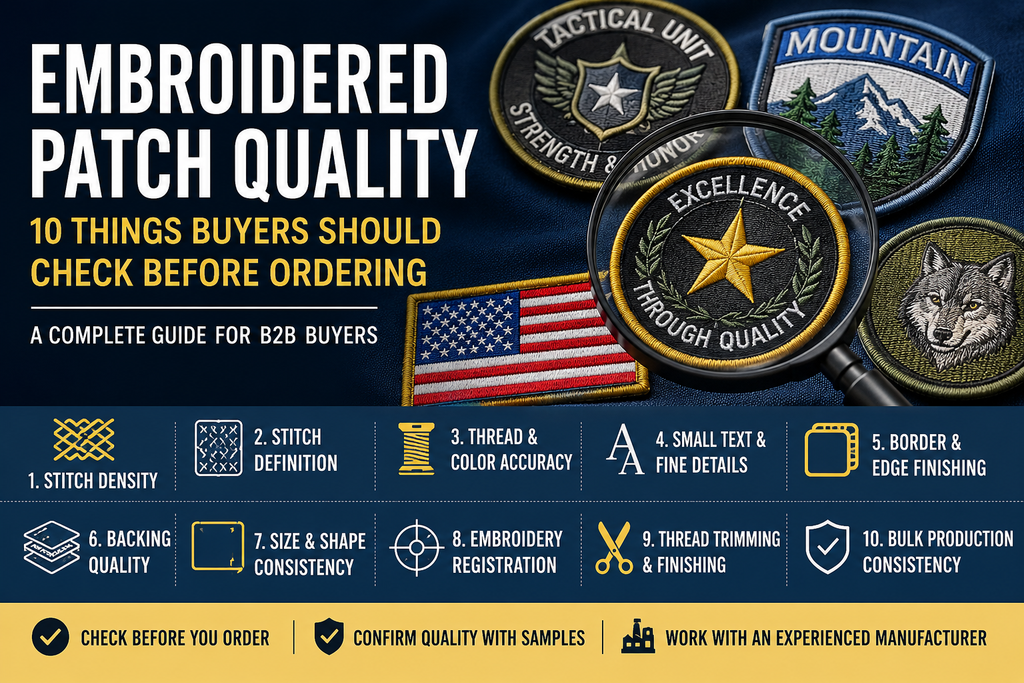
在為制服、軍警用途、戶外裝備、運動隊伍、企業品牌、社團或促銷產品採購客製化刺繡徽章時,價格僅是採購決策的其中一環。. 刺繡貼布的品質 這會直接影響成品的外觀、耐用性、品牌一致性,甚至整體印象。對於每次訂單下單數以百或數千計的海外買家而言,一旦生產從已核准的樣品轉為大量生產,即使微小的品質差異也可能變得十分顯著。.
高品質的刺繡徽章並非僅由單一因素決定。買家應綜合評估以下各項因素: 針跡密度、刺繡覆蓋率、線材品質、色彩精準度、圖案還原度、邊緣處理、襯底材料、形狀一致性,以及生產管控. 一塊補丁在照片中看似尚可,但若仔細檢視,便會發現有線頭鬆脫、邊緣不平整、字體變形、布料起皺或顏色不均勻等問題。.
在比較某個……時,這一點尤其重要 OEM 繡花貼片製造商 與貿易公司或採購中介機構合作。若製造商能直接掌控數位化、刺繡機、線材選用、生產參數、後加工及檢驗等環節,便能在需要調整時更有效地做出回應。.
對於 B2B 採購方而言,了解這些品質因素也能讓供應商的比較更具實質意義。採購方不應僅單純詢問「每塊貼布的價格是多少?」,而是應評估報價是否基於可比的材料、刺繡規格、後加工標準及品質控制要求。.
本指南說明 買家在評估客製化刺繡徽章品質時應檢查的 10 項重要因素, ,協助採購團隊、品牌、制服供應商、經銷商、組織及其他專業採購人員,在批准大量生產之前,能做出更明智的採購決策。.
什麼決定了高品質刺繡徽章的品質?
高品質的刺繡徽章是多項生產要素協同作用的成果,而非單純依靠增加針數或使用更厚的繡線。成品徽章應能清晰呈現經核准的設計圖稿、保持形狀一致、具備適當的刺繡覆蓋率、採用穩定的材料,並在正反兩面均擁有整潔的收邊處理。 對於 OEM 買家而言,一致性尤為重要,因為目標並非僅是製作一個外觀吸引人的樣品,而是要在整個生產批次中,可靠地重現已核准的品質標準。.
刺繡密度與針腳覆蓋率
刺繡密度是買家在檢視時首先注意到的特徵之一 刺繡貼片的品質. 適當的針腳覆蓋率應能形成堅實且專業的外觀,避免出現不必要的空隙而露出底層布料。然而,若未考量布料材質、補丁尺寸、針腳方向及圖案結構便盲目增加密度,並不會自動造就更好的補丁。.
若刺繡過於稀疏,針腳間可能會露出底料,使圖案顯得廉價或未完成。 另一方面,過於密集的刺繡會造成不必要的僵硬感,增加針數與生產時間,並可能導致布料起皺或變形。因此,經驗豐富的刺繡生產必須在覆蓋率、穩定性、外觀與效率之間取得平衡。.
同一設計的不同部分也可能需要不同的針腳結構。大面積的背景、小字、邊框、細線以及細節豐富的標誌,並非總是能使用相同的設定進行數位化處理。專業的刺繡數位化處理會決定針腳應如何排列,以便在維持結構穩定的同時,忠實重現設計圖樣。.
因此,對買家而言,關鍵問題不應僅僅是 “「這塊補丁有幾針?」” 相反地,應評估針腳是否覆蓋得當、表面是否均勻,以及在細節處的刺繡是否保持整潔。.
細膩的細節與精準的圖稿再現
藝術品的複製是另一個關鍵指標,用以衡量 客製化刺繡徽章的品質. 一款專業的刺繡徽章應保留經核准設計的重要視覺特徵,包括標誌、符號、字體、比例以及可辨識的細節。.
然而,刺繡與數位印刷在根本上有所不同。線材具有實體厚度,針腳需要佔用空間,而且極細小的圖案元素未必總能完全如電腦螢幕上所顯示的那樣精確重現。這意味著專業生產有時需要對圖稿進行優化,而非照搬重現。.
例如,極細的線條可能需要稍微加寬,微小的間隙可能需要調整,而非常細小的字體則可能需要簡化,以確保刺繡完成後仍能清晰可讀。這些修改應在維持原始圖稿視覺辨識度的同時,使設計在技術上適合進行刺繡。.
買家應檢查文字是否仍清晰可辨、輪廓是否對齊正確、圓形元素是否保持對稱,以及細微的設計元素是否清晰可辨。在比較供應商時,這些細節能揭示其在數位化經驗與生產管控方面存在的顯著差異。.
💡 買家小貼士: 在評估樣品時,請將刺繡徽章與核准的設計圖稿並排比較。請著重檢視重要的標誌、字樣、比例、間距及可辨識的設計細節,而非期望繡線能重現數位設計圖稿的每個像素。.
材質、布料與線材的品質
即使數位化處理再精湛,也無法彌補材料不當所造成的缺點。底布、刺繡線、襯裡材料以及後加工組件,都會影響成品徽章的外觀與耐用性。.
聚酯繡花線常被用於商業及工業用的刺繡徽章,因為它具備良好的強度、色澤均一性,且能抵禦一般磨損。線材的品質也會影響光澤度、針腳清晰度,以及刺繡機在生產過程中運作的穩定性。.
底布必須能為所選的刺繡密度提供足夠的穩定性。若材質過於脆弱或與針腳結構不相容,補丁可能會變形或產生皺褶。 同樣地,背襯材料應根據預定用途來選擇,無論買家需要縫製式貼布、魔鬼氈背襯、熨燙式背襯、黏膠背襯,或其他固定方式。.
因此,對於專業的 OEM 訂單而言,材料選用應被視為完整製造規格的一部分,而非一項孤立的採購決策。可靠的 刺繡貼片製造商 在開始大量生產之前,應評估藝術作品、刺繡密度、布料、繡線、襯布、邊框結構以及預期用途之間的相互作用。.
📊 表格:高品質刺繡徽章的主要特徵
| 品質因素 | 買家應檢查的事項 | 潛在的警示徵兆 |
|---|---|---|
| 針腳覆蓋範圍 | 一致且適當的刺繡覆蓋範圍 | 可見的空隙或密度過高 |
| 藝術品複製 | 精準的比例與辨識度高的細節 | 標誌變形或細節缺失 |
| 字體設計 | 文字清晰易讀 | 填補了空白或模糊的字元 |
| 線路品質 | 外觀一致且車縫線整潔 | 頻繁的停頓或不平整的表面 |
| 底布 | 穩定的形狀與適當的支撐 | 皺褶或變形 |
| 邊界 | 俐落且均勻的邊緣 | 布料寬度不均或線頭鬆脫 |
| 顏色 | 符合已核准的遴選標準 | 出乎意料的色差 |
| 整體完成度 | 清潔正面和背面 | 線頭過長或修剪不當 |
📖 延伸閱讀
檢查針腳密度與刺繡覆蓋範圍
針距密度與刺繡覆蓋率是買家在評估時應檢視的兩項最重要因素 刺繡貼片的品質. 這些因素不僅影響徽章的外觀是否扎實且專業,還影響其柔韌性、尺寸穩定性、生產時間以及整體成本。 一個常見的誤解是,針腳數越多,徽章的品質就必然越高。然而,在專業刺繡製造中,品質取決於針腳密度是否適合該設計圖案、徽章尺寸、底布、繡線以及預期的應用情境。.
因此,對於正在比較不同刺繡貼片製造商樣品的 B2B 採購者而言,僅憑針數所提供的資訊相當有限。 兩塊尺寸相近的徽章,其針數可能有很大差異,這是因為刺繡覆蓋範圍、文字、背景填充、設計複雜度以及數位化方法的差異所致。一份設計完善的刺繡檔案應能提供足夠的覆蓋範圍,同時避免不必要的針數——這些針數不僅會增加生產時間,卻無法提升成品效果。.
為何針距很重要
針腳密度指的是在特定區域內,刺繡針腳的排列有多緊密。當密度控制得當,刺繡表面會呈現出扎實、均勻且視覺上整潔的狀態。在應完全覆蓋刺繡的區域,底布不應透出,而個別圖形、輪廓及顏色則應保持清晰分明。.
若針腳密度過低,線與線之間可能會出現空隙,導致底布顯露出來。這會使補丁看起來未完成,特別是在大面積填充區域或純色部分。稀疏的刺繡也可能降低買家通常所期待的視覺深度與豐富感, 高品質刺繡徽章.
然而,若過於激進地增加針距,將會引發另一系列問題。過多的針腳會對布料施加額外張力,可能導致布料起皺、僵硬、變形、斷線或表面不平整。針距密集的設計也需要更長的機器運行時間,這可能會影響生產成本和交貨期。.
這就是為什麼專業的數位化處理至關重要。必須綜合考量繡線方向、底布、密度、拉力補償、繡線順序,以及相鄰刺繡區域之間的相互作用。專業製造商會根據實際設計來調整這些參數,而非對每塊補丁都套用同一種通用密度設定。.
針數越多,是否就代表品質越好?
不。針數越多,並不一定代表品質更好。 刺繡貼片的品質.
針數主要是一種生產指標,用以表示完成一幅刺繡圖案所需的大致針數。它能提供有關生產複雜度及機器加工時間的有用資訊,但不應被視為獨立的品質評級標準。.
舉例來說,一塊包含多個完整繡花背景區域的大型繡片,其所需針數自然會遠多於帶有未繡布料的較小繡片。同樣地,兩塊尺寸相同的繡片,其針數也可能有所不同,因為其中一個圖案可能包含細緻的字樣、多個填充區域、邊框或重疊的圖案元素。.
不必要的針腳實際上可能會降低品質。過高的密度可能會導致補丁過於僵硬,或造成布料變形。此外,這還會增加刺繡機的運作時間、線材消耗及生產成本,卻無法帶來顯著的視覺改善。.
因此,專業採購人員應評估該 針數與實際圖案之間的關係 而非要求盡可能高的針數。目標在於實現最佳化的刺繡效果:針數需足夠以達到乾淨的覆蓋效果、穩定的結構以及精準的圖案還原,同時避免產生不必要的密度。.
💡 買家小貼士: 在比較報價時,切勿僅因供應商聲稱使用更多針數就選擇該供應商。應詢問針數是否已針對圖案、刺繡覆蓋範圍、布料穩定性及所需的細節程度進行最佳化調整。.
平衡針跡密度、細節與布料穩定性
要確保客製化刺繡徽章的品質始終如一,必須在三個密切相關的因素之間取得平衡: 密度、細節與穩定性. 調整其中一項參數可能會影響其他參數,因此刺繡數位化需要專業的技術判斷,而非單純將圖案轉換為繡線。.
小字體便是個很好的例子。若過多的線跡集中在極小的範圍內,字母內的空隙可能會被填滿,導致文字難以辨識。降低密度雖能提升清晰度,但若降低過多,則可能使底布顯露出來。類似的取捨情況也常見於細線、小型圖示、疊色設計以及細節豐富的標誌。.
布料的穩定性也必須納入考量。在刺繡過程中,成千上萬次的針刺與線跡移動會產生機械張力。數位化順序、針跡方向、底布、穩定布以及刺繡密度,都會影響布料的反應。 若設定不當,可能會導致邊緣捲曲、圓形圖案失去原有的形狀,或是直線出現變形。.
這對……來說尤其重要 批發刺繡徽章. 樣品不僅要單獨看起來美觀;其結構也應適合可重複的量產。製造商需要穩定的機器設定以及經過妥善設計的刺繡檔案,才能確保在大量生產過程中品質始終如一。.
因此,對買家而言,最佳的評估方法應著重於視覺與結構層面,而非數值。應仔細檢查刺繡是否完全覆蓋布面、細部細節是否依然清晰、貼片是否平整,以及成品的尺寸與形狀是否與核准樣品一致。.
📊 表格:刺繡密度與貼片品質的對比
| 刺繡狀況 | 外觀 | 潛在影響 | 買家評鑑 |
|---|---|---|---|
| 密度過低 | 底布可能會透出來 | 視覺覆蓋範圍有限 | 請仔細檢查大面積填色區域 |
| 適當的密度 | 堅實且均勻的表面 | 外觀均衡且穩定 | 理想的生產結果 |
| 密度過高 | 非常厚或堅硬的表面 | 起皺、變形、生產時間較長 | 針數越多,未必就越好 |
| 密度平衡不佳 | 各區域之間的覆蓋範圍不均勻 | 細節與質感的表現不一致 | 比較修補檔的不同區段 |
| 最佳化密度 | 封面設計與插圖及布料相呼應 | 在批量生產中具備更佳的重複性 | 請配合經核准的樣本一併進行評估 |
📖 延伸閱讀
檢查線材品質與顏色精準度
線材的選擇會直接影響 刺繡貼片的品質, ,這會影響色彩呈現、針腳清晰度、耐用性、生產穩定性,以及大批量訂單中成品貼片的均一性。 對於專業採購人員而言,評估繡線時不應僅以顏色是否美觀為準。繡線的品質、與工業繡花設備的相容性、色澤一致性,以及設計圖稿所需的總色數,皆會影響最終成品效果。.
色彩準確性對於企業標誌、制服、軍警徽章、運動隊伍、組織以及品牌商品而言尤為重要,因為在這些場合中,特定色彩往往是既定視覺識別系統的一部分。 因此,在打樣階段,採購人員應仔細確認線色,並將經核准的樣品作為量產的重要參考依據。若預期會有重複訂單,妥善保存清晰明確的生產紀錄,亦有助於提升不同生產批次間的一致性。.
為何刺繡線的品質至關重要
在高速工業生產過程中,刺繡線會持續承受機械應力。單一補丁可能需要數千針,而大批量訂單在整個生產週期中,總針數甚至可能達數百萬針。因此,線材的品質不僅影響成品的外觀,也影響製造製程的穩定性。.
高品質的刺繡線應具備均勻的線徑、可靠的抗拉性能、穩定的色澤以及潔淨的表面外觀。聚酯纖維刺繡線廣泛應用於商用刺繡徽章,因為它在耐用性、色彩表現及生產可靠性之間達到了理想的平衡。.
品質較差或規格不一致的縫紉線,可能會導致斷線、縫線不規則、表面外觀不均勻,或是不同生產批次之間出現差異。頻繁的斷線情況亦可能中斷機器運作,並需要操作員額外介入,進而可能影響生產效率。.
在 Artist Embroidery,專業刺繡線的選用會綜合考量數位化處理、機器設定、布料、針腳密度,以及成品貼布的要求。若需進一步了解專業刺繡線的製造相關資訊,採購人員可參閱 富富的線 - 專業刺繡線材.
因此,對買家而言,線材品質不僅僅是材料規格的一環,更是實現穩定品質所必需的完整生產系統中不可或缺的一部分。 客製化刺繡徽章的品質.
線色如何影響補丁的外觀
在重現標誌、徽章、旗幟、制服、品牌圖形或其他對顏色要求嚴謹的圖案時,選擇正確的刺繡線顏色至關重要。即使刺繡工藝在技術上無可挑剔,若顏色選擇不當,成品貼片的外觀仍會與買家原意中的設計產生明顯差異。.
一個重要的考量點在於,螢幕上顯示的顏色是透過光線呈現的,而刺繡的顏色則是透過實體繡線所構成。因此,RGB 或 CMYK 圖檔的數值未必總能完美轉譯為刺繡線的顏色。螢幕校色、照明條件、繡線的光澤、鄰近顏色以及針腳的方向,都會影響顏色的呈現效果。.
因此,專業刺繡製造商通常會根據現有的線色範圍及買方的需求,挑選最接近且合適的線色。當色彩精準度特別重要時,應在開始量產前,於打樣階段確認所選的顏色。.
買家還應注意,線材具有紋理,且會根據縫線方向的不同而呈現不同的光澤效果。同一種顏色的線,從不同角度觀看時,可能會顯得略微淺一些或深一些。這並不一定表示是生產瑕疵。.
對於重複的 OEM 訂單而言,保留已核准的規格及螺紋顏色參考資料尤為重要。這能讓製造商在處理未來訂單時更為一致地進行生產,而非每次都從頭開始挑選顏色。.
💡 買家小貼士: 若企業或組織的代表色特別重要,請在樣品確認階段向製造商提供最明確的顏色參考,並確認所選用的刺繡線。.
為何線色越多會增加生產成本
刺繡徽章所使用的線色數量,會同時影響設計的複雜程度與生產成本。一般來說,, 某個設計所需的刺繡顏色越多,生產成本就可能越高, ,尤其是當某個補丁包含許多獨立的色彩區塊,或需要額外的生產處理時。.
每種線色都必須預先準備好,並分配至相應的刺繡順序中。雖然現代的多頭工業刺繡機能夠處理多種線色,但線色的增加仍會提高生產的複雜度。視設計與機器配置而定,線色越多,可能就需要進行更多的線材設定、機器準備、監控以及換色作業。.
當買家要求設計中包含大量細小的彩色區域時,這一點尤為重要。即使實際尺寸相同,使用十種或更多色號的設計,其生產管理需求可能比僅使用四、五種顏色的類似徽章更高。.
然而,純粹為了壓低價格而減少用色,未必總是最佳解決方案。重要的標誌顏色、國旗顏色、識別元素或視覺區隔,可能對設計至關重要。目標應在於在圖稿精準度與生產效率之間取得平衡。.
一位經驗豐富的 刺繡貼片製造商 可審閱設計稿,並判斷某些視覺上相似的顏色是否能在不大幅改變設計的前提下進行整合。若情況合適,此舉可簡化生產流程,並可能降低成本。當所有顏色皆不可或缺時,買家應預期報價將反映出生產過程的額外複雜性。.
因此,在比較客製化刺繡徽章的報價時,買家不應僅以尺寸和數量作為評估依據。. 線材顏色數量是另一項可能影響定價的規格, ,以及針數、刺繡覆蓋率、底布、邊框類型、貼布尺寸、訂購數量及其他生產要求。.
💡 買家小貼士: 在申請批量報價之前,請先確認哪些線色對設計至關重要。簡化不必要的顏色變化可提高生產效率,但品牌或識別所需的關鍵顏色應保持不變。.
📊 表格:買家應評估的線材品質與顏色因素
| 因子 | 買家應檢查的事項 | 為何重要 |
|---|---|---|
| 線路品質 | 厚度均勻且外觀整潔 | 有助於穩定地進行刺繡與後製工序 |
| 線色 | 與核准的設計稿相符 | 維持視覺與品牌的一致性 |
| 色彩一致性 | 整個生產批次的外觀均一致 | 針對大批量及重複訂單的重要事項 |
| 顏色數量 | 該設計所需的線色總數 | 顏色越多,可能會增加生產的複雜度與成本 |
| 線光澤 | 在不同照明條件與觀看角度下的外觀 | 可能影響所感知的顏色 |
| 核准的顏色參考標準 | 取樣期間確認的顏色 | 有助於在大量生產過程中維持一致性 |
| 重複訂單紀錄 | 先前核准的螺紋規格 | 提升未來訂單的一致性 |
📖 延伸閱讀
檢視細微之處、文字與細線
小字體、細線條、微型符號以及複雜的標誌細節,是刺繡中最具挑戰性的元素,難以確保重現效果的一致性。與印刷不同,刺繡是透過實體線材與針頭的穿刺,在布料上構成圖案。 每條線都需要預留足夠的空間供針腳穿過,而每個字母也必須保持足夠的開口,以便在縫線完成後仍能清晰可讀。正因如此,在買家檢驗時,評估這些細微細節是至關重要的一步 刺繡貼片的品質, ,特別是適用於軍警徽章、公司標誌、姓名徽章、社團徽章、運動徽章,以及其他包含文字或複雜圖案的設計。.
專業製造商不應在不考量刺繡限制的情況下,將原始圖稿的每個元素直接轉化為針腳。相反地,應根據實際貼布尺寸,對圖稿及數位化處理進行優化。為達到更俐落的成品效果,可能需要對線條粗細、間距、文字、輪廓或微小圖形元素進行微調。 其目的並非不必要地更改買家的設計,而是要在保留其視覺特徵的同時,使其適合刺繡生產。.
刺繡的最小字母尺寸
字體設計是買家在評估時最容易參考的方面之一 客製化刺繡徽章的品質. 製作精良的文字應在預期的觀看距離下,呈現出均衡、清晰可辨且易於閱讀的狀態。然而,並不存在一個單一的最小字體大小,能保證每種設計都能完美刺繡出來。.
實際的極限取決於多個因素,包括字體樣式、大寫或小寫字母、筆畫粗細、字元間距、線材類型、布料、縫線方向,以及補丁的總尺寸。相較於含有細窄筆畫和複雜曲線的裝飾性手寫體字體,簡單的粗體大寫字體在小尺寸下通常能呈現得更清晰。.
舉例來說,像「E」、「A」、「R」和「B」這類字母內部含有空隙,這些空隙在刺繡完成後必須保持足夠的開闊度。若字體設計得太小,線跡在視覺上可能會填滿這些空隙,進而降低可讀性。此外,相鄰字母之間的極窄間隙,在加上針腳後也可能消失。.
正因如此,專業的刺繡數位化工作絕不僅僅是選擇字型和輸入文字。根據字樣的實際尺寸,可能需要調整針跡方向、密度、底層、拉伸補償以及間距。.
對於 B2B 採購者而言,當可讀性至關重要時,最穩妥的做法是透過實體樣品來評估細小文字的呈現效果。即使在 200% 放大倍率下,向量圖稿看起來再清晰,當實際以刺繡線在最終生產尺寸下再現時,呈現效果也可能有所不同。.
💡 買家小貼士: 若設計中必須使用小字體,請勿僅憑數位刺繡預覽來判斷。在批准批量生產前,請務必確認實際尺寸的刺繡樣品是否清晰可讀。.
為何細微的細節往往難以重現
刺繡存在一些數位藝術或高解析度印刷所沒有的物理限制。向量線在理論上可以極為細微,但刺繡線本身具有實際的粗細,且針腳需要足夠的空間才能正確形成。當多個微小元素緊密排列時,其針腳在視覺上可能會重疊,或因空間有限而相互衝突。.
這一點在細節極為豐富的標誌、動物插圖、飛機設計、印章、徽章、紋章以及包含多重輪廓的標誌上尤為明顯。如果每個微小元素都原樣重現,成品補丁可能會顯得過於擁擠,難以辨識。.
另一個挑戰在於相鄰針腳區域之間的相互作用。刺繡過程中,由於線材反覆穿入布料,會產生張力。這可能導致細微元素相較於原始圖稿中的位置略有偏移。專業的數位化處理會透過調整針腳方向、順序、重疊度及補償值,來彌補這些物理特性所造成的影響。.
貼片的尺寸也會影響技術上的可行性。一個在 100 毫米貼片上效果良好的精細標誌,若縮減至 50 毫米,可能會失去清晰度,因為相同的視覺資訊必須塞進僅剩一半的可用空間中。.
評估時 刺繡針法的品質, 因此,買家應著眼於製造商是否保留了重要的視覺特徵,而非源檔案中的每個微小細節是否都被完美重現。簡潔的簡化往往是繡花工程更為精湛的體現,而非硬將過多細節塞入不合適的空間。.
何時應為刺繡而簡化圖案
當原始設計中的細節過於細小、纖細、複雜或間距過密,以致無法確保刺繡製作的品質時,可能需要對圖案進行簡化。這應被視為技術上的優化,而非品質的降低。.
常見的調整方式包括:增加細線的粗細、放大小字體、增加元素之間的間距、移除極其細微的細節、減少不必要的輪廓線,或是將那些在縫製後會相互重疊的視覺元素合併在一起。.
關鍵在於釐清哪些細節定義了設計的獨特性。諸如品牌名稱、編號、國家象徵、組織名稱、飛機輪廓,或是易於辨識的標誌特徵等重要元素,應予以優先處理。次要的裝飾性細節有時可予以簡化,以提升整體清晰度。.
對於 OEM 生產而言,此流程尤為重要,因為刺繡圖案必須具備可重複性。即使在理想條件下,若樣品僅能勉強重現極細微的細節,也可能無法滿足數百或數千件產品所需的生產公差要求。在實際可行的刺繡限制範圍內進行設計,有助於提升整個訂單的一致性。.
買家亦應在設計初期便考量徽章的尺寸。若每個細節都必須與原始設計圖完全一致,增加徽章的實際尺寸或可為刺繡提供更多空間;若尺寸無法變更,則有選擇性地簡化設計或許能取得更好的效果。.
一位專業人士 刺繡貼片製造商 應能在量產前識別這些潛在問題,並在審查設計稿及製作樣品時,與買方商討實務上的調整方案。.
💡 買家小貼士: 當製造商建議簡化某個極細微的細節時,請將該調整方案與貼布的實際生產尺寸進行對比。相較於過於複雜的版本,簡化後的設計在刺繡完成後往往看起來更簡潔俐落、更精準。.
📊 表格:藝術作品詳情與刺繡限制
| 設計元素 | 可能的刺繡問題 | 建議考量事項 |
|---|---|---|
| 小字體 | 字元可能會變得模糊 | 使用更簡單的字型,或將字型大小調大 |
| 細線 | 線條可能會消失或變得不一致 | 在必要處增加線條粗細 |
| 字距過密 | 相鄰的針腳在視覺上可能會融合在一起 | 增加元素之間的間距 |
| 微小的室內空間 | 線材可能會封閉開放區域 | 簡化或放大該功能 |
| 複雜的輪廓 | 縫線過多可能會造成縫線過於密集的外觀 | 減少不必要的輪廓線 |
| 極其細膩的圖像 | 在較小尺寸下,細節可能會變得不夠清晰 | 優先處理易於辨識的元素 |
| 小面積修補 | 適合進行精細刺繡的區域有限 | 簡化圖案設計,或考慮使用較大的補丁 |
| 分層元素 | 縫線重疊可能會影響對齊 | 優化縫紉順序與數位化 |
📖 延伸閱讀
檢查補丁邊緣與邊緣收邊處理
在評估時,邊框是最顯眼的收邊細節之一 刺繡貼片的品質. 即使中央的刺繡圖案清晰精準,若邊緣不平整、線頭鬆脫、邊框寬度不一致,或輪廓收邊處理不佳,都可能讓整塊徽章顯得不夠專業。 因此,對於訂購客製化徽章的 B2B 買家——無論是用於制服、軍警用途、戶外裝備、運動隊伍、社團、企業品牌推廣或零售產品——都應像檢查刺繡圖案本身一樣,仔細檢查邊緣的處理品質。.
正確的邊緣處理方式取決於補丁的形狀、圖案、基底材質以及預期呈現的外觀。傳統的梅羅縫邊(merrowed borders)特別適合許多標準形狀,而熱切或雷射切割邊緣則通常更適合不規則輪廓以及需要將刺繡延伸至接近外緣的設計。 買家不應預設某種邊緣處理方式總是更優,而應評估所選的後加工技術是否適合該設計,以及能否在整批訂單中保持一致的生產品質。.
什麼才算是一條整潔的梅羅縫邊?
梅羅邊(Merrowed border)是一種傳統的包邊處理方式,通常與刺繡徽章相關。它會在徽章周圍形成一個凸起的圓潤邊框,能呈現許多買家對制服、社團、童軍、軍用風格及宣傳用徽章所期待的經典外觀。.
檢查梅羅縫邊時,買家應確認邊緣寬度在整個布片上是否保持合理的一致性。縫線應顯得密實且連續,不得有明顯的縫隙、鬆脫的線圈、外露的布料或不規則的部位。角落和彎曲處尤需特別留意,因為相較於直邊,這些部位更容易顯現不一致之處。.
補丁的形狀同樣很重要。梅羅縫邊法通常最適合相對簡單的形狀,例如圓形、長方形、正方形、盾形,以及其他能讓邊緣縫線順暢貼合外圍的輪廓。極其複雜的形狀、銳利的內角,或狹窄的凸出部分,可能不適合採用這種收邊方法。.
買家還應檢視刺繡圖案與邊框之間的關係。重要的文字或圖形元素不應過於緊貼外緣,且邊框應與圖案相輔相成,而非在視覺上壓過圖案。.
在批量生產中,一致性尤為重要。如果各件產品的邊框厚度或整體尺寸存在顯著差異,僅憑一個外觀吸引人的樣品是遠遠不夠的。一個可靠的 刺繡貼片製造商 應控制裁切、定位、邊緣修整及最終檢驗等工序,以確保能一貫地重現經核准的外觀。.
熱切割與雷射切割的邊緣品質
熱切與雷射切割的後加工方法,特別適用於形狀不規則、外緣輪廓細膩,或是傳統凸起梅羅邊框不適用的客製化刺繡貼布。這些技術能讓貼布貼合更複雜的輪廓,並呈現更平整、更俐落的視覺效果。.
對於合成基材而言,透過受控熱處理有助於密封切口邊緣並減少毛邊。雷射切割能為複雜輪廓提供更高的精準度,通常應用於需要精確切割細部形狀的情境。然而,僅靠設備本身並不能保證良好的 客製化刺繡徽章的品質. 切割參數、圖稿準備、材料選擇、定位以及操作員的經驗,都會影響最終成果。.
買方應檢查外輪廓是否精確符合核准設計,以及從正面和背面觀看時邊緣是否整潔。需注意的異常跡象可能包括:過度變暗、看似熔化的區域、輪廓不規則、可見的毛邊、刺繡與裁切邊緣之間的間距不一致,或意外裁切到重要的刺繡元素。.
刺繡與裁切路徑之間的距離同樣很重要。若裁切線距離針腳過近,邊緣可能會變得不穩固,或損壞刺繡。若底布殘留過多,成品補丁可能會顯得修剪得不夠整齊。.
雷射切割對於複雜的貼片形狀特別有用,但應將其視為受控生產流程的一部分,而非單純的自動化後加工步驟。對這項技術在刺繡製造中的應用感興趣的買家,亦可參閱 Artist Embroidery 所編寫的雷射切割指南。.
為不同形狀的拼布選擇合適的邊框
選擇合適的邊緣處理方式,首先須考量補丁的幾何形狀。圓形、正方形、長方形等標準形狀,以及許多盾形設計,通常適合採用梅羅縫邊處理;而不規則輪廓則可能更適合採用熱切或雷射切割的處理方式。.
理想的視覺風格同樣至關重要。凸起的梅羅縫邊能營造出傳統補丁的外觀,並清晰地襯托出設計。熱切或雷射切割的邊緣則能呈現更平坦的輪廓,使圖案能更貼合外圍的細緻輪廓。.
買家也應考量預期的應用情境。 制服用徽章可能需要傳統的外觀,而時尚產品、品牌配件、複雜的標誌徽章以及特殊形狀的徽章,則可能更適合採用更精準的輪廓裁切工藝。背襯方式也會影響製作決策,因為縫製式、魔鬼氈式、熨貼式和黏膠式等應用方式,可能有不同的後加工要求。.
對於 OEM 買家而言,最佳做法是在設計稿審核階段就討論邊緣處理方式,而非等到樣品已製作完成之後。製造商可在評估形狀、刺繡位置、基材、背襯及預期用途後,再推薦最適合的後加工方法。.
💡 買家小貼士: 請勿僅憑外觀來選擇邊緣處理方式。請向製造商提供最終的貼片形狀及應用需求,以便能將邊緣結構與刺繡、背襯及生產穩定性一併考量。.
📊 表格:梅羅邊、熱切邊與雷射切割邊的比較
| 邊框/邊緣類型 | 最適合 | 主要特性 | 買家應檢查的事項 |
|---|---|---|---|
| 梅羅縫邊 | 圓形、矩形、盾形及標準圖形 | 立體、傳統刺繡邊緣 | 寬度均勻、針腳密實、邊角整齊 |
| 熱切割邊緣 | 客製化形狀與合成材料 | 平邊設計,採用熱封工藝處理 | 輪廓俐落,底布幾乎看不見 |
| 雷射切割邊緣 | 複雜或不規則的外形 | 精準輪廓切割 | 精準的輪廓與乾淨俐落的切割路徑 |
| 複雜輪廓邊緣 | 標誌與獨特的剪影 | 更貼近原作的風格 | 在狹窄或細節豐富的區域周圍的穩定性 |
📖 延伸閱讀
評估背襯材料與固定方式
背板系統是 刺繡貼片的品質 因為這將決定成品貼片在最終產品上的固定、拆卸、清洗或使用方式。 即使徽章正面繡工精湛,但若背襯不合適或縫製不當,實際使用時仍可能引發問題。因此,對於 B2B 採購者而言,應根據實際應用情境選擇合適的背襯,而非僅僅選擇最熟悉或成本最低的選項。.
客製化刺繡徽章可採用多種背襯配置進行生產,包括魔鬼氈、熨貼式、黏著式、縫製式及其他特殊選項。 每種方式在耐久性、便利性、可移除性以及與目標材質的相容性方面,各有其優勢。因此,即使刺繡圖案本身相似,制服供應商、軍警單位、戶外品牌、服裝公司、促銷產品經銷商及其他買家,仍可能需要不同的背襯規格。.
後場的選位同樣會影響 客製化刺繡徽章的價格, 、生產步驟及交貨期。買方應在報價階段明確說明預期用途,以便製造商能在取樣及量產前推薦合適的結構設計。.
魔鬼氈背膠的品質
魔鬼氈背襯(買家通常稱為「維可牢背襯」)廣泛應用於需要反覆黏貼與拆卸的徽章。常見的應用場合包括軍服、警服及保全制服、戰術裝備、戶外裝備、包袋、工作服,以及可更換的識別徽章。.
在評估魔鬼氈背襯的品質時,買家應首先檢查背襯是否牢固地附著於刺繡徽章上。材質應精準貼合徽章的輪廓,不得有過度外露、修剪不均或邊緣對齊不佳的情況。縫線或固定方式亦應整潔且穩固。.
另一項重要考量是,訂單要求僅將魔鬼氈的鉤面黏附於貼片上,還是需要完整的魔鬼氈組件。這兩者屬於不同的規格,可能會影響生產與定價。因此,買家在索取報價時應明確說明其需求。.
針對需頻繁拆卸的貼片,其背膠應能在正常使用時保持穩固附著,同時在需要時仍能輕鬆撕下。最終的性能表現亦取決於衣物或裝備上所使用的對應魔鬼氈材質。.
對於大批量訂單而言,一致性與黏著強度同樣重要。背襯應在整個生產批次中均勻定位,以確保成品貼片的形狀與尺寸保持一致。.
💡 買家小貼士: 訂購魔鬼氈貼片時,請說明您是否需要 僅限鉤側 或 a 完整的魔鬼氈套組. 這樣一來,在比較多家供應商的報價時,就能避免規格上的差異。.
熱轉印背襯的品質
熱轉印背襯是專為利用熱力與壓力,將補丁固定於相容布料上而設計的。由於它能簡化安裝流程,且無需立即縫製,因此在服飾、促銷產品、時尚應用、社團、活動及消費性產品等領域廣受歡迎。.
然而,熱壓貼片的性能不僅取決於黏著層本身。施作溫度、壓力、加熱時間、服裝材質、布料塗層、表面紋理以及最終使用條件,皆會影響其黏合性能。.
評估時 高品質刺繡徽章 若貼片附有熨燙背膠,買家應檢查背膠層是否均勻地塗佈於貼片背面。若塗佈不均,可能會導致黏合效果不一致。此外,在處理過程中,背膠層應保持清潔,且不應對刺繡正面外觀造成負面影響。.
同樣重要的是,必須認識到並非所有紡織品都適合採用熱壓固定法。對熱敏感的合成纖維面料、塗層材料、防水紡織品或特殊服裝,可能會對黏合所需的溫度產生不良反應。在這些情況下,縫合式或魔鬼氈式固定方式可能更為合適。.
對於預期會頻繁清洗或承受嚴苛使用環境的產品,買家應在選擇背襯前,先與製造商討論實際使用條件。視服裝類型及最終用途需求而定,在補丁邊緣進行額外縫合,可提供更持久的牢固性。.
黏著劑及其他貼片背襯選項
臨時性黏膠背層為那些需要定位貼片或僅在有限期間內使用貼片的應用場景,提供了另一種固定選項。這對於某些宣傳展示、臨時標識、包裝陳列,或是無需永久固定的應用場景而言,都相當實用。.
與熱轉印背膠不同,壓敏膠通常無需熱活化。然而,其黏著力會因表面材質、紋理、清潔度、溫度及使用時間長短等因素而產生顯著差異。因此,買家不應假設某種適用於特定用途的黏著劑,在所有表面上都能呈現完全相同的黏著效果。.
最簡單的選擇是傳統的縫製徽章。由於無需額外的固定系統,這類刺繡徽章可直接縫製在服裝或產品上。對於制服、夾克、包袋、工作服,以及需要永久固定徽章的產品而言,此方法依然極具實用性。.
不同的背襯系統也會影響製造成本。魔鬼氈材料、熨燙式黏膠層、壓敏膠以及其他附加組件,都會帶來不同的材料與加工要求。因此,當買家比較報價時,應將背襯納入考量,以 OEM 刺繡徽章 而非僅比較補丁的大小和刺繡覆蓋範圍。.
專業製造商應在推薦背襯方式之前,先審查最終的應用情境。了解補丁是將永久縫製於服裝上、反覆從制服上拆下、熱壓附著於服飾,還是僅作暫時性固定,有助於在量產前避免採用不合適的規格。.
💡 買家小貼士: 請告知您的製造商 該修補程式將用於何處以及如何使用, ,而不僅僅是您認為需要哪種背襯。預定縫製的衣物、表面材質、洗滌要求,以及補丁是否必須可拆卸,這些因素都會影響最適合的固定方式。.
📊 表格:刺繡貼片背襯品質比較
| 背膠類型 | 典型應用 | 主要優勢 | 買家應考慮的關鍵因素 |
|---|---|---|---|
| 縫合 | 制服、夾克、包包、工作服 | 簡單且耐用的永久性固定方式 | 需要縫合 |
| 鉤環 | 軍用、警用、戰術及戶外裝備 | 可拆卸且可更換 | 請確認僅選購掛鉤,或選購整套 |
| 熨貼 | 服飾、宣傳品、時尚單品 | 便捷的加熱方式 | 布料必須能承受所需的熱度 |
| 黏著劑 | 臨時應用與定位 | 無需縫製即可快速安裝 | 黏合效果取決於表面特性與用途 |
| 客製化/專業化 | 特定的 OEM 應用 | 可配合產品需求 | 在投入生產前討論應用方案 |
📖 延伸閱讀
檢查大量生產過程中的顏色一致性
色彩的一致性是 刺繡貼片的品質, ,特別是對於需要訂購數百或數千枚徽章的 B2B 買家,用途涵蓋制服、企業品牌、軍警應用、運動隊伍、社團、促銷產品或定期採購計畫。一旦樣品獲得核准,買家通常會期望批量生產時能維持相同的整體視覺外觀,包括選定的線色、刺繡結構、尺寸及後加工規格。.
然而,要評估色彩的一致性,必須先了解刺繡與印刷之間的差異。 刺繡使用具有質感與光澤的實體線材,因此所呈現的顏色會因光線條件、觀看角度、針腳方向及周圍色彩而略有變化。正因如此,專業的色彩控制應著重於維持經核准的線材規格與生產設定,而非在缺乏實體參考的情況下,試圖還原螢幕上的顏色。.
對於重複的 OEM 訂單而言,色彩管理變得更加重要。妥善保存經核准的線色及生產規格的清晰紀錄,有助於減少不同訂單間的不必要差異,並使未來的生產更為高效。.
樣品與量產的色彩一致性
經核准的樣品應作為批量生產的主要參考依據之一。在取樣過程中,買家可直接評估實際的刺繡成品,而非僅依賴數位設計圖或照片。這使他們能夠確認線色、針腳外觀、字樣、邊框結構、襯布、尺寸以及整體 客製化刺繡徽章的品質 在開始量產之前。.
樣品一經核准,製造商應在批量生產過程中遵循已確認的規格。對於標誌、旗幟、單位徽章、學校校徽、企業識別系統,以及其他必須確保顏色一致性的應用場合,使用相同的指定線色尤為重要。.
買家還應了解,將實體樣片直接與電腦螢幕進行比較可能會產生誤導。螢幕顯示的是 RGB 光線,而刺繡線則會反射環境光。因此,同一根線在日光、溫暖的室內照明、冷白光照明或攝影環境下,呈現的色澤可能會略有不同。.
對於對顏色要求嚴格的重要專案,實際檢視比僅憑照片判斷更為可靠。若買家要求特定的企業或組織專用顏色,提供公認的顏色參考標準,可協助製造商找出最接近的現有刺繡線。.
一致性並不意味著每根實體紗線在任何光照條件下都會在數學上呈現完全相同的狀態。實際目標在於維持受控的紗線選用與製造規格,以確保同一生產批次內的布片呈現一致的整體外觀。.
💡 買家小貼士: 只要有可能,請盡量保留經核准的實體樣品,尤其是針對重複訂單。與僅將新製作的補丁與先前訂單的照片進行比對相比,實體樣品能提供更有用的生產參考依據。.
多色刺繡的管理
多色設計需要額外的生產規劃,因為每種顏色都必須分配到正確的刺繡順序,並相對於鄰近的設計元素精準定位。隨著顏色數量增加,維持流暢的過渡與正確的對位就變得愈發重要。.
這一點在包含小字體、多重輪廓、旗幟、細緻的標誌、飛機、動物、徽章及其他圖形的設計中尤為明顯,因為這些圖形往往會在有限的區域內出現多種顏色的交界。若數位化或套印對準的控制不佳,可能會出現細微的間隙、重疊或色彩邊界對齊不當的情況。.
專業的刺繡數位化處理不僅決定每種顏色的呈現位置,還決定不同區域的縫繡順序。由於布料在整個刺繡過程中會受到張力影響,因此縫繡順序會影響對位精準度。適當的底布、補償、縫繡方向、密度及順序安排,有助於在圖案逐步成形時維持對位精準度。.
因此,買家在檢查時不應僅止於確認所有要求的顏色是否齊全,還應評估相鄰的色塊是否接合整齊、輪廓線是否保持正確位置,以及小型多色元素是否仍能呈現預期的外觀。.
線的顏色數量也會影響生產成本。. 顏色越多,通常會增加生產的複雜性,並可能導致價格上漲, ,特別是在需要額外進行色彩設定或調整時。因此,買家應保留必要的色彩,同時避免不必要的變體,以免在未帶來實質視覺效益的情況下增加複雜性。.
為何「核准的線色」對重複訂單至關重要
在 B2B 刺繡專案中,重複訂單相當常見。制服供應商可能會在全年中多次重新訂購識別徽章;品牌方可能會補充庫存;體育組織可能需要同一款徽章用於多個賽季;而經銷商則可能會針對既定設計下達定期訂單。.
維護經核准的線色資訊,有助於提升這些生產週期的一致性。製造商無需針對每筆訂單重新選色,而是可以參照先前已核准的生產規格。.
當設計中包含多種相似色調時,這一點尤為重要。例如,深海軍藍與黑色、多種灰色調,或是色調相近的紅色,在照片中看似相似,但若並排刺繡出來,呈現的效果卻會有明顯差異。記錄經核准的線色選擇,可減少日後生產過程中的歧義。.
當現有設計經過修改時,買家也應告知製造商。即使是微小的標誌或圖案變更,也可能影響數位化處理、顏色配置、針數或生產順序。若將修改後的設計視為與先前訂單完全相同,可能會造成不必要的誤解。.
因此,對於長期原廠代工(OEM)合作關係而言,一貫的生產紀錄可成為 刺繡品質控制. 線材參照、核准的設計圖、尺寸、背襯規格、邊框結構以及樣品記錄,這些要素相互配合,共同建立起一套可重複的製造標準。.
💡 買家小貼士: 對於重複訂單,請盡可能參照先前的採購訂單、已核准的樣品或產品代碼。這能為製造商提供更明確的生產參考依據,並有助於減少不同批次之間的規格差異。.
📊 表格:刺繡貼片生產過程中的色彩控制
| 生產階段 | 色彩控制點 | 買方應確認的事項 |
|---|---|---|
| 藝術品回顧 | 已確定所需顏色 | 品牌與設計的核心色彩 |
| 線材選型 | 已選用合適的刺繡線 | 最接近且可接受的實體螺紋顏色 |
| 取樣 | 實際刺繡顏色 | 在批量生產前核准實物樣品 |
| 大量生產 | 已遵循核准的線材規格 | Consistency across the production batch |
| 品質檢驗 | Finished patches compared | Check obvious color or registration differences |
| 重複訂單 | Previous specifications referenced | Provide prior order or approved sample information |
| Artwork Revision | Changed colors identified | Confirm whether new sampling is necessary |
📖 延伸閱讀
Look for Common Embroidered Patch Quality Defects
Understanding common defects is one of the most practical ways for buyers to evaluate 刺繡貼片的品質 before approving a sample or accepting a bulk order. Even when the artwork looks correct at first glance, closer inspection may reveal loose threads, incomplete trimming, puckering, distorted shapes, uneven borders, misaligned colors, or inconsistent stitch coverage. These issues can affect not only appearance but also the consistency expected from professional OEM production.
For B2B buyers, the goal should not be to search for microscopic differences between individual stitches. Embroidery is a textile manufacturing process, and minor natural variation can occur. Instead, buyers should focus on defects that noticeably affect the approved appearance, dimensions, readability, structural stability, or usability of the patch. Understanding the possible causes of these problems also makes it easier to communicate with an 刺繡貼片製造商 and determine whether an issue originates from artwork preparation, digitizing, machine settings, materials, cutting, finishing, or final inspection.
Loose Threads and Poor Thread Trimming
Loose or untrimmed threads are among the easiest defects to identify during a patch quality inspection. Small thread tails can remain after embroidery or color changes, particularly around lettering, detailed graphics, and areas containing many separate embroidery elements.
A limited amount of trimming is a normal part of embroidery finishing, but obvious loose threads should be removed before packing and shipment. Long thread tails, tangled thread, unsecured stitching, or excessive connecting threads between separate design elements can make the patch appear unfinished.
Thread trimming should also be performed carefully. Cutting too close to important stitches can potentially affect the embroidery, while insufficient trimming leaves unnecessary thread visible on the finished product. The objective is a clean appearance without damaging the stitch structure.
Buyers should inspect both the front and back of a sample. The front should be visually clean, while the reverse side should show controlled construction appropriate to the backing method. A patch with hook-and-loop or another backing material may naturally hide much of the reverse embroidery, whereas an unbacked sew-on patch allows buyers to inspect the stitch structure more directly.
In bulk production, final inspection and finishing procedures become especially important because a small trimming issue repeated across hundreds of pieces can create unnecessary rework for the buyer.
Fabric Puckering and Embroidery Distortion
Puckering occurs when the fabric around an embroidered area becomes wrinkled, pulled, or uneven instead of remaining reasonably flat. It can be caused by several interacting factors, including excessive stitch density, unsuitable stabilization, incorrect thread tension, stitch direction, fabric characteristics, or poorly optimized digitizing.
Distortion can appear in other forms as well. A circular patch may become slightly oval, a straight edge may curve, lettering may shift, or a logo may lose its intended proportions. These issues can become more noticeable in designs with dense embroidery or multiple overlapping stitch areas.
Professional embroidery production attempts to control these effects through proper digitizing, underlay, pull compensation, material selection, machine settings, and production handling. This is another reason why simply increasing stitch density does not automatically improve 客製化刺繡徽章的品質. Excessive embroidery can increase mechanical stress on the base fabric and potentially make distortion worse.
When inspecting a sample, buyers should place the patch on a flat surface and examine its overall shape. The design should maintain the intended proportions, and significant wrinkles or deformation should not interfere with its appearance or application.
💡 買家小貼士: Inspect the patch both while holding it and while it is lying flat. Some shape or surface issues are much easier to identify when the patch is viewed on a flat surface.
Uneven Borders and Misaligned Embroidery
Border consistency is particularly important because the outer edge defines the finished shape of the patch. An uneven merrowed border, inaccurate laser-cut contour, inconsistent edge distance, or visibly asymmetric shape can make otherwise clean embroidery look poorly manufactured.
Buyers should check whether the border width remains reasonably consistent and whether the embroidered design is positioned correctly inside the finished shape. Circular patches provide a useful example: if the central logo is noticeably off-center or the distance between the design and border changes significantly around the circumference, the problem becomes visually obvious.
Misalignment can also occur between different embroidered colors. When outlines and filled areas do not register correctly, unwanted gaps or overlaps may appear. Small registration differences can be particularly visible around lettering, thin outlines, flags, detailed emblems, and contrasting colors.
These issues can originate from digitizing, fabric movement, hooping or framing, machine settings, cutting alignment, or other production variables. Quality control should therefore evaluate the finished patch as a complete product rather than inspecting individual embroidery elements in isolation.
For bulk orders, buyers should also consider consistency across multiple pieces. If dimensions, border widths, or design positioning vary noticeably from patch to patch, the production process may require additional control.
Inconsistent Stitch Coverage
Inconsistent coverage occurs when some areas of the embroidery appear solid while others reveal excessive base fabric, irregular stitch spacing, or uneven surface texture. This can reduce the visual quality of large fill areas and make colors appear less uniform.
Coverage problems may result from digitizing settings, stitch direction, density, thread tension, base fabric, or the interaction between adjacent embroidery areas. Designs containing large solid backgrounds can make these inconsistencies particularly easy to see.
However, buyers should distinguish between intentional stitch structures and actual defects. Different areas of a design may use different stitch types or directions to create visual definition. Changes in thread reflection can therefore make one section appear lighter or darker even when the same thread color is used.
The appropriate question is whether the finished embroidery matches the intended design and approved sample—not whether every section has exactly the same visual texture.
For professional 刺繡品質控制, inspectors should evaluate coverage, registration, trimming, shape, border finishing, backing, dimensions, and overall appearance together. This broader approach helps identify defects that could affect customer acceptance while avoiding unnecessary rejection of normal characteristics inherent to textile embroidery.
💡 買家小貼士: Before approving mass production, agree on the important visual and dimensional requirements with the manufacturer. A clearly approved sample provides a much stronger quality reference than subjective descriptions such as “premium” or “high quality.”
📊 Table: Common Embroidered Patch Defects and Possible Causes
| Quality Issue | What Buyers May Notice | Possible Production Factors | 檢查事項 |
|---|---|---|---|
| Loose Threads | Visible thread tails | Incomplete finishing or trimming | Front and edge finishing |
| Excess Connecting Threads | Threads between separate elements | Digitizing or trimming process | Small lettering and detailed areas |
| Puckering | Wrinkled or uneven fabric | Density, tension, stabilization or digitizing | Lay patch on a flat surface |
| Shape Distortion | Circle or outline appears uneven | Fabric tension or production handling | Compare dimensions and shape |
| Uneven Border | Border width varies noticeably | Edge finishing or alignment | Inspect entire perimeter |
| Color Misregistration | Gaps or overlaps between colors | Digitizing, fabric movement or alignment | Check contrasting color boundaries |
| Poor Stitch Coverage | Base fabric visible unintentionally | Density, thread or digitizing settings | Inspect large fill areas |
| Inconsistent Bulk Pieces | Noticeable variation between patches | Production or finishing control | Compare multiple random pieces |
📖 延伸閱讀
Why Embroidery Machines and Production Control Matter
Professional embroidery equipment plays an important role in maintaining consistent 刺繡貼片的品質, particularly when manufacturers need to produce hundreds or thousands of patches according to an approved specification. Industrial embroidery machines are designed for continuous production, multi-color embroidery, and repeatable stitch placement, but the machine itself is only one part of the manufacturing process. Digitizing quality, thread selection, machine settings, operator experience, maintenance, material preparation, and inspection all contribute to the final result.
For overseas B2B buyers, understanding this relationship is useful when evaluating potential suppliers. A factory equipped with industrial embroidery machines has direct control over an important stage of production, but equipment ownership alone does not automatically guarantee high-quality embroidered patches. The manufacturer must also know how to optimize embroidery files, prepare machines correctly, monitor production, identify abnormalities, and maintain consistency throughout a bulk order. This combination of industrial embroidery technology and production control is what ultimately supports repeatable OEM manufacturing.
Industrial Embroidery Equipment and Production Stability
Industrial multi-head embroidery machines allow manufacturers to produce multiple patches simultaneously using the same embroidery program. This is particularly valuable for bulk OEM orders because identical designs can be repeated across multiple machine heads while maintaining consistent stitch sequences, thread colors, and embroidery settings.
Compared with small-scale or hobby embroidery equipment, industrial machines are designed for higher production volumes and longer operating periods. They can accommodate multiple thread colors and execute complex embroidery programs containing thousands or tens of thousands of stitches.
However, production stability still depends on how the equipment is used. Thread tension, needle condition, machine speed, framing, material stability, thread path, and other variables can influence embroidery performance. If these factors are not properly controlled, even advanced equipment may produce thread breaks, registration problems, inconsistent stitches, or other defects.
At Artist Embroidery, industrial embroidery equipment forms part of the production process used for custom OEM patch manufacturing. Buyers interested in the technology behind professional embroidery equipment can also refer to 田島集團 - 工業刺繡技術.
For B2B sourcing, seeing actual production equipment and factory operations can provide additional information when determining whether a supplier directly manages embroidery manufacturing rather than relying entirely on outsourced production.
Machine Calibration and Operator Experience
Industrial embroidery machines require proper setup and ongoing production monitoring. Before and during production, operators may need to consider needle condition, thread tension, embroidery speed, thread routing, frame positioning, material preparation, and other machine-related factors.
These settings cannot always be identical for every design. A large patch with extensive fill embroidery may behave differently from a small name patch containing narrow lettering. Likewise, a design with many thread colors and detailed outlines can require different production considerations from a simple two-color logo.
Experienced operators can recognize warning signs during production. Repeated thread breaks, unusual stitch formation, fabric movement, registration problems, or inconsistent tension may indicate that adjustments are necessary. Identifying these issues early is particularly important during large production runs because a small problem can otherwise be repeated across many pieces.
Machine maintenance also contributes to production stability. Needles, thread paths, moving components, and other machine systems experience wear during continuous operation. Routine maintenance and appropriate component replacement help keep equipment operating consistently.
This demonstrates why 刺繡品質控制 should begin during production rather than only after all patches have been completed. Monitoring machine performance allows potential issues to be corrected earlier and reduces the risk of discovering widespread defects during final inspection.
💡 買家小貼士: When evaluating an OEM supplier, do not ask only what embroidery machine brand they use. Ask how production is monitored, how samples are approved, and how the factory controls consistency during bulk manufacturing.
Why Equipment Alone Does Not Guarantee Quality
Advanced embroidery equipment provides manufacturers with important production capabilities, but it cannot independently determine whether the finished patch will meet the buyer’s expectations. The embroidery machine executes instructions contained in the digitized embroidery file. If those instructions are poorly prepared, the machine can reproduce the same problem very accurately across an entire production batch.
For example, excessive stitch density in the embroidery file can create unnecessary stiffness or puckering. Poor compensation can cause outlines to shift away from filled areas. Incorrect stitch sequencing can increase fabric movement, while unsuitable small lettering can remain unreadable regardless of the quality of the machine.
Materials also influence the result. Thread, base fabric, stabilizer, backing, and border construction must work together with the embroidery settings. A technically capable machine cannot compensate for an unsuitable material specification.
Human judgment therefore remains an important part of professional 客製化刺繡徽章的品質. Digitizers must translate artwork into a technically appropriate stitch structure, operators must prepare and monitor production, and inspectors must evaluate whether finished patches meet the approved requirements.
This is especially important when comparing an 刺繡貼片製造商 with a sourcing intermediary. Direct production capabilities can give a manufacturer greater visibility and control over machine settings, troubleshooting, production scheduling, and corrective adjustments. However, buyers should still evaluate the complete manufacturing system rather than relying solely on equipment photographs or machine specifications.
The strongest quality indicator is the combination of appropriate industrial equipment, experienced personnel, controlled specifications, an approved sample, stable production procedures, and final quality inspection.
💡 買家小貼士: Factory equipment is useful evidence of manufacturing capability, but the approved sample and the supplier’s quality-control process remain more important indicators of the finished product buyers will actually receive.
📊 Table: Factors That Affect Industrial Embroidery Quality
| 生產要素 | 為何重要 | Potential Issue if Poorly Controlled |
|---|---|---|
| Embroidery Machine | Executes the digitized stitch program | Inconsistent operation or production interruptions |
| 數位化 | Defines stitch structure, sequence and density | Distortion, poor coverage or unclear details |
| 線張力 | Influences stitch formation | Loose or uneven embroidery |
| Needle Condition | Affects stitch penetration and thread performance | Thread breaks or inconsistent stitching |
| Machine Settings | Must suit the design and material | Unstable embroidery or unnecessary production issues |
| Operator Experience | Helps identify and correct abnormalities | Defects may continue throughout the production run |
| 材料準備 | Supports stable embroidery | Puckering, movement or distortion |
| Machine Maintenance | Supports reliable production | Reduced consistency and increased downtime |
| In-Process Monitoring | Detects issues before production is completed | Repeated defects across bulk quantities |
| 最終檢查 | Confirms finished patch quality | Defective pieces may reach the buyer |
📖 延伸閱讀
Why Buyers Should Approve a Sample Before Mass Production
Sample approval is one of the most important steps in controlling 刺繡貼片的品質 before an OEM order moves into mass production. Digital artwork, embroidery simulations, and specifications can help buyers understand how a patch is expected to look, but they cannot completely replace the value of reviewing an actual embroidered sample. Thread has physical thickness, sheen, and texture, while fabric responds to thousands of needle penetrations during embroidery. These characteristics mean that a design can appear slightly different when converted from artwork into a real embroidered product.
For B2B buyers, the pre-production sample establishes a practical reference for the manufacturer and customer. It allows both parties to confirm dimensions, thread colors, embroidery coverage, lettering, fine details, border construction, backing, and overall appearance before hundreds or thousands of pieces are produced. If adjustments are required, making them during the sampling stage is generally more efficient than discovering a problem after bulk production has been completed.
A clear sample approval process is therefore not simply an additional purchasing step. It is an important part of 刺繡品質控制 and can reduce misunderstandings between the buyer and manufacturer.
What to Check on a Pre-Production Sample
When receiving a pre-production sample, buyers should evaluate the patch systematically rather than checking only whether the overall design “looks right.” Several individual elements contribute to the finished 客製化刺繡徽章的品質, and each should be reviewed before approval.
Start with the overall dimensions and shape. Confirm that the width, height, and external contour correspond with the agreed specifications. For circular, rectangular, shield-shaped, or irregular patches, check whether the shape appears balanced and whether the embroidered design is properly positioned inside the border.
Next, inspect the thread colors and embroidery coverage. Buyers should confirm whether the selected colors are acceptable and whether large embroidered areas provide sufficient coverage without unnecessary gaps. Small text, thin lines, and detailed elements should be checked carefully because these areas are more sensitive to embroidery limitations.
The border and backing should also match the quotation and order specification. If a merrowed border was requested, examine its width and consistency. If the patch uses a laser-cut or heat-cut edge, check whether the external contour is clean. For hook-and-loop, iron-on, adhesive, or other backing systems, verify that the correct option has been applied.
Finally, examine the overall finishing. Look for obvious loose threads, distortion, puckering, misregistration, or other visible defects. This complete evaluation provides a much stronger approval standard than focusing on only one characteristic such as stitch count.
💡 買家小貼士: Review the sample at its actual physical size. Enlarged photographs are useful for inspecting details, but they can make minor characteristics appear more significant than they would under normal use.
Sample Approval vs Bulk Production
Once the sample has been reviewed and approved, it becomes an important production reference for mass manufacturing. The manufacturer can use the confirmed embroidery file, thread colors, dimensions, materials, border type, backing, and other specifications when preparing the bulk order.
This does not mean buyers should expect every individual stitch on every patch to be microscopically identical. Embroidery is a textile manufacturing process, and minor production variation can occur. The practical objective is for bulk production to remain consistent with the approved specifications and overall appearance of the sample.
This distinction is important for professional sourcing. An approved sample helps define what both parties consider acceptable 刺繡貼片的品質, reducing reliance on subjective descriptions such as “premium quality,” “perfect embroidery,” or “high density.” A physical reference is easier to evaluate than an undefined expectation.
If buyers request modifications after approving the sample, the manufacturer may need to revise the embroidery file, change thread colors, adjust dimensions, or produce another sample. These changes can affect production scheduling, cost, and custom embroidered patch lead time, particularly if bulk production has already been arranged.
For this reason, buyers should complete internal approval carefully. If several departments, brand managers, designers, or end customers are involved, it is generally better to consolidate feedback during sampling instead of sending multiple rounds of changes after production approval.
What Should Be Confirmed Before Production Starts?
Before mass production begins, the buyer and manufacturer should have a clear understanding of the final product specification. At minimum, this normally includes the approved artwork, patch dimensions, quantity, thread colors, embroidery construction, border type, backing option, and any special packaging or finishing requirements.
Quantity is particularly important because it affects production planning and pricing. Likewise, backing specifications should be stated precisely. For example, a buyer requesting hook-and-loop patches should confirm whether the requirement is for the hook side attached to the patch only or for a complete hook-and-loop set.
If the order includes multiple designs, sizes, color versions, or packaging configurations, each variation should be clearly identified. Product codes or design references can help reduce confusion when managing larger OEM programs.
Shipping requirements should also be discussed before production is completed. Although transportation is separate from embroidery manufacturing itself, delivery destination, packaging method, and required shipping schedule can affect the overall project timeline.
For repeat orders, buyers should reference the previous approved order whenever the specifications remain unchanged. If artwork or dimensions have been modified, those changes should be clearly identified so the manufacturer can determine whether new sampling is required.
A well-defined approval process allows the 刺繡貼片製造商 to move into bulk production with fewer uncertainties. This improves communication, supports production consistency, and reduces the risk of costly corrections after manufacturing has begun.
💡 買家小貼士: Avoid approving a sample with unresolved comments such as “almost correct” or “we may change this later.” Finalize important artwork, color, size, backing, and construction details before authorizing bulk production.
📊 Table: Pre-Production Sample Approval Checklist
| Inspection Item | 買方應確認的事項 | 為何重要 |
|---|---|---|
| 補丁尺寸 | Width and height match specification | Ensures correct final application |
| Overall Shape | Contour and proportions are acceptable | Prevents shape inconsistencies |
| 藝術作品 | Important elements match approved design | Maintains design identity |
| 小文字 | Letters remain readable | Critical for names and identification |
| 顏色 | Selected colors are approved | Supports brand and batch consistency |
| 針腳覆蓋範圍 | Embroidery appears appropriately covered | Influences overall appearance |
| 詳細資訊 | Important small elements remain recognizable | Confirms embroidery feasibility |
| 邊界 | Correct type and clean finishing | Defines the finished patch edge |
| 背板 | Correct attachment option is applied | Ensures compatibility with intended use |
| 整體完成度 | No significant loose threads, puckering or misalignment | Establishes the quality reference |
| 數量 | Final production quantity confirmed | 支援生產規劃 |
| Packaging / Shipping | Special requirements communicated | Reduces final-stage changes |
📖 延伸閱讀
Embroidered Patch Quality Control Checklist for Buyers
A structured inspection checklist gives B2B buyers a more reliable way to evaluate 刺繡貼片的品質 than judging a patch only by its overall appearance. Whether a buyer is reviewing a pre-production sample, inspecting a shipment, comparing several suppliers, or preparing a repeat order, the same core quality factors can be checked systematically. This is particularly useful for procurement teams, uniform suppliers, distributors, brands, military and police organizations, sports teams, and companies managing recurring OEM patch programs.
The objective of a quality checklist is not to demand that every individual stitch be visually identical. Embroidery is a textile manufacturing process, and minor natural variations can occur. Instead, buyers should determine whether the finished patches remain consistent with the approved artwork, sample, dimensions, colors, materials, and construction requirements. The most useful inspection therefore combines visual appearance with practical production specifications.
The following 10-point embroidered patch quality checklist summarizes the major factors buyers should review before approving a sample or accepting bulk production.
1. Check Stitch Density and Embroidery Coverage
Begin by examining the overall embroidery surface. Areas intended to have solid embroidery coverage should appear sufficiently filled without obvious and unintended gaps exposing the base fabric. At the same time, the patch should not appear excessively stiff, distorted, or overloaded with unnecessary stitches.
Different sections of a design may intentionally use different stitch directions or structures, so buyers should not expect every area to have an identical surface texture. The important question is whether the embroidery coverage supports the intended appearance of the artwork.
Large fill areas are particularly useful for evaluating consistency because insufficient density or irregular stitch formation is often easier to identify there.
2. Inspect Stitch Definition and Surface Appearance
After checking coverage, examine whether the stitches appear clean and controlled. Thread should form a reasonably consistent embroidery surface without obvious loops, excessive thread buildup, or irregular sections that distract from the design.
Stitch direction can intentionally create visual texture and changes in light reflection, so differences in sheen should not automatically be treated as defects. Instead, buyers should look for abnormalities that noticeably affect the appearance compared with the approved sample.
This inspection is especially important for 高品質刺繡徽章 containing large solid areas, detailed logos, or contrasting thread colors.
3. Confirm Thread Quality and Color Accuracy
Check whether the thread colors correspond with the approved selection. For brand logos, national flags, uniform identification, team emblems, and organizational patches, color consistency can be particularly important.
Whenever possible, compare the finished patch with an approved physical sample or confirmed thread reference rather than relying solely on a computer monitor. Embroidery thread reflects light differently from digital colors, and its appearance can change under different lighting conditions.
For bulk orders, buyers should also compare several randomly selected patches to identify any obvious color differences within the production batch.
4. Review Small Text and Fine Details
Small lettering and intricate graphics are among the most technically challenging parts of embroidery. Buyers should confirm that important text remains readable and that essential design elements are recognizable at the patch’s actual size.
Look closely at internal spaces in letters, narrow lines, small numbers, outlines, and areas where several colors meet. These details should remain consistent with the approved sample without excessive merging or distortion.
However, buyers should remember that embroidery cannot reproduce unlimited digital detail. A properly optimized design may intentionally simplify very small elements to create a cleaner embroidered result.
5. Examine the Border and Edge Finish
Inspect the entire perimeter of the patch. For a merrowed border, check whether the border appears continuous and reasonably consistent in width. For heat-cut or laser-cut patches, examine whether the external contour follows the intended shape and whether excessive base fabric remains visible.
Special attention should be given to corners, curves, narrow sections, and irregular contours because these areas can reveal finishing inconsistencies more easily.
The border should also maintain an appropriate distance from important text and graphic elements so the finished patch looks balanced.
6. Verify the Backing Specification
Confirm that the backing matches the approved order specification. A hook-and-loop patch should have the correct component attached, while iron-on, adhesive, sew-on, or other backing options should correspond with the intended application.
Backing should be positioned cleanly and should not significantly distort the patch. For hook-and-loop orders, buyers should also verify whether the purchase specification requires the hook side only or a complete hook-and-loop set.
This step is easy to overlook because most visual attention is focused on the embroidered front, but incorrect backing can affect the actual usability of an otherwise well-produced patch.
7. Check Shape and Dimensional Consistency
Measure the patch dimensions and compare them with the approved specification. For bulk production, several randomly selected pieces can be compared to determine whether the overall shape and dimensions remain reasonably consistent.
Circular patches should remain visually balanced, rectangular patches should not appear noticeably skewed, and irregular shapes should follow the approved external contour.
Dimensional consistency is especially important when patches must fit predefined locations on uniforms, bags, garments, tactical equipment, or other products.
8. Inspect Embroidery Registration and Alignment
Registration refers to how accurately different embroidered elements align with one another. Buyers should check whether outlines match filled areas, whether different color sections meet cleanly, and whether the overall design is positioned correctly inside the patch.
Misregistration may create visible gaps or unwanted overlaps between colors. It can also make text, borders, and graphic elements appear shifted.
Highly contrasting colors make registration issues easier to identify, so buyers should inspect these boundaries carefully when evaluating 刺繡品質控制.
9. Check Trimming and Overall Finishing
Look for obvious loose threads, excessive connecting threads, unfinished areas, or other visible finishing issues. The front of the patch should appear clean, and the edge should be properly finished according to the selected border method.
Buyers should also inspect the back when appropriate. Although the appearance of the reverse side varies according to backing construction, obvious production problems should still be identified before shipment.
For large OEM orders, good final finishing reduces the need for the buyer to perform additional trimming or rework after receiving the products.
10. Compare Multiple Pieces from Bulk Production
A single patch cannot fully represent the consistency of a large production order. When inspecting bulk quantities, buyers should compare multiple pieces selected from different parts of the shipment rather than examining only one example.
Check whether thread colors, dimensions, embroidery placement, borders, backing, and overall finishing remain reasonably consistent. This is particularly important for orders containing hundreds or thousands of pieces because production consistency is one of the main differences between a successful sample and reliable mass manufacturing.
The approved sample should remain the primary reference. If several inspected pieces show the same noticeable difference from that reference, buyers can discuss the issue with the manufacturer before the products move further through distribution or assembly.
💡 買家小貼士: Keep the approved sample, artwork, order specification, and thread references together whenever possible. These provide objective comparison points and make future repeat orders easier to manage.
📊 Table: 10-Point Embroidered Patch Quality Checklist
| # | Quality Check | What Buyers Should Inspect | Warning Signs |
|---|---|---|---|
| 1 | Stitch Density & Coverage | Solid, appropriate embroidery coverage | Visible unintended gaps or excessive stiffness |
| 2 | Stitch Definition | Clean and controlled embroidery surface | Loops, buildup or irregular stitching |
| 3 | Thread & Color | Approved colors and consistent appearance | Obvious color differences |
| 4 | Text & Fine Details | Readability and recognizable details | Closed letters or merged elements |
| 5 | Border & Edge | Consistent and clean perimeter | Uneven border or poor cutting |
| 6 | 背板 | Correct backing specification | Wrong material or poor positioning |
| 7 | 尺寸與形狀 | Dimensions and overall geometry | Noticeable distortion or inconsistency |
| 8 | Registration | Alignment between colors and outlines | Gaps, overlaps or shifted elements |
| 9 | 精加工 | Clean trimming and overall appearance | Loose or excessive connecting threads |
| 10 | Bulk Consistency | Compare multiple production pieces | Significant variation within the order |
📖 延伸閱讀
- 刺繡徽章耐用性指南:買家應知事項
- OEM 刺繡貼片製造商與貿易公司之比較
- Custom Embroidered Patches Lead Time: Production & Delivery Guide
How Artist Embroidery Controls Embroidered Patch Quality
Consistent 刺繡貼片的品質 requires control throughout the manufacturing process rather than relying only on a final inspection after production is complete. For OEM orders, potential quality issues can originate at several stages—from artwork interpretation and embroidery digitizing to thread selection, machine setup, bulk production, border finishing, backing application, and packing. Identifying requirements early and maintaining consistent specifications throughout these stages helps reduce unnecessary variation and rework.
At Artist Embroidery, the production workflow begins with understanding the buyer’s artwork and product requirements before mass production. Patch dimensions, embroidery coverage, thread colors, border construction, backing, quantity, and intended application are reviewed as part of the project specification. The artwork is then converted into an embroidery program suitable for industrial production, followed by sampling and buyer confirmation before the approved specifications move into bulk manufacturing.
For overseas buyers, this direct production workflow provides an important advantage: quality requirements can be communicated through the manufacturing process rather than being treated only as purchasing information. The objective is to establish a clear reference during sampling and reproduce that approved standard as consistently as possible throughout mass production.
Artwork Review Before Production
Quality control begins before the embroidery machine starts running. Artwork that looks excellent on a computer screen may contain elements that are difficult to reproduce at the requested patch size, including extremely small lettering, thin lines, narrow gaps, complicated outlines, or excessive detail.
During artwork review, the design must therefore be considered from an embroidery-production perspective. Important factors include the finished dimensions, shape, lettering size, number of thread colors, embroidery coverage, border type, backing requirements, and the relationship between individual design elements.
If a design contains details that may not reproduce clearly, adjustments can be discussed before bulk manufacturing. This may include slightly increasing line thickness, opening small spaces, simplifying minor details, or adjusting embroidery construction while preserving the overall visual identity of the artwork.
The digitizing stage then translates the approved design into machine instructions. Stitch type, stitch direction, density, underlay, sequencing, and compensation can all influence the final 客製化刺繡徽章的品質. Proper preparation at this stage helps create a more stable foundation for sampling and subsequent mass production.
For buyers, early artwork review also reduces the likelihood of discovering fundamental design limitations after an order has already entered production.
Sample Confirmation Before Mass Production
After artwork preparation and embroidery digitizing, sampling provides a physical reference for evaluating the actual product. This stage allows the buyer to review characteristics that cannot be fully judged from digital artwork alone, such as thread texture, embroidery coverage, physical dimensions, small lettering, border appearance, backing construction, and overall finishing.
If modifications are required, they can be addressed before the bulk production stage. Depending on the requested change, this may involve adjusting thread colors, modifying embroidery density, refining lettering, changing dimensions, revising the border, or updating another production specification.
Once the sample is approved, the confirmed design and specifications provide the reference for mass production. This creates a clearer quality standard than relying on general descriptions such as “premium” or “high quality.”
Sample confirmation is particularly important for new OEM projects, detailed logos, color-sensitive designs, patches containing small text, and orders with specialized backing or finishing requirements.
💡 買家小貼士: When approving a sample, provide consolidated feedback whenever possible. Confirming all required changes together helps reduce unnecessary revision cycles and keeps the production schedule clearer.
Production Monitoring During Bulk Manufacturing
After sample approval, the embroidery program moves into bulk manufacturing. At this stage, maintaining 刺繡貼片的品質 depends on consistent execution of the approved specifications and active production monitoring.
Industrial multi-head embroidery machines allow multiple pieces to be embroidered simultaneously, improving efficiency for larger OEM quantities. During production, however, machine operation still needs to be monitored. Thread breaks, needle condition, thread tension, material movement, registration, and other variables can affect embroidery performance.
When an abnormal condition is identified, production personnel can investigate and make appropriate adjustments rather than allowing the same problem to continue across a larger quantity. This is why in-process monitoring forms an important part of quality control.
Consistency also involves using the approved thread colors, embroidery program, materials, dimensions, and construction specifications. If an order contains multiple designs or versions, clear production identification helps prevent different specifications from being mixed.
For repeat orders, previous production information can also provide a useful reference. Maintaining consistent design files and specifications helps support continuity when buyers reorder established products.
Final Inspection Before Packing and Shipping
Final inspection provides another quality-control point after embroidery and finishing have been completed. The purpose is to identify noticeable production defects before patches are packed and shipped to the buyer.
Inspection can include overall appearance, thread trimming, embroidery coverage, color placement, dimensions, border finishing, backing, shape, and visible alignment. Different patch constructions may require different inspection priorities. For example, an irregular laser-cut patch requires attention to the external contour, while a hook-and-loop patch requires confirmation of the backing configuration.
The finished patches should also be compared with the approved production requirements to confirm that the correct design and specifications have been manufactured. This is especially important when an order contains multiple sizes, colors, or patch variations.
Packing represents the final stage before shipment. Patches should be organized according to the agreed order requirements so that the correct products and quantities can be prepared for delivery.
For professional buyers, this workflow demonstrates why 刺繡品質控制 should be considered a process rather than a single inspection step. Artwork preparation, sampling, production monitoring, finishing, and final inspection each contribute to the consistency of the finished product.
📊 Table: Artist Embroidery Quality Control Workflow
| 生產階段 | Main Quality-Control Focus | 買家好處 |
|---|---|---|
| 藝術品回顧 | Size, details, colors and embroidery feasibility | Identifies potential issues before production |
| 刺繡數碼化 | Density, stitch direction, sequence and compensation | Creates a production-ready embroidery structure |
| 樣品生產 | Physical appearance and construction | Allows evaluation before bulk manufacturing |
| 樣本核准 | Final specifications confirmed | Establishes a clear production reference |
| Bulk Embroidery | Machine operation and production consistency | Helps maintain approved specifications |
| In-Process Monitoring | Thread, registration and visible abnormalities | Allows issues to be identified during production |
| Border / Backing Finishing | Edge and attachment construction | Confirms required finished configuration |
| 最終檢查 | Appearance, dimensions, trimming and overall finish | Helps identify defects before packing |
| Packing & Shipping Preparation | Product, quantity and order organization | Supports accurate final delivery |
📖 延伸閱讀
FAQ: About Embroidered Patch Quality
Buyers evaluating 刺繡貼片的品質 often have questions about stitch density, thread colors, artwork limitations, sampling, bulk production, and quality control. The following frequently asked questions address some of the most important considerations for brands, uniform suppliers, distributors, organizations, and other B2B buyers sourcing custom embroidered patches.
Q1. What Makes an Embroidered Patch High Quality?
A high-quality embroidered patch is the result of several production factors working together. These include appropriate stitch density, consistent embroidery coverage, suitable thread and base materials, accurate artwork reproduction, readable lettering, clean borders, correct backing, stable dimensions, and proper finishing.
Buyers should avoid judging quality based on a single specification such as stitch count. A patch with an extremely high stitch count is not necessarily better if excessive density causes stiffness, puckering, or distortion. Likewise, a visually attractive sample is not enough if the manufacturer cannot reproduce the same overall standard consistently during bulk production.
For professional OEM orders, 刺繡貼片的品質 should therefore be evaluated according to the complete product and manufacturing process.
Q2. How Can I Tell If an Embroidered Patch Is Good Quality?
Start by examining the patch at its actual size. Check whether the embroidery coverage looks consistent, important text is readable, thread colors are correct, the design is properly aligned, and the border is clean.
Next, place the patch on a flat surface to identify significant puckering or distortion. Inspect the perimeter for uneven finishing and check whether the backing matches the agreed specification. Loose threads, excessive connecting threads, obvious gaps between colors, or inconsistent cutting can indicate finishing or production issues.
For bulk orders, compare several randomly selected patches rather than inspecting only one piece. Consistency across multiple pieces is an important indicator of reliable OEM manufacturing.
Q3. Does a Higher Stitch Count Mean Better Quality?
Not necessarily. Stitch count indicates approximately how many stitches are required to produce the embroidery design, but it should not be treated as a quality score.
A larger patch, higher embroidery coverage, more detailed artwork, or complex lettering can naturally increase stitch count. However, adding unnecessary stitches can increase production time and cost while potentially creating excessive stiffness, puckering, or fabric distortion.
Professional embroidery digitizing aims to achieve the appropriate balance between coverage, detail, stability, and production efficiency. Buyers should therefore evaluate the finished result rather than simply requesting the highest possible stitch count.
Q4. What Causes Embroidered Patches to Wrinkle or Pucker?
Puckering can result from several interacting factors, including excessive embroidery density, unsuitable stabilization, incorrect thread tension, stitch direction, fabric characteristics, and embroidery digitizing.
Embroidery places mechanical tension on the base fabric as thousands of stitches are added. If the stitch structure and material are not properly balanced, the fabric may pull inward or become uneven around densely embroidered areas.
Professional digitizing, appropriate underlay, compensation, material selection, machine setup, and production monitoring can help control these effects. Buyers should inspect samples on a flat surface before approving mass production.
Q5. Why Do Small Letters Sometimes Look Unclear?
Embroidery thread has physical thickness, which limits how much information can be reproduced within a very small area. When letters become too small, internal spaces can close, narrow strokes can merge, and spacing between characters may become difficult to distinguish.
Font style also matters. Simple, bold lettering is generally easier to reproduce at small sizes than thin or decorative fonts.
If small text is important, the manufacturer may recommend increasing the lettering size, adjusting spacing, simplifying the font, or modifying the embroidery construction. Buyers should evaluate important text on a physical sample at the actual production size.
Q6. How Many Thread Colors Can an Embroidered Patch Use?
The practical number of thread colors depends on the artwork, embroidery machine configuration, production setup, patch size, and required level of detail. Industrial multi-color embroidery equipment can accommodate designs containing numerous colors, making complex logos, flags, emblems, and illustrations possible.
However, buyers should not add colors unnecessarily. Every additional color can increase production complexity, particularly when the artwork contains many small color sections or requires additional color changes.
The objective should be to retain the colors necessary for accurate design reproduction while avoiding unnecessary variations that do not meaningfully improve the finished patch.
Q7. Does Using More Thread Colors Increase the Price?
Yes. In general, using more thread colors can increase the production cost of custom embroidered patches.
Additional colors can require more thread preparation, production setup, machine management, and color changes. The exact effect on price depends on the design and production configuration, but buyers should expect highly multi-colored designs to potentially cost more than comparable patches using fewer colors.
Color count is only one pricing factor. Patch dimensions, quantity, stitch count, embroidery coverage, border type, backing, artwork complexity, and other specifications also influence the final quotation.
💡 買家小貼士: Preserve colors that are important for logos, identification, or brand consistency, but consider consolidating unnecessary similar shades when production efficiency and cost are priorities.
Q8. Should I Request a Sample Before Bulk Production?
Yes, particularly for a new design or a large OEM order. A physical sample allows buyers to evaluate characteristics that cannot be fully confirmed from digital artwork alone.
These include actual thread colors, embroidery texture, stitch coverage, lettering readability, dimensions, border construction, backing, and overall finishing.
Once the sample is approved, it can serve as an important reference for mass production. If modifications are necessary, making them before bulk manufacturing is generally more efficient than correcting issues after hundreds or thousands of patches have already been produced.
Q9. How Can Buyers Check Patch Quality Before Shipping?
Buyers should establish clear product specifications and approve a sample before production. The manufacturer can then use the approved specifications as the reference during manufacturing and final inspection.
Important inspection points include stitch coverage, thread colors, small text, alignment, border finishing, dimensions, shape, backing, thread trimming, and overall appearance.
For larger orders, quality evaluation should involve multiple production pieces rather than relying on a single patch. Buyers can also discuss specific inspection requirements with the manufacturer before production if the project has special quality criteria.
Q10. Can Bulk Production Differ From the Approved Sample?
Minor natural variation can occur because embroidery is a textile manufacturing process. However, bulk production should remain consistent with the approved specifications and overall appearance of the confirmed sample.
Significant differences in thread colors, dimensions, backing, border construction, artwork, or embroidery appearance should not be treated as normal simply because the order quantity is larger.
This is why the approved sample is valuable: it creates a clearer reference for both the buyer and the 刺繡貼片製造商. Maintaining the approved embroidery program, thread specifications, materials, construction requirements, and production controls helps support consistency throughout mass production.
💡 買家小貼士: Keep the approved physical sample for future reference, especially when you expect to place repeat orders for the same embroidered patch.
📊 Table: Embroidered Patch Quality FAQ Quick Reference
| 買家提問 | 關鍵點 |
|---|---|
| What defines high quality? | Evaluate embroidery, materials, finishing and consistency together |
| Does more stitching mean better quality? | No; stitch density should be optimized for the design |
| Why does embroidery pucker? | Density, tension, material and digitizing can all contribute |
| Why is small text difficult? | Physical thread requires sufficient space |
| Can patches use many colors? | Yes, but design and production limitations should be considered |
| Do more colors cost more? | Generally yes, because production complexity increases |
| Is a sample necessary? | Strongly recommended before larger OEM orders |
| How should bulk quality be checked? | Compare multiple pieces with approved specifications |
| Can bulk patches vary slightly? | Minor textile variation can occur |
| What is the best quality reference? | The approved physical sample and confirmed specifications |
📖 延伸閱讀
- 客製化刺繡徽章價格:完整買家指南
- 客製化刺繡徽章的最低訂購量(MOQ):買家需知事項
- Custom Embroidered Patches Lead Time: Production & Delivery Guide
CTA: Order High-Quality Custom Embroidered Patches from a Taiwan Manufacturer
Choosing the right manufacturing partner is an important step when sourcing high-quality custom embroidered patches for commercial, uniform, military, police, sports, outdoor, promotional, or branded applications. Price, MOQ, and lead time are important purchasing considerations, but consistent 刺繡貼片的品質 ultimately depends on how effectively the manufacturer manages artwork preparation, embroidery digitizing, thread selection, sampling, production, finishing, and inspection.
For international B2B buyers, working directly with an experienced embroidered patch manufacturer in Taiwan can provide clearer communication throughout the manufacturing process. Instead of evaluating a supplier only by quotation price, buyers should consider whether the manufacturer can review embroidery feasibility, produce samples for confirmation, control industrial embroidery production, maintain approved specifications, and inspect finished patches before shipment.
Artist Embroidery focuses on OEM manufacturing for custom embroidered patches and related embroidery products. Different projects can be produced according to the buyer’s artwork, dimensions, quantity, embroidery requirements, thread colors, border type, backing, and intended application. Whether the project involves corporate logos, military and police patches, uniform insignia, sports team badges, scout patches, outdoor products, promotional patches, or other customized applications, the production specifications can be reviewed before sampling and bulk manufacturing.
Work Directly with an OEM Embroidered Patch Manufacturer
Direct communication with an OEM manufacturer can be particularly valuable when a project requires technical adjustments. Artwork that appears suitable on screen may contain lettering, lines, spacing, or details that need to be optimized for embroidery. By reviewing these factors before production, potential problems can be identified earlier.
Once the design requirements are confirmed, embroidery digitizing converts the artwork into production instructions for industrial embroidery equipment. A physical sample can then be used to evaluate the actual result before mass production begins.
This process creates a clearer path from buyer requirements to finished production:
Artwork Review → Embroidery Digitizing → Sample → Buyer Approval → Bulk Production → Quality Inspection → Packing & Shipping
For repeat orders, retaining approved specifications can also help improve consistency and simplify future production.
Working directly with a manufacturer does not mean buyers should stop evaluating quality. On the contrary, buyers should use the same standards discussed throughout this guide—including stitch coverage, thread colors, fine details, borders, backing, dimensions, and finishing—to evaluate both the sample and finished production.
Custom Production for Different Patch Requirements
There is no single specification that is suitable for every embroidered patch project. A military identification patch may prioritize clear lettering and hook-and-loop attachment, while a corporate logo patch may require accurate brand colors. A fashion or promotional patch may use an irregular contour, while a traditional uniform emblem may be better suited to a merrowed border.
Patch size, embroidery coverage, stitch count, number of thread colors, border construction, backing, and order quantity can all influence manufacturing requirements and price. Providing complete project information during the quotation stage therefore helps the manufacturer evaluate the order more accurately.
For new projects, buyers can prepare:
- Artwork or logo files
- Required patch dimensions
- Estimated order quantity
- 首選背襯
- Border requirements
- Required thread colors or color references
- Intended application
- Delivery destination
- Any special production or packaging requirements
The manufacturer can then review these specifications and determine whether any embroidery-related adjustments should be discussed before sampling.
💡 買家小貼士: When requesting a quotation, provide the artwork, dimensions, quantity, and backing requirements together whenever possible. Complete specifications make it easier to evaluate production requirements and provide a more accurate quotation.
開始您的客製化刺繡徽章專案
A successful OEM patch order begins with clear specifications and a realistic understanding of embroidery production. Buyers who evaluate 客製化刺繡徽章的品質 before focusing solely on unit price are better positioned to compare suppliers on meaningful criteria.
Stitch density should be appropriate rather than simply maximized. Thread colors should be selected and approved carefully. Fine details should be designed within practical embroidery limits. Borders and backing should match the intended application. Most importantly, a physical sample should establish the reference before larger quantities enter production.
Artist Embroidery works with B2B buyers seeking custom embroidery manufacturing for different industries and applications. If you are preparing a new embroidered patch project, you can submit your artwork and production requirements for review.
Provide your artwork, required size, quantity, backing, and other specifications to begin the quotation and sampling process.
📊 Table: Information to Prepare for Your Custom Patch Inquiry
| 資訊 | 範例 | 為何這有幫助 |
|---|---|---|
| 藝術作品 | AI, PDF, vector logo or clear image | Allows embroidery feasibility review |
| 補丁尺寸 | 寬度 × 高度 | Determines production dimensions |
| 數量 | 100, 500, 1,000+ pieces | Influences production planning and pricing |
| 顏色 | Artwork reference or required colors | Supports color selection |
| 刺繡覆蓋範圍 | Partial or high coverage | Influences stitch count and production |
| 邊界 | Merrowed, heat-cut or laser-cut | 決定邊緣的結構 |
| 背板 | Sew-on, hook-and-loop, iron-on, adhesive | Determines attachment requirements |
| 應用 | Uniform, outdoor gear, branding, etc. | Helps determine suitable construction |
| 目的地 | 國家/地區 | Helps evaluate shipping requirements |
| 特殊要求 | Packing, labeling or other instructions | Helps clarify the complete order specification |
📖 延伸閱讀
聯絡我們
藝術家刺繡公司
📞 電話:+886-2-8245-8989
🌐 網站: artistembroidery.com
📧 電子郵件: service@artistembroidery.com
🏢辦公室:235026 新北市中和區巧安街21號7樓
🏭工廠511006 彰化縣社頭鄉志和二路12號
台灣製造 | 為全球 B2B 買家提供 OEM 刺繡代工服務
🔗 開始
關於作者
藝術家刺繡工程團隊
本指南由 的工程與銷售專家編撰, 廣營實業, ,這是一家總部位於台灣的刺繡徽章代工製造商,擁有豐富的經驗,長期為全球各地的軍方、執法機關、企業、時尚、促銷及工業領域客戶提供服務。.
我們的團隊專精於客製化刺繡徽章製造、刺繡數位化、品質管控、材料選用,以及國際代工生產。本指南中的每項建議,皆基於我們為全球品牌及組織生產客製化刺繡徽章所累積的實際製造經驗與實務知識。.
最後更新時間: 2026年8月