
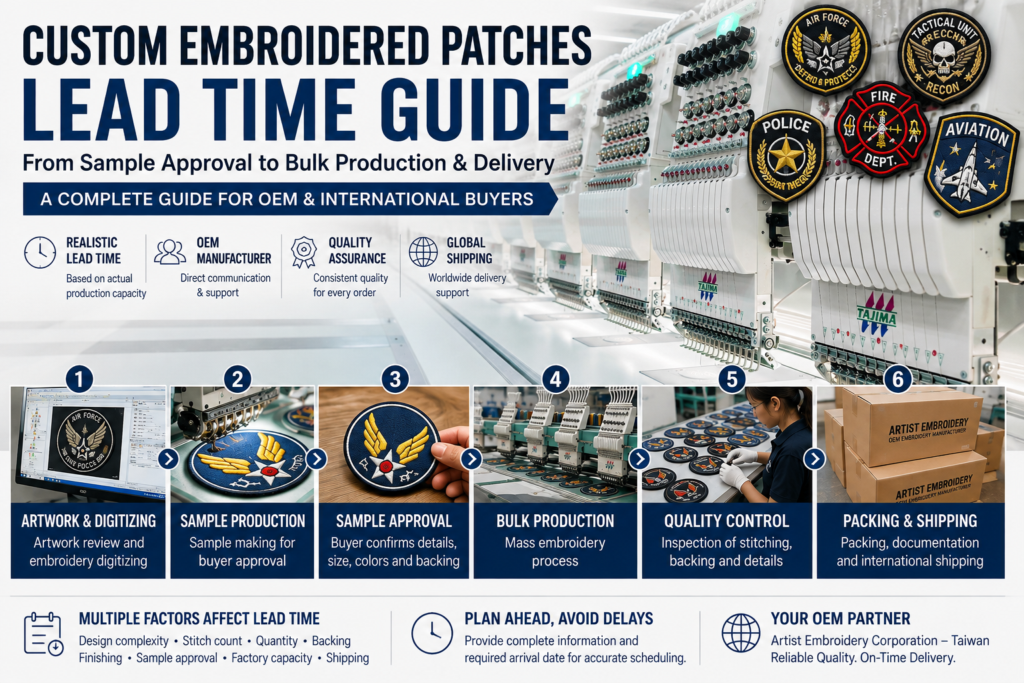
Introduction
When sourcing custom patches for uniforms, military and police applications, clubs, sports teams, corporate branding, or promotional programs, one of the first questions buyers ask is: How long does it take to make custom embroidered patches? Understanding the custom embroidered patches lead time is especially important for OEM buyers who need to coordinate product launches, uniform programs, events, seasonal orders, or international delivery deadlines.
However, embroidered patch production time is not determined by quantity alone. The complete manufacturing process may include artwork review, embroidery digitizing, thread color selection, sample production, sample approval, mass production, edge finishing, backing application, quality inspection, packing, and international shipping. Patch size, stitch count, embroidery coverage, design complexity, number of thread colors, backing type, order quantity, and factory production capacity can all influence the final custom patch turnaround time.
For international buyers, it is also important to distinguish between production lead time and shipping time. A factory may complete an order within the agreed production schedule, but the total time required for the patches to arrive at the buyer’s location will also depend on the destination and shipping method. This distinction becomes especially important when working with bulk orders or projects with fixed delivery dates.
As an OEM embroidery manufacturer in Taiwan, Artist Embroidery Corporation works directly with buyers through the major stages of custom patch development and production. Clear specifications, efficient sample approval, and realistic production planning can help reduce unnecessary delays while maintaining consistent embroidery quality.
This guide explains the complete custom embroidered patches lead time, from artwork and sampling to mass production, quality control, and delivery. It also examines the factors that can extend production time, how order quantity and stitch count affect manufacturing schedules, when rush production may be possible, and what buyers can do to keep their custom embroidered patch orders on schedule.
By understanding the complete production timeline before placing an order, buyers can communicate more effectively with their embroidery manufacturer, establish realistic delivery expectations, and plan bulk custom patch orders with greater confidence.
How Long Does It Take to Make Custom Embroidered Patches?
Understanding how long it takes to manufacture custom embroidered patches is essential for buyers planning uniforms, promotional products, military or police patches, sports team merchandise, corporate branding, and large OEM programs. The actual custom embroidered patches lead time depends on more than simply how many patches are ordered. Artwork preparation, embroidery digitizing, sample development, buyer approval, production scheduling, stitch count, finishing options, quality control, and packing can all influence the final production schedule.
For this reason, professional buyers should view lead time as a series of production stages rather than a single number of days. A simple repeat order with approved embroidery data may move through production differently from a new design requiring digitizing, physical sampling, color adjustments, or multiple revisions. Large-volume orders also require appropriate machine capacity and production scheduling.
Another important distinction is the difference between embroidered patch production time and total delivery time. Production lead time generally refers to the period required by the manufacturer to prepare and manufacture the order, while international transportation takes place afterward. Buyers with a fixed event, launch, uniform issue date, or retail delivery deadline should therefore plan backward from the required arrival date instead of focusing only on the factory completion date.
Typical Lead Time for a Custom Embroidered Patch Order
A typical custom embroidered patch project begins before mass production actually starts. For a new design, the manufacturer first reviews the artwork and specifications to determine whether the requested details can be reproduced effectively with embroidery. The artwork is then converted into embroidery data through digitizing, where stitch types, stitch directions, densities, underlay, color sequences, and other machine instructions are established.
A physical sample may then be produced for evaluation. Buyers can review dimensions, thread colors, lettering, border appearance, embroidery coverage, backing, and overall visual quality before approving mass production. If changes are requested, the embroidery data or specifications may need to be adjusted and another sample may be required.
Once the sample and production specifications are approved, the order can enter the factory’s production schedule. The actual custom patch turnaround time at this stage depends on order quantity, total stitch count, machine availability, finishing requirements, and current factory capacity.
Because these variables differ from project to project, buyers should be cautious about treating a generic online turnaround-time claim as a guaranteed manufacturing schedule. A more reliable approach is to provide the manufacturer with complete order information and request a lead-time estimate based on the actual design, quantity, construction, and required delivery date.
Why There Is No Single Production Time for Every Order
Two embroidered patches of the same dimensions can require significantly different manufacturing time. For example, a relatively simple logo with moderate embroidery coverage may contain far fewer stitches than a highly detailed full-coverage patch with small lettering, multiple elements, and dense background embroidery.
Stitch count is especially important because embroidery machines physically create the design stitch by stitch. Higher stitch counts generally require more machine running time per piece. When that additional machine time is multiplied across hundreds or thousands of patches, the difference can become significant in production planning.
Thread colors can also influence manufacturing complexity. Designs using more colors require additional thread preparation and color changes, and more thread colors can also increase production cost. Backing options such as hook-and-loop, iron-on, adhesive, or other custom constructions may introduce additional finishing processes after embroidery.
The production schedule can also be affected by the factory’s existing workload. Professional OEM manufacturers must allocate machine capacity across multiple orders while maintaining appropriate quality-control standards. This is why buyers should request an order-specific OEM embroidered patch lead time instead of assuming that every design and quantity can follow the same turnaround schedule.
💡 Buyer Tip: When requesting a quotation, provide the artwork, finished patch dimensions, quantity, backing type, required delivery date, and destination at the same time. Complete specifications allow the manufacturer to evaluate both pricing and production scheduling more accurately.
Sample Lead Time vs. Bulk Production Lead Time
Sample development and bulk production should be treated as two separate stages of the embroidered patch manufacturing process.
During sampling, the primary objective is not production speed but confirmation. The manufacturer needs to determine whether the digitized embroidery accurately represents the artwork and whether small details, lettering, thread colors, borders, and overall construction meet the buyer’s requirements. Adjustments made at this stage can prevent much larger problems after hundreds or thousands of patches have already been manufactured.
Bulk production normally begins only after the buyer approves the sample and confirms the final specifications. At that point, the manufacturer can schedule the approved embroidery program across suitable production equipment. Multi-head embroidery machines can manufacture multiple pieces simultaneously, but production capacity is still influenced by stitch count, quantity, machine configuration, and other orders already scheduled at the factory.
Repeat orders may follow a different timeline because approved embroidery data and specifications may already exist. If the artwork, size, colors, construction, and other requirements remain unchanged, some development steps may not need to be repeated. However, buyers should still confirm the current production schedule rather than assuming that every repeat order will automatically receive the same lead time.
The key for OEM buyers is therefore to separate sample approval time, bulk production time, and shipping time when planning an order. Doing so provides a much clearer picture of when the finished patches can realistically arrive.
📊 Table: Typical Custom Embroidered Patch Lead Time by Order Stage
| Order Stage | Main Activity | What Can Affect the Timeline |
|---|---|---|
| Artwork Review | Check design and embroidery feasibility | Artwork quality, size, fine details |
| Digitizing | Convert artwork into embroidery machine data | Complexity, stitch count, lettering |
| Sample Production | Produce a physical embroidery sample | Design complexity, colors, construction |
| Sample Approval | Buyer reviews and confirms sample | Response time, revisions, color changes |
| Production Scheduling | Allocate machines and production capacity | Order quantity, factory workload |
| Mass Production | Manufacture approved patches | Stitch count, quantity, machine capacity |
| Finishing | Cutting, borders, backing, other processes | Backing and finishing requirements |
| Quality Control | Inspect finished patches | Quantity and project specifications |
| Packing | Prepare goods for shipment | Packaging requirements |
| International Shipping | Transport goods to buyer | Destination and shipping method |
💡 Buyer Tip: When a supplier provides a lead time, ask whether the quoted schedule begins before or after sample approval and whether it includes international shipping. This simple question can prevent misunderstandings when planning a time-sensitive order.
📖 Extended Reading
- Custom Embroidered Patches MOQ: Complete Guide for Buyers
- Custom Embroidered Patches Cost: Complete Pricing Guide for Buyers
- How to Order Custom Embroidered Patches
What Is the Typical Custom Embroidered Patches Lead Time?
The custom embroidered patches lead time can vary considerably depending on whether the project is a small first-time order, a larger OEM production run, or a repeat order using previously approved embroidery data. For international buyers, understanding these differences is important because order quantity does not simply determine how many patches need to be produced—it also affects machine scheduling, finishing capacity, quality control, packing, and overall production planning.
Instead of relying on a universal turnaround-time promise, buyers should evaluate lead time according to the specific order type. A small custom patch order may require relatively limited mass-production capacity, but a new design still needs artwork review, embroidery digitizing, sampling, and approval. A large-volume order may already have an approved sample but require substantially more machine hours and finishing work. Repeat orders can sometimes eliminate certain development stages, yet they still need to be scheduled according to current factory capacity.
For this reason, a professional manufacturer should evaluate the embroidered patch production time based on the complete project specifications and provide a realistic production schedule before the order begins.
Lead Time for Small Custom Patch Orders
Small orders are often assumed to have extremely short turnaround times, but quantity is only one part of the manufacturing process. If a buyer submits a completely new design, the manufacturer must still review the artwork, confirm dimensions and construction, prepare embroidery data, select appropriate thread colors, produce a sample when required, and obtain approval before beginning production.
This means that the development stage for 100 patches may be similar in structure to the development stage for 1,000 patches. The major difference appears during mass production, where the smaller quantity generally requires fewer total machine hours.
Design complexity can significantly influence the schedule even at low quantities. A patch with high embroidery coverage, dense stitching, small lettering, multiple thread colors, or detailed artwork may require more digitizing and sampling adjustments than a relatively simple logo. Backing and finishing requirements can also add production steps. Hook-and-loop backing, iron-on backing, adhesive options, button loops, special borders, or individual packaging should therefore be confirmed before the manufacturer estimates the final custom patch turnaround time.
For buyers ordering smaller quantities, the most effective way to avoid unnecessary delays is to provide complete specifications from the beginning. Clear artwork, exact dimensions, quantity, backing requirements, preferred colors, and the required arrival date allow the factory to evaluate the project without repeatedly requesting missing information.
Lead Time for Medium and Large Bulk Orders
For medium and large OEM orders, production capacity becomes increasingly important. Once an approved embroidery program enters mass production, the manufacturer must allocate suitable embroidery machines according to the patch size, stitch count, quantity, and production schedule.
Modern multi-head embroidery equipment allows multiple pieces to be embroidered simultaneously, significantly improving manufacturing efficiency. However, larger quantities still require more total production capacity. A high-stitch-count patch multiplied across several thousand pieces can occupy considerably more machine time than a simple design of the same physical size.
Production does not end when embroidery is completed. Bulk orders may still require border finishing, laser cutting or other cutting processes, backing application, inspection, trimming, sorting, counting, and packing. These downstream processes must also be included when estimating the bulk embroidered patches production time.
Quality control becomes particularly important with larger quantities. An OEM manufacturer must maintain consistency across the complete production run, including embroidery positioning, thread colors, border appearance, dimensions, backing application, and overall workmanship. Compressing the schedule excessively can create unnecessary production pressure, which is why professional buyers should prioritize a realistic lead time rather than selecting a supplier solely because it promises the shortest turnaround.
💡 Buyer Tip: For large orders with a fixed deadline, contact the manufacturer as early as possible and provide the expected quantity and required arrival date. This allows production capacity to be evaluated before the order is finalized.
Why Repeat Orders May Have a Shorter Turnaround Time
Repeat orders can sometimes move through the manufacturing process more efficiently because important development work has already been completed. If the buyer requests exactly the same patch design, dimensions, thread colors, embroidery data, backing, and finishing specifications, the manufacturer may already have the approved production information available.
This can reduce the need for artwork interpretation, new digitizing, and extensive sample development. For established OEM programs involving recurring uniform patches, corporate emblems, military or police patches, sports patches, or branded merchandise, maintaining consistent production records can therefore improve ordering efficiency.
However, a repeat order should not automatically be treated as an immediate-production order. Factory workload changes throughout the year, and the embroidery machines required for the project may already be allocated to other orders. Material availability, thread preparation, backing requirements, quantity changes, or packaging specifications may also affect scheduling.
Buyers should also clearly identify whether anything has changed from the previous order. Even a small adjustment to patch dimensions, lettering, colors, backing, or artwork may require modifications to the embroidery program or another sample confirmation.
For this reason, repeat buyers should provide the previous order reference whenever possible and clearly state whether the specifications remain unchanged. This helps the manufacturer retrieve the correct production information and determine whether development steps can safely be reduced.
Repeat production is particularly valuable for long-term B2B sourcing programs. By establishing approved specifications and maintaining consistent communication with the same OEM embroidery manufacturer, buyers can create a more predictable ordering process and reduce avoidable delays over time.
📊 Table: Estimated Lead Time by Custom Patch Order Type
| Order Type | Development Requirements | Production Considerations | Lead Time Characteristics |
|---|---|---|---|
| New Small Order | Artwork review, digitizing, sample approval | Lower production quantity | Development may represent a larger portion of total lead time |
| New Medium Order | Full development and approval | Requires production scheduling | Balanced between development and manufacturing time |
| New Large/Bulk Order | Full development and approval | High machine and finishing capacity required | Should be planned further in advance |
| Repeat Order – Unchanged | Existing embroidery data may be reused | Current factory capacity still applies | Potentially shorter development process |
| Repeat Order – Modified | Embroidery data may require adjustment | May require new sample approval | Timeline depends on extent of changes |
| Rush Order | Specifications must be confirmed quickly | Depends heavily on available capacity | Must be evaluated individually |
💡 Buyer Tip: When comparing suppliers, do not evaluate turnaround time only by the number of days quoted. Ask what the quoted custom embroidered patches lead time includes—digitizing, sampling, approval, mass production, finishing, QC, packing, and shipping may be calculated separately.
📖 Extended Reading
- OEM Embroidered Patch Manufacturer: Complete Buyer Guide
- OEM Embroidered Patch Manufacturer vs Trading Company
- Complete Guide to Embroidered Patches
What Happens During the Embroidered Patch Production Process?
Understanding the complete embroidered patch manufacturing process helps buyers see why the custom embroidered patches lead time includes much more than the time an embroidery machine spends stitching. Before mass production begins, a manufacturer must review the artwork, prepare embroidery data, select thread colors, create a physical sample when required, and confirm the specifications with the buyer. After embroidery, additional processes such as cutting, border finishing, backing application, quality control, and packing must also be completed.
Each stage affects both quality and production efficiency. A delay during artwork confirmation or sample approval can postpone the start of mass production, while complex finishing requirements may add processing time after embroidery is complete. For OEM buyers, understanding this workflow makes it easier to establish realistic deadlines and communicate effectively with the manufacturer.
A well-managed production process also reduces the risk of discovering problems after bulk manufacturing has already started. This is especially important for large orders where even a small error in dimensions, lettering, thread color, or backing specifications can affect hundreds or thousands of finished patches.
Step 1: Artwork Review and Embroidery Feasibility Check
Every new custom embroidered patch begins with artwork evaluation. A design that looks excellent on a computer screen may not automatically translate into high-quality embroidery because thread has physical limitations that digital graphics do not.
The manufacturer evaluates the requested patch dimensions, lettering size, line thickness, spacing, embroidery coverage, color separation, borders, and fine details. Very small text, extremely thin lines, complex gradients, or tightly packed elements may require adjustments before digitizing.
This stage is particularly important when buyers want to reproduce detailed logos, military insignia, police patches, corporate emblems, sports team graphics, or other designs where visual consistency matters. Identifying potential embroidery limitations before production can prevent unnecessary sample revisions later.
Buyers can help shorten the custom patch turnaround time by providing clear artwork files and complete specifications at the beginning of the project. Whenever possible, vector artwork or high-resolution source files are preferable to screenshots or low-resolution images.
Step 2: Embroidery Digitizing and Machine Setup
After the artwork is reviewed, it must be converted into embroidery machine instructions through a process known as digitizing. This is not simply an automatic file conversion. Professional embroidery digitizing determines how the design will actually be constructed with thread.
The digitizer defines stitch types, stitch directions, densities, underlay, sequencing, pull compensation, trims, and color changes. These decisions influence the appearance, stability, efficiency, and total stitch count of the finished patch.
A poorly optimized embroidery program can increase machine time, create unnecessary thread trims, distort lettering, cause excessive density, or produce inconsistent results. By contrast, properly prepared embroidery data helps balance visual quality with efficient production.
The approved program is then prepared for industrial embroidery equipment. Professional multi-head embroidery machines allow multiple patches to be stitched simultaneously, making them suitable for OEM and bulk production. Industrial embroidery technology from manufacturers such as Tajima Group – Industrial Embroidery Technology demonstrates how computerized multi-head systems support repeatable commercial embroidery production.
Step 3: Sample Production and Buyer Approval
Before large-scale manufacturing begins, a physical embroidery sample may be produced to verify how the digitized design performs on actual materials. This stage gives both the manufacturer and buyer an opportunity to evaluate details that cannot always be judged accurately from a digital preview.
The sample can be checked for overall dimensions, embroidery density, lettering clarity, thread colors, border shape, alignment, backing construction, and general appearance. If the design includes particularly small details or dense areas, the sample also helps determine whether further optimization is necessary.
Buyer response time can significantly influence the custom embroidered patches lead time. If the sample is approved quickly, the factory can proceed toward production scheduling. If revisions are required, the embroidery program may need adjustment followed by another sample or confirmation.
💡 Buyer Tip: Review all sample details at the same time—including size, colors, spelling, backing, border, and construction—and consolidate revision requests whenever possible. Multiple separate revision rounds can unnecessarily extend the approval process.
Step 4: Mass Embroidery Production
Once the sample and specifications are approved, the project can move into mass production. The manufacturer schedules the order according to machine availability, quantity, stitch count, design complexity, and required completion date.
During production, industrial multi-head embroidery machines can stitch multiple identical designs simultaneously. However, machine speed alone does not determine total output. Designs with high stitch counts require longer running time, while multiple thread colors may involve additional preparation and color-change considerations.
Thread consistency is also important for repeatable OEM production. Professional embroidery threads must provide stable color, strength, and performance during high-speed machine operation. Artist Embroidery uses professional embroidery materials for production, and buyers interested in thread manufacturing can reference FuFu’s Thread – Professional Embroidery Threads.
Production planning must balance efficiency with consistency. Running machines faster or compressing schedules excessively is not a substitute for proper manufacturing control, particularly when producing large quantities that must maintain a consistent appearance.
Step 5: Cutting, Backing, Edge Finishing, and Quality Control
After embroidery is completed, the patches still require finishing. Depending on the design and specifications, this may include laser cutting, merrowed borders, heat cutting, backing application, hook-and-loop attachment, adhesive backing, iron-on backing, trimming, or other custom processes.
Different finishing methods require different workflows. A simple sew-on patch may require fewer post-embroidery operations than a patch with hook-and-loop backing and individual packaging. Buyers should therefore specify these requirements before requesting an accurate embroidered patch production time.
Quality control is performed to identify issues such as loose threads, incorrect dimensions, embroidery defects, border irregularities, backing problems, or other inconsistencies. For bulk OEM orders, maintaining consistency across the production run is just as important as producing an attractive initial sample.
Finishing and inspection should therefore be considered part of manufacturing lead time rather than an optional process after production.
Step 6: Packing and Preparing for International Shipping
After inspection, finished patches are counted, organized, and packed according to the agreed requirements. Standard bulk packing is generally more straightforward, while individual packaging, labeling, assortment sorting, barcode requirements, or customized packing instructions can add additional processing.
Export orders must also be prepared for international transportation. The factory completion date and the buyer’s actual delivery date are not the same. Courier transit, air freight, sea freight, customs clearance, destination, holidays, and other logistics factors can influence the final arrival date.
For this reason, international buyers should communicate their required arrival date rather than only requesting a specific production completion date. The manufacturer can then evaluate the production schedule together with the expected transportation requirements.
Separating production and shipping timelines also makes project planning more accurate. If an order is needed for a uniform rollout, promotional campaign, sports event, trade show, or product launch, additional buffer time should be considered instead of scheduling manufacturing against the final deadline.
📊 Table: Custom Embroidered Patch Manufacturing Process and Timeline
| Production Stage | Main Work | Key Lead Time Factors |
|---|---|---|
| Artwork Review | Evaluate embroidery feasibility | Artwork quality, dimensions, fine details |
| Digitizing | Create embroidery machine data | Complexity, stitch count, color sequencing |
| Sample Production | Produce physical sample | Design complexity and construction |
| Sample Approval | Buyer reviews specifications | Response speed and revisions |
| Production Scheduling | Allocate machine capacity | Quantity and current factory workload |
| Mass Embroidery | Produce approved design | Stitch count, colors, quantity |
| Finishing | Cutting, borders, backing | Construction and backing type |
| Quality Control | Inspect finished patches | Quantity and quality requirements |
| Packing | Count and prepare goods | Packaging specifications |
| Shipping Preparation | Prepare export order | Destination and transportation method |
💡 Buyer Tip: When calculating your purchasing schedule, treat artwork → sample approval → mass production → finishing/QC → shipping as one complete timeline. Leaving additional buffer before the required arrival date can reduce the risk created by revisions or logistics delays.
📖 Extended Reading
- How to Design Artwork for Embroidery
- High-Density Embroidery & Stitch Count Guide
- Laser Cutting in Embroidery
What Factors Affect Embroidered Patch Production Time?
The custom embroidered patches lead time is influenced by several interconnected manufacturing factors. Two patches with the same dimensions and order quantity can require very different production schedules depending on embroidery coverage, stitch count, design complexity, thread colors, backing, finishing, and packaging requirements. For OEM buyers, understanding these variables makes it easier to obtain a realistic lead-time estimate before placing a bulk order.
Production time should therefore be evaluated according to the actual embroidery specification rather than patch size alone. A simple design with open background areas may run much faster than a fully embroidered design containing dense fills, small lettering, multiple color sections, and detailed borders. Additional finishing operations performed after embroidery can further increase the total manufacturing time.
Providing complete specifications during the quotation stage allows the manufacturer to evaluate these factors together and estimate both cost and embroidered patch production time more accurately.
Patch Size and Embroidery Coverage
Patch dimensions influence production time, but embroidery coverage is equally important. A large patch does not necessarily require more machine time than a smaller patch if much of its background remains unembroidered. Conversely, a relatively small patch with nearly 100% embroidery coverage can contain a high number of stitches and require substantial machine running time.
Embroidery coverage generally refers to how much of the patch surface is covered by thread. Designs using extensive fill stitching require the machine to build the surface through thousands of individual stitches. When the same design is multiplied across hundreds or thousands of pieces, even a modest increase in stitches per patch can significantly affect total machine hours.
Patch size can also affect how many pieces can be arranged efficiently within the embroidery machine’s production setup. Manufacturers therefore evaluate dimensions, coverage, stitch count, and quantity together when planning machine capacity.
For buyers, this means that simply requesting a lead time for a “10 cm patch” does not provide enough information. The actual artwork and embroidery coverage should be reviewed before a reliable production schedule is established.
Stitch Count and Design Complexity
Stitch count is one of the most direct factors affecting embroidery machine time. Industrial embroidery machines physically create each design through repeated needle movements, so a patch containing 30,000 stitches naturally requires more machine operation than a comparable design containing 10,000 stitches.
However, stitch count alone does not explain every aspect of production efficiency. Complex designs may contain frequent trims, short stitch sections, small lettering, multiple directional changes, or isolated embroidery elements. These characteristics can reduce production efficiency even when the overall stitch count appears reasonable.
Professional digitizing therefore plays an important role in balancing appearance and manufacturing efficiency. The objective is not simply to minimize stitches. Removing necessary underlay or reducing density excessively can negatively affect embroidery quality. Instead, the embroidery program should use appropriate stitch types, densities, sequencing, and construction for the artwork and material.
For bulk orders, these differences become increasingly important because machine time is multiplied across the entire quantity. Buyers planning large-volume OEM programs should therefore allow the manufacturer to review the actual artwork before assuming a specific custom patch turnaround time.
💡 Buyer Tip: When comparing quotations from different manufacturers, do not compare patch dimensions alone. Embroidery coverage, estimated stitch count, construction, and quality requirements can explain why two apparently similar patches have different prices and production schedules.
Number of Thread Colors
The number of thread colors can also affect both the production process and cost. Designs with more colors require additional thread preparation and may involve more color changes during embroidery. As the number of thread colors increases, production becomes more complex and the price may increase accordingly.
The impact is particularly noticeable when a design uses many small color sections rather than several large, efficiently sequenced areas. Each additional color may require thread setup, machine preparation, sequencing, and quality verification.
Color selection is also important during sample approval. Buyers may provide Pantone references, existing samples, brand guidelines, or other color standards. Because embroidery thread reflects light differently from printed ink or a digital screen, physical thread selection may require judgment to achieve the closest practical match.
Using stable, professional embroidery thread is important for maintaining consistent color and machine performance during bulk production. FuFu’s Thread – Professional Embroidery Threads provides an example of professional embroidery thread manufacturing used for commercial embroidery applications.
Buyers can help prevent delays by confirming required colors early and avoiding unnecessary color changes after sampling has already begun.
Backing and Edge Finishing Options
The embroidered portion of a patch is only one part of the finished product. Backing and edge finishing can introduce additional manufacturing steps that must be included in the total OEM embroidered patch lead time.
Common backing options include sew-on construction, iron-on backing, adhesive backing, and hook-and-loop systems. Hook-and-loop patches, for example, require additional material and attachment operations after embroidery. Specialized constructions may involve even more finishing work.
Edge treatment also varies according to the design. Traditional merrowed borders are suitable for many standard patch shapes, while irregular or highly detailed outlines may require heat cutting or laser cutting. The appropriate method depends on the artwork, patch construction, and desired appearance.
These processes take place after the embroidery machine has completed the design, which is why machine stitching time should never be treated as the complete manufacturing timeline.
For buyers comparing different patch constructions, backing and edge options should be confirmed during the quotation stage rather than after the sample is produced. Late changes may affect pricing, sample approval, and production scheduling.
Order Quantity and Production Capacity
Quantity directly affects the amount of factory capacity required for an order. Industrial multi-head embroidery equipment can produce multiple patches simultaneously, but every production line still has finite capacity.
A manufacturer must determine which machines are suitable for the patch dimensions and design, how many heads can be used efficiently, how long each embroidery cycle requires, and how the order fits into the existing production schedule. Large orders may therefore need to be divided across production runs or scheduled across multiple machines.
Equipment technology also influences production capability. Industrial embroidery systems such as those developed by Tajima Group – Industrial Embroidery Technology are designed for commercial multi-head production, but proper production scheduling remains necessary regardless of machine capability.
Seasonal demand can also affect factory capacity. Buyers planning large orders for specific events, uniform rollouts, promotional campaigns, or seasonal merchandise should communicate projected quantities as early as possible.
A reliable manufacturer should provide a realistic schedule based on current capacity rather than promising an aggressive turnaround that may be difficult to maintain.
Special Packaging or Custom Requirements
Packaging requirements are sometimes overlooked when buyers calculate custom embroidered patches lead time. Standard bulk packing is relatively straightforward, but customized packing can require additional labor after quality inspection.
Examples include individual polybags, product labels, barcode labels, quantity sorting, color assortment packing, retail-ready packaging, or packing patches according to different departments, stores, teams, or locations.
OEM projects may also include special inspection standards, carton markings, documentation, or shipment separation requirements. These operations do not necessarily affect embroidery machine time, but they can affect the factory completion date.
For large international orders, buyers should therefore provide packaging instructions before production begins. Waiting until the patches are already completed to introduce complex packing requirements may extend the final preparation stage and delay shipment.
Clear specifications allow the manufacturer to incorporate packaging into the production plan from the beginning and provide a more accurate total turnaround estimate.
📊 Table: Factors That Can Increase Embroidered Patch Lead Time
| Factor | Potential Effect on Production | Buyer Recommendation |
|---|---|---|
| Larger Embroidery Area | May increase total stitches | Provide exact dimensions and artwork |
| High Embroidery Coverage | Increases machine running time | Confirm desired coverage early |
| High Stitch Count | Requires more embroidery cycles | Allow manufacturer to evaluate artwork |
| Complex Fine Details | May require additional digitizing and sampling | Simplify details when appropriate |
| More Thread Colors | More setup and color changes; may also increase cost | Confirm colors before sampling |
| Special Backing | Adds post-embroidery processing | Specify backing during quotation |
| Complex Edge Finishing | Adds cutting or border operations | Confirm finished shape early |
| Large Order Quantity | Requires more factory capacity | Plan bulk orders in advance |
| Custom Packaging | Adds sorting and packing operations | Submit packing instructions early |
| Late Design Changes | May require new digitizing or sampling | Finalize specifications before approval |
💡 Buyer Tip: The fastest way to obtain an accurate lead-time estimate is to send the manufacturer the actual artwork + dimensions + quantity + backing + finishing + packaging requirements + required arrival date together. Asking only “How many days for 1,000 patches?” usually does not provide enough information for reliable production planning.
📖 Extended Reading
- Embroidered Patch Backing Comparison: Which Option Is Best?
- Embroidered Badge Durability Guide
- Velcro Embroidered Patches Guide
Does Order Quantity Affect Custom Patch Turnaround Time?
Order quantity is an important factor in determining custom embroidered patches lead time, but the relationship between quantity and production time is not always as simple as “more pieces equal more days.” Industrial embroidery factories use multi-head embroidery machines that can produce multiple patches simultaneously, allowing bulk orders to be manufactured far more efficiently than producing each patch individually. However, every order still consumes machine capacity, finishing resources, quality-control time, and packing labor.
For OEM buyers, the key consideration is therefore not only the number of patches ordered but also how that quantity interacts with stitch count, patch dimensions, embroidery coverage, thread colors, machine configuration, and current factory workload. An order for 5,000 relatively simple patches may sometimes be easier to schedule than a smaller quantity of extremely complex, high-stitch-count designs.
Understanding how manufacturers plan production capacity can help buyers establish more realistic expectations, particularly when sourcing large quantities for uniform programs, military and police applications, sports organizations, promotional campaigns, retail merchandise, or recurring corporate orders.
Small Orders vs. Bulk Embroidered Patch Orders
Small and bulk orders generally follow many of the same development steps. A new design still requires artwork review, embroidery digitizing, specification confirmation, and potentially sample production regardless of whether the buyer needs 100 pieces or several thousand.
The difference becomes more significant after approval.
A smaller order requires fewer total embroidery cycles and less finishing, inspection, and packing labor. Once it enters the production schedule, the mass-production stage may therefore be completed relatively efficiently. However, the development process still represents a meaningful portion of the overall custom patch turnaround time.
With bulk orders, the situation is reversed. Artwork preparation and sampling do not necessarily become proportionally longer simply because the quantity increases, but mass production requires significantly more factory capacity.
For example, if a patch contains a high stitch count, every additional piece adds machine running time. When the design is produced in quantities of thousands or tens of thousands, the cumulative difference becomes substantial even when multi-head machines are used.
Post-embroidery operations also scale with quantity. Cutting, border finishing, backing application, thread trimming, inspection, counting, sorting, and packing must be completed across the entire production run.
This is why buyers should not estimate bulk embroidered patches production time by simply multiplying or dividing the turnaround time of a previous small order. The manufacturer should evaluate the actual quantity against available production capacity.
Why Higher Quantities Require Production Scheduling
Industrial embroidery manufacturing operates according to planned machine capacity. When a bulk order is confirmed, the manufacturer must determine when appropriate equipment will be available and how much production capacity the project requires.
This calculation depends heavily on the embroidery program. Patch dimensions determine how designs can be arranged for production, while stitch count affects the duration of each embroidery cycle. Designs with many color changes, trims, or complex details may require additional machine time or operator attention.
Factories also manufacture multiple customer orders simultaneously. A professional OEM manufacturer therefore needs to coordinate machine assignments so that existing production commitments can be completed while new orders enter the schedule.
For this reason, a large order confirmed today may not necessarily begin embroidery immediately the following day. Materials may need preparation, machine capacity must be allocated, and approved production information must be transferred into the manufacturing schedule.
This is especially important during periods of higher factory demand. Buyers working toward a fixed launch, event, uniform distribution, or promotional deadline should avoid waiting until the last possible moment to confirm a large order.
Providing expected quantities early allows the manufacturer to evaluate capacity before the final purchase order is issued and can make the OEM embroidered patch lead time more predictable.
💡 Buyer Tip: If you already know that an initial order may expand into a larger production run, tell the manufacturer during the quotation stage. Forecast information can help the factory evaluate future capacity and recommend a more practical ordering schedule.
How Manufacturers Plan Multi-Head Embroidery Machine Capacity
Multi-head embroidery machines are one of the main reasons professional factories can efficiently manufacture custom patches in commercial quantities. Instead of stitching one patch at a time, multiple embroidery heads can operate simultaneously using the same embroidery program.
However, the number of machine heads does not translate directly into a fixed number of patches per day.
Production output depends on several variables. The dimensions of the patch influence how the design can be arranged within the embroidery frame. Stitch count determines the approximate machine running time for each cycle, while thread changes, trims, machine stops, material preparation, and operator handling also affect actual output.
Machine allocation must therefore be calculated according to the individual project. A factory may use different machine configurations for different designs, and production planners need to balance efficiency across multiple customer orders.
Industrial systems from companies such as Tajima Group – Industrial Embroidery Technology demonstrate how computerized multi-head embroidery technology supports high-volume commercial manufacturing. Nevertheless, equipment capability must still be combined with experienced digitizing, machine setup, operator management, finishing, and quality control.
For buyers, this explains why asking only about the number of embroidery machines or machine heads does not provide a complete picture of factory capacity. The more useful question is whether the manufacturer can allocate sufficient capacity to the specific design, stitch count, quantity, and required delivery schedule.
For recurring OEM programs, production planning can become even more efficient when buyers provide forecasts. If a company expects to order the same patches regularly throughout the year, sharing approximate annual demand or planned purchasing cycles can help the manufacturer prepare for upcoming requirements.
This type of coordination is particularly useful for uniform suppliers, government contractors, clubs, sports organizations, apparel brands, and distributors that need consistent products across multiple production batches.
📊 Table: Order Quantity vs. Production Planning
| Order Situation | Production Consideration | Recommended Buyer Action |
|---|---|---|
| Small New Order | Development may represent a large portion of total lead time | Submit complete specifications early |
| Medium Order | Requires balanced machine and finishing capacity | Confirm quantity before scheduling |
| Large Bulk Order | Requires significant production capacity | Place orders further in advance |
| High-Stitch-Count Bulk Order | Longer machine time per piece | Allow additional production planning |
| Multiple Designs | Capacity must be divided among different embroidery programs | Provide quantities for each design |
| Repeat Order | Existing production data may improve efficiency | Provide previous order reference |
| Recurring OEM Program | Future capacity can potentially be planned | Share purchasing forecasts when possible |
| Urgent Large Order | Depends heavily on current available capacity | Check feasibility before committing to a deadline |
💡 Buyer Tip: For recurring orders, consider providing a 3–6 month purchasing forecast when practical. It does not necessarily need to be a firm purchase order, but approximate demand can help both buyer and manufacturer anticipate production requirements and reduce last-minute scheduling pressure.
📖 Extended Reading
- Military, Police & Firefighter Embroidered Patches Guide
- Sports Team Embroidered Badges Guide
- Embroidered Patches for the Uniform Industry
How Do Design Complexity and Stitch Count Affect Lead Time?
Design complexity and stitch count are two of the most important technical factors affecting custom embroidered patches lead time. Unlike printed graphics, embroidery is physically constructed with thread, meaning every line, letter, fill area, border, and decorative element must be translated into a sequence of stitches that an embroidery machine can execute. As a result, two patches with identical dimensions can require very different production times depending on how their designs are constructed.
For OEM buyers, this distinction is important when comparing quotations or planning bulk orders. A visually simple patch with moderate embroidery coverage may contain relatively few stitches, while a highly detailed full-coverage design may require tens of thousands of stitches per piece. Once that difference is multiplied across hundreds or thousands of patches, machine time can become a major component of the overall embroidered patch production time.
However, reducing stitch count should never be the only objective. Professional embroidery digitizing must balance production efficiency with appearance, durability, fabric stability, lettering clarity, and consistency. The goal is to create an embroidery program that reproduces the artwork effectively without unnecessary stitches or inefficient machine movements.
Why High Stitch Counts Require More Machine Time
Every embroidered patch is produced through thousands of individual needle movements. A design containing a higher stitch count generally requires more machine running time because the embroidery equipment must physically complete each programmed stitch.
The difference may appear relatively small when considering a single patch, but it becomes much more significant during bulk manufacturing. If one design requires substantially more stitches than another, the additional machine time is repeated across every piece in the production run.
For example, increasing embroidery coverage, adding a fully stitched background, enlarging filled areas, or incorporating more detailed elements can significantly increase the total stitch count. Large quantities of these high-density designs therefore require greater machine capacity and may extend the bulk embroidered patches production time.
Machine speed alone cannot eliminate this difference. Industrial embroidery equipment can operate at high speeds, but actual production speed must remain appropriate for the thread, materials, stitch construction, and design. Excessively aggressive machine settings can increase thread breaks, registration problems, distortion, or other quality issues.
For professional OEM production, the objective is therefore not simply to run the embroidery machines as fast as possible. The manufacturer must balance output with stable, repeatable embroidery quality.
Fine Details, Small Lettering, and Dense Embroidery
Fine details are another important source of embroidery complexity. Small lettering, thin outlines, closely spaced elements, and intricate logos can require careful digitizing to remain recognizable after being converted from digital artwork into thread.
Embroidery thread has physical thickness, which means extremely small graphic elements cannot always be reproduced exactly as they appear on a computer screen. If lettering becomes too small or lines are placed too closely together, stitches may overlap or lose definition.
Dense embroidery can create additional challenges. Excessive stitch density may make a patch unnecessarily stiff, increase thread consumption, extend machine time, and potentially affect the appearance of small details. Appropriate density therefore depends on the design, materials, stitch type, and desired visual result.
Complex designs may also contain more trims, jumps, direction changes, and isolated color areas. These operations can reduce manufacturing efficiency even when the total stitch count is not exceptionally high.
This is why professional evaluation before production is important. An experienced manufacturer can identify areas where artwork may need adjustment and recommend practical changes while preserving the overall visual identity of the design.
💡 Buyer Tip: If your design contains extremely small lettering or fine details, avoid reducing the patch size without consulting the manufacturer. A design that works well at 10 cm may not reproduce equally well at 5 cm simply by scaling the artwork down.
How Design Optimization Can Improve Production Efficiency
Design optimization does not necessarily mean simplifying a logo or changing its identity. In embroidery manufacturing, optimization often involves translating the artwork into stitches more intelligently.
An experienced digitizer can select appropriate stitch types, adjust stitch direction, manage underlay, control density, organize color sequences, and reduce unnecessary trims or machine movements. These decisions can improve both visual quality and manufacturing efficiency.
For example, several nearby areas using the same thread color may sometimes be sequenced more efficiently to reduce unnecessary color changes. Fill directions may be adjusted to improve visual texture or stability, while underlay can be optimized to support the top stitches without creating unnecessary density.
Proper sequencing can also reduce excessive machine stops. During a large production run, small improvements in each embroidery cycle can accumulate into meaningful production efficiencies.
However, optimization should never compromise important design characteristics simply to shorten the custom patch turnaround time. Brand logos, official insignia, military and police emblems, and other identity-sensitive designs may require specific proportions, colors, lettering, and details.
The best approach is collaboration between the buyer and manufacturer. If certain elements are difficult to reproduce at the requested size, the manufacturer can explain the technical limitation and propose an embroidery-friendly adjustment for approval.
Why a Physical Sample Is Important for Complex Designs
Digital embroidery previews are useful for evaluating stitch paths and general construction, but they cannot completely replace a physical embroidered sample—particularly for complex designs.
A physical sample allows buyers to see how thread texture, density, colors, lettering, borders, and fine details appear on the actual material. It also allows the manufacturer to evaluate how the embroidery program performs under real machine conditions.
This becomes especially important when a design includes high stitch density, small lettering, intricate shapes, multiple colors, or unusual construction. Issues that appear acceptable on a screen may become more noticeable once the design is physically stitched.
Making adjustments during the sampling stage is considerably safer than discovering a problem after mass production has started. For a 100-piece order, a small issue can already create unnecessary rework. For an order involving several thousand patches, the consequences can be substantially greater.
Although sampling adds a stage to the custom embroidered patches lead time, it can ultimately protect the overall project schedule by reducing the risk of bulk-production errors and large-scale remakes.
Buyers should therefore view sample approval as a quality-control milestone rather than an unnecessary delay. Once the physical sample has been approved, the manufacturer has a clear production standard that can be followed during mass manufacturing.
📊 Table: Design Complexity and Its Impact on Embroidery Production
| Design Factor | Production Impact | Potential Lead Time Effect |
|---|---|---|
| High Stitch Count | More needle movements per patch | Longer machine running time |
| High Embroidery Coverage | More fill stitching required | Increased production time |
| Small Lettering | Requires careful digitizing | May increase sampling adjustments |
| Fine Lines | Can be difficult to reproduce with thread | May require artwork optimization |
| Dense Embroidery | More stitches concentrated in small areas | Longer machine time and possible adjustments |
| Frequent Color Changes | More sequencing and machine operations | May reduce production efficiency |
| Multiple Isolated Elements | More trims and movement between areas | Increased cycle complexity |
| Complex Shapes | More detailed digitizing and finishing | May require additional preparation |
| Optimized Digitizing | Improves stitch sequencing and efficiency | Can reduce unnecessary production time |
| Physical Sampling | Adds an approval stage | Helps prevent larger bulk-production delays |
💡 Buyer Tip: When requesting a quotation for a detailed design, send the original high-resolution or vector artwork rather than estimating production time from patch dimensions alone. The manufacturer can evaluate stitch count, embroidery coverage, fine details, and production complexity much more accurately.
📖 Extended Reading
- Embroidered Badges vs. Printed Badges: Comparison Guide
- Hat-Specific Embroidered Patch Design
- Streetwear Brand Embroidered Patches Design
Sample Approval vs. Mass Production: Where Do Delays Usually Happen?
One of the most commonly underestimated factors in custom embroidered patches lead time is the approval process between sample development and mass production. Buyers often focus primarily on how quickly the factory can manufacture the patches, but in many new projects, delays can occur before bulk production even begins. Artwork revisions, color confirmation, specification changes, delayed feedback, or multiple sample rounds can all extend the overall project timeline.
A physical sample serves as the production reference for the final order. Before an OEM manufacturer commits factory capacity to hundreds or thousands of pieces, both sides should confirm that the patch dimensions, embroidery details, thread colors, lettering, borders, backing, and other specifications are correct.
For buyers working toward a fixed delivery deadline, managing this approval stage efficiently can be just as important as selecting a manufacturer with sufficient production capacity. A well-organized approval process helps the factory move from development into mass production with fewer interruptions and reduces the risk of costly changes after bulk manufacturing has already started.
Why Sample Approval Is a Critical Production Milestone
Sample approval establishes the standard that the manufacturer will follow during mass production. Once the buyer confirms the sample, the factory can proceed using the approved embroidery program, materials, colors, dimensions, backing, and finishing specifications.
This is especially important because embroidery is a physical manufacturing process. A digital artwork file or embroidery simulation can help visualize the design, but it does not always show exactly how thread density, texture, small lettering, borders, or colors will appear on the finished patch.
The sample provides an opportunity to evaluate these details before large-scale manufacturing begins. Buyers should check the spelling and positioning of text, overall dimensions, logo proportions, thread colors, embroidery coverage, border construction, backing type, and other project-specific requirements.
For official insignia, corporate identity programs, military or police patches, uniforms, sports organizations, and branded merchandise, consistency can be particularly important. Approving a physical reference before production helps both buyer and manufacturer establish a clear quality expectation.
Although sample development contributes to the overall embroidered patch production time, skipping or rushing this stage can create a much greater risk later. Correcting a sample is generally far easier than correcting thousands of finished patches.
How Artwork Revisions Can Extend Lead Time
Artwork revisions are a normal part of many custom embroidery projects, particularly when a design is being converted into embroidery for the first time. However, repeated changes after digitizing or sampling has begun can extend the custom patch turnaround time.
For example, changing the patch dimensions may require the embroidery program to be adjusted because stitch density, lettering, spacing, and other elements may no longer perform the same way at the new size. Adding or removing design elements can also affect stitch sequencing and total stitch count.
Changes requested after a physical sample has already been produced may require additional digitizing work and another sample. If revisions are submitted one at a time across multiple approval rounds, the accumulated delay can become significant.
Buyers can reduce this risk by conducting an internal review before sending final artwork to the manufacturer. All relevant decision-makers should ideally confirm the logo, text, dimensions, colors, backing, and construction before sampling begins.
This is particularly valuable for organizations where multiple departments or stakeholders must approve the finished product. Consolidating feedback before sending revisions to the manufacturer can prevent contradictory instructions and unnecessary sample rounds.
💡 Buyer Tip: Before requesting a physical sample, confirm internally that the artwork, spelling, size, colors, backing, quantity, and construction are final. Design changes are much easier to manage before embroidery digitizing and sampling are completed.
Color Confirmation and Embroidery Detail Adjustments
Color is another common area where sample approval may require additional communication. Embroidery thread does not reproduce color in exactly the same way as printed ink, paint, or a digital screen. Thread has texture and reflects light, which can change its visual appearance depending on lighting and viewing angle.
Buyers may provide Pantone references, existing product samples, brand standards, photographs, or other references when requesting specific colors. The manufacturer can then select an appropriate embroidery thread color as closely as practical.
However, buyers should understand that a digital image of a thread sample can also appear differently depending on camera settings, screen calibration, and lighting. For projects where precise color matching is particularly important, physical confirmation may be more appropriate.
Professional thread suppliers such as FuFu’s Thread – Professional Embroidery Threads offer extensive embroidery thread selections for commercial production, but the final color should still be confirmed according to the buyer’s actual requirements.
Other embroidery details may also need adjustment during sampling. Small text may require slightly thicker strokes, narrow gaps may need additional spacing, or dense areas may need stitch optimization. These modifications are intended to improve the physical embroidery result rather than arbitrarily alter the original design.
Clear communication during this stage helps the buyer understand why certain adjustments may be recommended and allows the final production standard to be established efficiently.
How Buyers Can Speed Up the Approval Process
One of the easiest ways to reduce custom embroidered patches lead time is to shorten unnecessary waiting time during approval. Once the manufacturer sends a sample photo, digital confirmation, or physical sample, delayed buyer feedback can prevent the project from entering the next production stage.
Buyers with fixed deadlines should therefore identify who has authority to approve the sample before the project begins. If approval requires several departments, clients, or managers, the internal review process should be coordinated in advance.
Feedback should also be specific. Instead of requesting a general change such as “make the logo better,” buyers can identify the exact issue—for example, increase the size of a particular letter, change one thread color, adjust the border width, or modify a specific design element.
It is also useful to separate required corrections from optional preferences. If every minor preference triggers another sample round, the development stage can expand unnecessarily.
Once the sample is approved, buyers should avoid introducing additional design changes unless they are essential. A modification made after approval may require revised embroidery data, new confirmation, production rescheduling, or even another sample.
For urgent projects, efficient communication between the buyer and the factory can sometimes save more time than attempting to accelerate machine production itself.
📊 Table: Common Sample Approval Delays and Solutions
| Common Delay | How It Affects Lead Time | Recommended Buyer Action |
|---|---|---|
| Incomplete Artwork | Manufacturer needs additional information | Send final high-resolution or vector artwork |
| Incorrect Spelling | Requires artwork or embroidery revision | Proofread all text before sampling |
| Size Change After Sampling | May require embroidery data adjustment | Confirm dimensions before digitizing |
| Thread Color Change | May require new confirmation or sample | Provide color references early |
| Multiple Decision-Makers | Feedback may take longer | Assign a clear approval contact |
| Separate Revision Requests | Creates multiple adjustment rounds | Consolidate feedback into one response |
| Backing Change | May affect construction and pricing | Confirm backing before sampling |
| Delayed Sample Feedback | Prevents production from starting | Review samples promptly |
| Changes After Approval | May interrupt production scheduling | Finalize requirements before approval |
| Unclear Revision Instructions | Creates additional communication | Provide specific, itemized feedback |
💡 Buyer Tip: When reviewing a sample, create one consolidated revision list covering artwork, dimensions, spelling, colors, embroidery details, border, and backing. Sending all required changes together can significantly reduce unnecessary back-and-forth.
📖 Extended Reading
- Flag Embroidered Patches OEM Guide
- Police Embroidered Patches OEM Guide
- Scout Embroidered Badges Guide
Can Custom Embroidered Patches Be Produced Faster for Rush Orders?
Rush production may be possible for some custom embroidered patch projects, but it should never be assumed that every order can be accelerated simply by requesting a shorter deadline. The feasibility of a rush order depends on the design, quantity, stitch count, sample requirements, finishing options, material availability, and—most importantly—the factory’s current production capacity.
For OEM buyers, understanding this distinction is important when planning the custom embroidered patches lead time. A manufacturer must balance an urgent project against orders that have already been scheduled. Even when embroidery machine capacity is available, additional stages such as digitizing, sampling, backing application, cutting, quality control, and packing still need sufficient time to be completed properly.
Rush production is generally most practical when specifications are complete, artwork is production-ready, decisions can be made quickly, and the buyer communicates a clear required arrival date. Instead of asking only, “How fast can you make these patches?” buyers should provide the complete project requirements so the manufacturer can determine whether an expedited schedule is realistically achievable.
What Is a Rush Embroidered Patch Order?
A rush embroidered patch order is a project that needs to be completed faster than the manufacturer’s normal production schedule. This may occur when patches are required for an upcoming event, uniform deployment, sports competition, product launch, promotional campaign, emergency replacement, or another fixed deadline.
However, “rush” does not represent a universal number of days. What qualifies as urgent depends on the individual project and the factory’s current workload.
For example, a repeat order using previously approved embroidery data may be easier to accelerate because the digitizing and development stages have already been completed. A completely new design requiring artwork adjustments, sample production, color confirmation, and buyer approval may require considerably more preparation before mass production can begin.
Quantity is another important factor. An urgent requirement for a relatively small quantity may consume limited machine capacity, while several thousand high-stitch-count patches could require substantial production resources even if the artwork is already approved.
The best approach is therefore to treat rush production as an order-specific feasibility evaluation rather than a guaranteed service. The manufacturer needs to review the complete specifications before confirming whether the requested custom patch turnaround time can be achieved.
When Expedited Production May Be Possible
Expedited production is generally easier when the project contains fewer uncertainties. Complete artwork, confirmed dimensions, finalized thread colors, approved backing specifications, and a clear quantity allow the manufacturer to evaluate the order immediately.
Repeat orders can be particularly suitable for accelerated production when the previous embroidery data and specifications remain unchanged. If the factory already has an approved production reference, some development steps may not need to be repeated.
Design complexity also matters. A straightforward patch with moderate stitch count and standard construction may be easier to fit into an available production window than a highly detailed design requiring extensive digitizing, multiple sample revisions, complex backing, or specialized finishing.
Factory capacity remains the deciding factor. Industrial multi-head embroidery equipment can produce patches efficiently in commercial quantities, but machines cannot be scheduled beyond their available capacity without affecting other confirmed orders.
For this reason, professional manufacturers should evaluate the requested deadline before promising expedited production. A realistic schedule protects both delivery reliability and product quality.
💡 Buyer Tip: If your project is urgent, clearly mark the required arrival date in your first inquiry. This allows the manufacturer to evaluate production and transportation together rather than focusing only on the factory completion date.
Why Rush Production Depends on Factory Capacity
Factory capacity is not determined only by the number of embroidery machines available. Production planners must consider which machines are appropriate for a particular patch, how many embroidery heads can be utilized, the number of stitches in each design, thread changes, material preparation, operator requirements, and finishing capacity.
A high-stitch-count design may occupy embroidery equipment considerably longer than a simpler design. Similarly, a large order may require multiple production cycles even when industrial multi-head machines are used.
Existing orders also matter. A responsible OEM manufacturer schedules production according to previously confirmed commitments. Inserting an urgent project may only be possible when sufficient capacity is available without disrupting other orders.
The downstream production process must also be considered. Completing embroidery faster provides limited benefit if cutting, backing, inspection, or packing cannot be accelerated accordingly. The entire manufacturing workflow must support the requested schedule.
This is one reason buyers should be cautious when a supplier guarantees an unusually short embroidered patch production time before reviewing the artwork or specifications. Without knowing the design, quantity, stitch count, construction, and required date, an accurate production commitment is difficult to make.
What Buyers Should Prepare Before Requesting a Rush Order
For urgent projects, preparation can make a substantial difference. Buyers should send as much complete information as possible in the initial inquiry rather than providing specifications across multiple emails.
At minimum, the manufacturer should receive the artwork, finished patch dimensions, required quantity, backing type, border or edge requirements, thread color references when necessary, packaging requirements, destination, and required arrival date.
Buyers should also identify whether a physical sample must be shipped and approved before production. For some projects, physical sample approval is essential. For others, an existing approved reference or repeat-order specification may already be available. This should be clarified with the manufacturer rather than assumed.
Internal approval should also be organized in advance. If several people must approve the sample, waiting days for feedback can eliminate much of the time saved through expedited factory scheduling.
Finally, buyers should avoid unnecessary design changes once an urgent project has started. Changing dimensions, colors, lettering, backing, or artwork after digitizing and sampling may require additional work and can make the original rush schedule impossible to maintain.
A successful rush order therefore depends on cooperation between buyer and manufacturer. Factory capacity matters, but fast and accurate buyer communication is equally important.
📊 Table: Standard Production vs. Rush Production
| Factor | Standard Production | Rush Production |
|---|---|---|
| Production Scheduling | Normal factory schedule | Requires available priority capacity |
| Artwork | Standard review process | Should be finalized and production-ready |
| Digitizing | Normal development schedule | Must be completed quickly without compromising quality |
| Sample Approval | Normal buyer review | Fast buyer response is critical |
| Design Revisions | Can be accommodated within schedule | Should be minimized |
| Order Quantity | Planned according to capacity | Large quantities may limit feasibility |
| Stitch Count | Included in normal planning | High stitch counts can restrict acceleration |
| Finishing | Standard workflow | Finishing capacity must also be available |
| Packaging | Standard requirements easier to schedule | Complex packaging may reduce time savings |
| Shipping | Selected after production planning | Express transportation may be necessary |
| Deadline | Production completion often emphasized | Required arrival date should be provided |
💡 Buyer Tip: For urgent orders, send artwork + size + quantity + backing + colors + packaging + destination + required arrival date in your first inquiry. The fewer missing specifications, the faster a manufacturer can determine whether rush production is feasible.
📖 Extended Reading
- Button Loop Embroidered Patches: Benefits & Applications
- Outdoor Activity Embroidered Patches
- Air Force Flight Hours Embroidered Patch Guide
Production Lead Time vs. Shipping Time: What Buyers Should Know
One of the most important distinctions for international buyers is the difference between production lead time and shipping time. These two periods are often combined when buyers think about the custom embroidered patches lead time, but they represent different stages of an order. Production lead time covers the work required to prepare and manufacture the patches, while shipping time begins after the finished goods are packed and handed over for transportation.
Confusing these two timelines can create unexpected delivery problems. For example, a factory may complete an order on the agreed production date, but the patches still need to travel internationally, pass through customs when applicable, and reach the buyer’s final destination. Transportation time can vary according to destination, shipping method, customs procedures, holidays, weather, and carrier operations.
For this reason, OEM buyers should plan according to the required arrival date rather than focusing only on the factory completion date. This is particularly important for uniforms, events, product launches, sports competitions, promotional campaigns, and other projects where the patches must physically arrive before a fixed deadline.
What Is Production Lead Time?
Production lead time refers to the period required for the manufacturer to complete the manufacturing-related stages of an order. Depending on the project, this can include artwork review, embroidery digitizing, sample development, sample approval, production scheduling, mass embroidery, cutting, border finishing, backing application, quality control, and packing.
The exact starting point should always be clarified. Some manufacturers may calculate the quoted embroidered patch production time from the date the purchase order is confirmed, while others may calculate it from sample approval or receipt of payment. If the buyer assumes a different starting point, the expected completion date can easily be misunderstood.
For new custom patch projects, sample approval is particularly important because mass production generally should not begin until the specifications are confirmed. If the buyer takes several days to review the sample or requests multiple revisions, the overall project timeline may become longer even though the factory’s actual production schedule remains unchanged.
Buyers should therefore ask two simple questions when confirming an order: When does the production lead time start, and what production stages are included?
Clear answers make it much easier to calculate the realistic delivery schedule.
What Is International Shipping Time?
International shipping time begins after the order has completed manufacturing, inspection, and packing and is ready to leave the factory. It represents the transportation period between the manufacturing location and the buyer’s destination.
Shipping time varies considerably depending on the destination and transportation method. Express courier services are generally suitable for relatively small or time-sensitive shipments, while larger commercial orders may use air freight or sea freight depending on weight, volume, cost considerations, and delivery urgency.
Customs clearance must also be considered. Even when transportation itself is fast, import procedures at the destination can affect the final delivery date. National holidays, peak shipping seasons, weather disruptions, or carrier delays may also influence transit.
Because these factors occur outside the embroidery production process, buyers should avoid treating international transportation as a guaranteed extension of factory lead time.
A practical purchasing schedule should therefore contain at least three milestones:
Sample approval → Production completion → Required arrival date
This separation makes it easier to identify where additional buffer time may be necessary.
Express Courier vs. Air Freight vs. Sea Freight
The appropriate shipping method depends on the size, weight, urgency, destination, and commercial requirements of the order.
Express courier services can be convenient for samples and many small-to-medium shipments because they provide door-to-door transportation and tracking. They may also be useful when the required delivery date is close and transportation speed is more important than minimizing freight cost.
Air freight is another option for larger or heavier commercial shipments where relatively fast transportation is required. However, airport handling, customs clearance, and local delivery arrangements should be considered when calculating the complete logistics timeline.
Sea freight is generally more appropriate for significantly larger shipments where transportation cost is prioritized over speed. Although embroidered patches themselves are relatively compact compared with many manufactured products, sea freight may still become relevant when patches are consolidated with other products or included in larger purchasing programs.
The manufacturer and buyer should therefore evaluate transportation separately from the OEM embroidered patch lead time. Selecting a faster shipping method cannot recover unlimited time if artwork approval or manufacturing begins too late.
💡 Buyer Tip: Do not wait until production is finished to discuss shipping for a deadline-sensitive project. Confirm the expected shipping method and destination while establishing the production schedule.
Why Buyers Should Plan Backward From Their Required Delivery Date
The most effective way to plan a time-sensitive custom patch order is to work backward from the date the finished products must physically arrive.
Suppose patches are needed for a uniform rollout, corporate event, competition, trade show, retail launch, or promotional campaign. The required date should not be treated as the factory shipping date. The goods need to arrive early enough for receiving, internal distribution, inspection, attachment to garments, or other preparation.
The buyer should therefore allow time for international transportation and a reasonable logistics buffer before determining the latest acceptable factory completion date. From there, the manufacturer can account for mass production, sample approval, and development.
The planning sequence becomes:
Required Use Date → Delivery Buffer → International Shipping → Production → Sample Approval → Artwork & Digitizing
This backward-planning method gives both buyer and manufacturer a much clearer understanding of the real deadline.
It can also reveal early when a schedule is unrealistic. If there is insufficient time for sampling, manufacturing, and transportation, the buyer can evaluate alternatives before committing to the project rather than discovering the problem shortly before delivery.
For recurring orders, maintaining inventory forecasts can provide even greater protection against urgent shortages. Buyers who know their approximate annual usage can reorder before stock reaches a critical level and avoid relying repeatedly on rush production and expedited shipping.
📊 Table: Production Time vs. International Shipping Time
| Timeline Stage | Responsibility | Typical Activities | Key Variables |
|---|---|---|---|
| Artwork & Digitizing | Manufacturer + Buyer | Artwork review and embroidery programming | Design complexity and revisions |
| Sample Approval | Manufacturer + Buyer | Sample production and confirmation | Buyer response and revisions |
| Production Scheduling | Manufacturer | Allocate production capacity | Quantity and factory workload |
| Mass Production | Manufacturer | Embroidery and manufacturing | Stitch count, quantity, colors |
| Finishing & QC | Manufacturer | Backing, cutting, inspection | Construction and quantity |
| Packing | Manufacturer | Prepare finished goods | Packaging requirements |
| Express Courier | Logistics Provider | Door-to-door transportation | Destination, carrier, customs |
| Air Freight | Logistics Provider / Buyer | Air transportation and clearance | Weight, destination, handling |
| Sea Freight | Logistics Provider / Buyer | Ocean transportation | Route, consolidation, customs |
| Final Delivery | Carrier / Local Logistics | Delivery to buyer | Customs and local transportation |
💡 Buyer Tip: Instead of asking “Can you finish production by October 1?”, tell the manufacturer “We need the patches to arrive at our location by October 10.” Providing the required arrival date allows production and shipping to be evaluated together and reduces the risk of scheduling misunderstandings.
📖 Extended Reading
- Taiwan vs China Embroidered Patch Manufacturers: Which One Is Better in 2026?
- Sustainable Embroidered Patches
- Global Market Trends for Embroidered Patches
How Can Buyers Reduce Custom Embroidered Patches Lead Time?
Reducing custom embroidered patches lead time does not always require asking the manufacturer to run production faster. In many OEM projects, a significant amount of time can be saved before mass production begins by improving artwork preparation, specification confirmation, sample approval, and communication. Buyers who provide complete information early allow the manufacturer to evaluate the project, prepare embroidery data, schedule production, and resolve technical questions more efficiently.
This is particularly important for international orders because manufacturing is only one part of the complete timeline. If artwork revisions consume several days or sample approval is delayed, the factory may lose the originally available production window. The finished order must then still go through quality control, packing, and international shipping.
For buyers working toward fixed deadlines, the most effective strategy is therefore to remove avoidable uncertainty. Finalize the design, confirm construction requirements, establish internal approval responsibility, and communicate the required arrival date from the beginning. These actions can make the custom patch turnaround time more predictable without compromising embroidery quality.
Prepare Production-Ready Artwork
Providing clear, production-ready artwork is one of the simplest ways to prevent delays at the beginning of a custom patch project. High-resolution artwork or vector files allow the manufacturer to evaluate dimensions, lettering, line thickness, color separation, and fine details more accurately.
Low-resolution screenshots, blurry photographs, incomplete logos, or artwork containing unclear text may require additional communication before embroidery digitizing can begin. If the manufacturer must repeatedly ask for missing information, the development schedule can be extended before the first sample is even produced.
Buyers should also consider whether the artwork is appropriate for embroidery at the requested finished size. Extremely small text, thin lines, gradients, or highly detailed elements may need adjustment because thread cannot reproduce every digital graphic feature exactly.
Providing brand guidelines, Pantone references, previous samples, or other useful references at the beginning can also reduce uncertainty.
The objective is not necessarily for the buyer to prepare embroidery machine data independently. Instead, the buyer should provide the clearest possible original artwork so an experienced embroidery manufacturer can determine how to translate it into an effective stitch program.
Confirm Size, Colors, Backing, and Quantity Early
Artwork alone is not enough to establish an accurate embroidered patch production time. The manufacturer also needs to understand how the final patch should be constructed.
Finished dimensions affect embroidery detail, stitch count, and production setup. Thread colors influence preparation and color sequencing. Backing options determine which finishing processes are required after embroidery, while quantity affects machine scheduling and overall production capacity.
For this reason, buyers should ideally confirm the following information during the initial quotation process:
Artwork + Finished Size + Quantity + Thread Colors + Backing + Border/Edge + Packaging + Required Arrival Date
Providing these specifications together reduces unnecessary back-and-forth and helps the manufacturer evaluate both pricing and production scheduling more accurately.
Late specification changes can have a larger impact than buyers expect. Changing the patch size after digitizing, for example, may require adjustments to stitch density, lettering, spacing, or the embroidery program. Changing backing after sampling may affect construction, cost, and finishing operations.
Finalizing the major specifications before sample development is therefore one of the most effective ways to maintain a predictable schedule.
💡 Buyer Tip: Create a standard specification sheet for recurring OEM patch orders. Keeping artwork, dimensions, thread colors, backing, packaging, and other requirements in one document can make repeat purchasing much more efficient.
Respond Quickly During Sample Approval
Sample approval is one of the production stages where buyers have the greatest direct influence over the timeline.
Once a manufacturer sends a sample for review, mass production may remain on hold until approval is received. A factory may be capable of meeting the planned production schedule, but several days of delayed buyer feedback can shift the entire project.
For organizations with multiple decision-makers, internal approval procedures should be arranged before the sample arrives. Ideally, one person should coordinate feedback and provide the manufacturer with a consolidated response.
The review itself should be systematic. Buyers should check dimensions, spelling, logo proportions, thread colors, embroidery quality, borders, backing, and construction together rather than approving one element and requesting changes to another later.
If corrections are necessary, specific instructions are more efficient than general comments. Identifying the exact lettering, color, position, or detail requiring modification helps the manufacturer understand the requested change and reduces the possibility of another unnecessary revision round.
Fast approval should never mean careless approval. The objective is to make decisions efficiently while still confirming that the sample meets the required production standard.
Avoid Last-Minute Design Changes
Last-minute changes are one of the easiest ways to extend custom embroidered patches lead time.
Once embroidery data has been prepared and a sample approved, the manufacturer can schedule mass production according to a defined specification. Changing the artwork, size, lettering, colors, or construction afterward can interrupt that process.
Some modifications may require only a relatively minor embroidery data adjustment, while others can require re-digitizing, another physical sample, revised pricing, or changes to materials and production planning.
The impact becomes even greater if mass production has already started. At that point, changing specifications may create partially completed inventory that no longer matches the buyer’s requirements.
OEM buyers should therefore distinguish between necessary corrections and optional aesthetic changes. If a change is essential to brand accuracy or product function, it should be addressed before bulk production. If it is merely a preference that does not materially affect the approved design, buyers should consider whether restarting part of the development process is worthwhile.
Establishing a clear approval point—after which the design is considered production-final—helps both parties maintain schedule control.
Forecast Repeat and Bulk Orders in Advance
For recurring B2B programs, forecasting can reduce the need for repeated rush orders. Buyers who regularly purchase uniform patches, corporate logos, club badges, military or police patches, sports emblems, or branded merchandise may already have enough purchasing history to estimate future demand.
Instead of waiting until inventory is nearly depleted, buyers can establish a reorder point that accounts for OEM embroidered patch lead time, international transportation, and a reasonable safety buffer.
Forecasting is particularly useful for large-volume orders. If the manufacturer knows that a buyer expects another substantial production run within the next several months, future capacity requirements can be discussed earlier.
Forecasts do not always need to represent binding purchase orders. Even approximate information can help both sides anticipate demand and identify periods where production capacity may become tighter.
Repeat orders can also benefit from maintaining approved embroidery data and specifications. When the design remains unchanged, existing production information may reduce development work and simplify communication.
For long-term OEM sourcing relationships, this combination of forecasting, standardized specifications, and established production references can make ordering more predictable and reduce dependence on expensive or risky last-minute scheduling.
📊 Table: Buyer Actions That Can Help Shorten Lead Time
| Buyer Action | Why It Helps | Production Benefit |
|---|---|---|
| Provide Vector or High-Resolution Artwork | Reduces artwork clarification | Faster feasibility review |
| Confirm Finished Size | Prevents later embroidery adjustments | More accurate digitizing |
| Confirm Thread Colors | Reduces color revisions | Faster sample approval |
| Select Backing Early | Defines finishing requirements | Better production planning |
| Confirm Quantity | Allows capacity evaluation | More accurate scheduling |
| Provide Required Arrival Date | Clarifies the true deadline | Better production + shipping planning |
| Consolidate Sample Feedback | Reduces revision rounds | Faster approval |
| Approve Samples Promptly | Prevents production waiting | Earlier mass-production start |
| Avoid Changes After Approval | Protects approved production schedule | Fewer interruptions |
| Forecast Repeat Orders | Provides earlier visibility into demand | Better long-term capacity planning |
💡 Buyer Tip: If delivery timing matters, do not simply ask for the “fastest production.” The better approach is to provide complete specifications and your required arrival date, then ask the manufacturer to recommend a realistic production and shipping schedule.
📖 Extended Reading
- What Are Embroidered Epaulettes?
- Leather Embroidered Patches: Applications & Benefits
- Flight Embroidered Keychain Guide
Why Working Directly With an Embroidery Manufacturer Can Improve Lead Time
Working directly with an embroidery manufacturer can make production communication more efficient, particularly for buyers managing custom designs, bulk quantities, recurring orders, or fixed delivery schedules. While the custom embroidered patches lead time still depends on design complexity, stitch count, quantity, finishing requirements, and factory capacity, direct communication can reduce unnecessary information transfers between the buyer and the actual production team.
This becomes especially valuable during artwork evaluation, embroidery digitizing, sampling, revisions, and production scheduling. When technical questions arise, buyers benefit from receiving information from people who understand the actual embroidery process and manufacturing limitations. Similarly, when a delivery deadline changes or an order quantity increases, direct access to production information can make it easier to determine what is realistically achievable.
However, choosing a manufacturer should not be based on lead time alone. Buyers should evaluate production capability, quality consistency, communication, sampling procedures, manufacturing experience, and the supplier’s ability to support repeat orders. The objective is not simply to find the fastest supplier, but to establish a reliable OEM production relationship capable of maintaining both schedule and quality.
Direct Communication With the Production Team
Custom embroidered patch manufacturing often involves technical decisions that cannot be answered accurately from artwork alone. Small lettering may need adjustment, stitch density may need optimization, a particular border may not suit an irregular shape, or a backing option may require a different finishing process.
When buyers work directly with a manufacturer, these questions can be communicated more efficiently between the customer-facing team and the factory’s digitizing, sampling, and production personnel.
This can be especially useful during sample revisions. Instead of simply receiving a message that a requested detail “cannot be done,” the buyer may receive a manufacturing explanation and an alternative recommendation. For example, slightly enlarging small text or modifying spacing may preserve the visual identity of a design while improving embroidery clarity.
Direct technical communication also helps during quotation. If the manufacturer can review the actual artwork, dimensions, embroidery coverage, quantity, backing, and packaging requirements, it can evaluate both pricing and embroidered patch production time according to the real project rather than a generic specification.
For OEM buyers, fewer communication layers can also reduce the possibility that technical details are misunderstood or lost while information moves between different parties.
Better Visibility Into Factory Capacity and Scheduling
One advantage of working directly with a production factory is better visibility into whether the requested order can realistically fit into the manufacturing schedule.
Factory capacity depends on more than the total number of embroidery machines. Production planners must evaluate machine configuration, patch dimensions, stitch count, embroidery cycle time, quantity, finishing requirements, existing orders, and required completion dates.
When buyers communicate directly with the manufacturer, questions about capacity can be evaluated against actual production conditions. This is particularly important for large-volume or urgent orders.
For example, a buyer may ask whether 5,000 patches can be completed within a specific timeframe. A realistic answer requires more than knowing the quantity. The factory needs to review the design and calculate how much machine and finishing capacity the project will consume.
Direct manufacturers can also provide more meaningful feedback when a requested schedule is too aggressive. Instead of making an unrealistic promise, the production team may recommend an earlier approval date, partial shipment, alternative scheduling, or another practical solution when feasible.
💡 Buyer Tip: When evaluating a manufacturer, ask how it determines production lead time. A supplier that reviews artwork, stitch count, quantity, finishing, current capacity, and required arrival date before committing to a schedule is generally providing a more meaningful estimate than one quoting the same turnaround for every project.
Faster Handling of Samples and Production Adjustments
Sampling is one of the stages where direct factory communication can be particularly valuable. A physical embroidered sample may reveal details that need adjustment before mass production, including lettering clarity, stitch density, thread colors, borders, proportions, or backing construction.
When the sample is produced and evaluated within the same manufacturing organization responsible for bulk production, technical feedback can move directly into the embroidery program and production specifications.
If a buyer requests a change, the factory can determine whether the modification requires artwork adjustment, re-digitizing, thread-color replacement, another sample, or simply a minor production correction.
This does not mean every revision will be instantaneous. Complex changes still require appropriate development time. However, reducing unnecessary communication steps can help prevent avoidable delays.
The same principle applies during mass production. If a technical issue is identified, direct coordination between production, quality control, and customer communication can help determine the appropriate response more efficiently.
For repeat orders, maintaining the approved embroidery program, specifications, and production history within the manufacturing organization can also simplify future purchasing and support a more predictable custom patch turnaround time.
Manufacturer vs. Trading Company Lead Time Considerations
Trading companies can provide useful sourcing, coordination, language, logistics, or supplier-management services depending on the buyer’s needs. However, buyers should understand that a trading company and an embroidery manufacturer perform different roles in the supply chain.
When working through an intermediary, artwork, specifications, revisions, and production questions may need to pass between the buyer, trading company, and factory. The impact on lead time depends on how efficiently those parties communicate and manage the project.
Working directly with an embroidery manufacturer can shorten this communication chain. Buyers can discuss manufacturing feasibility, samples, revisions, quantities, production capacity, and scheduling with the organization actually responsible for production.
For technically detailed or recurring OEM projects, this can improve transparency. Buyers can better understand why a design requires modification, why a certain quantity needs additional production time, or whether a rush request is realistically achievable.
However, supplier selection should still be based on verified capability rather than the word “manufacturer” appearing on a website. Buyers can look for evidence such as factory and production-line information, embroidery equipment, manufacturing photos or videos, technical explanations, sampling procedures, and the supplier’s ability to discuss embroidery-specific production details.
Ultimately, the most reliable OEM embroidered patch lead time comes from a supplier that understands its actual manufacturing capacity and communicates realistic schedules rather than simply offering the shortest promised turnaround.
📊 Table: Direct Manufacturer vs. Trading Company Production Communication
| Area | Direct Embroidery Manufacturer | Trading Company / Intermediary |
|---|---|---|
| Artwork Feasibility | Direct production evaluation | May require communication with factory |
| Digitizing Questions | Technical team can evaluate directly | Information may pass through intermediary |
| Sample Revisions | Direct connection to production process | Additional communication layer may apply |
| Factory Capacity | Based on internal production schedule | Requires confirmation from supplying factory |
| Rush Order Evaluation | Can assess actual available capacity | Must coordinate with manufacturer |
| Technical Adjustments | Direct manufacturing feedback | Feedback may pass through multiple parties |
| Repeat Order Records | Can maintain production data internally | Depends on supplier-management structure |
| Buyer Convenience | Requires direct factory communication | May offer broader sourcing coordination |
💡 Buyer Tip: Whether purchasing directly or through an intermediary, ask who actually manufactures the patches and who controls the production schedule. Knowing where production takes place helps buyers evaluate lead-time commitments, technical communication, and supply-chain transparency more accurately.
📖 Extended Reading
- OEM Embroidered Patch Manufacturer vs Trading Company
- OEM Embroidery Manufacturer – Artist Embroidery
- Taiwan vs China Embroidered Patch Manufacturers
FAQ: About Custom Embroidered Patches Lead Time
Buyers planning custom embroidered patch orders often have similar questions about sampling, production schedules, bulk quantities, repeat orders, backing options, shipping, and urgent deadlines. Because the custom embroidered patches lead time depends on multiple manufacturing variables, there is rarely one turnaround time that applies to every project.
The following FAQ addresses common questions from OEM and international buyers. These answers can also help purchasing teams understand which information should be prepared before requesting a quotation or production schedule. For the most accurate estimate, buyers should provide the actual artwork, finished dimensions, quantity, backing requirements, packaging specifications, destination, and required arrival date.
Q1. How Long Does It Take to Make Custom Embroidered Patches?
The time required to make custom embroidered patches depends on whether the design is new or previously approved, as well as its complexity, stitch count, quantity, backing, finishing requirements, and current factory capacity.
A new project generally includes artwork review, embroidery digitizing, sample development and approval before mass production begins. After embroidery, the patches may still require cutting, border finishing, backing application, quality inspection, and packing.
For this reason, buyers should request an order-specific production schedule instead of assuming that a generic turnaround advertised online will apply to every design.
Q2. How Long Does a Custom Patch Sample Take?
Sample lead time depends primarily on artwork readiness, digitizing complexity, construction requirements, and whether revisions are needed.
A simple design with complete specifications can usually move through development more efficiently than a highly detailed design containing small lettering, high stitch density, many colors, or unusual finishing requirements.
Buyer response time is also important. If revisions are requested after the first sample, additional development time may be necessary. Buyers with fixed deadlines should therefore review samples promptly and consolidate required changes into one clear response whenever possible.
Q3. How Long Does Bulk Embroidered Patch Production Take?
The bulk embroidered patches production time depends on quantity and the amount of manufacturing capacity required by the specific design.
A high-stitch-count design requires more machine time per piece than a simpler patch. When this difference is multiplied across thousands of pieces, the effect on factory capacity can become substantial.
Finishing operations must also be considered. Cutting, backing, trimming, inspection, counting, sorting, and packing all occur outside the embroidery machine and contribute to the complete manufacturing schedule.
The manufacturer should therefore review both the artwork and quantity before confirming a bulk-production lead time.
Q4. Does a Larger Order Take Longer to Produce?
Generally, larger quantities require more total production capacity, but production time does not increase in a simple one-to-one relationship with quantity.
Industrial multi-head embroidery machines can produce multiple pieces simultaneously, which makes bulk manufacturing significantly more efficient. However, the factory still needs sufficient machine hours, finishing capacity, quality-control resources, and packing labor to complete the entire order.
The design’s stitch count is particularly important. A large order of relatively simple patches may be more efficient to manufacture than a smaller order of extremely complex, high-density embroidery.
Q5. Does More Thread Color Increase Production Time?
Using more thread colors can increase manufacturing complexity because additional colors require thread preparation and color changes within the embroidery sequence. More colors can also increase production cost.
However, the impact depends on how the design is digitized and how the colors are distributed throughout the artwork. A well-organized embroidery program can improve sequencing efficiency, while numerous isolated color areas may require more machine operations.
Buyers should confirm thread colors before sample approval whenever possible. Changing colors later may require additional confirmation and can extend the overall custom patch turnaround time.
Q6. Can Embroidered Patches Be Produced on a Rush Schedule?
Rush production may be possible, but it depends on current factory capacity and the actual project requirements.
Repeat orders with previously approved embroidery data may be easier to accelerate than completely new projects requiring digitizing, sampling, and multiple approvals. Quantity, stitch count, backing, finishing, and packaging also influence whether an urgent schedule is realistic.
Buyers requesting rush production should provide complete specifications and the required arrival date immediately. The manufacturer can then evaluate both production and shipping requirements before confirming feasibility.
💡 Buyer Tip: Be cautious of guaranteed rush schedules offered before a supplier has reviewed your artwork, quantity, construction, and deadline. A meaningful rush-production commitment should be based on the actual order.
Q7. Does Velcro Backing Increase Production Time?
Hook-and-loop backing can add processing compared with a basic sew-on construction because the backing must be prepared and attached after embroidery.
The exact effect on the OEM embroidered patch lead time depends on the patch design, quantity, backing construction, and factory workflow. For large-volume orders, additional finishing operations become more significant because they must be repeated across the entire production quantity.
Buyers should therefore specify hook-and-loop or other backing requirements during quotation rather than requesting them after sample approval.
Q8. Can Repeat Orders Be Produced Faster?
Repeat orders may have a shorter development process when the artwork, embroidery data, dimensions, colors, backing, and construction remain exactly the same.
The manufacturer may be able to reuse previously approved production information, reducing the need for new digitizing or extensive sample development.
However, repeat orders still depend on current factory capacity. Buyers should not assume that an unchanged order can immediately enter production simply because it has been manufactured before.
Providing the previous order reference helps the manufacturer retrieve the correct specifications and evaluate the current schedule more efficiently.
Q9. Is Shipping Time Included in Production Lead Time?
Not necessarily. Buyers should always confirm this point with the manufacturer.
Production lead time generally covers manufacturing-related processes, while shipping time refers to transportation after the finished goods leave the factory. Express courier, air freight, sea freight, customs clearance, and local delivery can all add time after manufacturing has been completed.
For international projects, it is more useful to communicate the required arrival date rather than only requesting a factory completion date.
Q10. When Should I Place My Custom Patch Order?
Orders should be placed early enough to accommodate artwork preparation, sampling, approval, mass production, finishing, quality control, packing, international transportation, and an appropriate delivery buffer.
The required planning period will vary depending on the complexity and quantity of the project. Large bulk orders, complex designs, specialized packaging, and projects with strict approval procedures generally benefit from earlier planning.
Buyers should also consider seasonal demand, holidays, transportation disruptions, and the time needed to distribute or attach the patches after delivery.
Working backward from the required use date is usually safer than attempting to determine the latest possible date to place an order.
Q11. What Information Should I Provide to Get an Accurate Lead Time?
The manufacturer should receive enough information to evaluate both manufacturing complexity and scheduling requirements.
Whenever possible, provide:
Artwork + Finished Dimensions + Quantity + Thread Colors + Backing + Border/Edge Requirements + Packaging + Destination + Required Arrival Date
If the project is a repeat order, include the previous order reference and identify any changes clearly.
Complete information allows the manufacturer to evaluate digitizing, sampling, machine capacity, finishing, and logistics more accurately and reduces unnecessary clarification before production begins.
Q12. How Can I Avoid Production Delays?
The most effective way to prevent avoidable delays is to finalize the project before mass production begins.
Provide clear artwork, confirm dimensions and construction early, respond quickly to sample questions, consolidate revisions, and avoid changing the design after approval. Buyers should also communicate the required arrival date from the beginning and allow sufficient time for international transportation.
For recurring OEM programs, maintaining standardized specifications and forecasting future quantities can make ordering more predictable.
Ultimately, reducing custom embroidered patches lead time is not simply about increasing machine speed. Efficient preparation, clear communication, realistic production planning, and timely approvals can be equally important.
📊 Table: Custom Embroidered Patches Lead Time FAQ Quick Reference
| Buyer Question | Key Consideration |
|---|---|
| How long does production take? | Design, stitch count, quantity, finishing, capacity |
| How long does sampling take? | Artwork readiness, complexity, revisions |
| Do bulk orders take longer? | Higher quantities require more factory capacity |
| Do more colors affect lead time? | More preparation and color changes may be required |
| Are rush orders possible? | Depends on specifications and available capacity |
| Does Velcro affect production? | Adds a finishing process |
| Are repeat orders faster? | Development may be reduced if specifications are unchanged |
| Is shipping included? | Production and shipping should be confirmed separately |
| When should I order? | Work backward from the required arrival/use date |
| How can delays be reduced? | Finalize specifications and approve samples promptly |
💡 Buyer Tip: Before placing an order, ask the manufacturer to confirm (1) when lead time starts, (2) when the sample must be approved, (3) the estimated factory completion date, and (4) whether shipping time is included. These four checkpoints can prevent many common scheduling misunderstandings.
📖 Extended Reading
- Federal Bureau of Prisons Embroidered Patch Guide
- Police Name Patch Guide
- Fighter Jet Embroidered Patches Guide
CTA: Plan Your Next Custom Embroidered Patch Order With Artist Embroidery
A reliable custom embroidered patches lead time begins with clear specifications, realistic production planning, and direct communication between the buyer and manufacturer. Whether you are sourcing patches for uniforms, military or police applications, sports teams, clubs, corporate branding, promotional merchandise, or recurring OEM programs, providing complete project information from the beginning can make both quotation and production planning more efficient.
Artist Embroidery Corporation is a Taiwan-based OEM embroidery manufacturer supporting international buyers with custom embroidered patch development and bulk production. From artwork evaluation and embroidery digitizing to sampling, mass production, finishing, quality control, and packing, each project is evaluated according to its actual manufacturing requirements rather than a one-size-fits-all turnaround promise.
If your project has a fixed deadline, the most useful information you can provide is your required arrival date. This allows the production schedule to be considered together with sampling, approval, manufacturing, and international transportation. For repeat and bulk orders, providing previous order information or expected future quantities can further improve production planning.
Request a Custom Embroidered Patch Quote
An accurate quotation requires more than the quantity of patches needed. Patch dimensions, artwork complexity, embroidery coverage, stitch count, number of thread colors, backing, edge finishing, packaging, and quantity can all influence manufacturing cost and embroidered patch production time.
For this reason, buyers should provide the actual artwork whenever possible. Vector artwork or high-resolution source files allow the production team to evaluate small lettering, fine details, embroidery coverage, color areas, and overall feasibility before preparing the quotation.
If the design has been manufactured previously, reference samples or previous production information can also be helpful. For repeat orders placed with Artist Embroidery, providing the previous order reference makes it easier to identify whether existing embroidery data and specifications can be reused.
Buyers planning multiple designs should specify the quantity required for each individual design rather than providing only the total order quantity. This helps evaluate production requirements more accurately.
For large or recurring OEM programs, estimated future demand can also be discussed during the quotation stage. Early communication provides greater visibility into potential production requirements and helps both parties establish a more practical purchasing schedule.
What Information to Include in Your Inquiry?
Providing complete information in the initial inquiry is one of the easiest ways to receive a more accurate quotation and OEM embroidered patch lead time.
Whenever possible, include:
- Artwork: Vector or high-resolution file
- Finished Size: Width × height
- Quantity: Required quantity for each design
- Thread Colors: Pantone or other references when applicable
- Embroidery Coverage: If a specific coverage level is required
- Backing: Sew-on, hook-and-loop, iron-on, adhesive, or other construction
- Edge Finishing: Merrowed border, heat cut, laser cut, or required finish
- Packaging: Bulk packing, individual packing, labels, or other requirements
- Destination: Country or delivery location
- Required Arrival Date: When the finished patches need to reach you
This information allows the manufacturer to evaluate both technical feasibility and production requirements before confirming the order.
For deadline-sensitive projects, the required arrival date is particularly important. A factory completion date does not account for international transportation and customs procedures. Working backward from the actual delivery requirement provides a more realistic basis for scheduling.
💡 Buyer Tip: Instead of sending only “Please quote 1,000 embroidered patches,” include the artwork and complete specifications in your first inquiry. Better information usually leads to faster and more accurate quotation, sampling, and production planning.
Work Directly With an OEM Embroidery Manufacturer in Taiwan
For international buyers, selecting an OEM supplier involves more than comparing unit prices. Manufacturing capability, quality consistency, technical communication, sampling procedures, production transparency, and reliable scheduling can all affect the success of a long-term sourcing program.
Working directly with an embroidery manufacturer gives buyers an opportunity to communicate manufacturing requirements closer to the actual production process. Questions involving artwork feasibility, stitch count, embroidery density, thread colors, backing, sample revisions, machine capacity, and production scheduling can be evaluated according to real factory conditions.
Artist Embroidery focuses on OEM embroidery manufacturing for B2B customers and supports custom embroidered patch projects from development through bulk production. This manufacturing-oriented approach is particularly valuable for buyers requiring repeat orders, consistent specifications, custom constructions, or larger quantities.
A successful sourcing relationship should ultimately provide more than a low unit price or an aggressive custom patch turnaround time. Buyers need a supplier capable of understanding their requirements, identifying potential production issues before mass manufacturing, maintaining consistent quality, and communicating realistic schedules.
If you are preparing a new custom embroidered patch project, send your artwork and specifications to Artist Embroidery for evaluation. Providing the required arrival date together with your inquiry will also help determine an appropriate production schedule for your project.
📊 Table: Information to Prepare Before Requesting a Custom Patch Quote
| Information | Example | Why It Matters |
|---|---|---|
| Artwork | AI, PDF, EPS or high-resolution image | Evaluates embroidery feasibility |
| Finished Size | 80 × 60 mm | Determines detail and production setup |
| Quantity | 500 / 1,000 / 5,000 pcs | Determines pricing and capacity requirements |
| Thread Colors | Brand/Pantone references | Supports color confirmation |
| Backing | Hook-and-loop, sew-on, iron-on | Determines finishing process |
| Edge | Merrowed or heat/laser cut | Determines edge construction |
| Packaging | Bulk or individual packing | Affects final processing |
| Destination | Country / delivery location | Supports logistics planning |
| Required Arrival Date | Project deadline | Supports production + shipping planning |
💡 Buyer Tip: For the most useful lead-time evaluation, send your required arrival date rather than only your preferred shipping date. This gives the manufacturer a clearer understanding of the complete project deadline.
📖 Extended Reading
- OEM Embroidered Patch Manufacturer: Complete Buyer Guide
- Custom Embroidered Patches Cost: Complete Pricing Guide
- Custom Embroidered Patches MOQ: Complete Guide for Buyers
Ready to Start Your Custom Embroidered Patch Project?
Work directly with Artist Embroidery Corporation, an OEM embroidery manufacturer in Taiwan, to discuss your artwork, quantity, specifications, production requirements, and target delivery schedule.
Contact us
Artist Embroidery Corporation
📞 Tel: +886-2-8245-8989
🌐 Website: artistembroidery.com
📧 Email: service@artistembroidery.com
🏢 Office: 7 F., No. 21, Qiao’an St., Zhonghe Dist., New Taipei City 235026, Taiwan
🏭 Factory: No. 12, Zhiwa 2nd Rd., Shetou Township, Changhua County 511006, Taiwan
Made in Taiwan | OEM Embroidery Manufacturing for Global B2B Buyers
About the Author
Artist Embroidery Engineering Team
This guide was prepared by the engineering and sales specialists at Artist Embroidery, a Taiwan-based OEM embroidered patch manufacturer with extensive experience serving military, law enforcement, corporate, fashion, promotional, and industrial customers worldwide.
Our team specializes in custom embroidered patch manufacturing, embroidery digitizing, quality control, material selection, and international OEM production. Every recommendation in this guide is based on real manufacturing experience and practical knowledge gained from producing custom embroidered patches for global brands and organizations.
Last Updated: August 2026
 English
  Japanese
  Chinese
  Korean
  Spanish
  French
  Russian
  Portuguese
  German