
Introduction
When sourcing patches for uniforms, brands, clubs, promotional products, military or police applications, one of the first questions buyers ask is: How much do custom embroidered patches cost? The answer is not determined by size alone. In professional OEM production, custom embroidered patches cost can vary significantly depending on embroidery coverage, stitch count, design complexity, order quantity, thread colors, backing options, border finishing, and other manufacturing requirements.
For international buyers, understanding embroidered patch pricing is especially important when comparing quotations from different suppliers. Two manufacturers may quote different prices for what appears to be the same patch, but the underlying production specifications may not actually be identical. Differences in stitch density, thread quality, backing materials, embroidery coverage, edge finishing, digitizing quality, and quality-control standards can all affect the final custom patch price.
This 2026 OEM pricing guide explains the major factors that influence custom embroidered patches cost, helping importers, distributors, uniform suppliers, promotional product companies, fashion brands, sports organizations, and other B2B buyers evaluate quotations more accurately. Rather than focusing only on finding the lowest unit price, buyers should understand what they are receiving for that price and whether the supplier can consistently reproduce the approved quality during bulk production.
The goal is not to provide a universal price list because every custom embroidery project has different specifications. Instead, this guide explains how professional manufacturers calculate embroidered patch cost per piece, which specifications have the greatest impact on production costs, and what information buyers should provide when requesting an accurate OEM quotation.
How Much Do Custom Embroidered Patches Cost in 2026?
There is no universal price for custom embroidered patches. A small and simple logo patch ordered in several thousand pieces will have a very different production cost from a large, fully embroidered patch ordered in a quantity of 100. Even when two patches have identical dimensions, their stitch counts and production time may differ substantially.
For this reason, professional OEM manufacturers normally evaluate the complete specification before determining the final custom embroidered patches cost. Size is certainly important, but it is only one part of the calculation. Embroidery density, coverage percentage, design complexity, backing, border type, thread requirements, order volume, packaging, and shipping can all influence the quotation.
Understanding these variables allows buyers to compare quotations on an equivalent basis instead of assuming that the supplier offering the lowest price automatically provides the best value.
Why There Is No Single Price for a Custom Patch
Unlike standardized products manufactured with fixed specifications, custom embroidered patches are made according to individual artwork and production requirements. Each new design therefore creates a different combination of machine time, thread consumption, material usage, setup work, finishing processes, and labor.
Consider two 3-inch patches. The first may contain a simple embroidered logo over a twill background with approximately 50% embroidery coverage. The second may use nearly 100% embroidery coverage, small lettering, multiple colors, detailed graphic elements, and a hook-and-loop backing. Although their physical dimensions are identical, the second design may require considerably more stitches, machine time, thread changes, finishing processes, and materials.
This is why comparing custom patch prices based only on dimensions can be misleading.
Stitch count is particularly important. Every stitch requires machine movement and production time. A design containing large areas of dense embroidery generally requires more machine time than a simple design with substantial exposed background fabric. Fine lettering, complicated borders, layered elements, and detailed graphics may further increase the number of stitches required to reproduce the artwork correctly.
Order quantity also changes the economics of production. Before embroidery begins, manufacturers must prepare digitized embroidery files, thread colors, materials, machine settings, backing, and finishing processes. These setup requirements are distributed across the total production quantity. As a result, a 100-piece order will usually have a higher manufacturing cost per piece than a substantially larger bulk order with identical specifications.
Therefore, when evaluating OEM embroidered patch pricing, buyers should compare complete specifications rather than simply asking which supplier offers the lowest price per piece.
The Main Factors Behind the Cost Per Patch
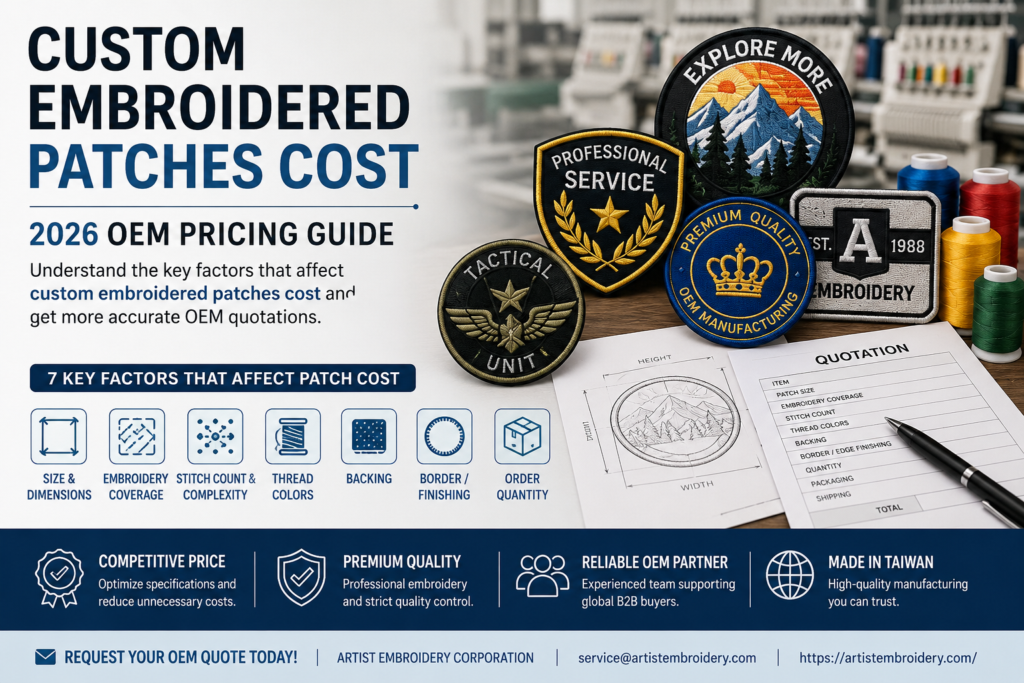
A professional quotation considers multiple manufacturing variables together. The most common factors influencing embroidered patch cost per piece include patch dimensions, embroidery coverage, stitch count, design complexity, thread colors, backing, edge finishing, quantity, and special materials.
Patch size affects the amount of base fabric and embroidery area required. However, a larger patch is not automatically more expensive than every smaller patch because embroidery density and stitch count can sometimes have an even greater effect on production time.
Embroidery coverage refers to how much of the visible patch surface is covered by embroidery. A design using approximately 50% embroidery leaves more of the base fabric visible, while a 100% embroidered patch uses stitches across nearly the entire visible surface. Greater coverage generally increases thread consumption and machine time.
Stitch count provides another useful measurement of production complexity. Detailed logos, small lettering, gradients simulated through embroidery, and dense background areas may require substantially more stitches than simple graphics.
Order quantity affects how production setup costs are distributed. Bulk orders typically allow manufacturers to use machinery, materials, and preparation time more efficiently, reducing the manufacturing cost per piece.
Additional specifications—including hook-and-loop backing, iron-on adhesive, specialty threads, individual packaging, complex edge finishing, or unusual shapes—may also influence the final quotation.
For B2B buyers, the most reliable approach is therefore to provide the manufacturer with complete project specifications instead of requesting a price based only on dimensions.
📊 Table: Key Factors That Affect Custom Embroidered Patch Cost
| Cost Factor | What It Affects | Typical Cost Impact |
|---|---|---|
| Patch Size | Fabric, embroidery area, material usage | Low–High |
| Embroidery Coverage | Thread usage and machine time | Medium–High |
| Stitch Count | Machine running time | High |
| Design Complexity | Digitizing and embroidery difficulty | Medium–High |
| Thread Colors | Thread changes and production setup | Low–Medium |
| Backing | Materials and finishing processes | Low–Medium |
| Border Type | Edge-finishing process | Low–Medium |
| Order Quantity | Production efficiency and unit cost | High |
| Specialty Materials | Material and manufacturing requirements | Medium–High |
| Packaging | Additional materials and labor | Low–Medium |
💡 Buyer Tip: When comparing quotations, send the same artwork, dimensions, quantity, backing, border, and other specifications to every supplier. Otherwise, the quoted prices may represent different production standards and are not directly comparable.
📖 Extended Reading
- Custom Embroidered Patches MOQ: What Buyers Need to Know
- OEM Embroidered Patch Manufacturer: Complete Buyer Guide for Custom Patches
- Taiwan vs China Embroidered Patch Manufacturers: Which One Is Better in 2026?
7 Factors That Affect Custom Embroidered Patch Pricing
Understanding the factors behind custom embroidered patches cost is essential when comparing quotations from different OEM manufacturers. Although buyers often begin by asking for a price based on patch dimensions and quantity, professional embroidered patch pricing involves several interconnected production variables. A change in embroidery coverage, stitch count, backing, border finishing, or order volume can alter the amount of machine time, materials, and processing required for the same design.
For B2B buyers, these differences become particularly important when purchasing hundreds or thousands of patches. A small change in the embroidered patch cost per piece can significantly affect the total procurement budget at higher quantities. However, reducing specifications purely to obtain the lowest price can also affect appearance, durability, and consistency.
The following seven factors are among the most important variables manufacturers evaluate when preparing an OEM quotation.
1. Patch Size and Dimensions
Patch dimensions are one of the first specifications required for an accurate quotation. Larger patches generally require more base fabric, stabilizing material, thread, and embroidery time. However, size should never be evaluated independently from the artwork.
For example, a 4-inch patch with a simple logo and substantial exposed twill may require fewer stitches than a highly detailed 3-inch patch with dense background embroidery. In this situation, the smaller patch can still require significant production time despite using less base material.
Shape can also influence manufacturing. Standard circles, rectangles, shields, and simple geometric forms are generally straightforward to produce, while intricate outlines containing narrow points or complex contours may require additional attention during digitizing and edge finishing.
For this reason, buyers requesting custom patch prices should always provide both the artwork and exact finished dimensions instead of requesting quotations based on size alone.
2. Embroidery Coverage
Embroidery coverage describes the percentage of the visible patch surface covered by embroidered stitches. Common specifications are often described as approximately 50%, 75%, or 100% embroidery.
A design with lower coverage allows more of the base fabric—such as twill—to remain visible. This reduces the amount of embroidery required and can decrease machine running time and thread consumption.
By contrast, a fully embroidered design requires stitches across nearly the entire visible surface. Depending on the artwork, this can substantially increase stitch count and production time.
However, buyers should not automatically assume that greater coverage always produces a better patch. For certain logos and uniform applications, exposed twill can provide desirable contrast and a clean professional appearance. The appropriate coverage should therefore be selected according to the design rather than simply maximizing embroidery density.
3. Stitch Count and Design Complexity
Stitch count is one of the most important technical variables affecting OEM embroidered patch pricing. Every additional stitch contributes to machine running time, and complex artwork generally requires more careful digitizing to reproduce the design effectively.
Fine lettering, small details, layered graphics, dense backgrounds, multiple outlines, and intricate visual elements can all increase stitch count. Even two patches with identical dimensions and embroidery coverage may have different stitch counts because their internal artwork is structured differently.
Professional embroidery digitizing is therefore more than converting an image into a machine-readable file. The digitizer must determine stitch types, directions, densities, underlay, sequencing, and other technical settings that influence both appearance and production efficiency.
An optimized embroidery file should reproduce the artwork clearly without adding unnecessary stitches that increase production time or create excessive density.
4. Thread Colors and Special Threads
The number of thread colors used in a design directly affects custom embroidered patches cost. In general, the more thread colors a patch requires, the higher the production price will be.
Each additional color requires production preparation. The manufacturer must select and prepare the correct embroidery thread, assign it within the embroidery program, arrange the required thread on the embroidery machine, and manage color changes during production. As the number of colors increases, embroidery sequencing and production control can also become more complicated.
For example, a relatively simple patch using three or four standard thread colors will generally be more economical to manufacture than a comparable design requiring nine, ten, or more colors. When large quantities are involved, these differences become increasingly important because the additional production cost is multiplied across the entire order.
Buyers should therefore provide complete color requirements when requesting embroidered patch pricing. Quotations based on different numbers of thread colors should not be considered directly equivalent.
However, reducing colors purely to obtain the lowest price is not always the best approach. Corporate logos, national flags, military and police emblems, sports team designs, and other branded applications may require specific colors to preserve visual accuracy and identity.
When cost optimization is necessary, buyers can ask the manufacturer whether visually similar or unnecessary shades can be consolidated without significantly changing the original artwork.
Specialty threads can further affect pricing. Metallic, reflective, or other specialized embroidery materials may require different thread preparation, machine settings, production speeds, or handling compared with standard polyester embroidery thread.
For projects requiring precise brand colors, buyers should provide Pantone references or approved physical samples whenever possible.
💡 Buyer Tip: More thread colors generally mean a higher custom patch price. When budget is important, review whether every color is necessary while preserving essential brand and design colors.
5. Backing Options
Backing determines how the finished patch will be attached to a garment, uniform, bag, cap, or other product. The selected backing adds materials and processing steps and therefore contributes to the final custom embroidered patches cost.
A basic sew-on patch generally requires fewer additional backing processes. Iron-on patches require a heat-activated adhesive layer, while hook-and-loop patches require additional materials and assembly. Pressure-sensitive adhesive backing is another option for temporary or specialized applications.
The appropriate backing should be selected according to the intended use rather than price alone. For example, hook-and-loop backing is particularly useful for applications where patches must be removed or replaced regularly, while sew-on attachment provides a permanent solution for many garments.
Buyers should therefore specify the required backing when requesting quotations so manufacturers can calculate the correct production process.
6. Border and Edge Finishing
The edge of an embroidered patch affects both appearance and durability. Two commonly used finishing methods are merrowed borders and heat-cut edges.
A merrowed border creates a raised stitched edge around the patch and is commonly used for traditional circles, rectangles, shields, and other relatively simple shapes. Heat-cut edges are especially useful for irregular or highly customized outlines where a conventional merrowed border may not follow the shape effectively.
The appropriate method depends on artwork, patch geometry, desired appearance, and application. Certain designs may require additional embroidery or cutting processes around detailed contours.
When comparing embroidered patch pricing, buyers should confirm whether suppliers are quoting the same edge-finishing method. A price difference may reflect different construction specifications rather than simply a higher manufacturing margin.
7. Order Quantity
Order quantity can have a major influence on the embroidered patch cost per piece because every production run involves preparation before mass embroidery begins.
Manufacturers may need to prepare the embroidery program, thread colors, fabric, backing materials, machine settings, cutting processes, inspection procedures, and packaging. These preparation requirements exist whether the order contains 100 pieces or several thousand pieces.
With larger orders, these setup requirements are distributed across more units, and continuous machine production can improve manufacturing efficiency. This is why bulk embroidered patches generally achieve a lower unit cost than small production runs with identical specifications.
However, buyers should distinguish between MOQ and the most economical order quantity. MOQ simply represents the minimum quantity a manufacturer is willing to produce. It does not necessarily represent the quantity with the best cost efficiency.
For recurring programs, buyers may benefit from discussing annual demand, repeat orders, or volume forecasts with the manufacturer rather than evaluating each small purchase independently.
📊 Table: 7 Major Custom Patch Cost Factors
| Pricing Factor | Why It Matters | Relative Cost Influence |
|---|---|---|
| Patch Size | Changes material usage and embroidery area | Medium–High |
| Embroidery Coverage | Influences thread consumption and machine time | Medium–High |
| Stitch Count & Complexity | Directly affects embroidery running time | High |
| Thread Colors | More colors require additional setup, color changes, and production control | Medium–High |
| Backing | Adds materials and processing | Low–Medium |
| Border / Edge Finishing | Changes finishing requirements | Low–Medium |
| Order Quantity | Distributes setup costs and improves efficiency | High |
💡 Buyer Tip: When comparing OEM quotations, do not evaluate the unit price alone. Confirm that every manufacturer is quoting the same size, embroidery coverage, backing, border, quantity, and production specifications. Otherwise, the lowest quotation may simply represent a different product specification.
📖 Extended Reading
- How to Design Artwork for Embroidery
- High-Density Embroidery & Stitch Count Guide
- Embroidered Patch Backing Comparison
Does Stitch Count Matter More Than Patch Size?
When buyers request an OEM quotation, patch dimensions are usually one of the first specifications they provide. Size is important, but it does not always explain the actual production workload. In many designs, stitch count can have a greater influence on custom embroidered patches cost than dimensions alone because stitch count directly affects machine running time, thread consumption, embroidery density, and overall production efficiency.
This explains why two patches measuring exactly 3 inches can receive different quotations. One design may contain a simple logo over exposed twill, while another may include dense backgrounds, small lettering, multiple outlines, and nearly complete embroidery coverage. The second design can require significantly more stitches even though both patches have identical finished dimensions.
For B2B buyers comparing embroidered patch pricing, understanding this relationship helps prevent misleading price comparisons. A professional OEM manufacturer should evaluate the actual artwork and production requirements rather than calculating price exclusively from width and height.
What Stitch Count Means in Embroidery Manufacturing
Stitch count refers to the approximate number of individual stitches required for an embroidery machine to reproduce a digitized design. Once artwork is converted into an embroidery program, the machine follows programmed stitch paths to build lettering, borders, backgrounds, logos, and other graphic elements.
As stitch count increases, the embroidery machine generally needs more time to complete each patch. This relationship makes stitch count an important component of embroidered patch cost per piece, especially for large-volume orders.
However, stitch count should not be viewed simply as a number that manufacturers should minimize. Sufficient stitch density is necessary to create clean coverage, stable lettering, defined shapes, and an appropriate finished appearance. If density is too low, the base fabric may become visible where it should be covered. Excessive density, on the other hand, can make embroidery unnecessarily heavy and may increase machine time without improving visual quality.
This is where professional embroidery digitizing becomes important. Stitch types, stitch directions, underlay, density, pull compensation, sequencing, and other parameters must work together to reproduce the artwork efficiently.
Industrial embroidery equipment also plays an important role in achieving consistent production across larger quantities. Professional multi-head embroidery machines allow multiple pieces to be embroidered simultaneously while following the same digitized program. Equipment manufacturers such as Tajima Group have developed industrial embroidery technologies used by professional embroidery operations worldwide.
The objective is therefore not simply to produce the highest possible stitch count. A properly engineered embroidery program should use an appropriate number of stitches to achieve the required appearance, durability, and production efficiency.
📖 External Industry Reference:
Tajima Group – Industrial Embroidery Technology
Why Two Same-Size Patches Can Have Different Costs
Imagine two custom patches that both measure 3 inches in diameter.
Patch A contains a relatively simple embroidered emblem positioned over a visible twill background. Large portions of the base material remain exposed, and the artwork contains limited lettering and relatively few detailed elements.
Patch B has the same 3-inch diameter but uses a fully embroidered background, several lines of small text, multiple borders, and detailed internal graphics.
Although the dimensions are identical, Patch B may require substantially more stitches. More stitches generally mean longer machine running time, greater thread consumption, and potentially more demanding production control.
Design geometry also matters. Large areas can often be embroidered efficiently with appropriate fill stitches, while small lettering, narrow outlines, complex shapes, and tightly spaced details may require more carefully programmed stitch sequences. A physically small patch can therefore be surprisingly complex to manufacture.
This is one reason buyers should be cautious when comparing quotations based on a statement such as “3-inch embroidered patch, 500 pieces.” That information alone does not define the product accurately enough for a meaningful comparison.
The artwork, embroidery coverage, backing, border, thread requirements, and construction specifications should also be consistent between quotations.
For repeat B2B orders, maintaining an approved embroidery file is particularly valuable. Once the design has been digitized, sampled, reviewed, and approved, future production can follow the established specifications, helping maintain visual consistency between production batches.
How Professional Digitizing Affects Stitch Efficiency
Embroidery digitizing is the process of translating artwork into instructions that an embroidery machine can execute. It determines not only where stitches are placed but also how different sections of the design are constructed.
A professional digitizer considers the intended patch size, base fabric, lettering dimensions, embroidery coverage, stitch direction, density, underlay, sequence, and edge construction. These decisions influence both the appearance of the patch and the efficiency of production.
For example, simply increasing stitch density does not necessarily create a higher-quality result. Excessive density may increase thread buildup, make the patch unnecessarily rigid, extend machine running time, and raise the custom patch price without delivering a meaningful visual improvement.
At the opposite extreme, insufficient density can result in poor coverage and an unfinished appearance.
Efficient digitizing seeks the appropriate balance. Large fill areas should be structured to achieve consistent coverage, while lettering and small details must remain readable at the actual production size. Stitch direction can also be used strategically to create visual separation between neighboring elements even when they use similar thread colors.
For buyers, this means the quality of an embroidery quotation cannot be evaluated solely by asking for the lowest stitch count or the lowest price. The more useful question is whether the manufacturer can reproduce the approved artwork with suitable density, clarity, durability, and consistency while maintaining efficient production.
When an OEM supplier reviews artwork before quoting, it can also identify details that may not reproduce well in embroidery. Simplifying extremely small lettering, adjusting narrow gaps, or modifying unnecessary complexity can sometimes reduce stitch count while improving the final appearance.
This combination of artwork evaluation, professional digitizing, industrial embroidery equipment, sampling, and production control is particularly important for bulk orders where even small inefficiencies can multiply across thousands of pieces.
📊 Table: Patch Size vs. Stitch Count vs. Production Complexity
| Example | Patch Size | Embroidery Coverage | Stitch Complexity | Expected Production Impact |
|---|---|---|---|---|
| Simple Logo Patch | 3″ | ~50% | Low | Lower machine time |
| Detailed Logo Patch | 3″ | ~75% | Medium | Moderate machine time |
| Full Embroidery Patch | 3″ | ~100% | High | Higher machine time |
| Large Simple Patch | 4″ | ~50% | Low–Medium | Size increases material usage |
| Small Detailed Patch | 2.5″ | ~100% | High | Small size does not guarantee low production complexity |
💡 Buyer Tip: When requesting an OEM quotation, provide the actual artwork whenever possible. Dimensions and quantity alone cannot accurately determine custom embroidered patches cost because the manufacturer must also evaluate embroidery coverage, stitch count, and design complexity.
📖 Extended Reading
- Laser Cutting in Embroidery
- Embroidered Badge Durability Guide
- Complete Guide to Embroidered Patches
How Embroidery Coverage Affects Patch Cost
Embroidery coverage is one of the most important variables affecting custom embroidered patches cost because it determines how much of the visible patch surface is covered with embroidery thread. Buyers may commonly encounter descriptions such as 50%, 75%, or 100% embroidery when requesting quotations, but these percentages should be understood as practical production categories rather than exact mathematical measurements of every stitch.
As embroidery coverage increases, more thread and machine running time are generally required. However, higher coverage does not automatically mean better quality. A well-designed patch using exposed twill can look just as professional as a fully embroidered patch while offering a different visual texture and potentially more efficient production.
For OEM buyers, the correct embroidery coverage should therefore be selected according to artwork, intended appearance, application, durability requirements, and budget. When comparing embroidered patch pricing between suppliers, it is also important to confirm that each quotation is based on approximately the same embroidery coverage. Otherwise, two apparently similar quotations may represent substantially different construction specifications.
50% Embroidery Coverage
A patch with approximately 50% embroidery coverage leaves a significant portion of the base fabric visible. Instead of filling the entire surface with stitches, embroidery is concentrated on logos, lettering, symbols, borders, and other essential design elements.
This construction can be highly effective for designs that intentionally use the background fabric as part of the visual composition. Twill is commonly used because it provides a clean, stable surface that complements embroidered elements while reducing the need for unnecessary fill stitches.
From a manufacturing perspective, lower embroidery coverage can reduce stitch count, thread consumption, and machine running time. This can contribute to a lower embroidered patch cost per piece, particularly when the design is ordered in large quantities.
However, 50% embroidery should not be viewed simply as a budget option. In many uniform, corporate, club, scout, and organizational applications, visible background fabric is an intentional design feature. Strong contrast between the twill and embroidery thread can make lettering and logos easy to recognize while maintaining a traditional patch appearance.
The actual cost still depends on the complexity of the embroidered areas. A patch with approximately 50% coverage but extremely detailed lettering or multiple intricate elements may require more production work than a simpler design with somewhat greater coverage.
For this reason, manufacturers should evaluate the artwork rather than determining price exclusively from the stated coverage percentage.
75% Embroidery Coverage
Approximately 75% embroidery coverage provides a balance between exposed base fabric and densely embroidered areas. It is useful for designs that require a richer embroidered appearance while still allowing selected sections of twill or another base material to remain visible.
This level of coverage is often suitable for logos containing large embroidered elements combined with intentional negative space. Compared with approximately 50% coverage, the design will generally require additional stitches and machine running time, which can increase custom patch pricing.
The advantage is flexibility. Buyers can achieve a more substantial embroidered appearance without necessarily filling every section of the patch with thread. This can be particularly effective when background fabric already matches the intended color of the design.
For example, if a patch requires a black background, using black twill in selected areas may achieve the desired appearance without embroidering an entire black field. The digitizer can then concentrate stitches on the logo, text, outlines, and visual elements that benefit most from embroidery.
This approach can help control stitch count while maintaining strong visual quality.
However, buyers should avoid selecting a coverage percentage before considering the artwork. The most efficient construction depends on how the colors, shapes, lettering, and background interact. Professional OEM manufacturers can review the artwork and determine whether exposed fabric can be incorporated naturally without compromising the intended design.
100% Full Embroidery
A 100% embroidered patch uses embroidery across nearly the entire visible surface. The base fabric primarily acts as a structural foundation while the finished appearance is created almost completely with thread.
Full embroidery is popular when buyers want a dense, premium embroidered texture or when the artwork requires a background color or visual effect that is best produced with stitches. It can also provide greater flexibility when multiple embroidered sections must interact across the entire patch surface.
Because almost the entire surface is stitched, full embroidery typically requires more stitches and machine time than comparable designs using substantial exposed twill. This means 100% coverage can have a significant influence on custom embroidered patches cost, particularly for larger patches and high-volume orders.
Nevertheless, the final price is still not determined by coverage alone. Stitch direction, density, lettering, number of design elements, thread changes, border construction, and overall digitizing complexity remain important.
Full embroidery can also create opportunities for visual effects that exposed fabric cannot reproduce. Different stitch directions can reflect light differently, creating subtle contrast even when neighboring areas use similar thread colors. Carefully planned stitch patterns can therefore add depth and texture to the finished design.
For B2B buyers, the key question should not be whether 100% embroidery is always superior, but whether it is necessary for the intended design. If large areas can use exposed twill without affecting the desired appearance, a lower embroidery percentage may provide both visual and manufacturing advantages.
When full coverage is necessary, professional digitizing becomes especially important because unnecessary stitch density across a large area can increase machine time and material consumption without providing a corresponding improvement in quality.
📊 Table: 50% vs. 75% vs. 100% Embroidery Coverage
| Embroidery Coverage | Visible Base Fabric | Stitch Requirement | Relative Production Cost | Best Suited For |
|---|---|---|---|---|
| ~50% | High | Lower | $ | Simple logos, uniforms, organizations, traditional patches |
| ~75% | Moderate | Medium | $$ | Detailed logos requiring balanced fabric and embroidery |
| ~100% | Minimal | Higher | $$$ | Full embroidered appearance, dense designs, premium visual texture |
💡 Buyer Tip: Do not automatically specify 100% embroidery because it sounds more premium. The most suitable coverage depends on the artwork. Using the base fabric strategically can sometimes reduce stitch count and custom embroidered patches cost while maintaining or even improving visual clarity.
📖 Extended Reading
- Embroidered Badges vs. Printed Badges: Comparison Guide
- Scout Embroidered Badges Guide
- Embroidered Patches for the Uniform Industry
How Order Quantity Changes the Cost Per Patch
Order quantity is one of the most influential factors affecting custom embroidered patches cost. When buyers request quotations for 50, 100, 500, 1,000, or several thousand pieces, the unit price generally changes because embroidery manufacturing includes both production setup and recurring manufacturing processes.
Before mass production begins, an OEM manufacturer must review the artwork, prepare or confirm the embroidery program, select thread colors, arrange base materials and backing, configure machinery, prepare cutting or border-finishing processes, and establish quality-control requirements. These preparation steps are necessary regardless of whether the production run contains 100 pieces or several thousand.
As order quantity increases, these setup requirements can be distributed across more finished pieces. Longer production runs can also improve machine utilization and reduce the frequency of preparation between jobs. This is why bulk embroidered patches cost less per piece in many OEM production scenarios.
However, buyers should not assume that ordering the largest possible quantity is always the best purchasing strategy. Inventory requirements, design changes, storage costs, future demand, and cash flow should also be considered. The objective is to find an order quantity that provides an appropriate balance between unit cost and actual purchasing requirements.
Why Small Orders Have a Higher Unit Cost
Small orders generally have a higher embroidered patch cost per piece because many production preparation steps remain necessary even when the total quantity is limited.
A new design must first be reviewed for embroidery feasibility. If digitizing is required, the artwork must be converted into an embroidery program that defines stitch types, directions, density, sequence, underlay, and other machine instructions. Threads and materials must then be prepared according to the approved specifications.
The embroidery machine also requires setup before production begins. After embroidery, patches may require cutting, merrowed borders, backing application, trimming, inspection, cleaning, sorting, and packaging. These processes create production overhead that cannot simply disappear because the order quantity is small.
For example, imagine that two buyers order the same design. Buyer A requests 100 pieces, while Buyer B requests 1,000 pieces. Both projects may require similar initial preparation, but Buyer B distributes that preparation across ten times as many finished units.
This does not mean small orders are undesirable. They may be appropriate for product testing, limited events, new organizations, small uniform programs, prototypes, or first-time orders. Buyers should simply understand why the custom patch price at 100 pieces cannot normally be expected to match the unit economics of a 1,000-piece production run.
How Bulk Production Reduces Unit Cost
Bulk production improves cost efficiency by allowing embroidery machinery, materials, and production preparation to be used across a larger number of pieces.
Once the embroidery program and machine settings are established, a manufacturer can continue producing the same design without repeatedly performing the complete setup required for a new job. Industrial multi-head embroidery equipment can further improve efficiency by producing multiple identical pieces during the same machine cycle.
Material purchasing and preparation can also become more efficient at larger quantities. Base fabric, backing materials, thread, packaging, and other components can be organized around a longer production run instead of multiple small jobs.
This is why wholesale embroidered patches price structures commonly include quantity breaks. The unit cost may decrease as the order moves from a small production run into medium or high-volume manufacturing.
However, buyers should avoid assuming that unit prices decrease at a perfectly linear rate. Increasing an order from 100 to 500 pieces may create a meaningful improvement in production efficiency, while increasing from 5,000 to 5,500 pieces may produce a much smaller difference.
The actual pricing structure depends on the design, stitch count, materials, machine capacity, finishing processes, packaging, and other manufacturing requirements.
For international B2B buyers, it can therefore be useful to request quotations for several realistic quantities. Instead of asking only for 500 pieces, a buyer expecting future demand might request pricing for 500, 1,000, and 3,000 pieces. This makes it easier to evaluate whether a larger production run provides sufficient savings to justify additional inventory.
MOQ vs. Best Economic Order Quantity
Minimum Order Quantity (MOQ) and the most economical order quantity are related concepts, but they are not the same.
MOQ refers to the minimum quantity that a manufacturer is willing or able to produce under its normal production conditions. It is influenced by setup requirements, materials, production scheduling, finishing processes, and the manufacturer’s operating model.
The best economic order quantity, on the other hand, is the quantity that provides an attractive balance between unit price, inventory requirements, expected demand, storage, and purchasing flexibility.
For example, suppose a manufacturer accepts an order of 100 patches. That quantity may satisfy the MOQ requirement, but a buyer who regularly uses 1,000 pieces per year may discover that ordering several hundred pieces at a time provides better unit economics.
At the same time, ordering excessively large quantities simply to obtain the lowest embroidered patch pricing can create other costs. Branding may change, uniform specifications may be updated, products may be discontinued, or unused inventory may remain in storage.
This is particularly relevant for distributors, promotional product companies, uniform suppliers, and brands managing multiple designs. Inventory capital should be considered alongside manufacturing cost.
For repeat programs, buyers can discuss expected annual volume with their OEM manufacturer. Even when orders are released in separate batches, providing realistic demand information can help both parties plan materials and production more effectively.
The key is therefore not simply to ask, “What is your MOQ?” A more useful sourcing question is: “At what quantity does this design become more cost-efficient for our purchasing requirements?”
📊 Table: How Order Quantity Influences Unit Cost
| Order Quantity | Production Setup Impact per Piece | Production Efficiency | Typical Unit Cost Trend | Suitable For |
|---|---|---|---|---|
| 50–100 pcs | High | Low | $$$$ | Samples, small organizations, limited projects |
| 200–500 pcs | Medium–High | Moderate | $$$ | Small commercial orders |
| 500–1,000 pcs | Medium | Good | $$–$$$ | Regular B2B purchasing |
| 1,000–5,000 pcs | Low | High | $$ | Wholesale and recurring programs |
| 5,000+ pcs | Lower | Very High | $–$$ | Large-volume OEM programs |
The table illustrates general manufacturing economics only. Actual pricing depends on artwork, dimensions, stitch count, embroidery coverage, backing, finishing, packaging, and other specifications.
💡 Buyer Tip: When requesting a quotation, ask for two or three realistic quantity levels instead of only one. Comparing 500, 1,000, and 3,000 pieces, for example, can help determine whether a larger order provides enough unit-cost savings to justify the additional inventory.
📖 Extended Reading
- Custom Embroidered Patches MOQ
- Global Market Trends in Embroidered Patches
- Sustainable Embroidered Patches
Which Backing and Finishing Options Affect Pricing?
Backing and finishing options can significantly influence both the functionality and custom embroidered patches cost. After embroidery is completed, a patch may require additional materials and production processes depending on how it will be attached to a garment, uniform, bag, cap, tactical product, or promotional item. A basic sew-on patch, for example, has different production requirements from a patch using iron-on adhesive or hook-and-loop backing.
For B2B buyers, the lowest-cost backing is not necessarily the best choice. The correct option depends on the end application, whether the patch needs to be permanent or removable, how frequently it will be washed, the garment material, and how the finished product will be used.
Edge finishing is another important consideration. Merrowed borders and heat-cut edges create different appearances and are suitable for different patch shapes. When comparing embroidered patch pricing, buyers should therefore confirm that competing quotations include the same backing and finishing specifications.
Sew-On Backing
Sew-on is one of the simplest and most traditional attachment methods for embroidered patches. The finished patch is sewn directly onto a garment or product without requiring an adhesive attachment system.
Because sew-on patches generally require fewer additional backing materials, they can provide a straightforward manufacturing option. However, the final embroidered patch cost per piece still depends on the base construction, embroidery coverage, stitch count, border, and other specifications.
Sew-on attachment is commonly used for uniforms, workwear, jackets, bags, scout applications, clubs, organizations, and products where the patch is intended to remain permanently attached.
One advantage is attachment durability. When properly sewn, the patch is mechanically secured to the garment around its edge or designated sewing area. This makes sew-on construction suitable for applications exposed to repeated handling or washing.
From a sourcing perspective, buyers should also consider who will perform the final sewing operation. If patches are being delivered to a garment factory, the supplier may already have sewing operations available. In other cases, the buyer may need to arrange local attachment, which adds a downstream cost even if the patch itself has a relatively simple backing.
Therefore, the lowest patch manufacturing price does not always represent the lowest total finished-product cost.
Iron-On Backing
Iron-on backing adds a heat-activated adhesive layer to the reverse side of the embroidered patch. During application, heat and pressure activate the adhesive and bond the patch to a compatible fabric.
This option can be attractive for consumer products, promotional merchandise, fashion items, and applications where buyers want a convenient attachment method without immediate sewing.
Because additional adhesive material and processing are required, iron-on backing can increase custom patch pricing compared with a basic sew-on construction. The actual difference depends on the patch dimensions, backing material, production quantity, and manufacturing process.
Buyers should also consider the fabric to which the patch will be applied. Not every garment material responds equally well to heat. Heat-sensitive fabrics, coated materials, waterproof fabrics, or certain synthetic textiles may require testing before iron-on application is selected.
Washing conditions and intended product life are also relevant. For applications requiring maximum long-term attachment security, sewing may still be preferred or used together with heat application.
For large OEM projects, buyers should communicate the final garment material and application method whenever possible so the manufacturer can recommend a suitable construction.
Velcro / Hook-and-Loop Backing
Hook-and-loop backing is widely used when embroidered patches need to be removable, interchangeable, or repositioned. It is particularly common for military-style equipment, police and security uniforms, tactical products, outdoor equipment, name patches, identification systems, and organizational applications.
Unlike a simple sew-on patch, hook-and-loop construction requires additional material to be attached to the back of the embroidered patch. Depending on the specification, buyers may require only the hook side on the patch or a complete hook-and-loop set.
These additional materials and assembly processes generally increase custom embroidered patches cost compared with basic backing options.
The advantage is flexibility. Users can remove a name patch, rank patch, identification badge, unit emblem, or decorative design without permanently altering the garment or equipment.
For B2B sourcing, it is important to specify exactly what is required. A quotation for “Velcro backing” may not always mean the same thing between suppliers. Buyers should confirm whether the price includes only the hook side or both mating components.
Dimensions and shape also matter because the hook-and-loop material usually needs to follow the patch outline or another specified configuration.
Adhesive Backing
Pressure-sensitive adhesive backing allows a patch to be temporarily attached by removing a protective release liner and pressing the patch onto a surface.
This option can be useful for positioning, promotional applications, temporary displays, product presentation, or situations where permanent sewing is not immediately required.
Adhesive backing should not automatically be treated as a replacement for permanent attachment methods. Its performance depends on the adhesive system, application surface, temperature, handling, and intended duration of use.
Adding adhesive backing introduces additional material and processing requirements, which may affect the embroidered patch cost per piece. For large quantities, even a relatively small additional processing cost can become significant across the complete order.
Buyers should therefore explain the intended application instead of selecting adhesive backing simply because it appears convenient. If the patch will experience frequent washing, heavy movement, outdoor exposure, or long-term use, another attachment method may be more suitable.
Button Loop and Specialty Attachments
Some embroidered patches require attachment systems beyond standard sew-on, iron-on, hook-and-loop, or adhesive backing. Button loops are one example.
A button-loop embroidered patch includes a loop that allows the patch to hang from or attach to an existing button. This construction can be useful when users want a removable embroidered identification element without permanently sewing it to the garment.
Specialty attachment requirements may include loops, tabs, custom hook-and-loop configurations, or other construction features developed for a specific uniform, promotional product, accessory, or equipment system.
These features can affect OEM embroidered patch pricing because they introduce additional materials, assembly steps, and quality-control points.
For custom projects, buyers should provide reference photos, technical drawings, dimensions, or physical samples when possible. A description such as “add a loop” may not provide enough information to determine the required material, loop length, position, or construction method.
Clearly defining these details before sampling reduces the risk of revisions and helps the manufacturer prepare a more accurate quotation.
Border and Edge Finishing Considerations
Backing determines how a patch attaches to another product, while edge finishing determines how the perimeter of the patch is completed.
A merrowed border creates the familiar raised stitched edge commonly seen on traditional embroidered patches. It works particularly well with circles, rectangles, ovals, shields, and other shapes with relatively smooth contours.
A heat-cut edge is often preferred for detailed or irregular shapes because the patch can be cut closely around the embroidered outline. This allows greater freedom when the artwork includes complex external contours.
Neither method is universally superior. The correct choice depends on the design.
When evaluating custom embroidered patches cost, buyers should make sure the border specification remains consistent between suppliers. Comparing a quotation using a standard merrowed border with another quotation requiring a complex heat-cut shape may not provide a meaningful price comparison.
📊 Table: Patch Backing Options and Relative Cost Impact
| Backing / Attachment | Additional Processing | Relative Cost Impact | Typical Applications |
|---|---|---|---|
| Sew-On | Minimal | $ | Uniforms, jackets, bags, permanent applications |
| Iron-On | Heat-activated adhesive | $$ | Fashion, promotional products, consumer applications |
| Hook-and-Loop | Additional backing material and assembly | $$–$$$ | Military, police, tactical, name patches |
| Adhesive | Pressure-sensitive adhesive and liner | $$ | Temporary positioning and promotional applications |
| Button Loop | Loop material and additional assembly | $$–$$$ | Removable uniform and identification patches |
| Specialty Attachment | Depends on specification | Varies | Custom OEM applications |
Relative cost symbols are intended only to illustrate general manufacturing complexity. Actual pricing depends on the complete patch specification and order quantity.
💡 Buyer Tip: When requesting a quotation for hook-and-loop patches, clearly state whether you need hook backing only or both hook and loop pieces. This small specification difference can affect materials, processing, and the final quotation.
📖 Extended Reading
- Embroidered Patch Backing Comparison: A Beginner’s Practical Guide
- Velcro Embroidered Patches Guide
- Button Loop Embroidered Patches: Benefits and Applications
How Thread, Colors, and Materials Affect Manufacturing Cost
Thread selection, color requirements, and base materials are important components of custom embroidered patches cost. Although stitch count and order quantity usually have a greater influence on overall production economics, material specifications can change thread consumption, machine setup, production speed, appearance, and finishing requirements.
For B2B buyers, material selection should not focus exclusively on reducing the embroidered patch cost per piece. An embroidered patch may be used on workwear, uniforms, outdoor equipment, promotional products, fashion items, sports apparel, or identification systems, and each application may have different expectations for appearance, color consistency, durability, and repeated use.
The artwork itself also influences material decisions. Some designs can be produced efficiently with standard polyester embroidery thread and twill, while others may require specific colors, metallic effects, reflective elements, or other specialty materials. Clearly identifying these requirements during the quotation stage helps OEM manufacturers calculate production costs accurately and reduces the risk of unexpected changes after sampling.
Standard Polyester Embroidery Thread
Polyester embroidery thread is widely used in commercial embroidery because it offers a practical combination of strength, color availability, production stability, and visual quality. For many OEM patch applications, it provides the performance required for regular handling, garment use, and repeated production.
Thread quality matters because embroidery machines operate at high speed. Consistent thread construction helps reduce unnecessary interruptions while maintaining uniform stitch formation across production runs. This becomes increasingly important for bulk orders where a design may be reproduced hundreds or thousands of times.
For buyers, thread selection also affects long-term consistency. A manufacturer producing repeat orders should be able to manage thread specifications so that future batches remain reasonably consistent with previously approved production.
Polyester thread is available in a broad range of colors, allowing manufacturers to match artwork closely without automatically requiring specialty materials. This makes it suitable for corporate logos, uniforms, clubs, sports organizations, military-style patches, promotional products, fashion applications, and many other embroidered products.
The final custom patch price, however, cannot be determined simply by stating that polyester thread is used. The amount of thread consumed depends heavily on embroidery coverage and stitch count. A small fully embroidered design may consume more thread than a larger patch containing extensive exposed twill.
For this reason, thread requirements should always be considered together with artwork, stitch density, dimensions, and production quantity.
Multiple Thread Colors and Machine Setup
Color is one of embroidery’s major visual advantages, allowing individual thread colors to create clear separation between lettering, borders, logos, symbols, backgrounds, and other design elements. However, buyers should understand that increasing the number of thread colors also increases custom embroidered patches cost.
Each additional color requires preparation before and during production. The correct thread must be selected, prepared, assigned within the embroidery program, and arranged on the embroidery machine. Designs requiring many colors also involve more color changes and can require more complicated embroidery sequencing and production control.
As a result, a patch using three or four standard thread colors will generally have a lower production cost than a comparable patch using nine, ten, or more colors.
The pricing difference becomes particularly relevant for bulk OEM production. A relatively small additional embroidered patch cost per piece can become significant when multiplied across 1,000, 5,000, or more patches.
For this reason, buyers comparing quotations should confirm that every supplier is quoting the same number of thread colors. A lower quotation based on fewer colors does not represent the same production specification as a quotation that includes all colors shown in the original artwork.
However, reducing the number of colors should be approached carefully. Important corporate colors, national flag colors, identification elements, team colors, or other brand-specific requirements should generally be preserved.
When artwork contains several visually similar shades, buyers can ask the manufacturer whether some colors can be consolidated without significantly affecting the overall appearance. This can help control custom patch pricing while maintaining the essential visual identity of the design.
Buyers requiring precise brand colors should provide Pantone references whenever possible. Approved physical samples can also be valuable for repeat production because embroidery thread is a physical material whose appearance can vary depending on lighting, sheen, neighboring colors, and stitch direction.
Therefore, color optimization should not simply mean “use fewer colors.” The objective is to use the necessary number of colors to reproduce the artwork correctly while avoiding unnecessary color complexity.
💡 OEM Tip: If a design contains many similar shades, ask whether some colors can be consolidated before sampling. Fewer unnecessary colors can reduce production complexity and custom embroidered patches cost without significantly changing the design.
Metallic, Reflective, and Specialty Threads
Specialty threads can create visual effects that standard polyester embroidery cannot reproduce. Metallic threads, reflective elements, and other specialty materials may be used to add shine, contrast, visibility, or distinctive surface characteristics.
These materials can influence custom embroidered patches cost because their behavior during embroidery may differ from standard thread. Depending on the material, manufacturers may need to adjust machine speed, tension, needle selection, stitch structure, or other production parameters.
Metallic thread, for example, can provide an attractive decorative effect for emblems, ceremonial patches, fashion products, club designs, and premium branding. However, using metallic thread across unnecessarily large areas may increase manufacturing complexity without improving the design proportionally.
Reflective materials or specialty elements may be valuable for applications where visibility is important, but buyers should clearly define whether they require a visual reflective effect, a specific performance level, or simply a particular appearance.
Specialty materials should therefore be selected based on function and design intent rather than added automatically as a premium feature.
Sampling becomes particularly important when these materials are involved. A digital artwork preview cannot fully represent how metallic shine, thread texture, stitch direction, or reflective characteristics will appear on the finished embroidered product.
For OEM orders, reviewing a physical sample before mass production allows buyers to confirm whether the selected materials create the intended result and whether any artwork adjustments are necessary.
Thread Quality and Supply-Chain Consistency
For recurring B2B production, thread sourcing is not only a question of individual patch appearance. Supply consistency can also affect repeat-order reliability.
Professional embroidery manufacturers depend on established thread suppliers that can provide stable specifications and broad color selections. This helps manufacturers manage repeat programs where buyers expect future orders to remain consistent with previously approved samples.
One industry supplier relevant to professional embroidery manufacturing is FuFu’s Thread, which provides embroidery threads for industrial applications. Material suppliers form an important part of the broader embroidery production chain because thread quality and availability directly support consistent manufacturing.
When buyers evaluate an OEM supplier, asking about materials can therefore provide useful information beyond price. A quotation based on unspecified or inconsistent materials may appear attractive initially but can create difficulties when repeat orders require matching previous production.
📖 External Industry Reference:
FuFu’s Thread – Professional Embroidery Threads
📊 Table: Standard vs. Specialty Embroidery Materials
| Material / Requirement | Production Characteristics | Relative Cost Impact | Typical Applications |
|---|---|---|---|
| Standard Polyester Thread | Efficient, durable, broad color selection | $ | Most commercial embroidered patches |
| Multiple Standard Colors | More colors increase setup, color changes, and production complexity | $$–$$$ | Logos, uniforms, branding |
| Precise Color Matching | Requires color references and confirmation | $–$$ | Corporate and brand programs |
| Metallic Thread | May require production adjustments | $$–$$$ | Ceremonial, premium, decorative designs |
| Reflective Elements | Specialized material and processing | $$–$$$ | Outdoor, safety-oriented applications |
| Other Specialty Materials | Depends on specification | Varies | Custom OEM projects |
Relative cost symbols illustrate general production complexity only and do not represent fixed pricing.
💡 Buyer Tip: For brand-sensitive projects, provide Pantone references or an approved physical sample when requesting a quotation. Also provide the complete artwork rather than removing colors before quotation, so the manufacturer can evaluate the actual production requirements.
📖 Extended Reading
- Flag Embroidered Patches: OEM Guide
- Sports Team Embroidered Badges Guide
- Outdoor Activity Embroidered Patches
Hidden Costs Buyers Should Check Before Ordering
When comparing custom embroidered patches cost, buyers often focus on the quoted unit price. However, the price per patch may not represent the complete cost of an OEM order. Digitizing, sampling, packaging, international shipping, design revisions, special materials, and other project requirements can affect the final amount a buyer pays.
This is particularly important when comparing quotations from multiple suppliers. One manufacturer may include certain production services in its quotation, while another may list them separately. A lower embroidered patch cost per piece can therefore appear more competitive initially even though additional charges are added later.
For importers, distributors, uniform suppliers, promotional product companies, and other B2B buyers, the most useful comparison is the total procurement cost for equivalent specifications, not simply the lowest number shown beside the unit price.
Before placing an order, buyers should confirm what the quotation includes, which costs are charged separately, and whether additional expenses could arise between artwork approval and final delivery.
Digitizing and Setup Fees
Before artwork can be embroidered, it must be converted into a machine-readable embroidery program. This process is commonly known as embroidery digitizing.
Digitizing determines stitch types, stitch direction, density, underlay, sequencing, pull compensation, and other technical parameters required to reproduce the artwork with embroidery equipment. A professional digitizer must consider not only how the design looks on screen but also how thread and fabric behave during actual production.
Some manufacturers charge digitizing or setup as a separate one-time fee, while others may incorporate part or all of the preparation cost into the quotation. Buyers should therefore confirm how this expense is handled before comparing OEM embroidered patch pricing.
Design complexity can also affect digitizing requirements. Simple lettering and basic logos may require less preparation than artwork containing small text, layered graphics, complicated borders, or highly detailed elements.
For repeat orders using the same approved embroidery program, the original digitizing work may not need to be recreated unless the buyer changes the dimensions, artwork, construction, or other specifications.
This is one reason maintaining approved artwork and production records is valuable for recurring B2B programs.
Sample and Pre-Production Costs
Sampling allows buyers to evaluate the actual embroidered result before full-scale production begins. This can be especially important because embroidery is a physical process, and some details that appear clear in digital artwork may behave differently when reproduced with thread.
Small lettering may need adjustment, narrow gaps can close visually, colors may appear different under real lighting, and stitch direction can influence texture and contrast.
A manufacturer may therefore create a pre-production sample so the buyer can review dimensions, colors, embroidery quality, border construction, backing, and overall appearance.
Depending on the supplier and project, sampling may involve a separate fee, shipping cost, or other preparation expenses. These charges should be considered when calculating the complete custom patch price.
For large-volume orders, however, the value of sampling can significantly outweigh its cost. Discovering a design problem before producing thousands of pieces is far less expensive than correcting an entire completed production run.
Buyers should also establish a clear approval process. Once a physical or confirmed production sample is approved, it should become an important reference for subsequent mass production and quality control.
Packaging Requirements
Packaging is sometimes overlooked during early quotation discussions because buyers naturally concentrate on the embroidered product itself.
For bulk industrial orders, patches may only require efficient bulk packaging suitable for transportation. Retail programs, however, may require individual polybags, labels, header cards, barcode stickers, sets, quantity sorting, or other custom packaging.
Every additional packaging operation requires materials and labor. While the incremental cost may appear small per piece, it can become significant when multiplied across thousands of units.
For example, individually packaging 5,000 patches involves a very different production process from placing the same quantity into several bulk cartons.
B2B buyers should therefore communicate packaging requirements during the initial RFQ rather than introducing them after the patch price has already been negotiated.
This helps the manufacturer prepare a quotation based on the complete project and prevents unexpected cost changes before shipment.
International Shipping
For overseas buyers, freight can represent an important part of the total procurement cost. The impact varies according to shipment weight, carton dimensions, destination, delivery speed, shipping method, and order quantity.
A quotation may be provided on a product-only basis or may include shipping depending on the agreed terms. Buyers should confirm this clearly.
Small urgent shipments may have a relatively high freight cost per piece because the transportation charge is distributed across fewer products. Larger orders can sometimes achieve better freight economics per unit, although total shipment weight will naturally increase.
International buyers should also distinguish the manufacturer’s product quotation from possible import-related charges in the destination market. Depending on the country and transaction terms, duties, taxes, customs clearance, brokerage, or other local charges may be handled separately.
Because these requirements vary by destination, buyers should avoid assuming that an attractive factory price automatically represents the final landed cost.
When requesting an OEM quotation, providing the destination country—and postal code when relevant—allows the supplier to evaluate shipping options more accurately if freight is required.
Design Revisions and Special Requirements
Changes made after digitizing, sampling, or production preparation can create additional work and may affect custom embroidered patches cost.
Minor artwork adjustments before production may be straightforward, but significant changes to dimensions, lettering, colors, embroidery coverage, backing, border construction, or overall artwork can require the embroidery program to be modified or rebuilt.
If a buyer approves a sample and later changes the design, another sample may also be necessary before mass production.
Special requirements can create similar cost differences. Custom packaging, unusual backing systems, specialty threads, extremely precise color requirements, sequential numbering, special inspection procedures, or other non-standard specifications may require additional materials or labor.
The most effective way to control these expenses is to establish specifications as clearly as possible before production begins.
A complete RFQ should ideally include artwork, finished dimensions, quantity, embroidery coverage expectations, backing, border type, color references, packaging requirements, delivery destination, and any special performance requirements.
Clear communication at the beginning of the project reduces unnecessary revisions and allows suppliers to provide quotations that more accurately represent the final product.
📊 Table: Potential Costs Beyond the Patch Unit Price
| Potential Cost | Why It May Apply | What Buyers Should Confirm |
|---|---|---|
| Digitizing / Setup | Converts artwork into an embroidery program | Included or separately charged? |
| Pre-Production Sample | Confirms physical appearance before mass production | Sample and delivery cost? |
| Packaging | Individual bags, labels, sorting, retail packaging | Bulk or individual packaging? |
| International Shipping | Depends on weight, destination, and delivery method | Included in quotation? |
| Import Charges | May apply in the destination country | Who is responsible? |
| Artwork Revisions | Major changes may require re-digitizing | How are revisions handled? |
| Specialty Materials | Metallic thread, special backing, custom materials | Included in unit price? |
| Special QC Requirements | Additional inspection or documentation | Standard or additional service? |
💡 Buyer Tip: Instead of asking only “What is your price per patch?”, ask suppliers “What exactly is included in this quotation?” Comparing the total cost for identical specifications provides a much more reliable picture of the real custom embroidered patches cost.
📖 Extended Reading
- How to Order Custom Embroidered Patches
- OEM Embroidery Manufacturer
- Embroidered Patch Quality and Durability Guide
Manufacturer vs. Trading Company: Does It Affect Patch Pricing?
When sourcing custom embroidered patches internationally, buyers may receive quotations from both direct manufacturers and trading companies. The two business models can provide different services, communication structures, and sourcing experiences, which may ultimately influence custom embroidered patches cost.
A direct OEM manufacturer operates embroidery production equipment and manages manufacturing processes internally. A trading company, by contrast, typically coordinates orders with one or more external factories and acts as an intermediary between the buyer and the actual producer. Neither model should automatically be judged only by price; what matters is whether the supplier can provide the required quality, communication, production control, delivery reliability, and commercial support.
However, buyers should understand which type of supplier they are working with. When a project involves complex artwork, strict color requirements, special backing, sampling revisions, repeat production, or large quantities, direct communication with the production side can become particularly valuable.
For accurate OEM embroidered patch pricing, transparency about manufacturing capability helps buyers understand what is included in the quotation and how production issues will be managed if specifications change.
Direct Factory Pricing
Working directly with an embroidered patch manufacturer can reduce the number of commercial layers between the buyer and the production facility. The factory reviews the artwork, evaluates stitch count and production requirements, prepares samples, schedules embroidery, performs finishing processes, and manages quality control.
This direct structure can provide advantages when determining embroidered patch cost per piece because technical questions can be evaluated by people closely connected to actual production.
For example, if artwork contains extremely small lettering, unnecessary embroidery density, or a complicated edge shape, a manufacturer can assess whether modifications could improve embroidery quality or production efficiency. Similarly, if a buyer needs hook-and-loop backing, special packaging, or a specific border construction, the production requirements can be considered during quotation.
Direct factory sourcing does not necessarily mean that every quotation will always be cheaper. Manufacturing cost depends on equipment, labor, materials, order quantity, quality standards, production capacity, and many other factors.
The greater advantage is often visibility into how the product will be manufactured. For repeat B2B programs, this can help buyers maintain approved specifications across future orders and communicate technical changes more efficiently.
Trading Company Markups and Communication Layers
Trading companies typically coordinate sourcing rather than performing every manufacturing process themselves. They may work with one or multiple production facilities and manage communication, purchasing, consolidation, logistics, or other commercial services on behalf of buyers.
Because an intermediary provides these services, its quotation may include a commercial margin in addition to the underlying factory cost. However, it would be inaccurate to assume that every trading company automatically provides poor value or that every direct manufacturer is automatically the cheapest option.
A trading company may be useful when a buyer needs several different product categories sourced from multiple factories, consolidated purchasing, language support, or centralized supplier management.
The important issue is transparency.
When technical questions pass through additional communication layers, there is a greater possibility that details can be simplified, delayed, or interpreted differently before reaching the actual production team. For basic products, this may not create significant problems. For technically demanding embroidered patches, however, details such as stitch density, thread selection, small lettering, backing construction, edge finishing, and sample revisions can matter considerably.
Buyers comparing custom patch prices should therefore evaluate not only the quotation amount but also how technical information will move between the buyer and production team.
Why Production Transparency Matters
Production transparency allows buyers to evaluate whether a supplier’s claimed capabilities correspond with the actual manufacturing process.
For embroidered patches, useful evidence may include embroidery machinery, production-floor photographs, factory videos, sample development procedures, material preparation, finishing operations, quality-control processes, and examples of completed products.
This information is particularly valuable for international buyers who cannot easily visit every potential supplier.
Transparency also becomes important when production problems occur. If a sample contains lettering that is too small, an incorrect thread color, or an unsuitable border, buyers need to know whether their supplier can communicate directly with the production team and implement corrections efficiently.
For recurring orders, the ability to retain embroidery programs, approved color specifications, construction details, and sample references can also help improve consistency between production batches.
Buyers should therefore avoid evaluating suppliers using only a website description or the lowest wholesale embroidered patches price. Instead, they can ask practical manufacturing questions:
- What embroidery equipment is used for production?
- Is embroidery performed in-house?
- How are embroidery files prepared and maintained?
- How are thread colors confirmed?
- How are samples approved before mass production?
- What quality-control procedures are used?
- Can the supplier provide production or factory evidence?
The objective is not simply to identify whether a supplier calls itself a “manufacturer.” The objective is to determine whether the supplier has sufficient control over the processes required to deliver the agreed product consistently.
For B2B buyers placing repeat or high-volume orders, manufacturing transparency can reduce sourcing uncertainty and provide a more meaningful basis for comparing custom embroidered patches cost.
📊 Table: OEM Manufacturer vs. Trading Company for Patch Sourcing
| Comparison | Direct OEM Manufacturer | Trading Company |
|---|---|---|
| Embroidery Production | Typically operated in-house | Usually outsourced to partner factories |
| Technical Communication | More direct access to production | Information may pass through an intermediary |
| Pricing Structure | Based primarily on manufacturing and service costs | May include sourcing / trading margin |
| Artwork Evaluation | Direct production feasibility review | May require factory consultation |
| Sample Revisions | Can communicate directly with production | Additional communication layer may apply |
| Factory Transparency | Production equipment can potentially be verified | Actual producer may be less visible |
| Multi-Product Sourcing | Usually focused on manufacturing capabilities | Can be useful for sourcing multiple categories |
| Repeat Production Control | Direct control over stored production specifications | Depends on factory relationship and management |
| Best Fit | Buyers prioritizing direct production control | Buyers requiring sourcing and consolidation services |
💡 Sourcing Tip: Do not ask only “Are you a factory?” Ask for evidence of manufacturing capability, such as production equipment, factory photos or videos, sample procedures, and quality-control processes. Verifiable production transparency is more useful than a supplier label alone.
📖 Extended Reading
- OEM Embroidered Patch Manufacturer vs. Trading Company
- OEM Embroidered Patch Manufacturer: Complete Buyer Guide
- Taiwan vs. China Embroidered Patch Manufacturers
How to Reduce Custom Patch Costs Without Sacrificing Quality
Reducing custom embroidered patches cost does not necessarily mean choosing cheaper materials or lowering manufacturing standards. In many cases, the most effective savings come from optimizing the design and production specifications before mass production begins. Patch size, stitch count, embroidery coverage, order quantity, backing, and unnecessary artwork complexity can all influence the final embroidered patch cost per piece.
For B2B buyers, this distinction is important. Selecting the lowest quotation without understanding why it is cheaper can create problems with readability, durability, color consistency, backing performance, or repeat-order quality. A more effective sourcing strategy is to identify which specifications genuinely contribute to the finished product and which ones increase production cost without providing meaningful value.
An experienced OEM manufacturer can often review artwork and recommend adjustments that maintain the intended visual identity while improving embroidery efficiency. This is particularly valuable for distributors, uniform suppliers, brands, clubs, promotional product companies, and organizations purchasing patches in larger quantities.
The following methods can help control OEM embroidered patch pricing without simply reducing quality.
Simplify Unnecessary Design Complexity
Detailed artwork can look impressive on a computer screen, but not every visual element translates effectively into embroidery. Extremely small lettering, thin lines, tiny gaps, complex gradients, and numerous miniature details may require additional stitches while still becoming difficult to recognize at the final patch size.
Simplifying these elements can improve both production efficiency and visual clarity.
For example, very small text may need to be enlarged or reduced to fewer characters. Closely spaced lines may need additional separation, while complicated gradients may be converted into defined thread-color areas.
The objective is not to redesign the buyer’s logo unnecessarily. Instead, artwork should be adapted to the physical characteristics of embroidery.
This process can reduce excessive stitch count and unnecessary machine time, helping control custom patch prices while potentially making the finished patch easier to read.
Design simplification is particularly useful when the same artwork will be ordered repeatedly. A more efficient embroidery program can provide manufacturing benefits across every future production run.
Choose the Right Embroidery Coverage
Selecting 100% embroidery when the artwork does not require it can increase stitch count and machine running time unnecessarily.
In many designs, the base fabric can become an intentional part of the visual composition. A suitable twill color can create the required background while embroidery is concentrated on logos, lettering, symbols, and borders.
For example, if the artwork requires a large black background, using black twill may eliminate the need to fill the entire background with black stitches. The design can still maintain a strong embroidered appearance while using fewer stitches.
This does not mean lower embroidery coverage is always preferable. Some designs genuinely require complete embroidery to achieve the intended appearance or texture.
The important point is to select coverage according to the artwork rather than assuming that a higher percentage automatically means better quality.
An optimized 75% embroidered design can sometimes look better than an unnecessarily dense 100% version while also reducing custom embroidered patches cost.
Optimize Patch Size
Patch dimensions influence material usage, embroidery area, stitch count, backing requirements, packaging, and potentially shipping volume. Even a relatively small change in dimensions can become meaningful when multiplied across a large production quantity.
However, reducing size purely to lower the custom patch price can create new problems. Lettering may become too small, logos may lose definition, and narrow details may become difficult to embroider cleanly.
The objective should therefore be optimization rather than simple reduction.
If a buyer has flexibility in dimensions, the manufacturer can evaluate whether a slightly smaller size would preserve artwork clarity while reducing production requirements. Conversely, some complex designs may actually benefit from being slightly larger because additional space allows lettering and details to be reproduced more effectively.
Buyers should provide the intended application when discussing dimensions. A chest patch, shoulder patch, cap patch, tactical identification patch, and promotional badge may all have different practical size requirements.
The best patch size balances visibility, application, embroidery feasibility, and manufacturing efficiency.
Consolidate Order Quantities
Increasing order quantity can reduce embroidered patch cost per piece by distributing setup and preparation requirements across more units.
For buyers who regularly reorder the same design, consolidating several small orders into a larger production run may improve cost efficiency. Instead of placing four separate orders of 250 pieces, for example, a buyer with predictable demand may compare the economics of producing 1,000 pieces at once.
This strategy can reduce repeated production preparation and improve machine utilization.
However, inventory risk should also be considered. If the artwork, branding, uniform specifications, or product design is likely to change, purchasing excessive inventory solely to obtain a lower unit price may not be economical.
B2B buyers should therefore consider annual usage, storage capacity, cash flow, and expected design life when determining order quantity.
For recurring programs, requesting several quantity levels during the RFQ stage can help identify the point where additional volume produces worthwhile savings.
Select the Appropriate Backing
Backing should be selected according to the final application rather than automatically choosing the most feature-rich option.
A patch that will be permanently sewn onto a garment may not require hook-and-loop backing. Similarly, adding iron-on adhesive to a patch that will ultimately be professionally sewn onto a uniform may introduce an unnecessary material and processing step.
Hook-and-loop systems are valuable when patches must be removed or exchanged frequently, while iron-on backing provides convenient attachment for compatible applications. Adhesive backing can be useful for temporary positioning or specialized purposes.
Each option has a function, but unnecessary backing specifications can increase custom embroidered patches cost without providing practical value to the end user.
For B2B buyers, discussing the final use with the manufacturer can help determine whether the selected backing is actually necessary.
Cost optimization therefore does not mean choosing the cheapest backing. It means paying for the attachment system the product genuinely needs.
📊 Table: Cost-Saving Methods and Their Potential Impact
| Optimization Method | Potential Cost Benefit | Quality Risk When Done Correctly | Additional Benefit |
|---|---|---|---|
| Simplify Unnecessary Details | Medium–High | Low | Can improve embroidery clarity |
| Optimize Stitch Count | Medium–High | Low | Improves production efficiency |
| Use Appropriate Coverage | Medium–High | Low | Can improve fabric/thread contrast |
| Optimize Patch Size | Medium | Low–Medium | Reduces materials and embroidery area |
| Consolidate Quantities | High | None to product quality | Improves unit-cost efficiency |
| Select Necessary Backing Only | Low–Medium | Low | Avoids unnecessary processing |
| Reduce Unnecessary Specialty Materials | Medium | Low | Simplifies repeat production |
💡 OEM Tip: Before asking a manufacturer to lower the price, ask whether the artwork or specifications can be optimized for embroidery. Reducing unnecessary stitches, selecting appropriate coverage, or removing an unnecessary backing process can lower custom embroidered patches cost without lowering the production standard.
📖 Extended Reading
- Hat-Specific Embroidered Patch Design
- Streetwear Brand Embroidered Patches Design
- Leather Embroidered Patches Applications
How to Get an Accurate Custom Embroidered Patch Quote
Getting an accurate quotation for custom embroidered patches requires more than sending a logo and asking, “How much does this patch cost?” Because custom embroidered patches cost depends on multiple production variables, incomplete specifications can result in preliminary estimates that later change when the actual manufacturing requirements become clear.
For B2B buyers, a well-prepared Request for Quotation (RFQ) can significantly improve both pricing accuracy and communication efficiency. The manufacturer needs enough information to evaluate artwork complexity, finished dimensions, quantity, embroidery requirements, backing, border finishing, packaging, and delivery requirements. When these details are provided at the beginning, different supplier quotations are also easier to compare on an equivalent basis.
This becomes especially important for international sourcing. A quotation that excludes shipping, uses a different backing, assumes a different embroidery coverage, or is based on another quantity cannot be compared directly with a supplier quoting a complete specification.
Before requesting OEM embroidered patch pricing, buyers should prepare the following essential information.
Provide Your Artwork
Artwork is one of the most important pieces of information required for an accurate embroidered patch quotation. The manufacturer needs to review the actual design to estimate embroidery coverage, stitch count, lettering requirements, color changes, border construction, and overall production complexity.
Whenever possible, buyers should provide clear, high-resolution artwork. Vector files can be especially useful because logos, lettering, and graphic elements can be reviewed without the loss of clarity associated with low-resolution images.
However, a buyer does not necessarily need to prepare the embroidery digitizing file independently. A professional embroidery manufacturer can evaluate the artwork and determine how it should be converted into machine stitches.
Artwork review may also reveal elements that require adjustment. Extremely small lettering, narrow gaps, thin lines, gradients, or highly detailed graphics may not reproduce effectively at the requested patch dimensions.
Addressing these issues before sampling can help control stitch count, reduce unnecessary revisions, and improve the final result.
For repeat orders, buyers should clearly identify whether the artwork has been manufactured previously and whether an approved physical sample or embroidery file exists.
Specify Patch Dimensions
Finished dimensions should always be included when requesting custom patch prices.
A manufacturer cannot accurately evaluate production requirements from artwork alone because the same design may behave very differently at 2 inches, 3 inches, or 5 inches.
Dimensions influence base material usage, stitch count, embroidery detail, backing materials, border construction, packaging, and potentially freight.
Buyers should specify the finished width and height for irregular shapes. For circular patches, the finished diameter is generally sufficient.
Units should also be clearly stated. International projects may use inches, centimeters, or millimeters, and including the unit prevents avoidable misunderstandings.
If the buyer is uncertain about the ideal size, providing the intended application can help. A manufacturer may be able to recommend a practical dimension based on artwork readability and embroidery feasibility.
For example, a design containing several lines of text may require more space than a simple two-color logo. Attempting to force complex artwork into an excessively small patch can reduce clarity even if it technically lowers material usage.
Confirm Order Quantity
Quantity has a major influence on embroidered patch cost per piece, so buyers should provide the expected production volume during the RFQ stage.
If the final quantity has not yet been determined, requesting several realistic quantity levels can be more useful than asking for a single estimate.
For example:
- 100 pieces
- 300 pieces
- 500 pieces
- 1,000 pieces
This allows buyers to understand how unit pricing changes as production efficiency improves.
For larger B2B programs, estimated annual volume can also be useful information. A distributor or uniform supplier may initially purchase 1,000 pieces but expect several repeat orders throughout the year.
The manufacturer can then understand the broader production context even if each purchase order is released separately.
However, buyers should avoid requesting unrealistic high-volume quotations simply to obtain the lowest theoretical price. If the actual purchase quantity is 300 pieces, a quotation for 10,000 pieces does not provide a useful basis for budgeting.
Accurate quantity information leads to more meaningful wholesale embroidered patches price comparisons.
Select Backing and Border Options
Backing and edge finishing should be defined before suppliers prepare final quotations.
Common backing options include:
- Sew-on
- Iron-on
- Hook-and-loop
- Adhesive
- Button loop
- Other custom attachment systems
If hook-and-loop backing is required, buyers should specify whether they need the hook side only or both hook and loop components.
Border construction should also be confirmed. Traditional shapes such as circles, rectangles, ovals, and shields may work well with merrowed borders, while irregular custom outlines may be better suited to heat-cut edges.
These choices affect both appearance and manufacturing processes.
If buyers do not specify backing or border requirements, different suppliers may make different assumptions. One manufacturer might quote a sew-on patch while another includes hook-and-loop backing, creating an apparent price difference that does not represent equivalent products.
Clear specifications therefore make custom embroidered patches cost comparisons considerably more reliable.
Provide Shipping Destination
International buyers should provide the delivery country when requesting a quotation if they want shipping costs evaluated.
For more accurate freight calculations, a postal code may also be useful. Shipment cost can vary according to destination, total weight, carton dimensions, delivery method, and required transit time.
Buyers should clarify whether they need:
- Product pricing only
- Product plus international freight
- A specific delivery arrangement or trade term
This distinction helps prevent confusion between the factory unit price and the total delivered procurement cost.
For bulk orders, packaging requirements can also influence shipping dimensions and weight. Individually packaged retail patches, for example, may occupy more carton space than the same quantity packed efficiently in bulk.
Import duties, taxes, customs clearance, and other destination-country charges may be separate depending on the transaction and agreed terms. Buyers should therefore confirm which expenses are included in the supplier’s quotation rather than assuming that a shipping-inclusive price covers every possible import-related charge.
📊 Table: Information Buyers Should Provide for an Accurate Patch Quote
| RFQ Information | Example | Why It Matters |
|---|---|---|
| Artwork | AI, PDF, SVG, high-resolution image | Determines design complexity |
| Finished Size | 3″ diameter / 8 × 6 cm | Influences materials and stitch requirements |
| Quantity | 100 / 500 / 1,000 pcs | Major factor in unit pricing |
| Embroidery Coverage | Approx. 50%, 75%, 100% or manufacturer recommendation | Influences stitch count and machine time |
| Thread Colors | Artwork colors / Pantone reference | Helps prepare thread requirements |
| Backing | Sew-on, iron-on, hook-and-loop | Changes materials and processing |
| Border | Merrowed / heat-cut | Determines edge-finishing process |
| Packaging | Bulk / individual packaging | Affects labor, materials, and freight |
| Destination | Country + postal code | Required for freight estimates |
| Special Requirements | Specialty thread, custom attachment, etc. | Prevents unexpected quotation changes |
💡 Buyer Tip: Send the same RFQ specification to every supplier you are evaluating. If one quotation assumes sew-on backing and another includes hook-and-loop backing, comparing only the unit prices can lead to the wrong sourcing decision.
Recommended RFQ Format for B2B Buyers
A clear quotation request does not need to be complicated. Buyers can organize the essential information in a short specification such as:
Product: Custom Embroidered Patch
Artwork: Attached
Finished Size: 3 inches wide
Quantity: 500 / 1,000 / 3,000 pcs
Embroidery Coverage: Manufacturer recommendation based on artwork
Backing: Hook backing
Border: Heat-cut edge
Thread Colors: According to artwork
Packaging: Bulk packaging
Destination: Country + postal code
Special Requirements: Please advise if any artwork adjustments are recommended for embroidery.
Providing this information allows an OEM manufacturer to evaluate the actual project instead of making assumptions based on incomplete specifications.
For international B2B sourcing, a well-prepared RFQ can therefore save time at every stage—from initial quotation and sampling to mass production and repeat orders.
📖 Extended Reading
- How to Design Artwork for Embroidery
- How to Order Custom Embroidered Patches
- OEM Embroidered Patch Manufacturer: Complete Buyer Guide
FAQ: Custom Embroidered Patches Cost
Buyers sourcing custom patches often have similar questions about pricing, minimum quantities, stitch count, backing, sampling, and international shipping. Because custom embroidered patches cost varies according to the specifications of each project, understanding these variables before requesting a quotation can make supplier comparisons more accurate and reduce unnecessary revisions.
The following frequently asked questions address some of the most common pricing concerns from importers, distributors, uniform suppliers, promotional product companies, brands, clubs, and other B2B buyers.
Q1. How Much Does a Custom Embroidered Patch Cost?
There is no universal price for a custom embroidered patch. The final embroidered patch cost per piece depends on dimensions, embroidery coverage, stitch count, artwork complexity, quantity, backing, border finishing, thread requirements, packaging, and other production specifications.
For this reason, buyers should provide actual artwork and project requirements rather than requesting a price based only on size. Two 3-inch patches can have substantially different manufacturing costs if one uses exposed twill and simple lettering while the other requires full embroidery and complex details.
A professional OEM quotation should therefore be based on the complete design and manufacturing specification.
Q2. Why Are Small Orders More Expensive Per Patch?
Small orders generally have a higher unit cost because production preparation is distributed across fewer pieces.
Before embroidery begins, manufacturers may need to review artwork, prepare the embroidery program, arrange thread colors and materials, configure machinery, and prepare backing and finishing processes. These setup requirements exist even when the production quantity is relatively small.
As order volume increases, preparation costs can be distributed across more units and machine utilization generally becomes more efficient. This is why bulk embroidered patches cost less per piece in many production scenarios.
However, buyers should balance unit-cost savings against inventory requirements rather than ordering unnecessary quantities purely to obtain a lower price.
Q3. Does Patch Size Determine the Price?
Patch size is important, but it does not determine the final price by itself.
A larger patch requires more base material and potentially more embroidery area, but a smaller design with dense embroidery, fine lettering, and complex graphics can require more stitches and machine time than a larger, simpler patch.
Therefore, manufacturers should evaluate size together with stitch count, embroidery coverage, design complexity, backing, and order quantity.
Buyers comparing custom patch prices should avoid using dimensions as the only pricing benchmark.
Q4. Does Stitch Count Affect Embroidered Patch Pricing?
Yes. Stitch count is one of the most important technical variables influencing OEM embroidered patch pricing.
Each stitch contributes to machine running time and thread consumption. Designs with full embroidered backgrounds, dense fills, multiple outlines, fine details, or complicated lettering may require significantly more stitches than simple designs.
However, a higher stitch count does not automatically mean better quality. Professional digitizing aims to use appropriate stitch density and construction to reproduce the artwork clearly without unnecessary embroidery.
The goal should be efficient, high-quality stitch engineering rather than maximizing or minimizing stitch count without considering the design.
Q5. Is 100% Embroidery More Expensive?
In many comparable designs, 100% embroidery requires more stitches and machine time than 50% or 75% embroidery coverage and can therefore increase custom embroidered patches cost.
However, the actual difference depends on the artwork.
A highly complicated 75% embroidered design may still require significant production time, while a well-optimized full-coverage design may be relatively efficient.
Buyers should select embroidery coverage based on the intended appearance rather than automatically assuming that 100% embroidery is necessary for quality. Strategic use of visible twill can provide an attractive professional result while reducing unnecessary stitches.
Q6. Does Velcro Backing Cost More?
Hook-and-loop backing generally requires additional material and assembly compared with a basic sew-on patch, so it can increase the embroidered patch cost per piece.
The exact cost depends on dimensions, quantity, material specifications, and whether the buyer requires only the hook side or both hook and loop components.
Buyers should specify this clearly when requesting a quotation. Simply stating “Velcro backing” may not provide enough information for equivalent supplier comparisons.
Hook-and-loop backing is particularly useful for applications where patches need to be removed or exchanged regularly.
Q7. How Many Thread Colors Can an Embroidered Patch Use?
Custom embroidered patches can use multiple thread colors to reproduce logos, lettering, symbols, and detailed artwork. However, the number of thread colors directly affects custom embroidered patches cost. As the number of colors increases, the production price generally increases as well.
Each additional thread color requires extra production preparation. The manufacturer must select and prepare the correct thread, assign the color to the embroidery program, install or arrange the thread on the embroidery machine, and manage the required color changes during production. Designs containing many colors may also require more complicated embroidery sequencing and additional production control.
For this reason, a patch using three or four standard thread colors will generally be more economical to manufacture than a comparable patch using nine, ten, or more colors.
The impact becomes particularly important for bulk OEM orders. Even when the additional cost per patch appears relatively small, the difference can become significant when multiplied across hundreds or thousands of pieces. Buyers comparing embroidered patch pricing should therefore make sure competing suppliers are quoting the same number of thread colors.
However, reducing colors purely to obtain the lowest price is not always recommended. Corporate logos, national flags, military or police emblems, sports team designs, and branded products may require specific colors to maintain visual accuracy and brand identity.
A better approach is to review whether every color in the artwork is necessary. Similar shades that do not provide meaningful visual separation may sometimes be consolidated, while important brand or identification colors should be retained.
For projects requiring precise color matching, buyers should provide Pantone references or an approved physical sample whenever possible. This helps the manufacturer select suitable embroidery threads and reduces unnecessary revisions during sampling.
💡 Buyer Tip: More thread colors generally mean a higher custom patch price. If cost control is important, ask the manufacturer whether similar or unnecessary colors can be consolidated without significantly changing the appearance of the artwork.
Q8. Is There a Setup or Digitizing Fee?
This depends on the manufacturer and quotation structure.
Some OEM suppliers charge embroidery digitizing or setup separately, while others may incorporate these costs into the overall quotation. Buyers should confirm this before comparing prices.
Digitizing converts artwork into machine instructions defining stitch types, directions, density, underlay, sequencing, and other production parameters.
For repeat orders using the same approved artwork, the original embroidery program may be reusable unless dimensions, artwork, or construction specifications change.
Q9. Are Samples Charged Separately?
Sample policies vary between manufacturers and projects. A pre-production sample may involve sampling fees, shipping charges, digitizing expenses, or other preparation costs.
For larger B2B orders, sampling is often an important part of quality assurance because it allows buyers to inspect the actual dimensions, thread colors, lettering, embroidery quality, backing, border, and overall appearance before mass production.
Any sample-related costs should be clarified during the quotation stage.
The cost of confirming a sample is generally small compared with the potential risk of discovering a design problem after a large production run has been completed.
Q10. Is International Shipping Included in Patch Pricing?
Not necessarily.
Some quotations may include international freight, while others may provide only the product price. Buyers should confirm exactly what is included.
Shipping costs depend on destination, shipment weight, carton dimensions, delivery method, order quantity, and required transit time.
Import duties, taxes, customs clearance, brokerage, or other destination-country charges may also be handled separately depending on the transaction terms.
For accurate freight evaluation, international buyers should provide the destination country and postal code when requesting a quotation.
Q11. How Can Buyers Reduce Embroidered Patch Costs?
Buyers can often reduce custom embroidered patches cost by improving production efficiency rather than lowering quality.
Possible strategies include simplifying unnecessary artwork details, optimizing stitch count, selecting appropriate embroidery coverage, choosing practical dimensions, consolidating repeat orders, and avoiding backing or specialty materials that are not necessary for the final application.
The manufacturer can also review artwork and identify areas that may be difficult or inefficient to reproduce with embroidery.
For B2B sourcing, the objective should be to eliminate unnecessary production cost while preserving the appearance, function, durability, and consistency required by the project.
Q12. What Information Is Needed for an OEM Patch Quotation?
For an accurate quotation, buyers should ideally provide:
- Artwork
- Finished dimensions
- Order quantity
- Embroidery coverage or desired appearance
- Thread color requirements
- Backing type
- Border / edge finishing
- Packaging requirements
- Shipping destination
- Any special materials or production requirements
Providing complete information helps manufacturers estimate the actual custom embroidered patches cost and allows buyers to compare quotations based on equivalent specifications.
If some specifications have not yet been determined, buyers can also ask the manufacturer to recommend suitable production options based on the artwork and intended application.
📊 Table: Custom Embroidered Patch Pricing FAQ at a Glance
| Buyer Question | Short Answer | Major Pricing Factor |
|---|---|---|
| Is there a fixed patch price? | No | Complete specification |
| Does size affect price? | Yes, but not alone | Size + stitch count |
| Does stitch count matter? | Yes | Machine running time |
| Is 100% embroidery more expensive? | Usually, when comparing similar designs | Coverage + stitches |
| Does hook-and-loop cost more? | Generally yes | Additional materials |
| Do more colors increase cost? | Sometimes | Setup and sequencing |
| Is digitizing included? | Depends on supplier | Quotation structure |
| Are samples free? | Depends on project | Supplier sample policy |
| Is shipping included? | Not always | Quotation / shipping terms |
| Do larger quantities cost less per piece? | Generally yes | Production efficiency |
💡 Buyer Tip: A reliable price comparison requires more than collecting several unit prices. Send each supplier the same artwork, dimensions, quantity, backing, border, packaging, and delivery requirements so that every quotation represents the same product.
📖 Extended Reading
- Embroidered Patches Trend & Collectible Market
- Military, Police & Firefighter Embroidered Patches Guide
- What Are Embroidered Epaulettes?
CTA: Request an OEM Custom Embroidered Patch Quote from Taiwan
Understanding custom embroidered patches cost is an important part of sourcing, but the lowest unit price should not be the only factor when selecting an OEM supplier. Patch quality, embroidery consistency, production capability, material selection, communication, sampling, quality control, lead time, and repeat-order reliability can all influence the real value of a sourcing partnership.
As this guide has shown, embroidered patch pricing depends on multiple variables. Patch dimensions, embroidery coverage, stitch count, design complexity, thread colors, backing, border finishing, order quantity, packaging, and shipping requirements can all affect the final quotation. Even two patches with identical dimensions may have different production costs when their artwork and specifications require different manufacturing processes.
For international B2B buyers, the most effective approach is therefore to provide complete project specifications and compare suppliers on an equivalent basis. A quotation should reflect the actual product you intend to purchase—not an incomplete specification designed simply to produce the lowest initial price.
Why Work Directly with an OEM Embroidered Patch Manufacturer?
Working directly with an OEM embroidered patch manufacturer gives buyers closer access to the actual production process. Artwork feasibility, stitch count, embroidery coverage, thread colors, backing, border construction, sampling, and mass-production requirements can be evaluated according to manufacturing conditions rather than only commercial assumptions.
This becomes especially valuable when designs contain small lettering, complicated shapes, high stitch counts, multiple thread colors, specialty materials, or specific attachment requirements.
A direct manufacturer can review whether artwork is suitable for embroidery and identify areas where production can potentially be optimized. Unnecessary stitches may be reduced, similar colors may be consolidated when appropriate, and embroidery coverage can be adjusted according to the visual requirements of the design.
For repeat orders, direct production control can also help maintain approved embroidery programs and manufacturing specifications. This is particularly important for uniform suppliers, distributors, brands, organizations, and other buyers that require consistent production across multiple orders.
Price remains important, but professional sourcing should evaluate the complete relationship between cost, quality, production capability, consistency, and communication.
OEM Embroidered Patch Manufacturing in Taiwan
Taiwan can provide an attractive sourcing option for international buyers looking for a balance between manufacturing capability, communication, quality control, and reliable B2B cooperation.
Artist Embroidery Corporation specializes in OEM embroidery manufacturing for customers requiring custom embroidered patches and related embroidered products. Projects can be evaluated according to artwork, finished dimensions, quantity, embroidery construction, thread colors, backing, border finishing, and other production requirements.
Rather than relying on a universal price list, each project should be reviewed according to its actual manufacturing specifications. This allows the quotation to reflect the real production requirements of the design.
For international buyers, production transparency is also important. Evaluating manufacturing equipment, production experience, physical samples, factory capabilities, and quality-control processes can provide a stronger basis for supplier selection than comparing price alone.
Whether the project involves uniform patches, corporate logos, military or police applications, sports organizations, clubs, outdoor products, fashion brands, promotional merchandise, or other B2B programs, providing complete specifications at the beginning helps create a more efficient quotation and sampling process.
What to Send When Requesting a Quote
To receive a more accurate custom embroidered patches cost evaluation, buyers should provide as much project information as possible.
The most important starting point is the artwork. The manufacturer can review the design to evaluate embroidery feasibility, approximate stitch requirements, color complexity, and possible production challenges.
Finished dimensions and order quantity should also be provided. If the final quantity has not yet been decided, buyers can request several realistic volume levels to compare unit-cost differences.
Backing and border requirements should be specified whenever they are known. Buyers requiring hook-and-loop backing should clarify whether they need the hook side only or both mating components.
For international shipping quotations, provide the destination country and postal code when possible.
A complete RFQ can therefore include:
- Artwork or logo file
- Finished width and height
- Required quantity or quantity levels
- Thread colors or Pantone references
- Embroidery coverage requirements, if known
- Backing type
- Border / edge finishing
- Packaging requirements
- Delivery country and postal code
- Any specialty materials or other requirements
If some technical specifications are uncertain, buyers can also provide the intended application and ask for manufacturing recommendations.
📊 Table: Final OEM Patch Quotation Checklist
| Information to Provide | Example | Why It Matters |
|---|---|---|
| Artwork | AI, PDF, SVG or clear image | Allows production feasibility review |
| Finished Size | 3″ / 8 × 6 cm | Determines embroidery area |
| Quantity | 500 / 1,000 / 3,000 pcs | Determines production economics |
| Thread Colors | Artwork / Pantone references | More colors can increase production cost |
| Embroidery Coverage | 50%, 75%, 100% or recommendation | Influences stitch count |
| Backing | Sew-on / iron-on / hook-and-loop | Changes materials and processing |
| Border | Merrowed / heat-cut | Determines finishing process |
| Packaging | Bulk / individual | Influences labor and materials |
| Destination | Country + postal code | Helps calculate freight |
| Special Requirements | Metallic thread, custom attachment, etc. | Allows complete cost evaluation |
💡 Sourcing Tip: The fastest way to receive a useful OEM quotation is to send artwork + finished size + quantity + backing + destination in the first inquiry. The manufacturer can then evaluate the design and identify any additional information required before confirming the final price.
Ready to Request Your Custom Embroidered Patch Quote?
If you are sourcing custom embroidered patches for a brand, uniform program, distributor, organization, sports team, promotional project, military or police application, or other B2B requirement, Artist Embroidery Corporation can evaluate your artwork and production specifications for OEM manufacturing.
Instead of comparing suppliers only by the lowest custom patch price, consider the complete manufacturing requirements behind the quotation. A well-prepared project can help improve cost accuracy, sampling efficiency, production consistency, and communication throughout the order process.
Send us your artwork and project specifications to discuss your custom embroidered patch requirements.
Contact Artist Embroidery
Artist Embroidery Corporation
📞 Tel: +886-2-8245-8989
🌐 Website: artistembroidery.com
📧 Email: service@artistembroidery.com
🏢 Office: 7 F., No. 21, Qiao’an St., Zhonghe Dist., New Taipei City 235026, Taiwan
🏭 Factory: No. 12, Zhiwa 2nd Rd., Shetou Township, Changhua County 511006, Taiwan
Made in Taiwan | OEM Embroidery Manufacturing for Global B2B Buyers
About the Author
Artist Embroidery Engineering Team
This guide was prepared by the engineering and sales specialists at Artist Embroidery, a Taiwan-based OEM embroidered patch manufacturer with extensive experience serving military, law enforcement, corporate, fashion, promotional, and industrial customers worldwide.
Our team specializes in custom embroidered patch manufacturing, embroidery digitizing, quality control, material selection, and international OEM production. Every recommendation in this guide is based on real manufacturing experience and practical knowledge gained from producing custom embroidered patches for global brands and organizations.
Last Updated: August 2026
 English
  Japanese
  Chinese
  Korean
  Spanish
  French
  Russian
  Portuguese
  German