
Introduction
When sourcing custom embroidered patches, buyers often encounter specifications such as 50%, 75%, or 100% embroidery coverage. These percentages may look like a simple production detail, but they can significantly influence the appearance, texture, stitch count, production time, and overall cost of a patch. Understanding embroidery coverage before requesting a quotation can therefore help buyers compare options more accurately and avoid paying for embroidery that may not actually improve the finished design.
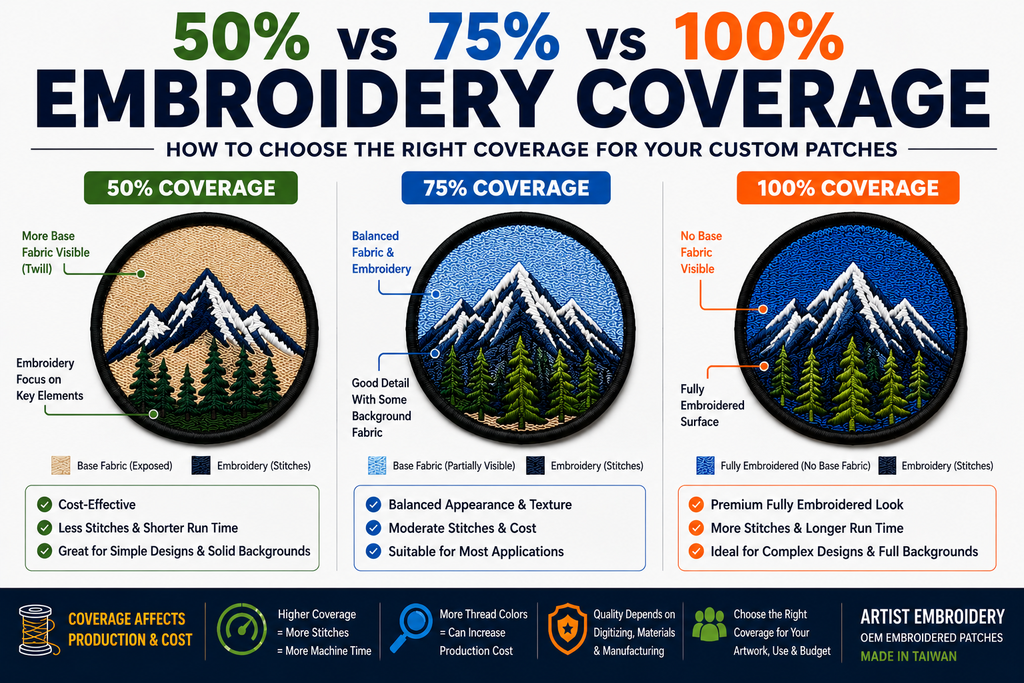
Embroidery coverage generally refers to how much of the visible patch surface is covered by embroidery stitches compared with how much of the base fabric remains exposed. For example, a patch with approximately 50% embroidery coverage leaves a substantial portion of the twill or other base fabric visible, while a 100% embroidered patch uses stitches to cover nearly the entire visible surface. A 75% embroidery patch falls somewhere between these two approaches, combining exposed fabric with larger embroidered areas.
However, embroidery percentage should not be treated as a simple quality rating. A 100% embroidered patch is not automatically better than a 50% or 75% embroidered patch. The most appropriate coverage depends on the artwork, patch size, application, desired texture, budget, and visual effect. A clean corporate logo with a solid twill background, for example, may look excellent with partial embroidery coverage. By contrast, a detailed collectible, military-style, fashion, or highly decorative patch may benefit from fuller embroidery.
Coverage also has an important relationship with production cost. As the embroidered area increases, the design will generally require more stitches and longer machine running time. This is one reason a fully embroidered patch can cost more than a partially embroidered version of the same size. However, embroidery coverage is only one pricing factor. Patch dimensions, order quantity, artwork complexity, number of thread colors, backing type, border construction, and finishing requirements can also affect the final quotation.
For OEM buyers, the goal should therefore not be to automatically specify the highest embroidery percentage. Instead, the objective is to select the right embroidery coverage for the design and intended application. An experienced embroidery manufacturer can evaluate the artwork and determine where exposed fabric can become part of the design and where additional stitching is necessary to achieve the desired appearance.
This guide explains the differences between 50%, 75%, and 100% embroidery coverage, how each option affects appearance and cost, and how buyers can choose the most suitable embroidery percentage for custom embroidered patches.
What Is Embroidery Coverage?
Embroidery coverage is one of the key specifications buyers should understand when ordering custom embroidered patches. In simple terms, embroidery coverage describes how much of the visible patch surface is covered by embroidery stitches and how much of the base fabric remains visible. Manufacturers commonly describe coverage using percentages such as 50%, 75%, or 100%, giving buyers a practical way to understand the overall construction and embroidered appearance of a patch.
A patch with lower embroidery coverage uses the base fabric as an intentional part of the finished design. For example, if a logo consists of embroidered lettering and a few graphic elements placed over a visible twill background, the patch may require only partial embroidery. This approach can create a clean appearance while reducing unnecessary stitches. As embroidery coverage increases, more of the visible surface is filled with thread until reaching a fully embroidered appearance where very little base fabric can be seen.
This distinction matters because coverage affects more than appearance. A larger embroidered area generally requires a higher stitch count, which can increase machine running time and influence production cost. It can also change the texture, weight, and flexibility of the finished patch. For this reason, two patches with identical dimensions may have very different production requirements if one uses substantial exposed fabric while the other is almost completely filled with embroidery.
However, buyers should not interpret embroidery percentage as a direct measurement of quality. A well-produced 50% embroidered patch can be more appropriate for a particular artwork than a 100% embroidered version. Likewise, adding stitches simply to achieve a higher percentage does not necessarily improve logo clarity or durability. The correct coverage should support the artwork rather than compete with it.
For OEM projects, embroidery coverage is therefore best treated as a design and manufacturing specification rather than a quality grade. The appropriate percentage depends on the relationship between artwork, patch size, fabric color, stitch density, intended application, and target budget. Understanding this principle makes it much easier to compare quotations and communicate requirements with an embroidery manufacturer.
How Is Embroidery Coverage Calculated?
Although embroidery coverage is expressed as a percentage, determining the appropriate percentage for a real patch is not always as simple as calculating the geometric area covered by thread. During production planning, the manufacturer evaluates the digitized embroidery design, the areas where base fabric remains exposed, and the sections that require stitched fills, borders, lettering, or decorative details.
For example, imagine a circular patch with a dark twill background, an embroidered company name around the edge, and a logo in the center. Even if the patch looks visually substantial, much of the background may still consist of exposed fabric. It would therefore have lower embroidery coverage than another patch of exactly the same diameter whose entire background is created using fill stitches.
The embroidery file also influences the actual production requirement. Stitch direction, underlay, overlapping elements, lettering, outlines, and fill construction can increase stitch count without necessarily producing a large change in the visible embroidery percentage. This is why embroidery coverage and stitch count are related but are not identical measurements.
In practical OEM manufacturing, percentages such as 50%, 75%, and 100% should therefore be viewed as useful coverage categories rather than perfectly precise mathematical measurements. The final production assessment should be based on the actual artwork and embroidery digitizing requirements.
This is particularly important when comparing quotations from different suppliers. Two manufacturers may evaluate the same artwork slightly differently depending on how the embroidery file is constructed. Buyers should compare not only the stated coverage percentage but also patch size, embroidery specifications, backing, border, thread colors, quantity, and other production requirements before concluding that one quotation is directly equivalent to another.
📊 Table: Embroidery Coverage Levels at a Glance
| Coverage Level | Base Fabric Visibility | Embroidery Characteristics | Typical Design Approach |
|---|---|---|---|
| 50% | High | Key elements are embroidered while substantial fabric remains visible | Logos, lettering, simple graphics |
| 75% | Moderate | Most design areas are embroidered with some fabric incorporated into the design | Balanced logo and decorative designs |
| 100% | Minimal | Nearly the entire visible surface is covered with embroidery | Fully embroidered and highly decorative designs |
💡 Buyer Tip: When requesting a quotation, provide the original artwork instead of estimating the embroidery percentage yourself. The manufacturer can evaluate the design, patch size, stitch construction, and visible fabric areas to recommend an appropriate coverage level.
📖 Extended Reading
- Custom Embroidered Patches Cost: What Affects Patch Pricing?
- Embroidered Patch Quality: How to Evaluate Stitching, Materials & Durability
- Embroidered Patch Size Guide: How to Choose the Right Size
What Does 50% Embroidery Coverage Mean?
A 50% embroidery coverage patch generally means that approximately half of the visible patch surface is covered with embroidery while a significant portion of the base fabric remains exposed. Rather than filling the entire patch with thread, embroidery is concentrated on important design elements such as logos, lettering, symbols, outlines, or decorative details. The visible fabric then becomes an intentional part of the finished appearance.
This construction is particularly effective when the background color can be created directly with the base fabric. For example, if a company needs a navy patch with white embroidered lettering and a simple emblem, using navy twill as the background can eliminate the need to embroider the entire navy area. The finished patch can still look clean and professional while requiring fewer stitches than a fully embroidered version.
One of the main advantages of 50% embroidery coverage is production efficiency. Because fewer areas need fill stitching, the overall stitch count and machine running time are generally lower. This can help reduce production cost, especially for larger patches or high-volume OEM orders. However, the final price still depends on multiple specifications, including patch size, quantity, number of thread colors, artwork complexity, backing, border type, and finishing requirements. Therefore, 50% coverage should not be treated as a fixed pricing category.
Partial embroidery can also produce a different physical character. With less thread covering the surface, the patch may feel lighter and more flexible than a heavily embroidered design. The texture of the base material remains visible, which can become part of the visual identity of the patch rather than simply an unfinished area.
Most importantly, 50% embroidery does not mean 50% quality. If the artwork is designed around exposed fabric, adding unnecessary fill stitches simply to increase the stated coverage may add cost without improving the final result. Good digitizing, consistent stitching, clean lettering, appropriate thread tension, accurate colors, and properly finished edges remain essential regardless of the embroidery percentage.
For buyers, the decision should therefore be based on whether exposed base fabric complements the artwork. When it does, approximately 50% embroidery coverage can provide an effective combination of appearance, production efficiency, flexibility, and cost control.
When Should You Choose 50% Embroidery Coverage?
A 50% embroidery patch is often a practical choice when the design contains a relatively simple logo, lettering, or symbol that does not require an embroidered background. Corporate identification patches, promotional patches, event patches, workwear labels, and other large-volume OEM programs can all benefit from this construction when the base fabric color fits naturally into the artwork.
Consider a rectangular company patch with a black background and white embroidered text. If black twill already provides the required background appearance, covering the entire black area with black thread may provide little visual benefit. Embroidering only the lettering, logo, border, and essential graphic elements can achieve the intended result more efficiently.
The same principle applies to larger patches. As patch dimensions increase, filling unnecessary background areas can substantially increase the total number of stitches. If the artwork allows the fabric to function as the background, partial embroidery can help control production requirements without sacrificing the visual identity of the design.
However, 50% coverage is not suitable for every project. Designs that require complex background graphics, multiple overlapping elements, extensive color areas, or a continuous embroidered texture may need higher coverage. Likewise, buyers seeking the specific surface appearance of a fully embroidered patch may prefer 75% or 100% coverage even when partial embroidery is technically possible.
The best approach is to evaluate the artwork, size, application, visual target, and budget together. Instead of specifying 50% simply because it may cost less, buyers should determine whether exposed fabric contributes positively to the design.
📊 Table: Advantages and Limitations of 50% Embroidery Coverage
| Factor | 50% Embroidery Coverage |
|---|---|
| Base Fabric | A substantial amount remains visible |
| Stitch Count | Generally lower than higher-coverage designs |
| Machine Time | Generally shorter |
| Cost | Often more economical when the artwork is suitable |
| Weight & Flexibility | Often lighter and more flexible |
| Appearance | Clean combination of fabric and embroidery |
| Best For | Simple logos, lettering, corporate and promotional patches |
| Limitation | Not ideal when the design requires a fully embroidered background |
💡 Buyer Tip: If your patch uses a solid background color, ask whether the base fabric itself can create that background instead of covering it with fill stitches. This can reduce unnecessary embroidery while preserving a clean, professional appearance.
📖 Extended Reading
- Custom Embroidered Patches MOQ: What Buyers Need to Know
- OEM Embroidered Patch Manufacturer: Complete Buyer Guide for Custom Patches
- Embroidered Patch Borders: Merrowed vs Heat-Cut & Laser-Cut Borders
What Does 75% Embroidery Coverage Mean?
A 75% embroidery coverage patch provides a middle ground between partially embroidered and fully embroidered construction. Most of the visible patch surface is covered with embroidery, while selected areas of the base fabric remain intentionally exposed. This allows buyers to achieve a richer embroidered appearance without necessarily covering every part of the patch with fill stitches.
In practical custom patch production, 75% embroidery coverage can work particularly well when the main logo, lettering, symbols, and decorative areas require embroidery but the artwork still contains background sections that can be represented effectively by the underlying fabric. Instead of treating exposed twill as an unfinished area, the fabric becomes an integrated component of the design.
For example, consider a shield-shaped uniform patch with embroidered lettering, an emblem, several colored graphic elements, and a dark background. If certain sections of the dark background can remain as visible twill, the patch may achieve the intended visual effect without requiring a completely embroidered surface. Compared with a 50% embroidered patch, the design will generally have a denser and more textured embroidered appearance. Compared with 100% embroidery, however, it can avoid fill stitches in areas where they provide little additional visual value.
From a manufacturing perspective, 75% coverage generally requires more stitches and machine time than a comparable 50% design because a greater portion of the patch must be embroidered. At the same time, it may require fewer stitches than a fully embroidered version. The actual difference depends heavily on the artwork, stitch density, patch dimensions, thread colors, digitizing method, and construction of individual design elements.
This is why 75% embroidery should not be interpreted as an exact guarantee of stitch count or price. Two patches with similar dimensions and the same stated embroidery coverage can still have different production costs if one contains complex lettering, numerous color changes, small details, or difficult stitch structures.
For OEM buyers, 75% coverage is best understood as a flexible design category. It can provide substantial embroidered texture while allowing strategically selected fabric areas to remain visible. When used appropriately, this balance can produce a professional patch without adding embroidery simply for the sake of reaching 100% coverage.
Why Is 75% Embroidery a Practical Choice for Many Designs?
Approximately 75% embroidery coverage can be particularly useful for designs that need a strong embroidered appearance but do not require complete surface coverage. It gives manufacturers more flexibility to use the base fabric strategically while concentrating stitches on the elements that contribute most to the patch’s visual identity.
This can be valuable for corporate patches, uniform patches, scout badges, sports patches, club emblems, security patches, and other OEM applications where logos and graphic elements occupy much of the available surface. In these designs, the combination of embroidered areas and visible fabric can create visual separation between elements and prevent the patch from becoming unnecessarily dense.
Another advantage is flexibility in cost optimization. If a design originally appears to require 100% embroidery, an experienced manufacturer may determine that certain solid background areas can instead be produced using an appropriately colored base fabric. When this change does not compromise the intended appearance, it can reduce stitch count and machine running time.
However, buyers should not automatically request 75% embroidery because it appears to offer a compromise between 50% and 100%. The correct coverage is ultimately determined by the artwork. Some simple designs may look better at lower coverage, while complex artwork may require almost complete embroidery to reproduce the intended colors, shapes, and visual depth.
The size of the patch must also be considered. Small embroidered patches have limited space for lettering and graphic details, so adding unnecessary fill stitches may make the surface visually crowded. Larger patches provide more room but can accumulate a substantial stitch count when large areas are filled. Evaluating embroidery coverage together with patch dimensions is therefore an important part of production planning.
Ultimately, 75% embroidery coverage is most effective when it is the natural result of the design rather than an arbitrary specification. The objective should always be to use embroidery where it improves the artwork and use the base fabric where it can perform the same visual function efficiently.
📊 Table: When 75% Embroidery Coverage Works Best
| Design Factor | 75% Embroidery Coverage |
|---|---|
| Base Fabric Visibility | Selected areas remain visible |
| Embroidered Appearance | High |
| Stitch Count | Generally moderate to high |
| Machine Time | Typically higher than 50% coverage |
| Cost Position | Usually between partial and full embroidery |
| Design Flexibility | Combines embroidery with exposed fabric |
| Suitable Applications | Corporate, uniform, scout, sports and club patches |
| Best Choice When | Most design elements require embroidery but some background can remain fabric |
💡 Buyer Tip: Do not redesign a patch simply to reach a specific embroidery percentage. If 70%, 75%, or 80% coverage naturally produces the best result, the artwork should take priority over an arbitrary percentage category.
📖 Extended Reading
- Embroidered Patch Size Guide: How to Choose the Right Patch Size
- Custom Embroidered Patches Lead Time: How Long Does Production Take?
- OEM Embroidered Patch Manufacturer vs Trading Company: What Buyers Should Know
What Does 100% Embroidery Coverage Mean?
A 100% embroidery coverage patch, often described as a fully embroidered patch, has nearly the entire visible surface covered with embroidery stitches. Unlike 50% or 75% embroidery coverage, where portions of the base fabric remain visible as part of the finished design, a fully embroidered patch uses thread to create the background as well as the main logo, lettering, symbols, and decorative elements.
For example, if a circular patch has a blue background, white lettering, and a multicolor central emblem, a 100% embroidered version would typically create the blue background using fill stitches rather than leaving blue twill exposed. This gives the patch a continuous embroidered texture across almost the entire visible surface and produces the dense, thread-rich appearance that many buyers associate with traditional embroidered badges.
Because more of the surface must be stitched, full embroidery generally requires a higher stitch count than a comparable partially embroidered design. More stitches can also mean longer machine running time, which is one reason 100% embroidered patches may cost more than 50% or 75% versions of similar size and complexity. The difference becomes particularly noticeable on larger patches because filling a large background area can require a substantial number of additional stitches.
However, embroidery coverage is only one component of pricing. Patch dimensions, artwork complexity, stitch density, number of thread colors, order quantity, backing type, border construction, and other finishing requirements can all affect the final production cost. A smaller 100% embroidered patch, for example, may still require fewer total stitches than a much larger 75% embroidered design.
Full embroidery also changes the physical and visual characteristics of the patch. Because the visible surface is largely constructed from thread, the finished patch generally has a denser embroidered texture and less visible base fabric. Depending on the artwork and construction, it may also feel slightly heavier or more structured than a comparable partial-coverage patch.
For some designs, this continuous embroidered surface is an important part of the desired appearance. For others, however, covering a solid background with thread may add stitches without providing a meaningful visual improvement. This is why 100% embroidery should be selected because it suits the artwork and intended appearance—not simply because it is the highest available percentage.
When Is 100% Embroidery Worth the Extra Cost?
A fully embroidered patch is most appropriate when the artwork genuinely requires embroidery across nearly the entire visible surface. This can occur when the background itself contains colors, shapes, patterns, gradients represented through stitch direction, or other graphic elements that cannot be reproduced simply by exposing a single-color base fabric.
Full embroidery can also be desirable when the buyer specifically wants a consistent embroidered texture across the entire patch. Military-style patches, police and security patches, club emblems, motorcycle patches, fashion patches, collectible badges, sports patches, and premium branded merchandise may use high or full embroidery coverage when that construction supports the intended visual character.
Design consistency can be another consideration. If a patch contains multiple background color areas, using exposed fabric may not reproduce the artwork accurately because the base material normally provides only one background color. Embroidering these areas allows different thread colors to form the required background graphics while maintaining the embroidered appearance.
There are also situations where 100% coverage may be unnecessary. If the design contains a large solid background that closely matches an available twill color, filling the entire area with thread may increase stitch count and machine time without significantly changing how the logo communicates visually. In such cases, 50% or 75% embroidery may achieve an equally professional result at a more efficient production specification.
Buyers should also consider patch size. A large fully embroidered patch can require significantly more stitches than a small one, particularly when broad background areas use dense fill stitching. This affects not only cost but also production time and the physical character of the finished patch.
For OEM purchasing, the decision should therefore be based on the actual design rather than the assumption that full embroidery represents an automatic upgrade. An experienced manufacturer can evaluate whether the background should be created with thread or base fabric and determine where full coverage provides genuine visual value.
📊 Table: Advantages and Considerations of 100% Embroidery Coverage
| Factor | 100% Embroidery Coverage |
|---|---|
| Base Fabric Visibility | Minimal or nearly none on the visible surface |
| Embroidered Appearance | Full, dense and continuous |
| Stitch Count | Generally higher for comparable designs |
| Machine Time | Generally longer |
| Relative Cost | Often higher than partial embroidery |
| Surface Texture | Consistent embroidered texture across the patch |
| Design Capability | Suitable for backgrounds containing multiple embroidered colors or graphic elements |
| Best For | Designs that genuinely require a fully embroidered surface |
| Main Consideration | Additional stitches should provide visual or functional value |
💡 Buyer Tip: Before specifying 100% embroidery, ask whether a solid background area can be created with the base fabric instead. If the appearance remains consistent with your artwork, partial embroidery may reduce unnecessary stitches and production cost.
📖 Extended Reading
- Embroidered Patch Quality: How to Evaluate Stitching, Materials & Durability
- Custom Embroidered Patches Cost: What Affects Patch Pricing?
- Embroidered Patch Borders: Merrowed vs Heat-Cut & Laser-Cut Borders
50% vs 75% vs 100% Embroidery Coverage
The main difference between 50%, 75%, and 100% embroidery coverage is how much of the visible patch surface is created with embroidery stitches and how much of the base fabric remains exposed. However, choosing between these options involves more than simply selecting a percentage. Coverage influences the appearance, texture, stitch count, machine time, flexibility, and production cost of custom embroidered patches.
At approximately 50% coverage, the base fabric plays a significant visual role. Embroidery is concentrated on the logo, lettering, borders, and important graphic elements, while larger background areas may remain exposed. This approach can be particularly efficient when the fabric color already matches the intended background.
At approximately 75% coverage, embroidery becomes the dominant visual element while selected areas of base fabric remain visible. This provides a balance between embroidered texture and production efficiency and can work well for many corporate, uniform, scout, sports, and general OEM patch designs.
With 100% embroidery coverage, nearly the entire visible surface is created with thread. Background areas that could otherwise remain as exposed fabric are embroidered using fill stitches, producing a continuous embroidered texture. This construction is appropriate when the artwork requires multiple background colors, detailed graphic elements, or the specific appearance of a fully embroidered patch.
Cost differences generally follow the amount and complexity of stitching required. If the size and artwork are otherwise comparable, higher coverage usually means more stitches and longer machine running time. However, the relationship is not perfectly linear. A complex 75% embroidered patch with small lettering, many thread colors, and detailed elements may require more production work than a simple 100% embroidered design.
The same principle applies to quality. Embroidery percentage is not a quality scale. A properly digitized and manufactured 50% patch can have excellent stitching quality, while increasing coverage does not automatically improve clarity, durability, or workmanship. Coverage should instead be chosen according to the artwork and intended visual result.
For buyers comparing quotations, this distinction is important. Two patches of the same dimensions may have very different prices because their embroidery coverage and stitch requirements differ. Conversely, two suppliers quoting “100% embroidery” may still produce different results depending on digitizing, stitch density, thread quality, production control, border construction, and finishing.
Understanding these differences allows buyers to compare specifications rather than percentages alone and select a construction that provides the appropriate balance of appearance, performance, and cost.
Which Embroidery Percentage Should You Choose?
The best embroidery percentage depends primarily on the artwork, intended application, patch size, visual expectations, and budget.
Choose approximately 50% embroidery coverage when the base fabric can effectively form a substantial portion of the background and the main embroidered elements consist of logos, lettering, symbols, or relatively simple graphics. This is often a practical choice for corporate identification, promotional programs, workwear, and high-volume OEM projects.
Choose approximately 75% embroidery coverage when most of the design benefits from embroidery but selected background areas can still remain as visible fabric. This can provide a strong embroidered appearance without requiring fill stitches across every part of the patch.
Choose 100% embroidery coverage when nearly the entire design needs to be created with thread or when a continuous embroidered surface is an important part of the intended appearance. Designs containing multiple background colors or graphic elements across the entire patch may naturally require this construction.
Buyers do not necessarily need to determine the exact percentage before contacting a manufacturer. In many cases, sending the artwork first is more useful. The manufacturer can review which areas require stitching, which areas can remain as base fabric, and how the design should be digitized for production.
This approach is particularly helpful when purchasing custom embroidered patches for the first time. Instead of asking, “Should I order 75% or 100% embroidery?” a more useful question is, “What embroidery coverage will reproduce this artwork effectively?”
The answer may not always fall exactly at 50%, 75%, or 100%. These percentages are useful categories for communication and quotation, but actual designs can naturally fall between them. The goal is not to reach a particular number; it is to achieve the intended appearance with an appropriate embroidery construction.
📊 Table: 50% vs 75% vs 100% Embroidery Coverage Comparison
| Factor | 50% Embroidery | 75% Embroidery | 100% Embroidery |
|---|---|---|---|
| Base Fabric Visibility | High | Moderate | Minimal |
| Embroidered Appearance | Partial | Dominant | Full |
| Typical Stitch Count | Lower | Medium to High | Higher |
| Machine Time | Generally Shorter | Moderate | Generally Longer |
| Relative Cost | $ | $$ | $$$ |
| Weight / Flexibility | Often Lighter | Balanced | Often Denser |
| Background Treatment | Fabric often forms background | Fabric + embroidery | Background mainly embroidered |
| Best For | Simple logos, lettering, promotional patches | Corporate, uniform, scout and sports patches | Full-surface and decorative designs |
| Main Advantage | Production efficiency | Balance of embroidery and fabric | Continuous embroidered appearance |
| Key Consideration | Visible fabric must suit artwork | Coverage should follow design | Extra stitches should add visual value |
💡 Buyer Tip: If you are unsure whether your design needs 50%, 75%, or 100% embroidery coverage, send the original artwork to your manufacturer. A production assessment is usually more reliable than selecting a percentage before the design has been reviewed.
📖 Extended Reading
- OEM Embroidered Patch Manufacturer: Complete Buyer Guide for Custom Patches
- Custom Embroidered Patches MOQ: What Buyers Need to Know
- Custom Embroidered Patches Lead Time: How Long Does Production Take?
How Embroidery Coverage Affects Patch Cost
Embroidery coverage can directly influence the cost of custom embroidered patches because increasing the amount of stitched surface generally increases the total stitch count and machine running time required to produce each piece. When comparing patches of the same size and similar artwork complexity, a design with 100% embroidery coverage will usually require more production work than a design that uses the base fabric as part of a 50% or 75% embroidered surface.
The relationship begins with stitch count. Large areas of solid embroidery require fill stitches to cover the base material consistently. As these areas increase, thousands of additional stitches may be needed depending on the size of the patch, stitch density, and digitizing method. More stitches mean the embroidery machine needs more time to complete each production cycle, which becomes particularly important when manufacturing hundreds or thousands of patches.
Patch size can amplify this difference. Adding full embroidery to a small patch may result in a relatively modest increase in total stitches, while filling the background of a large patch can add a substantial amount of machine time. This is why buyers should evaluate embroidery coverage together with patch dimensions rather than assuming that all 100% embroidered patches have similar production costs.
The number of thread colors is another pricing consideration. Designs using more colors may require additional thread setup, color changes, and production management. Therefore, increasing the number of colors can increase the final price even when the embroidery coverage remains unchanged. A patch with relatively moderate coverage but many thread colors and complex details may consequently cost more to manufacture than a visually simpler design with higher coverage.
Artwork complexity also matters. Small lettering, narrow outlines, overlapping elements, detailed symbols, and complicated stitch directions can require careful digitizing and additional production work. Backing options, border construction, special materials, order quantity, and finishing requirements further influence the final quotation.
For this reason, buyers should avoid estimating patch prices based only on whether a design is described as 50%, 75%, or 100% embroidery. Coverage is an important cost factor, but the final price is determined by the complete production specification.
For OEM orders, providing the manufacturer with the original artwork, finished dimensions, required quantity, backing preference, and other specifications allows the design to be evaluated accurately. The manufacturer can then determine the expected embroidery construction and provide a quotation based on the actual production requirements rather than a percentage alone.
Why More Embroidery Usually Means More Stitches and Machine Time
The connection between embroidery coverage and production cost becomes easier to understand when considering how an embroidery machine creates the patch. Every embroidered area must be converted into a sequence of stitches through digitizing. The machine then physically produces those stitches one after another according to the embroidery file.
If a large background area is left as visible twill, the machine does not need to fill that entire surface with thread. When the same area is converted into a fully embroidered background, however, additional fill stitches must be created across the surface. Depending on the patch dimensions, this can add a substantial number of stitches to each piece.
The basic relationship can therefore be summarized as:
Higher Embroidery Coverage → More Stitches → Longer Machine Time → Higher Production Cost
However, this should be treated as a general production principle rather than a fixed pricing formula. Stitch count does not depend on surface area alone. Stitch density, underlay construction, overlapping embroidery, small details, lettering, outlines, and digitizing strategy can all change how many stitches are required.
Color changes also interrupt continuous embroidery production. When a design uses additional thread colors, the production process may require more setup and color-change operations. For this reason, two patches with the same size and embroidery coverage can still have different prices when their color counts and artwork complexity differ.
Order quantity creates another important variable. Embroidery production involves setup and preparation before volume manufacturing begins, so unit pricing typically changes with quantity. A high-volume order can distribute certain setup costs across more pieces, while a small order may have a higher unit cost even when the physical patch specifications are identical.
Buyers should therefore use embroidery coverage as one piece of the pricing equation rather than a standalone price indicator. The most reliable quotation comes from evaluating the complete artwork and production requirements.
📊 Table: How Embroidery Coverage Influences Production Cost
| Cost Factor | Potential Effect on Production |
|---|---|
| Higher Embroidery Coverage | Generally increases stitched surface area |
| Higher Stitch Count | Generally increases machine running time |
| Larger Patch Size | Can significantly increase stitches when large areas are filled |
| More Thread Colors | Can increase setup, color changes, and production cost |
| Complex Artwork | May require more detailed digitizing and stitch construction |
| Higher Stitch Density | Can increase total stitch count |
| Backing & Border | Additional materials or processing may affect price |
| Order Quantity | Higher quantities can affect unit pricing and production efficiency |
💡 Buyer Tip: If you need to reduce patch cost, do not automatically reduce the size or remove important design details. Ask whether selected solid background areas can use the base fabric instead of fill embroidery. In suitable designs, adjusting coverage can improve production efficiency while preserving the intended appearance.
📖 Extended Reading
- Custom Embroidered Patches Cost: What Affects Patch Pricing?
- Custom Embroidered Patches MOQ: What Buyers Need to Know
- Embroidered Patch Size Guide: How to Choose the Right Patch Size
Does 100% Embroidery Mean Better Patch Quality?
No. 100% embroidery coverage does not automatically mean better patch quality. Embroidery coverage describes how much of the visible patch surface is covered with stitches, while embroidery quality describes how accurately, consistently, and cleanly those stitches are produced. These are related manufacturing characteristics, but they should not be treated as the same measurement.
This distinction is particularly important when comparing custom embroidered patches from different suppliers. A fully embroidered patch may contain more stitches and have a denser surface than a 50% or 75% embroidered patch, but additional stitches alone do not guarantee better workmanship. If the embroidery file is poorly digitized, the thread tension is inconsistent, small lettering is unclear, or the border is improperly finished, a 100% embroidered patch can still have poor overall quality.
Conversely, a well-manufactured partial-coverage patch can demonstrate excellent embroidery quality. Clean lettering, accurate logo proportions, consistent stitch direction, appropriate density, smooth fills, properly aligned outlines, and secure edge finishing are much more meaningful indicators of manufacturing quality than the embroidery percentage alone.
The quality of the equipment used in production is also important. Modern industrial embroidery systems provide manufacturers with the precision and production control required for consistent OEM manufacturing. Industrial embroidery technology from Tajima Group is widely used for professional embroidery applications, where machine control, production stability, and accurate stitch execution are essential considerations.
Thread selection is another fundamental part of patch quality. Consistent thread color, strength, surface appearance, and suitability for industrial embroidery can affect both production stability and the finished result. Professional embroidery thread suppliers such as FuFu’s Thread provide thread products developed for embroidery applications, illustrating why material selection should be evaluated alongside machine technology and production workmanship.
Buyers should therefore avoid using “100% embroidery” as shorthand for “premium quality.” A better approach is to evaluate the complete patch: Is the artwork reproduced accurately? Are the stitches consistent? Is the lettering readable? Are outlines properly aligned? Are thread colors appropriate? Is the border clean? Does the backing meet the intended application?
A high-quality embroidered patch is the result of appropriate artwork digitizing, suitable materials, controlled embroidery production, and proper finishing. Coverage should support those factors, not replace them as the definition of quality.
Embroidery Coverage vs Embroidery Quality
The easiest way to understand the difference is to view embroidery coverage as a design specification and embroidery quality as a manufacturing result.
Coverage determines where embroidery is placed. Quality determines how well that embroidery is executed.
For example, two manufacturers could receive the same artwork and both produce a 100% embroidered patch. Although the stated coverage is identical, the finished products may still look different. One patch may have smooth fill stitching, sharp lettering, accurate outlines, and balanced stitch density, while another may show uneven fills, distorted text, misaligned borders, or unnecessary bulk caused by inappropriate stitch construction.
Digitizing plays a major role in these differences. Artwork cannot simply be transferred directly to an embroidery machine as if it were printed. Graphic elements must be converted into stitches, with decisions made about stitch types, directions, density, underlay, sequencing, and overlapping areas. These decisions influence how accurately the original design can be reproduced in thread.
Patch size is also closely connected to quality. Very small lettering and fine details may become difficult to reproduce regardless of whether the patch uses 50%, 75%, or 100% coverage. Increasing the embroidery percentage cannot solve a design that contains more detail than the physical patch size can support.
Similarly, increasing stitch density beyond what the design and material require does not automatically create a better patch. Excessive density can make embroidery unnecessarily stiff and may create production challenges. The objective is to use an appropriate stitch structure for the artwork, fabric, thread, and intended application.
For B2B and OEM buyers, quality evaluation should therefore focus on measurable production characteristics rather than a single coverage percentage. Reviewing samples, checking small lettering and edges, examining stitch consistency, confirming materials, and working with a manufacturer capable of evaluating embroidery feasibility are more reliable ways to assess patch quality.
📊 Table: Embroidery Coverage vs Embroidery Quality
| Factor | Embroidery Coverage | Embroidery Quality |
|---|---|---|
| What It Measures | Amount of visible surface covered by stitches | Overall execution of the embroidered patch |
| Common Indicators | 50%, 75%, 100% | Stitch consistency, clarity, alignment and finishing |
| Determines Quality? | No | Yes, as part of the complete manufacturing process |
| Related to Stitch Count | Generally | Not necessarily |
| Related to Artwork Digitizing | Yes | Strongly |
| Thread Selection | Does not determine coverage percentage | Can influence appearance and production performance |
| Machine & Production Control | Does not define coverage | Important for consistent manufacturing |
| Best Buyer Approach | Choose according to artwork and application | Evaluate workmanship, materials and production capability |
💡 Buyer Tip: When comparing suppliers, do not ask only whether the quotation includes “100% embroidery.” Compare actual samples, digitizing quality, stitch consistency, lettering clarity, materials, border finishing, and production specifications.
📖 Extended Reading
- Embroidered Patch Quality: How to Evaluate Stitching, Materials & Durability
- OEM Embroidered Patch Manufacturer vs Trading Company: What Buyers Should Know
- OEM Embroidered Patch Manufacturer: Complete Buyer Guide for Custom Patches
How to Choose the Right Embroidery Coverage for Your Patch
Choosing the right embroidery coverage for custom patches should begin with the artwork rather than a predetermined percentage. Although 50%, 75%, and 100% embroidery are useful categories for quotation and production discussions, the best coverage depends on how the design uses color, background space, lettering, symbols, and other graphic elements.
The first factor to consider is the background design. If the patch has a large solid-color background that closely matches an available base fabric, leaving that fabric exposed can be an efficient solution. In this situation, 50% or 75% embroidery coverage may reproduce the artwork effectively without using fill stitches across the entire background. If the background contains multiple colors, patterns, or graphic elements that cannot be represented by a single fabric color, higher embroidery coverage may be necessary.
The second consideration is patch size and artwork complexity. Small patches have limited physical space for embroidery, especially when the artwork includes fine lettering, narrow lines, or multiple small elements. Increasing coverage does not create additional space for those details. Instead, the artwork may need to be simplified or the patch size increased to achieve clear embroidery.
Application also matters. A simple corporate identification patch may use exposed twill effectively, while a decorative fashion or collectible patch may intentionally use embroidery across the entire surface to create a specific texture. Police, military, security, scout, and sports patches can fall anywhere within the coverage range depending on their individual artwork and specifications. The application category alone should therefore not determine the percentage.
Budget should be considered alongside these design requirements. When a project involves hundreds or thousands of patches, unnecessary fill stitching can increase production requirements across the entire order. If exposed fabric can provide the same background appearance, partial embroidery may offer a more efficient specification. However, reducing coverage simply to achieve the lowest price can also compromise the intended design if important areas actually require embroidery.
For OEM buyers, the most reliable approach is to provide the manufacturer with the original artwork, finished dimensions, required quantity, intended application, and any specific appearance requirements. The manufacturer can then evaluate which areas should be embroidered and which areas can remain as visible base fabric.
The goal is not to maximize or minimize embroidery coverage. It is to select the amount of embroidery necessary to reproduce the artwork effectively while maintaining appropriate production efficiency.
Choosing Coverage Based on Design, Application, and Budget
Different applications can provide a useful starting point when considering embroidery coverage, but they should be treated as guidelines rather than fixed manufacturing rules.
For a corporate logo patch, approximately 50% to 75% coverage may be sufficient when a solid base fabric can form the background. Embroidered lettering and logo elements can stand clearly against the exposed fabric without requiring a fully stitched surface.
Promotional and event patches can also benefit from partial embroidery when cost efficiency is important for larger quantities. If the artwork is simple, concentrating embroidery on the primary branding elements can maintain visual impact while avoiding unnecessary stitches.
Scout, club, and sports patches frequently contain more graphic elements and may naturally move toward 75% or higher coverage. However, traditional designs that intentionally incorporate visible twill can still work effectively with lower percentages.
For police, military, and security patches, specifications can vary considerably. Some designs use a visible fabric background with embroidered text and insignia, while others require nearly complete embroidery. Buyers should follow the artwork, organizational specifications, and intended uniform application rather than assuming that this category always requires 100% coverage.
Fashion and collectible patches offer even greater design flexibility. In these applications, embroidery coverage may be selected partly for texture and visual character. A fully embroidered surface can create a dense thread appearance, while intentional exposed fabric can provide contrast and become part of the design language.
Ultimately, budget should be evaluated after the visual and functional requirements have been established. If two embroidery constructions can reproduce the artwork equally well, the more production-efficient option may make sense for a large OEM order. If full coverage is essential to the desired appearance, reducing embroidery simply to lower cost may not be appropriate.
📊 Table: Recommended Embroidery Coverage by Application
| Application | General Coverage Range | Main Consideration |
|---|---|---|
| Corporate Logo Patch | 50–75% | Solid fabric backgrounds can reduce unnecessary fill stitches |
| Promotional / Event Patch | 50–75% | Balance branding visibility with production efficiency |
| Workwear Patch | 50–75% | Readability and practical construction |
| Scout / Club Patch | 75–100% | Depends on emblem complexity and background design |
| Sports Team Patch | 75–100% | Logo detail and desired embroidered appearance |
| Police / Security Patch | 75–100%* | Follow artwork and organizational specifications |
| Military-Style Patch | 75–100%* | Construction depends on the individual design |
| Fashion Patch | 50–100% | Coverage can be part of the visual concept |
| Collectible Patch | 75–100% | Full embroidered texture may be intentionally preferred |
*Suggested ranges are general references only. Actual embroidery coverage should be determined from the artwork and project specifications.
💡 Buyer Tip: The best embroidery coverage should be determined by the artwork and intended use—not simply by choosing the highest percentage. When requesting an OEM quotation, send the original design and let the manufacturer evaluate whether exposed fabric can become part of the finished patch.
📖 Extended Reading
- Embroidered Patch Size Guide: How to Choose the Right Patch Size
- Embroidered Patch Borders: Merrowed vs Heat-Cut & Laser-Cut Borders
- Custom Embroidered Patches Cost: What Affects Patch Pricing?
Common Embroidery Coverage Mistakes Buyers Should Avoid
Choosing embroidery coverage may appear straightforward, but buyers can easily make incorrect assumptions when comparing custom embroidered patches. One of the most common mistakes is treating 50%, 75%, and 100% embroidery coverage as quality grades rather than manufacturing specifications. This can lead buyers to request additional embroidery that does not improve the artwork and may only increase stitch count, machine time, and production cost.
Another common mistake is specifying 100% embroidery before the manufacturer has reviewed the artwork. Buyers sometimes assume that a fully embroidered patch will automatically look more professional or premium. However, if the design contains a large solid-color background that can be represented effectively by the base fabric, covering the same area with fill stitches may provide limited visual benefit. The correct decision should depend on the intended appearance rather than the percentage itself.
Price comparisons can create similar problems. Two suppliers may quote patches described as having the same embroidery coverage, but this does not necessarily mean their specifications are identical. Patch dimensions, thread colors, stitch density, artwork digitizing, backing, border construction, materials, order quantity, and finishing requirements can all influence production cost. Comparing quotations solely on the stated embroidery percentage can therefore produce misleading conclusions.
Buyers should also avoid assuming that embroidery coverage and stitch count are interchangeable measurements. A patch with 75% coverage can sometimes have a substantial stitch count because of detailed lettering, multiple graphic elements, outlines, underlay, or complex stitch construction. Meanwhile, a relatively simple 100% embroidered design may use a more straightforward stitch structure. Coverage provides useful information about the visible surface, but it does not describe every aspect of the embroidery file.
Another mistake is reducing coverage only to achieve a lower unit price. Cost optimization is important for OEM orders, particularly at higher quantities, but removing embroidery from areas that are essential to the artwork can compromise the intended appearance. Efficient manufacturing means eliminating unnecessary stitches—not eliminating necessary ones.
Patch size must also be considered. Increasing embroidery coverage cannot compensate for artwork that contains lettering or details that are too small for the selected patch dimensions. When a design is difficult to embroider clearly, adjusting the artwork or increasing the finished size may be more effective than simply increasing stitch density or coverage.
The most reliable approach is therefore to treat embroidery coverage as part of the overall production specification. Buyers should provide complete artwork and project requirements, then evaluate the manufacturer’s recommendation based on design feasibility, appearance, cost, and intended application.
Why Choosing the Highest Coverage Is Not Always the Best Decision
The assumption that “more embroidery is always better” usually comes from confusing quantity of stitches with quality of workmanship. In reality, good embroidery manufacturing is about using the appropriate stitch construction in the appropriate areas.
If a solid background can be represented cleanly with twill, embroidering over that entire surface simply to reach 100% coverage may add thousands of stitches without improving logo readability or design accuracy. On a large OEM order, those additional stitches are repeated across every piece, increasing machine running time and potentially affecting production cost.
There are also visual considerations. Exposed base fabric can create contrast between embroidered elements and the background, helping lettering or logos stand out. In certain designs, replacing that fabric with fill stitches can change the texture and visual character of the patch rather than improve it.
At the opposite extreme, choosing lower coverage purely because it appears less expensive can also be a mistake. If the artwork contains multiple background colors, patterns, or graphic elements that must be created with thread, higher coverage may be necessary to reproduce the design correctly.
The right question is therefore not:
“What is the highest embroidery coverage available?”
A more useful question is:
“What embroidery coverage does this artwork actually require?”
This approach allows the manufacturer to evaluate the patch as a complete product. Artwork, finished dimensions, thread colors, stitch construction, base fabric, border, backing, quantity, and intended application can then be considered together.
For professional OEM sourcing, this is more reliable than selecting a percentage first and forcing the artwork to fit that specification afterward.
📊 Table: Common Embroidery Coverage Mistakes and Solutions
| Common Mistake | Why It Can Be a Problem | Better Approach |
|---|---|---|
| Assuming 100% means highest quality | Coverage does not measure workmanship | Evaluate stitching, digitizing, materials and finishing |
| Requesting 100% before artwork review | May create unnecessary fill stitches | Let the manufacturer evaluate the design first |
| Comparing quotations only by coverage | Other production specifications may differ | Compare the complete specification |
| Treating coverage as stitch count | Similar coverage can have different stitch counts | Evaluate artwork complexity and stitch construction |
| Reducing coverage only to lower cost | Important design areas may be lost | Remove only unnecessary embroidery |
| Ignoring patch size | Small details may remain difficult to reproduce | Adjust artwork or finished dimensions when necessary |
| Assuming one percentage fits every application | Every artwork has different requirements | Choose coverage according to the individual project |
💡 Buyer Tip: When comparing quotations from multiple manufacturers, provide each supplier with the same artwork, size, quantity, backing, border, color requirements, and other specifications. This creates a more meaningful comparison than evaluating embroidery percentage or unit price alone.
📖 Extended Reading
- OEM Embroidered Patch Manufacturer vs Trading Company: What Buyers Should Know
- Embroidered Patch Quality: How to Evaluate Stitching, Materials & Durability
- Custom Embroidered Patches Lead Time: How Long Does Production Take?
FAQ: About Embroidery Coverage
Buyers sourcing custom embroidered patches often have questions about how embroidery percentage affects appearance, cost, stitch count, quality, and production. The following answers cover the most common questions about 50%, 75%, and 100% embroidery coverage for OEM patch orders.
Q1. What Is Embroidery Coverage?
Embroidery coverage refers to how much of the visible patch surface is covered with embroidery stitches compared with how much of the base fabric remains exposed. Common categories include approximately 50%, 75%, and 100% embroidery coverage. Lower coverage uses more visible base fabric as part of the design, while higher coverage uses embroidery across a greater portion of the patch surface.
Coverage should be treated as a design and manufacturing specification rather than a quality rating. The appropriate percentage depends on the artwork, patch size, background design, intended application, and desired appearance.
Q2. What Does 50% Embroidery Mean?
A 50% embroidered patch generally uses embroidery on approximately half of the visible surface while leaving a substantial amount of base fabric exposed. The embroidery may be concentrated on lettering, logos, symbols, borders, and other important graphic elements.
This construction can work particularly well when the base fabric color already provides the background required by the artwork. It can also reduce unnecessary fill stitches and improve production efficiency when full embroidery is not visually necessary.
Q3. What Does 75% Embroidery Mean?
A 75% embroidery patch has most of its visible surface covered with stitches while selected areas of base fabric remain visible. It provides a balance between partial and full embroidery and can be suitable for many corporate, uniform, scout, club, and sports patch designs.
The percentage should not be treated as an exact mathematical requirement. A design may naturally require slightly more or less coverage depending on its artwork and embroidery construction.
Q4. What Does 100% Embroidery Mean?
A 100% embroidered patch, also known as a fully embroidered patch, has nearly the entire visible surface covered with embroidery stitches. The background is generally created using fill stitches rather than leaving significant areas of base fabric exposed.
This produces a continuous embroidered texture and may be appropriate when the artwork contains multiple background colors, detailed graphics, or when a fully embroidered appearance is specifically desired.
Q5. Is 100% Embroidery More Expensive?
Generally, a 100% embroidered patch can cost more than a comparable 50% or 75% design because a larger stitched surface usually requires more stitches and longer machine running time.
However, embroidery coverage is only one pricing factor. Patch size, order quantity, artwork complexity, stitch density, number of thread colors, backing, border construction, materials, and finishing requirements can also affect the final quotation. Therefore, 100% embroidery should not be treated as a fixed price category.
Q6. Does 100% Embroidery Mean Better Quality?
No. 100% embroidery does not automatically mean better quality. Coverage measures how much of the patch surface is embroidered, while quality depends on factors such as digitizing, stitch consistency, thread tension, lettering clarity, material selection, alignment, border finishing, and overall production control.
A professionally manufactured 50% embroidered patch can have excellent quality, while a poorly digitized 100% embroidered patch can still produce an unsatisfactory result.
Q7. How Is Embroidery Coverage Calculated?
Embroidery coverage is generally estimated according to the amount of the visible patch surface occupied by embroidery compared with exposed base fabric. In actual manufacturing, however, determining coverage involves evaluating the artwork and digitized embroidery construction rather than relying only on a simple geometric calculation.
Fill stitches, lettering, outlines, underlay, overlapping elements, and other stitch structures can affect production requirements. For this reason, percentages such as 50%, 75%, and 100% are best treated as practical coverage categories.
Q8. What Embroidery Coverage Is Best for Custom Patches?
There is no single embroidery percentage that is best for every custom patch. The appropriate coverage depends on the artwork, patch size, background colors, intended application, desired texture, and budget.
Simple logos with solid backgrounds may work well with 50% or 75% embroidery, while designs containing extensive background graphics or requiring a continuous embroidered texture may need higher or full coverage. The best option should be determined from the actual artwork.
Q9. Does Embroidery Coverage Affect Patch Durability?
Embroidery coverage can affect the physical construction and surface characteristics of a patch, but a higher percentage does not automatically make a patch more durable.
Durability also depends on thread quality, base material, stitch construction, edge finishing, backing, application method, and how the finished patch will be used or maintained. Buyers should therefore evaluate durability as part of the complete patch specification rather than using coverage alone as an indicator.
Q10. Does Embroidery Coverage Affect Stitch Count?
Yes, embroidery coverage and stitch count are generally related. Increasing the amount of embroidered surface usually requires additional stitches, particularly when large background areas are converted from exposed fabric to fill embroidery.
However, two designs with the same coverage percentage can still have different stitch counts. Patch dimensions, stitch density, lettering, outlines, underlay, overlapping elements, and artwork complexity all influence the total number of stitches required.
Q11. Can Embroidery Coverage Affect Production Lead Time?
Yes. Higher embroidery coverage can increase machine running time because more stitches may be required for each patch. When multiplied across a large OEM order, the additional machine time can become significant.
However, production lead time also depends on quantity, artwork approval, digitizing, thread colors, backing and border requirements, production capacity, finishing, inspection, and shipping arrangements. Coverage is therefore only one factor affecting the overall schedule.
Q12. Can a Manufacturer Recommend the Best Embroidery Percentage for My Design?
Yes. In many cases, having the manufacturer evaluate the artwork is more useful than selecting an embroidery percentage in advance.
Buyers can provide the original artwork, required finished size, quantity, intended application, backing preference, and any specific appearance requirements. The manufacturer can then determine which areas should be embroidered, which areas can use the base fabric, and whether partial or full embroidery is more appropriate.
This approach helps avoid unnecessary stitches while ensuring that important design elements receive the embroidery needed for a clear and professional finished patch.
💡 Buyer Tip: If you are requesting your first custom embroidered patch quotation, you do not need to know the exact embroidery percentage in advance. Providing clear artwork, size, quantity, and application requirements gives the manufacturer the information needed to evaluate the appropriate construction.
📖 Extended Reading
- OEM Embroidered Patch Manufacturer: Complete Buyer Guide for Custom Patches
- Custom Embroidered Patches Cost: What Affects Patch Pricing?
- Embroidered Patch Quality: How to Evaluate Stitching, Materials & Durability
CTA: Order Custom Embroidered Patches from Artist Embroidery
Choosing the right embroidery coverage for custom patches does not require buyers to determine an exact percentage before requesting a quotation. In many OEM projects, the most effective approach is to begin with the artwork and allow the embroidery construction to be evaluated according to the actual design.
At Artist Embroidery, we manufacture custom embroidered patches for B2B and OEM projects, with production specifications developed according to each customer’s artwork, finished dimensions, quantity, application, and required appearance. Whether a design is best suited to approximately 50%, 75%, or 100% embroidery coverage depends on how the embroidered elements and base fabric work together in the finished patch.
For designs with a simple solid background, exposed base fabric may provide the required appearance without unnecessary fill stitching. More detailed designs may require higher embroidery coverage to reproduce multiple colors, graphic elements, or a continuous embroidered surface. Rather than automatically recommending the highest percentage, the objective is to determine a construction that accurately represents the artwork while maintaining appropriate production efficiency.
Embroidery coverage is also evaluated together with other important specifications. Patch size, thread colors, artwork complexity, stitch construction, border type, backing, quantity, and finishing requirements can all influence the final manufacturing process and quotation. Reviewing these factors as a complete project provides buyers with a more meaningful production recommendation than selecting embroidery coverage alone.
For buyers sourcing patches for corporate uniforms, police and security applications, military-style designs, scout organizations, sports teams, clubs, promotional programs, fashion brands, or other OEM projects, providing complete project information at the quotation stage can help streamline the evaluation process.
Get the Right Embroidery Coverage for Your OEM Patch Project
To request a quotation, prepare as much of the following information as possible:
- Original artwork or logo file
- Required finished patch size
- Estimated order quantity
- Preferred backing
- Border requirements, if known
- Required thread colors or color references
- Intended application
- Any specific appearance or construction requirements
- Delivery destination
If you are unsure whether your design requires 50%, 75%, or 100% embroidery coverage, you can submit the artwork without specifying the percentage. The design can be reviewed to determine whether the background should remain as visible fabric or be constructed with embroidery.
This is particularly useful for buyers comparing different patch constructions or attempting to optimize a design for larger-volume production. Instead of adding stitches simply to reach a higher embroidery percentage, the focus can remain on the areas where embroidery contributes to design accuracy, appearance, and the intended finished result.
Artist Embroidery Corporation specializes in OEM embroidery manufacturing in Taiwan and works with buyers requiring custom embroidered patches for a wide range of commercial and organizational applications.
If you are preparing a new custom patch project, send us your artwork and specifications for evaluation and quotation.
Contact us
Artist Embroidery Corporation
📞 Tel: +886-2-8245-8989
🌐 Website: artistembroidery.com
📧 Email: service@artistembroidery.com
🏢 Office: 7 F., No. 21, Qiao’an St., Zhonghe Dist., New Taipei City 235026, Taiwan
🏭 Factory: No. 12, Zhiwa 2nd Rd., Shetou Township, Changhua County 511006, Taiwan
Made in Taiwan | OEM Embroidery Manufacturing for Global B2B Buyers
About the Author
Artist Embroidery Engineering Team
This guide was prepared by the engineering and sales specialists at Artist Embroidery, a Taiwan-based OEM embroidered patch manufacturer with extensive experience serving military, law enforcement, corporate, fashion, promotional, and industrial customers worldwide.
Our team specializes in custom embroidered patch manufacturing, embroidery digitizing, quality control, material selection, and international OEM production. Every recommendation in this guide is based on real manufacturing experience and practical knowledge gained from producing custom embroidered patches for global brands and organizations.
Last Updated: September 2026
 English
  Japanese
  Chinese
  Korean
  Spanish
  French
  Russian
  Portuguese
  German