
Introduction
How many custom embroidered patches do I need to order?
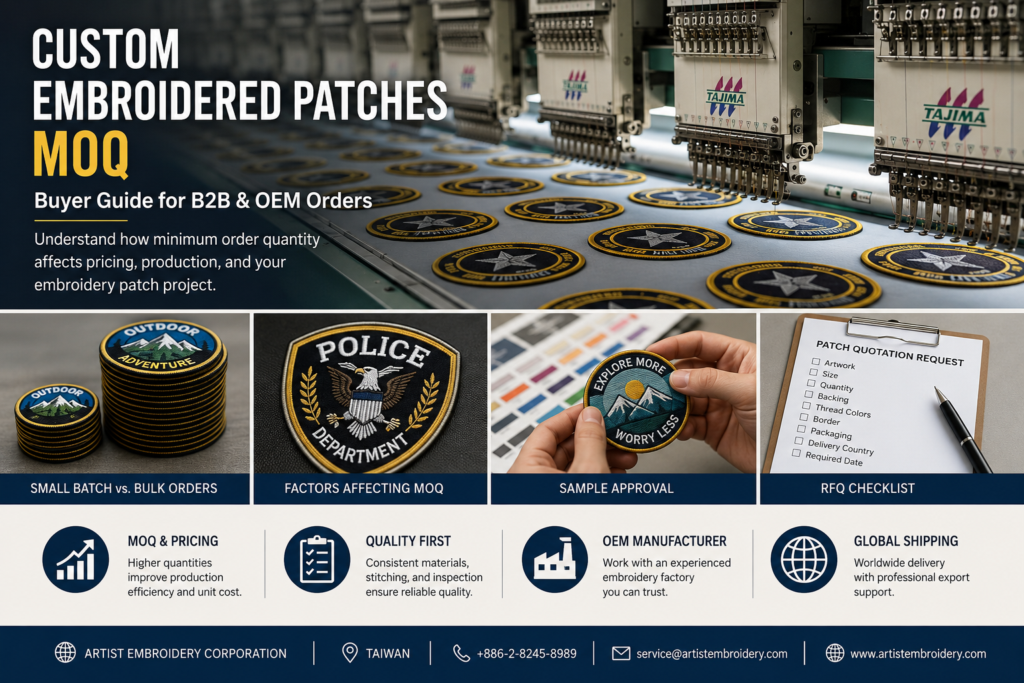
This is one of the first questions B2B buyers ask when sourcing patches from an OEM manufacturer. The answer depends on more than simply choosing the lowest possible quantity. The custom embroidered patches MOQ can be influenced by design complexity, patch size, stitch count, embroidery coverage, backing, materials, production setup, and the manufacturer’s production model.
For buyers, MOQ also affects unit pricing, sampling, inventory planning, and production efficiency. Ordering too few pieces may result in a higher cost per patch, while ordering too many simply to reach a lower price tier can create unnecessary inventory and cash-flow pressure.
This guide explains how custom embroidered patches MOQ works, what factors can affect minimum order requirements, why pricing changes at different quantities, how sample production differs from bulk manufacturing, and what buyers should prepare before requesting an OEM quotation.
Whether you are sourcing embroidered patches for uniforms, brands, promotional products, sports organizations, military or police applications, or wholesale distribution, understanding MOQ will help you make a more informed purchasing decision before placing your order.
What Does MOQ Mean for Custom Embroidered Patches?
When sourcing custom patches from an OEM manufacturer, one of the first terms international buyers encounter is MOQ, or Minimum Order Quantity. In simple terms, the custom embroidered patches MOQ refers to the minimum number of patches a manufacturer is willing or able to produce for a specific design, size, and specification under a production order. However, MOQ is not simply an arbitrary number established by a supplier. In embroidery manufacturing, it is closely connected to digitizing, machine setup, thread preparation, material handling, production efficiency, quality inspection, finishing, and packaging.
For brands, uniform suppliers, promotional product companies, clubs, military and public-safety organizations, understanding MOQ is important because order quantity directly influences both production feasibility and unit cost. A small order may provide greater purchasing flexibility, while a larger production run can distribute setup and operating costs across more pieces. Therefore, buyers should evaluate MOQ together with price, quality requirements, expected reorder volume, and total project needs rather than treating the minimum quantity as an isolated purchasing condition.
Understanding Minimum Order Quantity in Embroidery Manufacturing
Minimum Order Quantity represents the smallest production quantity that can be reasonably processed under a manufacturer’s standard production conditions. For custom embroidered patches, each new design normally requires several preparation steps before mass production begins. Artwork must first be evaluated for embroidery feasibility, converted into an embroidery-ready stitch file, and adjusted according to the patch’s dimensions, stitch density, thread colors, border type, backing, and other specifications.
After digitizing, the production team must prepare the embroidery machine, load the required threads, arrange the base materials, confirm machine settings, and test the design before continuous production can begin. These steps may be necessary whether the buyer orders a relatively small batch or several thousand patches.
This is why the cost structure of custom embroidery differs from simply purchasing an existing finished product. An off-the-shelf item can be taken directly from inventory, while an OEM embroidered patch is manufactured specifically for the buyer’s artwork and requirements.
For example, a company ordering patches with its corporate logo may require a particular size, Pantone-related color reference, embroidery coverage, border construction, and hook-and-loop backing. Another buyer using the same general patch dimensions may require completely different artwork and materials. Although both orders involve embroidered patches, they represent separate production jobs.
Therefore, buyers comparing a custom patch minimum order should first confirm what the MOQ actually represents. Does it apply to each individual design? Can multiple color variations be combined? Are different sizes treated as separate production runs? Is sampling included or handled separately? Understanding these conditions helps purchasing teams compare quotations more accurately and avoid unexpected differences after an order is placed.
Why Embroidery Manufacturers Set MOQs
An embroidery manufacturer must consider much more than the amount of thread used in each patch. Every production order involves both fixed preparation costs and variable manufacturing costs. Before the first finished patch comes off the production line, time and resources have already been invested in artwork review, embroidery digitizing, machine preparation, thread selection, material preparation, production testing, and operator setup.
For very small quantities, these preparation costs are distributed across only a few pieces. This can make the production cost per patch significantly higher. As quantities increase, the same setup work can be spread across a larger production run, allowing the manufacturer to operate machinery and labor more efficiently.
MOQ also helps factories manage production scheduling. Industrial embroidery machines are designed to produce multiple pieces efficiently, particularly when identical designs and specifications can be run continuously. Constantly stopping machines to replace materials, change thread configurations, reload files, or prepare different patch specifications reduces overall production efficiency.
However, buyers should not assume that a higher MOQ automatically means a better manufacturer. Different factories have different equipment configurations, production capacities, customer profiles, labor structures, and manufacturing processes. A manufacturer focused on large-volume uniform programs may operate very differently from a factory capable of supporting smaller OEM projects.
For this reason, embroidered patch MOQ should be evaluated alongside manufacturing capability, quality consistency, communication, sampling procedures, and pricing. The goal is not necessarily to find the supplier advertising the lowest possible MOQ, but to identify a production partner whose order requirements match the buyer’s actual purchasing needs.
MOQ vs. Production Efficiency
The relationship between MOQ and production efficiency becomes particularly important in bulk embroidered patches. Once a design has been approved and the embroidery machines are properly configured, producing additional identical pieces usually becomes more efficient than repeatedly setting up small production runs.
Consider a simplified example. If a manufacturer needs to prepare an embroidery program, install the required thread colors, position materials, test machine settings, and inspect the initial output, much of this work must be completed before continuous production starts. Whether the final order contains 100, 500, or 1,000 pieces, many of those preparation steps remain necessary.
With larger orders, the factory can maintain longer production runs with fewer interruptions. Operators can monitor consistent stitch quality, thread tension, registration, border finishing, and other production factors across the batch. Materials can also be prepared in larger quantities, while inspection and packaging procedures can be organized more efficiently.
This does not mean buyers should automatically order more patches simply to obtain a lower unit price. Excess inventory creates its own costs, particularly when designs, logos, personnel names, branding standards, or uniform specifications may change.
A better purchasing strategy is to identify the quantity that balances unit cost, inventory requirements, expected consumption, and future reorder frequency. Buyers expecting regular repeat orders may benefit from discussing annual demand or reorder schedules with their OEM manufacturer rather than evaluating each purchase solely on the minimum quantity.
Understanding this relationship helps explain why custom embroidered patches MOQ and pricing are closely connected. MOQ establishes a practical production threshold, while increasing quantities can improve manufacturing efficiency and reduce the impact of setup costs on each finished patch.
📊 Table: How MOQ Works in Custom Embroidery Production
| Production Factor | Small Order | Medium Order | Bulk Order | Why It Matters |
|---|---|---|---|---|
| Digitizing & Setup | Spread across fewer pieces | Better cost distribution | Spread across many pieces | Influences unit cost |
| Machine Setup | Required | Required | Required | Fixed preparation is needed before production |
| Production Run | Short | More efficient | Highly efficient | Longer runs reduce repeated setup |
| Material Preparation | Small batches | Moderate batches | Large batches | Larger quantities can improve workflow |
| Quality Control | Per production batch | Organized batch inspection | Systematic production QC | Helps maintain consistency |
| Packaging | Small-volume handling | Standardized | Bulk workflow possible | Can affect labor efficiency |
| Inventory Risk | Lower | Moderate | Higher | Buyers should avoid unnecessary over-ordering |
| Unit Cost Potential | Usually higher | More competitive | Usually lower | Fixed costs are distributed across more pieces |
📖 Extended Reading
- OEM Embroidered Patch Manufacturer: Complete Buyer Guide for Custom Patches
- How to Order Custom Embroidered Patches: Step-by-Step Guide
- High-Density Embroidery & Stitch Count: What Buyers Should Know
What Is a Typical Custom Embroidered Patches MOQ?
There is no single custom embroidered patches MOQ that applies to every manufacturer or every project. Minimum order requirements can vary depending on the factory’s production model, equipment configuration, patch specifications, design complexity, materials, finishing requirements, and expected production volume. For this reason, buyers may encounter very different minimum quantities when requesting quotations from multiple embroidered patch suppliers.
Rather than focusing only on the lowest number a supplier is willing to accept, B2B buyers should consider whether the proposed order quantity is appropriate for the intended application. A brand preparing a limited product launch may have very different requirements from a uniform distributor purchasing patches for recurring programs. Likewise, a promotional company testing a new design may prioritize flexibility, while an established importer may focus more heavily on competitive unit pricing and production consistency across thousands of pieces.
Understanding the difference between small-batch, medium-volume, and bulk production helps buyers determine which purchasing strategy provides the best balance between cost, inventory, and production efficiency.
Small-Batch Custom Patch Orders
Small-batch production is often suitable for buyers who need limited quantities, are testing a new design, or do not yet have predictable demand. Depending on the manufacturer and product specifications, a small production run may involve dozens or a few hundred pieces per design.
These orders are commonly used for product development, small organizations, limited-edition merchandise, local clubs, startup brands, event programs, specialty uniforms, or initial market testing. For a buyer introducing a new embroidered patch design, ordering a smaller quantity can reduce inventory exposure and provide an opportunity to evaluate the finished product before committing to larger volumes.
However, a small custom patch minimum order does not necessarily mean the lowest overall purchasing cost. Embroidery digitizing, machine preparation, thread setup, material preparation, testing, finishing, and quality control are still required even when only a limited number of patches are produced. Because these preparation costs are distributed across fewer pieces, the price per patch is usually higher than it would be for a larger production run.
Buyers should therefore distinguish between low MOQ and low unit price. They are not the same thing.
A low MOQ can provide flexibility, but it may come with a higher cost per piece. This can still make financial sense when the buyer wants to avoid excess inventory or validate a product before scaling. For example, a brand launching a new collection may prefer a smaller initial batch even if each patch costs more, because unsold inventory could ultimately cost far more than the difference in manufacturing price.
When requesting a small-batch quotation, buyers should provide complete specifications from the beginning, including artwork, dimensions, quantity, backing, border type, and any special finishing requirements. Accurate information allows the manufacturer to determine whether the requested quantity is practical for the design and production process.
Medium-Volume Production
Medium-volume orders often provide an effective balance between purchasing flexibility and manufacturing efficiency. Although exact quantities vary by manufacturer and project, orders in the hundreds to low thousands of pieces generally allow more production costs to be distributed across the batch while avoiding the inventory commitment associated with very large orders.
This production level can be especially suitable for established brands, uniform suppliers, promotional product distributors, schools, clubs, sports organizations, security companies, corporate programs, and other buyers with reasonably predictable demand.
For example, a uniform supplier may need the same embroidered emblem across several delivery cycles, while a promotional merchandise company may already have confirmed customer demand before placing the manufacturing order. In these situations, purchasing only the absolute embroidered patch MOQ may not provide the best value.
Medium-volume production can improve machine utilization because the same embroidery program, thread configuration, materials, and specifications remain in production for a longer period. This reduces the frequency of setup changes and allows the factory to organize cutting, embroidery, finishing, inspection, and packaging more efficiently.
Buyers should also consider expected reorder frequency. If a company regularly consumes several hundred patches every few months, it may be useful to compare the cost and operational impact of placing several smaller orders against producing a larger quantity at one time.
However, price should not be the only consideration. Storage capacity, cash flow, design changes, branding updates, employee turnover, uniform revisions, and product lifecycle should all be considered before increasing order quantities.
The most economical quantity is therefore not always the largest possible order. It is the quantity that provides a reasonable unit cost while matching realistic consumption and inventory requirements.
Bulk and Wholesale Embroidered Patch Orders
Bulk embroidered patches and wholesale embroidered patches are generally associated with larger production runs intended for distribution, retail programs, uniform supply contracts, promotional campaigns, or recurring organizational use. These orders may range from several thousand pieces to substantially larger quantities depending on the buyer and application.
At this scale, production planning becomes increasingly important. The manufacturer must coordinate raw materials, embroidery machine capacity, production schedules, quality control, finishing, packaging, and delivery requirements. Buyers should therefore evaluate not only the quoted unit price but also whether the supplier has sufficient production capability to maintain consistent quality throughout the complete order.
Larger quantities can provide significant manufacturing efficiencies. Once the embroidery design and machine configuration have been approved, longer production runs reduce repeated setup and allow fixed preparation costs to be distributed across more finished pieces. Material purchasing and packaging workflows may also become more efficient.
However, large-volume buyers should pay particular attention to consistency. A small sample may look excellent, but the real test of an OEM manufacturer is whether thousands of finished patches maintain consistent dimensions, thread colors, embroidery density, border quality, backing application, and overall appearance.
This is why sample approval, production specifications, and quality standards should be clearly established before bulk production begins.
Buyers should also avoid ordering unnecessary quantities simply because a supplier offers a lower price tier. A lower unit cost can appear attractive, but excess inventory may offset those savings if the design later changes or demand is lower than expected.
For recurring wholesale programs, buyers may benefit from discussing projected annual volume with the manufacturer. This can help both sides plan production more efficiently while allowing purchasing teams to make informed decisions about individual order quantities.
Ultimately, the right custom embroidered patches MOQ depends on more than the manufacturer’s minimum requirement. Buyers should consider their actual demand, target unit cost, inventory strategy, design lifecycle, reorder frequency, and quality expectations before selecting an order quantity.
📊 Table: Typical Order Volumes for Custom Embroidered Patches
| Order Volume | Typical Buyer Profile | Main Advantage | Main Consideration |
|---|---|---|---|
| Sample / Prototype | New buyers, product development teams | Evaluate design and quality | Not equivalent to mass-production pricing |
| Small Batch | Startups, clubs, limited releases, small programs | Lower inventory commitment | Higher potential unit cost |
| Medium Volume | Brands, uniform suppliers, promotional companies | Balance of cost and flexibility | Requires demand planning |
| Bulk Order | Importers, distributors, large organizations | Greater production efficiency | Higher inventory commitment |
| Recurring Wholesale | Distributors, uniform programs, established brands | Predictable long-term production | Requires consistent specifications and forecasting |
💡 Important: These categories describe general purchasing scenarios rather than fixed industry MOQ requirements. Actual minimum quantities depend on the manufacturer and the specifications of each custom embroidery project.
📖 Extended Reading
- Embroidered Patch Backing Comparison: Choosing the Right Backing
- Embroidered Badge Durability Guide: What Buyers Should Know
- Custom Embroidered Patches for Uniform Applications
What Factors Affect the MOQ for Embroidered Patches?
The custom embroidered patches MOQ is not determined by quantity alone. Two buyers may request exactly the same number of patches but receive different production recommendations or quotations because their designs require different materials, stitch counts, embroidery coverage, thread colors, backing systems, borders, or finishing processes. From an OEM manufacturing perspective, each of these specifications can affect machine time, material preparation, labor requirements, production efficiency, and quality control.
This is especially important when comparing quotations from different embroidered patch manufacturers. A lower price or MOQ may initially appear more attractive, but the specifications behind the quotation may not be identical. One supplier may quote a partially embroidered patch with a standard backing, while another may calculate the price based on full embroidery, hook-and-loop backing, additional thread colors, or a more complex border.
For B2B buyers, the best approach is to provide the same specifications to every potential supplier and compare quotations on an equivalent basis. Understanding the factors below can also help purchasing teams identify which design decisions have the greatest impact on production.
Patch Size and Stitch Count
Patch dimensions are among the most fundamental specifications in embroidery manufacturing. In general, a larger embroidered patch requires more base material and often requires more stitches to complete the design. However, size alone does not determine production complexity.
Two patches measuring the same width and height can have dramatically different stitch counts.
For example, a simple 10 cm patch featuring large lettering and open background areas may require substantially fewer stitches than another 10 cm patch containing a detailed emblem, multiple objects, small lettering, dense backgrounds, and extensive color changes. This means that stitch count can sometimes provide a more useful indication of production workload than physical dimensions alone.
Higher stitch counts generally require longer machine running time. They can also increase thread consumption and place greater demands on digitizing, material stabilization, thread tension, and quality control.
Buyers should therefore avoid assuming that all patches of the same size should have the same price or production requirements.
The shape of the patch can also influence manufacturing. Standard circles, rectangles, shields, and simple contours may be relatively straightforward, while complex silhouettes or narrow protruding sections can require additional attention during embroidery, cutting, border finishing, or inspection.
For an accurate quotation, buyers should provide actual dimensions rather than simply describing a patch as “small,” “medium,” or “large.” Measurements should ideally be given in inches, centimeters, or millimeters, together with the final artwork.
When an OEM manufacturer reviews both the dimensions and artwork, it can better estimate stitch count, machine time, materials, and overall production requirements. This information helps determine an appropriate embroidered patch MOQ and unit pricing for the specific project.
Embroidery Coverage and Design Complexity
Embroidery coverage describes how much of the visible patch surface is covered with embroidery thread. A design with significant exposed base fabric may require considerably fewer stitches than a fully embroidered design where nearly the entire surface is filled with thread.
This difference directly affects production time and thread consumption.
For example, a patch with approximately 50% embroidery coverage may use the base fabric as part of the visual design. In contrast, a patch approaching full embroidery coverage requires stitched backgrounds in addition to logos, lettering, borders, and other design elements.
Greater coverage does not automatically mean better quality. The appropriate embroidery percentage depends on the desired appearance, application, artwork, and budget.
Design complexity is equally important. Small lettering, narrow outlines, gradients interpreted through thread, overlapping elements, detailed logos, and complex shapes may require careful digitizing to reproduce effectively in embroidery.
Unlike printing, embroidery uses physical stitches with measurable thickness and spacing. Extremely fine artwork may therefore need to be simplified or adjusted before production.
For B2B buyers, this is an important distinction. A manufacturer that recommends modifying certain artwork details is not necessarily reducing quality. In many cases, simplifying very small elements can improve legibility, stitch stability, production consistency, and the overall appearance of the finished patch.
Complex designs can also require more sample adjustments before mass production. This may influence the practical production threshold, lead time, and total project cost.
When comparing custom embroidered patch minimum order requirements, buyers should therefore confirm whether each supplier is quoting the same embroidery coverage and design interpretation. Otherwise, apparently similar quotations may represent significantly different finished products.
Thread Colors and Material Requirements
Thread selection has both visual and production implications. Most embroidered patches use multiple thread colors to reproduce logos, insignia, lettering, symbols, and decorative elements. Each additional color may require machine preparation and thread management, particularly when the design uses colors that are not already configured for the production run.
Color changes can also affect embroidery efficiency. Modern industrial multi-needle embroidery machines are designed to handle multiple thread colors efficiently, but highly complex color combinations still require proper programming, preparation, and monitoring.
Buyers should provide clear color references whenever accurate brand reproduction is important. Pantone references, approved physical samples, or other standardized color information can help reduce ambiguity during sampling and production.
Material selection also matters. Different base fabrics, twills, threads, stabilizers, and specialty materials may require different handling or production techniques. If a project requires a non-standard material or a specially sourced component, the manufacturer’s purchasing requirements can influence the practical MOQ.
For example, a standard material already used regularly in production may be available without a large purchasing commitment. A unique fabric color or specialty component, however, may need to be ordered specifically for one project.
This is one reason buyers should disclose special material requirements at the quotation stage rather than after pricing has already been confirmed.
For repeat programs, standardizing thread colors and materials can also make future orders easier to manage. Maintaining consistent specifications helps the manufacturer reproduce the same appearance across different production batches and reduces unnecessary variation between orders.
Backing, Border, and Finishing Options
The backing and border of an embroidered patch are sometimes treated as minor details, but they can significantly affect the manufacturing process and final application.
Common backing options include sew-on construction, adhesive backing, iron-on backing, and hook-and-loop backing. Each option involves different materials and finishing steps after embroidery.
For example, a sew-on patch may require relatively straightforward finishing, while a hook-and-loop patch requires additional backing material that must be securely attached and accurately aligned. Depending on the project, buyers may also require both hook and loop components, custom-cut backing, or other specialized configurations.
Border construction is another important consideration. Merrowed borders are commonly used for traditional patch shapes with continuous outer edges, while heat-cut or laser-cut edges can be more suitable for complex contours and irregular shapes.
The artwork and patch shape therefore influence which border method is most appropriate.
Additional finishing requirements—such as individual packaging, labeling, special folding, sorting by design, or separating patches into multiple shipment groups—can further affect labor and production planning.
For buyers comparing bulk embroidered patches, these details should always be included in the RFQ. A quotation for 1,000 sew-on patches cannot be accurately compared with another quotation for 1,000 patches using hook-and-loop backing and individual packaging.
The key principle is simple: MOQ, unit price, and specifications must be evaluated together.
A reliable quotation should clearly identify the dimensions, quantity, embroidery requirements, backing, border, packaging, and other relevant specifications. This allows buyers to compare suppliers on an equivalent basis and reduces the likelihood of unexpected cost changes after production begins.
📊 Table: Key Factors That Can Affect Patch MOQ and Cost
| Factor | Production Impact | Potential Cost Impact | What Buyers Should Provide |
|---|---|---|---|
| Patch Size | Affects material usage and potential stitch count | Larger sizes may increase cost | Exact dimensions |
| Stitch Count | Determines embroidery machine time | Higher stitch counts can increase cost | Final artwork |
| Embroidery Coverage | Affects thread usage and production time | Higher coverage may increase cost | Desired appearance / artwork |
| Design Complexity | Influences digitizing and production stability | Complex details may require more preparation | High-resolution artwork |
| Thread Colors | Requires thread preparation and color management | Many or special colors may affect production | Color references |
| Base Material | Determines preparation and embroidery compatibility | Specialty materials may increase sourcing requirements | Material preference |
| Backing | Adds materials and finishing processes | Hook-and-loop, iron-on, or adhesive may add cost | Required application |
| Border | Determines edge-finishing method | Complex contours may require different finishing | Final patch shape |
| Packaging | Adds handling and labor | Individual packaging may increase cost | Packaging requirements |
📖 Extended Reading
- Velcro Embroidered Patches: A Complete Guide to Hook-and-Loop Backing
- Laser Cutting in Embroidery: Precision Finishing for Complex Patch Shapes
- How to Design Artwork for Embroidery: A Guide for Better Production Results
Why Does the Unit Price Drop at Higher Order Quantities?
One of the most common questions buyers ask when comparing custom embroidered patches MOQ and pricing is why the unit price decreases as the order quantity increases. A quotation for 100 patches may have a noticeably higher price per piece than an order for 500, 1,000, or several thousand pieces, even when the artwork and specifications remain exactly the same.
The reason is not simply that manufacturers offer a “bulk discount.” Custom embroidery includes several preparation and production costs that must be incurred before efficient mass production can begin. Digitizing, machine setup, thread preparation, material handling, testing, quality control, finishing, and packaging all require labor and production resources. Some of these costs remain relatively similar regardless of whether the order is small or large.
As the production quantity increases, these fixed or semi-fixed costs can be distributed across more finished patches. At the same time, longer production runs generally improve machine utilization and workflow efficiency. Understanding this cost structure helps buyers evaluate quotations more accurately and determine whether increasing an order quantity actually makes financial sense for their project.
Digitizing and Production Setup Costs
Before an embroidered patch can enter mass production, the original artwork must be converted into instructions that an industrial embroidery machine can execute. This process is commonly known as embroidery digitizing.
Digitizing is more than simply converting an image file into another format. The embroidery program must define stitch types, stitch directions, densities, sequences, underlay structures, color changes, and other parameters that influence the appearance and stability of the finished patch.
A detailed design containing small lettering, multiple shapes, dense backgrounds, or overlapping elements may require more careful programming than a simple logo. The digitized file may also need to be adjusted after an initial sample is produced.
Once the embroidery file is ready, additional preparation is required before production. Operators must confirm the thread colors, prepare materials, load the embroidery program, configure the machines, and test the first production pieces.
These preparation steps are required even for relatively small orders.
For example, if the same setup process is required for both 100 and 1,000 identical patches, the preparation cost of the smaller order is distributed across only 100 pieces. With the larger order, the same initial setup is spread across substantially more units.
This is one of the fundamental reasons why a low embroidered patch MOQ can be useful for flexibility but may result in a higher unit price.
Buyers should therefore distinguish between setup-related costs and the incremental cost of producing each additional patch. Understanding this distinction makes quantity-based pricing easier to evaluate.
Machine Efficiency and Production Runs
Industrial embroidery production becomes more efficient when machines can continuously produce the same design without frequent interruptions.
Once the artwork, stitch program, materials, thread colors, machine settings, and quality standards have been confirmed, a longer production run allows the factory to maintain a more consistent workflow. Operators spend proportionally less time switching between designs, changing production configurations, preparing new materials, or restarting different jobs.
This is particularly important in bulk embroidered patch production.
Industrial multi-head embroidery machines can embroider multiple pieces simultaneously. When the same design is repeated across a larger quantity, the manufacturer can make better use of this capacity. The production team can also organize subsequent processes—including cutting, edge finishing, backing application, inspection, and packaging—in larger and more standardized batches.
Equipment capability also matters. Professional industrial embroidery systems, such as those developed by Tajima Group – Industrial Embroidery Technology, are designed to support consistent multi-head embroidery production and efficient manufacturing workflows.
However, machine efficiency should never be interpreted as simply running equipment faster. Excessive production speed can affect thread tension, registration, small lettering, stitch formation, and overall consistency depending on the design and material.
An experienced manufacturer must balance productivity with quality requirements. This is especially important when thousands of patches need to match an approved sample rather than merely meet a production quantity.
For buyers, this means that larger quantities can improve manufacturing efficiency, but production capability and quality control remain just as important as the quoted unit price.
Material Purchasing and Labor Efficiency
Materials represent another component of embroidered patch pricing. Depending on the specification, production may require base fabric, embroidery thread, backing materials, stabilizers, hook-and-loop components, adhesive layers, packaging, and other supplies.
Larger production runs can allow these materials to be prepared and consumed more efficiently. Instead of repeatedly preparing small amounts for multiple short jobs, the factory can organize materials around a longer continuous production schedule.
Thread quality is especially important because embroidery thread affects color consistency, surface appearance, production stability, and the durability of the finished embroidery. Professional thread suppliers such as FuFu’s Thread – Professional Embroidery Threads provide embroidery threads developed for industrial production applications.
Labor efficiency also improves as production becomes more standardized.
Employees are involved in multiple stages of the manufacturing process, including material preparation, machine operation, trimming, cutting, backing application, border finishing, inspection, counting, sorting, and packaging. With larger quantities of identical patches, these tasks can often be organized into consistent workflows rather than repeatedly changing specifications between small jobs.
This does not mean labor becomes insignificant at higher quantities. Instead, the labor required for preparation and handling is distributed more efficiently across the production run.
For buyers comparing wholesale embroidered patches, it is therefore useful to understand that quantity pricing reflects the efficiency of the complete manufacturing process—not simply lower thread or fabric costs.
Packaging and Quality Control Costs
Quality control remains necessary regardless of order quantity. Finished patches may need to be checked for embroidery defects, incorrect thread colors, damaged borders, backing problems, dimensional inconsistencies, loose threads, contamination, or other issues before shipment.
Small orders and large orders both require inspection procedures, but the way these procedures are organized can differ.
In a larger production run, quality checks can be integrated into standardized batch workflows. The factory may inspect output during embroidery, after edge finishing, after backing application, and again during final counting and packaging.
This structured workflow can improve efficiency while helping identify production issues before they affect the entire batch.
Packaging follows a similar pattern. Preparing packaging materials, counting quantities, sorting designs, applying labels, and arranging cartons all require labor. When hundreds or thousands of identical patches are processed together, these operations can generally be organized more efficiently than handling many unrelated small orders.
However, customized packaging can change the calculation. Individual polybags, barcode labels, retail cards, sorting by location, or multiple shipping destinations may add significant handling requirements even when the embroidery itself is identical.
This is why buyers should specify packaging requirements when requesting a quotation rather than assuming packaging has little effect on price.
Ultimately, the relationship between custom embroidered patches MOQ and unit price is driven by the economics of the complete production process. Larger orders allow preparation costs to be spread across more pieces and can improve machine, material, labor, inspection, and packaging efficiency.
But a lower unit price does not automatically mean a larger order is the better purchasing decision. Buyers should compare the savings against inventory requirements, cash flow, expected consumption, storage, and the possibility of future design changes.
📊 Table: How Order Quantity Affects Cost per Patch
| Cost Component | Smaller Order | Larger Order | Why Unit Cost May Change |
|---|---|---|---|
| Digitizing | Spread across fewer pieces | Spread across more pieces | Fixed preparation becomes less significant per unit |
| Machine Setup | Higher impact per piece | Lower impact per piece | Setup is required before production |
| Machine Utilization | Short production run | Longer continuous run | Larger runs improve production efficiency |
| Thread & Materials | Prepared in smaller batches | More efficient batch preparation | Material handling can improve |
| Labor | More setup impact per piece | More standardized workflow | Repetitive production improves efficiency |
| Quality Control | Required | Required | Larger batches allow structured QC workflows |
| Packaging | Small-volume handling | Batch processing | Standard packaging can become more efficient |
| Inventory for Buyer | Lower | Higher | Lower unit price must be balanced against inventory risk |
💡 Key Buyer Takeaway: A lower price at higher quantities is primarily the result of improved production efficiency and better distribution of preparation costs. Buyers should select an order quantity based on total purchasing value—not unit price alone.
📖 Extended Reading
- OEM Embroidered Patch Manufacturer vs. Trading Company: What Buyers Should Know
- Complete Guide to Embroidered Patches: Materials, Production, and Applications
- Sustainable Embroidered Patches: Materials and Responsible Production
MOQ vs. Price: How Buyers Should Compare Patch Quotations
When sourcing custom patches internationally, buyers often compare suppliers by looking at two numbers first: the custom embroidered patches MOQ and the unit price. While both are important, neither should be evaluated independently. A quotation with a lower MOQ may offer greater flexibility but have a higher unit cost, while a larger minimum order may provide a more competitive price but require more inventory investment. More importantly, two quotations that appear to describe the same embroidered patch may actually be based on different materials, embroidery coverage, backing, border construction, packaging, quality standards, or shipping terms.
For professional B2B purchasing, the goal should not simply be to identify the lowest quoted price. Buyers should determine whether each supplier is quoting the same product specification and what is included in the total cost. A reliable comparison considers MOQ, unit price, setup charges, sample costs, specifications, quality expectations, production lead time, packaging, shipping terms, and potential reorder requirements.
Using a standardized RFQ allows buyers to compare quotations on an equivalent basis and reduces the risk of selecting a supplier based on a price that does not represent the actual finished product.
Why the Lowest MOQ Is Not Always the Best Deal
A low MOQ can be valuable, particularly for startups, new product launches, limited-edition programs, market testing, or buyers who want to minimize inventory. However, the supplier offering the lowest custom patch minimum order is not automatically providing the best purchasing value.
Small production runs still require artwork review, digitizing, machine setup, material preparation, embroidery testing, finishing, quality control, and packaging. When these costs are distributed across fewer pieces, the price per patch may be significantly higher.
For example, imagine that Buyer A needs approximately 500 patches over the next several months. Supplier One offers a very low MOQ but charges a higher unit price, while Supplier Two requires a moderately larger production quantity but provides a lower cost per piece. Selecting Supplier One solely because its MOQ is lower may not be the most economical decision if Buyer A already has predictable demand for the larger quantity.
The opposite can also be true.
A buyer should not order several thousand patches simply because the price per piece looks attractive. If only a few hundred are realistically needed, the unused inventory represents tied-up cash, storage requirements, and potential waste if the logo, artwork, uniform standard, or product design changes.
MOQ should therefore be viewed as a purchasing flexibility factor, not a standalone indicator of supplier quality or overall value.
The best order quantity is generally the one that balances production economics with actual demand, inventory turnover, cash flow, and future reorder plans.
Compare Total Cost Instead of MOQ Alone
Unit price is only one component of the total purchasing cost.
Depending on the manufacturer and project, a quotation may include or exclude embroidery digitizing, sampling, mold or setup charges, backing materials, special borders, individual packaging, labels, international shipping, import duties, taxes, or other services.
This makes headline price comparisons potentially misleading.
Suppose one supplier quotes a lower price per patch but charges separately for several production and finishing requirements. Another supplier may quote a slightly higher unit price but include more of the required specifications. Looking only at the initial unit price could therefore lead the buyer to the wrong conclusion.
B2B buyers should calculate the total landed or project cost wherever possible.
The quotation should also specify the pricing tiers available at different quantities. Instead of asking only, “What is your MOQ?”, buyers can request pricing at several realistic volumes—for example, their expected initial order, a medium-volume order, and a potential bulk order.
This allows purchasing teams to see where meaningful economies of scale occur.
The lowest price tier should not automatically determine the order quantity. Buyers should compare the additional cash commitment required to reach that tier against the actual savings generated.
A good purchasing decision considers total cost, usable inventory, expected demand, and reorder frequency together.
Watch for Differences in Patch Specifications
One of the most common mistakes when comparing embroidered patch quotations is assuming that every supplier has interpreted the RFQ in exactly the same way.
A quote can change substantially depending on specifications such as:
- Finished patch dimensions
- Embroidery coverage
- Estimated stitch count
- Number of thread colors
- Base fabric
- Border construction
- Backing type
- Hook-and-loop configuration
- Packaging
- Quantity per design
- Quality requirements
- Shipping terms
For example, one manufacturer may quote a patch based on partial embroidery with visible twill fabric, while another interprets the artwork as requiring nearly full embroidery coverage. One quotation may include hook-and-loop backing, while another assumes a standard sew-on finish.
The prices may be different because the products are different—not because one supplier is necessarily more expensive.
Buyers should therefore send the same RFQ information to every supplier and request confirmation of the specifications used for pricing.
Artwork is particularly important. Whenever possible, buyers should provide a clear vector file, PDF, AI, EPS, or high-resolution image together with actual dimensions and production requirements. This gives manufacturers a better basis for evaluating stitch count, design complexity, materials, and finishing.
A structured comparison prevents a seemingly inexpensive quotation from becoming more expensive later when missing specifications are added.
Factory-Direct Manufacturing vs. Trading Companies
Another factor buyers should consider is who will actually manufacture the patches.
A factory-direct embroidered patch manufacturer operates production equipment and manages manufacturing processes internally, while a trading company or intermediary may coordinate production through external factories. Both business models can serve legitimate roles in international sourcing, but the communication structure and level of production visibility can differ.
For projects involving repeat orders, strict specifications, detailed sampling, or large quantities, understanding the actual manufacturing source can become particularly important.
Direct communication with a manufacturer may make it easier to discuss embroidery limitations, stitch adjustments, material options, machine capacity, production scheduling, and quality-control requirements. It can also help buyers understand why certain design changes are recommended before mass production.
However, buyers should not assume that the word “factory” on a website automatically proves manufacturing capability.
Useful indicators can include production equipment, factory photographs or videos, manufacturing-process documentation, sample-development capability, quality-control procedures, and the supplier’s ability to answer detailed technical questions about embroidery production.
This is especially relevant when comparing embroidered patch MOQ and pricing. A quotation should be evaluated not only by its numbers but also by whether the supplier can reliably reproduce the approved design at the required quantity and quality level.
For long-term B2B sourcing, consistency, transparency, communication, and production reliability can be more valuable than a small difference in unit price.
📊 Table: What Buyers Should Compare in an Embroidered Patch Quote
| Comparison Item | What to Check | Why It Matters |
|---|---|---|
| MOQ | Minimum quantity per design/specification | Determines purchasing flexibility |
| Unit Price | Price at several quantity tiers | Shows potential economies of scale |
| Patch Size | Exact finished dimensions | Directly affects materials and stitch requirements |
| Embroidery Coverage | Partial or full embroidery | Can significantly change production cost |
| Stitch Complexity | Detail level and estimated stitch workload | Influences machine time |
| Thread Colors | Standard or special colors | Affects preparation and color matching |
| Backing | Sew-on, iron-on, adhesive, hook-and-loop | Changes material and finishing requirements |
| Border | Merrowed, heat-cut, laser-cut, or other finish | Must match patch shape and design |
| Sample | Cost, process, and approval procedure | Reduces mass-production risk |
| Setup Charges | Digitizing or other initial charges | Affects total project cost |
| Packaging | Bulk or individual packaging | Can add materials and labor |
| Lead Time | Sampling and mass-production schedule | Important for launch and delivery planning |
| Shipping Terms | Freight and delivery responsibility | Influences total landed cost |
| Quality Control | Inspection and consistency procedures | Critical for repeat and bulk orders |
| Manufacturer Type | Factory-direct or intermediary | Affects production visibility and communication |
💡 Buyer Tip: When comparing quotations, create one specification sheet and send the same information to every potential supplier. The more standardized the RFQ, the more meaningful the price comparison becomes.
📖 Extended Reading
- Taiwan vs. China Embroidered Patch Manufacturers: Which One Is Better?
- Embroidered Badges vs. Printed Badges: Comparison Guide
- Flag Embroidered Patches: OEM Manufacturing Guide
Sample Orders vs. MOQ for Mass Production
Before committing to a bulk order, many B2B buyers want to see a physical sample of their custom embroidered patch. This is especially important for new designs, new suppliers, detailed logos, strict color requirements, uniform programs, or large-volume orders. However, a sample order and the custom embroidered patches MOQ for mass production are two different concepts. A manufacturer may be able to produce one or several prototypes for evaluation without treating that quantity as its standard production MOQ.
Sampling serves a different purpose from mass production. Its primary goal is to verify whether the artwork has been translated effectively into embroidery and whether the proposed specifications meet the buyer’s expectations. The sample can reveal issues involving lettering, stitch density, thread colors, dimensions, border construction, backing, and overall appearance before hundreds or thousands of pieces are produced.
For professional buyers, sampling should therefore be viewed as a risk-control stage rather than simply an opportunity to purchase a very small quantity. A well-managed sample approval process can reduce misunderstandings, establish a clear production standard, and make subsequent bulk production more predictable.
What Is an Embroidered Patch Sample?
An embroidered patch sample is a prototype produced before mass production to demonstrate how the buyer’s artwork will appear when converted into physical embroidery.
The process typically begins with artwork review and embroidery digitizing. During digitizing, the manufacturer determines how the design should be reconstructed using stitches, including stitch types, directions, densities, underlay, sequencing, and color changes.
This step is particularly important because artwork displayed on a computer screen does not always translate directly into embroidery.
Very small lettering, narrow lines, complex gradients, tiny gaps, and highly detailed illustrations may need adjustment. Embroidery thread has physical thickness, and the fabric can respond differently depending on stitch density and direction. A design that looks perfect as a digital image may therefore require modification to achieve a clean embroidered result.
Once the embroidery program has been prepared, a physical sample allows both the buyer and manufacturer to evaluate the design under actual production conditions.
Depending on the project, buyers may review:
- Overall dimensions and shape
- Logo proportions
- Lettering clarity
- Thread colors
- Embroidery coverage
- Stitch density
- Border appearance
- Backing construction
- Small design details
- Overall visual balance
A sample is particularly valuable when a buyer is working with a new manufacturer. Instead of relying solely on photographs of unrelated products, the buyer can evaluate how the factory interprets its own artwork and specifications.
However, sample availability should not be confused with small batch embroidered patch MOQ. A manufacturer may produce a limited number of samples because sampling is part of the development process, while normal production requires a different minimum quantity.
Why Sample Approval Matters Before Bulk Production
Sample approval establishes a reference point between the buyer and manufacturer before mass production begins.
Without an approved reference, descriptions such as “dark blue,” “small lettering,” “thick border,” or “high embroidery coverage” can be interpreted differently. Even detailed artwork cannot communicate every physical characteristic of an embroidered product.
A physical sample makes these requirements more concrete.
For example, a buyer may discover that certain lettering appears too small after embroidery, a background area should use a different stitch direction, or a border needs to be adjusted to improve the overall shape. Identifying these issues during sampling is significantly easier than discovering them after thousands of patches have already been completed.
For bulk embroidered patches, the importance of sample approval increases with order size. The financial and operational impact of a specification error becomes much greater when the same issue is repeated across a large production run.
Buyers should review samples carefully and provide clear, consolidated feedback. Instead of sending multiple rounds of unrelated comments, purchasing or design teams should ideally collect all requested changes into one structured revision.
Once the final sample is approved, both parties should retain the approved specifications as the production reference.
This may include artwork, dimensions, thread-color references, backing, border type, packaging instructions, and other relevant requirements.
For recurring programs, maintaining an approved specification can also help improve consistency between repeat orders.
Sample Cost vs. Mass Production Cost
Buyers are sometimes surprised that a single embroidered sample can cost substantially more per piece than the quoted price for a bulk order.
The reason is straightforward: most of the initial development and setup work still needs to be completed even though only a very small number of pieces are produced.
Artwork must be reviewed. The design may need to be digitized. Thread colors must be prepared. Materials must be arranged. The embroidery machine must be configured. The sample must be produced, finished, inspected, and sometimes shipped internationally.
These activities cannot be divided across hundreds or thousands of pieces when only one or several samples are being made.
Therefore, the price of a sample should not be used to estimate the eventual mass-production unit price.
Likewise, the ability to produce a sample does not mean the manufacturer’s standard embroidered patch MOQ is one piece.
Sample charges can vary depending on design complexity, digitizing requirements, materials, backing, revisions, shipping, and supplier policies. Some manufacturers may separate digitizing and sample charges, while others may structure development costs differently.
Buyers should confirm these details before beginning the sample process.
For international sourcing, sample shipping can also represent a meaningful portion of the total development cost. If several designs are being evaluated at the same time, buyers may want to discuss whether samples can be consolidated into one shipment.
The important principle is to evaluate sample cost as part of product development and production risk management, rather than comparing it directly with bulk unit pricing.
What Buyers Should Check During Sample Approval
A good sample review should be systematic. Buyers should avoid approving a patch based only on a quick visual impression, especially when the design will later enter large-scale or recurring production.
Begin with dimensions. Confirm that the finished width and height match the required specification and that the overall shape is correct.
Next, review the artwork reproduction. Check whether logos, symbols, text, borders, and important design elements are proportionally accurate. Small lettering should be readable, and critical details should not merge together.
Thread colors should also be evaluated carefully. Screen colors can differ from physical embroidery thread, so buyers with strict corporate or organizational color standards should provide clear references during development.
The physical construction should then be checked. Confirm the embroidery coverage, border method, backing type, patch thickness, flexibility, and attachment system.
For hook-and-loop embroidered patches, buyers should verify the backing dimensions and attachment quality. For iron-on or adhesive options, the intended application should be considered before approval.
Finally, evaluate the sample from the perspective of its actual use. A patch intended for a tactical uniform may have different requirements from one designed for fashion, promotional merchandise, sports apparel, or collectibles.
The approved sample should represent the standard that mass production is expected to follow.
For this reason, buyers should avoid approving a sample while simultaneously requesting unresolved changes. Any necessary revisions should ideally be completed and confirmed before the custom embroidered patches MOQ enters mass production.
📊 Table: Sample Production vs. Bulk Production
| Item | Sample Production | Mass Production | Why It Matters |
|---|---|---|---|
| Primary Purpose | Design and quality verification | Produce final order quantity | Different stages serve different goals |
| Quantity | Usually very limited | Based on production MOQ/order | Sample quantity is not the production MOQ |
| Digitizing | Often required | Uses approved production file | Development occurs before bulk production |
| Machine Setup | Required | Required | Setup cost has greater impact on samples |
| Unit Cost | Usually much higher | Lower at larger quantities | Costs are distributed differently |
| Design Changes | Expected during development | Should be minimized after approval | Late changes can disrupt production |
| Color Review | Confirm thread selection | Follow approved reference | Improves consistency |
| Backing & Border | Verify construction | Repeat approved specification | Prevents specification errors |
| Quality Standard | Establish reference | Maintain approved standard | Important for bulk consistency |
| Buyer Decision | Approve or revise | Receive and inspect final goods | Approval should occur before production |
💡 Buyer Tip: Treat the approved sample as a production reference, not simply a preview. Keep the final artwork, dimensions, thread colors, backing, border, and other specifications documented for future production and repeat orders.
📖 Extended Reading
- Police Name Patches: Design and OEM Manufacturing Guide
- Military, Police & Firefighter Embroidered Patches Guide
- Sports Team Embroidered Badges: Custom Manufacturing Guide
How to Reduce Embroidered Patch Costs Without Sacrificing Quality
Reducing the cost of custom embroidered patches does not necessarily require choosing cheaper materials or lowering quality standards. In many cases, the most effective savings come from improving the design for embroidery, selecting appropriate specifications, and planning the order quantity more efficiently. For B2B buyers, this approach can be particularly valuable because even a small reduction in unnecessary production complexity can become meaningful when applied across hundreds or thousands of patches.
The relationship between custom embroidered patches MOQ, design specifications, and unit price should therefore be considered early in the sourcing process. Patch dimensions, stitch count, embroidery coverage, fine details, backing options, and order volume can all influence manufacturing costs. Instead of asking a manufacturer simply to “make it cheaper,” buyers can work with the factory to identify elements that add cost without contributing significant functional or visual value.
The objective is not to simplify every patch. Military insignia, corporate logos, sports emblems, fashion products, and collectible patches may contain details that must be preserved. The goal is to distinguish essential design features from unnecessary production complexity and develop a specification that achieves the required appearance while remaining suitable for consistent mass production.
Optimize Patch Size and Shape
Patch size affects material usage, potential stitch count, embroidery time, backing consumption, packaging, and sometimes shipping volume. For this reason, reducing the dimensions of an embroidered patch can lower production costs in certain projects.
However, simply making a patch smaller is not always the right solution.
As dimensions decrease, lettering, lines, gaps, and other design elements also become smaller. If a detailed design is reduced too aggressively, certain features may become difficult to reproduce clearly with embroidery thread. The manufacturer may then need to simplify the artwork or modify stitch construction to maintain readability.
Buyers should therefore select patch dimensions based on the intended application first.
A shoulder patch used on a uniform must be large enough to remain visible and proportionate to the garment. A hat patch needs to fit within the available embroidery area. A small brand label may prioritize compact dimensions, while a collectible patch may intentionally use a larger format to showcase detailed artwork.
Shape also matters. Simple circles, rectangles, shields, and smooth contours are generally straightforward to manufacture. Highly irregular shapes with narrow extensions, deep internal angles, or numerous small contours may require more complicated cutting and finishing.
When cost optimization is necessary, buyers can ask the OEM manufacturer whether a slight adjustment to dimensions or outer shape would improve production efficiency without significantly changing the appearance.
The best solution is usually not the smallest possible patch, but the smallest practical size that preserves the important visual and functional requirements of the design.
Simplify Unnecessary Embroidery Details
Embroidery has different technical limitations from printing.
A printed graphic can reproduce extremely fine lines, tiny text, gradients, shadows, and photographic details. Embroidery reconstructs artwork using physical thread, which means every visual element must be translated into stitches.
This creates an opportunity for intelligent design optimization.
Tiny decorative lines that are barely visible on the finished patch may add digitizing complexity and stitch count without improving the overall appearance. Extremely small text may become difficult to read. Closely spaced elements may merge after embroidery, while unnecessary overlapping stitches can create excessive thickness.
Removing or adjusting these elements can sometimes produce a patch that looks cleaner, not cheaper.
For example, a complex logo may contain small background details originally designed for digital or print use. If those details have little visual impact at the final patch size, simplifying them can improve embroidery clarity while reducing unnecessary stitches.
Buyers should therefore be open to technical feedback during artwork review and sampling.
A professional embroidery manufacturer should be able to identify areas where line thickness, lettering size, spacing, stitch direction, or design structure can be adjusted for better production results.
The objective is not to redesign the buyer’s identity. Critical logos, symbols, text, and brand elements should remain accurate. Optimization should focus on details that do not translate effectively into thread.
For bulk production, even modest reductions in unnecessary stitch complexity can improve machine efficiency while helping maintain more consistent results across the complete order.
Select the Right Embroidery Coverage
Another way to control production cost is to select an appropriate embroidery coverage rather than automatically requesting 100% embroidery.
Full embroidery can create a dense, premium appearance, but it is not necessary for every design.
In partial-coverage patches, the base fabric becomes part of the finished visual design. Instead of filling the entire background with stitches, selected areas of twill or another suitable material remain visible while logos, text, borders, and other elements are embroidered on top.
When used appropriately, this can reduce stitch count and machine time without reducing the functional quality of the patch.
The decision should be based on appearance and application.
A design that requires a fully stitched background, specific texture, or high-density visual effect may justify extensive embroidery coverage. Conversely, a simple emblem with a solid background color may work effectively using exposed base fabric.
Buyers should not select embroidery percentage solely by assuming that “more embroidery equals better quality.” Quality depends on the suitability of the design, materials, digitizing, stitch execution, finishing, and consistency.
During quotation or sampling, buyers can ask the manufacturer whether the artwork is better suited to partial or full embroidery and how each option would affect appearance and production.
This is particularly useful when evaluating bulk embroidered patches, where differences in stitch count are multiplied across a large quantity.
Choose the Right Order Quantity
Increasing quantity is one of the most obvious ways to reduce the unit price of custom embroidered patches, but it should be done strategically.
As explained earlier, larger production runs allow setup, machine preparation, labor, and other manufacturing costs to be distributed across more pieces. However, ordering unnecessary inventory simply to reach a lower price tier can create a false economy.
Suppose a buyer expects to use 600 patches during the next year. A quotation for 1,000 pieces may offer a lower unit price, but the buyer should calculate whether the savings on the first 600 pieces justify purchasing and storing the additional 400.
If the logo or specification changes before those patches are used, the remaining inventory may have little value.
Instead of asking only for the custom embroidered patches MOQ, buyers can request several quantity tiers that reflect realistic purchasing scenarios. For example, comparing the price at 100, 300, 500, and 1,000 pieces can reveal where meaningful production efficiencies occur.
The buyer can then select a quantity based on actual demand rather than simply choosing the lowest unit price.
For established programs with predictable consumption, larger quantities may be appropriate. For new products, limited releases, or frequently changing designs, smaller production runs may provide better overall value even at a higher price per patch.
MOQ should therefore be considered alongside inventory turnover, cash flow, storage, reorder frequency, and product lifecycle.
Standardize Specifications for Repeat Orders
For organizations that reorder embroidered patches regularly, standardization can be one of the most effective long-term purchasing strategies.
Once a design has been successfully sampled and approved, buyers should maintain clear records of the final specifications. These may include artwork, dimensions, embroidery file references, thread colors, base material, border type, backing construction, packaging requirements, and other relevant details.
This creates a stable reference for future production.
Without standardized specifications, repeat orders can unintentionally change. A different employee may send an older artwork file, dimensions may be described differently, thread colors may be selected again from scratch, or backing instructions may be incomplete.
These inconsistencies can create additional communication, sampling, and production work.
For distributors and uniform suppliers managing multiple patch programs, creating an internal specification sheet or SKU system can be particularly useful. Each approved design can be associated with a clear product code and production standard.
Forecasting can also improve repeat-order efficiency. If a buyer knows that a particular design is consumed regularly, discussing expected annual volume with the manufacturer may help both sides plan materials and production schedules more effectively.
Standardization does not eliminate the need for quality control, but it reduces unnecessary variation and provides a clear benchmark against which repeat production can be evaluated.
For long-term OEM relationships, this approach can be more valuable than repeatedly searching for a marginally lower unit price on every order.
📊 Table: Cost-Saving Strategies for Custom Embroidered Patches
| Strategy | Potential Benefit | Quality Consideration | Best Used When |
|---|---|---|---|
| Optimize Patch Size | Reduces materials and potential stitch count | Must preserve readability | Size is flexible |
| Simplify Fine Details | Reduces unnecessary stitch complexity | Preserve essential logo elements | Artwork contains very small details |
| Adjust Embroidery Coverage | Can reduce stitch count and machine time | Base fabric becomes visible | Full embroidery is not visually necessary |
| Optimize Order Quantity | Distributes setup costs more efficiently | Avoid excess inventory | Demand is reasonably predictable |
| Standardize Thread Colors | Simplifies repeat-order specifications | Maintain approved color references | Products are reordered regularly |
| Standardize Backing & Border | Reduces specification variation | Must suit final application | Multiple related products use similar construction |
| Maintain Approved Artwork | Reduces unnecessary redevelopment | Use the latest approved version | Repeat orders are expected |
| Forecast Repeat Orders | Improves purchasing and production planning | Forecast should reflect realistic demand | Regular B2B programs |
💡 Buyer Tip: The most effective cost reduction usually comes from eliminating unnecessary production complexity—not compromising materials, workmanship, or quality control.
📖 Extended Reading
- Hat-Specific Embroidered Patch Design: A Guide for Better Fit and Appearance
- Streetwear Brand Embroidered Patches: Design and Manufacturing Guide
- Button Loop Embroidered Patches: Benefits and Applications
What Information Should You Provide When Requesting a Quote?
An accurate quotation for custom embroidered patches depends on accurate project information. Asking a manufacturer, “How much is an embroidered patch?” without providing specifications is similar to asking for the price of a custom-made product without defining its size, materials, quantity, or construction. The manufacturer may only be able to provide a rough estimate, and the final price may change substantially once the actual requirements are confirmed.
For B2B buyers, preparing a clear Request for Quotation (RFQ) can make the sourcing process faster and more reliable. At minimum, the manufacturer should understand the artwork, finished dimensions, estimated quantity, embroidery requirements, backing, border or edge finish, delivery destination, and required schedule. These factors help determine stitch count, material consumption, machine time, finishing processes, packaging requirements, and the appropriate custom embroidered patches MOQ for the project.
Providing complete information also makes supplier comparisons more meaningful. If every manufacturer receives the same specifications, buyers can evaluate pricing, sampling, lead time, and production capabilities on a more consistent basis rather than comparing quotations based on different assumptions.
Artwork and Patch Dimensions
Artwork is one of the most important pieces of information in an embroidered patch RFQ because the manufacturer needs to understand what will actually be converted into stitches.
Whenever possible, buyers should provide a clear vector artwork file such as AI, EPS, PDF, or another suitable production reference. If vector artwork is unavailable, a high-resolution image may still provide enough information for an initial evaluation.
The manufacturer will review elements such as lettering, line thickness, spacing, color areas, shapes, gradients, and overall design complexity. Certain details that work well in print or digital graphics may need to be modified for embroidery.
Finished dimensions should always be provided together with the artwork.
For example:
Width: 90 mm × Height: 75 mm
is far more useful than descriptions such as “medium size” or “about the size of a shoulder patch.”
Dimensions affect not only material usage but also whether the artwork can be reproduced clearly. A detailed logo may work well at 100 mm but lose readability if reduced to 50 mm.
If the final size is not fixed, buyers can tell the manufacturer the intended application—such as a cap, jacket, shoulder, chest, tactical uniform, backpack, or promotional product—and request a recommended production size.
Clear artwork and dimensions allow the factory to evaluate the design before pricing and reduce the risk of specification changes later.
Estimated Order Quantity
Quantity has a direct relationship with pricing and production planning, so buyers should provide a realistic estimated order volume when requesting a quotation.
If the exact quantity has not yet been confirmed, requesting several price tiers can be more useful than asking only for the lowest embroidered patch MOQ.
For example, a buyer considering an initial order may request quotations at:
- 100 pieces
- 300 pieces
- 500 pieces
- 1,000 pieces
These are examples of quotation tiers rather than universal industry MOQs.
Comparing multiple quantities helps buyers understand how the unit price changes as production becomes more efficient. It can also reveal whether increasing the order slightly provides meaningful savings or whether the price difference is too small to justify additional inventory.
For repeat programs, buyers should consider mentioning estimated annual demand as well.
A uniform supplier, distributor, or brand that expects to reorder the same patch throughout the year may have different purchasing priorities from a buyer placing a one-time order.
Quantity should also be specified per design whenever multiple artworks are involved. Buyers should not assume that several different designs can automatically be combined to satisfy one minimum order requirement because each design may require separate digitizing, setup, thread configurations, and production runs.
Providing expected quantities by design allows the manufacturer to evaluate the project more accurately.
Embroidery Coverage and Backing
Buyers should specify whether they expect partial embroidery, full embroidery, or another particular visual result.
If the buyer is unsure about embroidery coverage, providing the artwork may allow the manufacturer to recommend a suitable construction. In some designs, exposed base fabric can become part of the visual appearance and reduce unnecessary stitch density. Other designs may require extensive embroidery to achieve the desired result.
Backing should also be clearly defined because it affects both materials and finishing.
Common options may include:
- Sew-on backing
- Iron-on backing
- Adhesive backing
- Hook-and-loop backing
For hook-and-loop patches, buyers should clarify whether they require only the hook side attached to the patch or both hook and loop components.
The intended application should also be considered. A patch permanently sewn onto a uniform has different functional requirements from a removable tactical patch or promotional patch intended for temporary attachment.
If the buyer does not know which backing is appropriate, describing how the patch will be used can help the manufacturer recommend an option.
These specifications should ideally be confirmed before comparing quotations because different backing systems can result in different material and production costs.
Border and Special Requirements
The outer edge of an embroidered patch influences both appearance and manufacturing method.
A merrowed border is commonly associated with traditional patch shapes such as circles, rectangles, ovals, and shields. For irregular contours or more complex silhouettes, heat-cut or laser-cut finishing may be more appropriate.
Buyers do not necessarily need to determine the manufacturing method themselves. Providing the final artwork and desired shape allows the factory to recommend an appropriate edge finish.
Any additional requirements should also be included in the RFQ from the beginning.
These may include special thread effects, specific material requirements, individual packaging, barcode labels, sorting, matching sets, hook-and-loop components, or other customized features.
For example, if patches need to be individually packed for retail distribution, this should be included during quotation rather than requested after production pricing has been confirmed.
The same principle applies to multiple color versions or size variations. A buyer requiring the same logo in five different color combinations should clearly identify the quantity of each variation.
Complete specifications help prevent later price adjustments and allow the manufacturer to evaluate whether special requirements affect the custom embroidered patches MOQ.
Delivery Country and Required Date
International buyers should always provide the delivery country when requesting a quotation.
Shipping cost can vary significantly depending on destination, shipment weight, package dimensions, delivery speed, and logistics method. Even when freight is quoted separately, knowing the destination allows the supplier to better understand the complete project requirements.
For example:
Delivery Destination: California, USA
or
Delivery Destination: Auckland, New Zealand
provides substantially more useful information than simply requesting “international shipping.”
Buyers should also provide the required delivery date whenever the patches are associated with a fixed event, product launch, uniform rollout, promotion, or seasonal program.
Importantly, the required delivery date is not the same as the date the buyer places the order.
The complete timeline may include artwork confirmation, digitizing, sample production, sample shipping, buyer approval, revisions, mass production, quality control, packaging, international transportation, customs clearance, and final delivery.
For projects with firm deadlines, buyers should communicate the schedule as early as possible rather than requesting urgent production after sample approval.
An experienced OEM manufacturer can then evaluate whether the requested timeline is realistic and identify any stages that require faster buyer decisions.
Clear scheduling benefits both parties and reduces the risk of delays caused by incomplete artwork, slow sample approval, specification changes, or unrealistic delivery expectations.
📊 Table: Embroidered Patch RFQ Checklist
| RFQ Information | Example | Why the Manufacturer Needs It |
|---|---|---|
| Artwork | AI, EPS, PDF, or high-resolution image | Evaluates design complexity and embroidery feasibility |
| Finished Size | 90 × 75 mm | Determines scale, materials, and potential stitch count |
| Quantity | 100 / 300 / 500 / 1,000 pcs | Determines MOQ compatibility and quantity pricing |
| Quantity per Design | Design A: 500 / Design B: 300 | Different designs may require separate setups |
| Thread Colors | Artwork or color references | Supports accurate color planning |
| Embroidery Coverage | Partial / full / manufacturer recommendation | Influences stitch count and machine time |
| Backing | Sew-on / iron-on / adhesive / hook-and-loop | Determines materials and finishing |
| Border | Merrowed / heat-cut / laser-cut / recommendation | Depends on shape and construction |
| Packaging | Bulk / individual / custom | Affects labor and material requirements |
| Sample Requirement | Physical sample required | Determines development process |
| Delivery Country | USA / Canada / UK / Australia, etc. | Helps evaluate logistics |
| Required Date | Specific delivery deadline | Supports production planning |
| Repeat Demand | One-time / recurring | Helps with long-term production planning |
💡 Buyer Tip: For the fastest and most accurate quotation, send the artwork, finished size, quantity, backing, delivery destination, and required date in your first inquiry. If some specifications are still undecided, explain the intended application so the manufacturer can recommend suitable production options.
📖 Extended Reading
- What Are Embroidered Epaulettes? Design, Production, and Applications
- Scout Embroidered Badges: Design and Manufacturing Guide
- Outdoor Activity Embroidered Patches: Applications and Design Guide
How to Choose an OEM Manufacturer for Small and Bulk Patch Orders
Finding a supplier that accepts your required custom embroidered patches MOQ is only the beginning of the sourcing process. For B2B buyers, the more important question is whether the manufacturer can consistently reproduce the approved design, manage the required production volume, communicate clearly, and maintain quality from sampling through mass production and future repeat orders.
This becomes increasingly important as order volumes grow. A supplier that can produce an acceptable prototype does not automatically have the production capacity, equipment, workflow, or quality-control system required for thousands of consistent patches. At the same time, a factory focused entirely on very large production runs may not always be the right fit for buyers who need smaller batches or frequent design changes.
Buyers should therefore evaluate an OEM embroidered patch manufacturer based on actual manufacturing capability rather than MOQ or price alone. In-house equipment, sampling procedures, material control, production capacity, quality inspection, technical knowledge, and communication transparency can all provide useful indicators of whether a supplier is suitable for a long-term manufacturing relationship.
Verify In-House Embroidery Equipment
One of the first questions buyers can ask is whether the supplier operates embroidery equipment directly or outsources the production process.
For factory-direct manufacturing, in-house machinery provides greater visibility into how designs are digitized, sampled, scheduled, embroidered, inspected, and adjusted during production. It can also make technical communication more efficient when buyers need to discuss stitch density, small lettering, thread colors, embroidery coverage, or production limitations.
Industrial multi-head embroidery machines are particularly important for volume production because multiple patches can be embroidered simultaneously under the same programmed conditions. Equipment from established industrial embroidery technology companies such as Tajima Group – Industrial Embroidery Technology demonstrates the type of professional machinery used throughout the commercial embroidery industry.
However, buyers should not evaluate a manufacturer based solely on a machine brand.
The more important questions are whether the equipment is suitable for the products being manufactured, whether operators understand embroidery production, and whether the factory can maintain consistent output across the required quantity.
Useful evidence may include factory photographs, production videos, machine information, manufacturing-process documentation, or the supplier’s ability to answer technical questions about its production workflow.
For large-volume programs, buyers may also ask how the manufacturer manages production scheduling and whether sufficient capacity is available during the required delivery period.
A transparent supplier should be able to explain how an order moves from artwork and digitizing through embroidery, finishing, inspection, and shipment.
Check Thread and Material Quality
The quality of an embroidered patch depends not only on the embroidery machine but also on the materials used throughout production.
Embroidery thread is one of the most visible components. Thread quality can influence color appearance, sheen, stitch formation, production stability, abrasion resistance, and the overall finish of the patch.
Professional embroidery thread suppliers such as FuFu’s Thread – Professional Embroidery Threads provide thread products developed for industrial embroidery applications.
Buyers with strict branding requirements should ask how thread colors are selected and controlled. Providing Pantone-related references or approved physical samples can help the manufacturer identify appropriate thread colors, although buyers should remember that physical embroidery thread and colors displayed on a screen are not always identical.
Base fabrics, stabilizers, backing materials, hook-and-loop components, adhesives, and packaging materials should also be considered.
For example, a removable tactical patch requires different backing considerations from a permanently sewn uniform badge. A fashion patch may prioritize surface appearance, while an outdoor application may place greater emphasis on durability.
Consistency becomes especially important for repeat orders.
If a buyer purchases the same patch several times throughout the year, material and color specifications should be documented so future batches can be produced against an established reference.
Buyers should therefore evaluate whether the manufacturer can clearly explain its material options rather than simply promising “high quality” without defining what materials or specifications are being used.
Evaluate Quality Control and Sampling
Sampling is one of the most effective ways to evaluate an OEM embroidered patch manufacturer before committing to a larger order.
A sample allows buyers to assess how the factory interprets artwork, handles embroidery details, selects thread colors, constructs borders, applies backing, and responds to revision requests.
However, buyers should evaluate the sampling process, not just the physical sample.
Does the manufacturer identify potential embroidery problems before sampling? Does it explain why very small details may need adjustment? Can it respond clearly when revisions are requested? Are dimensions, backing, thread colors, and other specifications documented?
These behaviors can reveal how the supplier may handle mass production later.
Quality control should continue after sample approval. During bulk production, consistency needs to be maintained across the complete batch.
Inspection may include:
- Finished dimensions
- Embroidery registration
- Thread colors
- Stitch quality
- Lettering clarity
- Border consistency
- Backing application
- Loose threads
- Physical damage
- Quantity and packaging
For recurring orders, an approved sample or documented specification can serve as a production reference.
Buyers should be cautious about selecting a supplier solely because it offers the lowest embroidered patch MOQ if there is no clear sampling or quality-control process. The cost of replacing an inconsistent bulk order can easily exceed the savings achieved through a lower initial quotation.
Check Production Capacity and Scalability
Production capacity becomes particularly important when a buyer expects growth.
A small initial order may eventually develop into recurring orders of several thousand pieces. If the manufacturer cannot scale production while maintaining quality and delivery performance, the buyer may need to qualify a new supplier just as demand begins to increase.
Buyers should therefore consider both current and future requirements.
For bulk embroidered patches, production capacity is influenced by factors such as the number and configuration of embroidery machines, available production heads, shift planning, finishing capability, labor, material availability, and the number of other orders already scheduled.
However, buyers do not necessarily need to select the largest factory.
The right manufacturing partner is one whose capacity matches the buyer’s expected order profile and can provide reliable production scheduling.
For example, a distributor with multiple recurring designs may value flexibility and repeat-order consistency, while a large uniform program may prioritize high-volume capacity and strict delivery schedules.
Seasonal demand should also be considered. Promotional campaigns, school programs, sports seasons, uniform rollouts, and holiday periods can create temporary production peaks.
If delivery timing is critical, buyers should discuss expected quantities and deadlines early rather than assuming the same lead time will apply regardless of factory workload.
A scalable OEM relationship allows buyers to begin with an appropriate order quantity and increase production as demand becomes more predictable.
Look for Transparent Factory Communication
Communication is sometimes underestimated when buyers compare manufacturers, yet it can have a major impact on the success of a custom production project.
Custom embroidery involves many specifications that cannot always be communicated through price alone. Artwork may need modification. Thread colors must be selected. Backing and border options need confirmation. Samples may require revisions. Production and delivery schedules may change depending on approval timing.
A reliable supplier should be able to explain these issues clearly rather than simply agreeing to every request without technical discussion.
In fact, constructive feedback can be a positive sign.
If a manufacturer explains that certain lettering is too small for reliable embroidery, recommends changing a border method for an irregular shape, or suggests adjusting stitch density to improve the finished product, the goal may be to prevent production problems rather than make the process more difficult.
Buyers should also look for consistency between sales communication and production documentation. Specifications confirmed during quotation should remain clear during sampling and mass production.
For international buyers, written communication is particularly useful because dimensions, quantities, thread colors, packaging, and delivery instructions can be documented and reviewed before production begins.
Transparency also extends to manufacturing identity. Factory photographs, production videos, equipment information, process explanations, and clear contact details can help buyers understand who they are working with.
Ultimately, the best OEM manufacturer is not necessarily the supplier offering the lowest MOQ or lowest unit price. It is the supplier capable of converting the buyer’s requirements into a consistent product while providing appropriate production capacity, technical support, quality control, and reliable communication.
📊 Table: OEM Embroidered Patch Manufacturer Evaluation Checklist
| Evaluation Area | What Buyers Should Check | Why It Matters |
|---|---|---|
| Manufacturing Capability | In-house embroidery and finishing processes | Provides greater production visibility |
| Equipment | Industrial embroidery machinery suitable for required volume | Supports consistent production |
| Technical Knowledge | Ability to explain stitch, artwork, and material considerations | Helps prevent production problems |
| Materials | Thread, fabric, backing, and finishing options | Affects appearance and durability |
| Sampling | Clear sample and revision process | Establishes production standard |
| Quality Control | Inspection procedures during and after production | Reduces inconsistency |
| MOQ Flexibility | Appropriate quantities for buyer’s requirements | Balances cost and inventory |
| Production Capacity | Ability to support current and future volume | Important for scaling |
| Lead Time | Realistic sampling and production schedules | Supports delivery planning |
| Repeat Orders | Ability to reproduce approved specifications | Important for long-term programs |
| Communication | Clear written confirmation and technical feedback | Reduces misunderstandings |
| Factory Transparency | Production photos, videos, processes, and company information | Helps buyers verify manufacturing capability |
💡 Buyer Tip: Do not evaluate an OEM manufacturer using MOQ and unit price alone. For long-term sourcing, production transparency, sample quality, consistency, communication, and scalability can have a greater impact on total purchasing value.
📖 Extended Reading
- Police Embroidered Patches: OEM Manufacturing Guide
- Epaulettes Design for Military and Police Uniforms
- Flight Embroidered Keychains: OEM Manufacturing and Applications Guide
Common MOQ Mistakes Buyers Should Avoid
Understanding the custom embroidered patches MOQ is only part of making a good purchasing decision. Buyers also need to consider how minimum quantities interact with pricing, specifications, sampling, inventory, and future demand. A low MOQ can provide flexibility, while a larger production run may improve unit pricing, but neither option is automatically the better choice.
Many sourcing problems occur when buyers focus on one purchasing factor while overlooking the complete production requirement. Choosing a supplier solely because it offers the lowest MOQ, comparing quotations based on different specifications, skipping sample approval, or ordering excessive inventory to obtain a lower unit price can all create additional costs later.
For B2B buyers, the objective should be to find the quantity and manufacturing partner that best match the actual project. Avoiding the following common mistakes can make embroidered patch sourcing more predictable and reduce unnecessary purchasing risk.
Choosing a Supplier Based Only on the Lowest MOQ
A very low embroidered patch MOQ can be attractive, particularly for buyers testing a new product or managing limited inventory. However, MOQ alone provides very little information about manufacturing quality, production capability, or total cost.
A supplier may accept a smaller quantity but charge a substantially higher unit price because setup costs are distributed across fewer pieces. Another supplier may have a moderately higher minimum quantity but provide better overall value for a buyer with predictable demand.
More importantly, MOQ says nothing about whether the manufacturer can reproduce the artwork accurately, maintain consistent thread colors, control dimensions, apply backing correctly, or deliver repeat orders to the same standard.
Buyers should therefore evaluate MOQ together with sample quality, specifications, production capability, communication, lead time, and total project cost.
For a one-time limited release, a low MOQ may be highly valuable. For an established uniform or wholesale program, consistency and production scalability may be more important.
The correct question is not simply:
“Which supplier has the lowest MOQ?”
A more useful question is:
“Which supplier and order quantity provide the best fit for this project’s quality, cost, inventory, and delivery requirements?”
That shift in purchasing perspective helps prevent MOQ from becoming the only factor driving supplier selection.
Comparing Prices Without Matching Specifications
A second common mistake is comparing unit prices before confirming that every supplier is quoting the same patch.
Two patches can have identical dimensions and still require very different production processes.
Differences in embroidery coverage, stitch count, thread colors, backing, border construction, base material, packaging, and design complexity can all affect pricing.
For example, Supplier A may calculate a quotation using partial embroidery and a standard sew-on backing, while Supplier B may quote nearly full embroidery with hook-and-loop backing. If the buyer looks only at the unit prices, Supplier A appears less expensive—but the products are not equivalent.
This is why a standardized RFQ is essential.
Buyers should provide the same artwork, dimensions, quantities, backing requirements, border type, packaging instructions, and other specifications to each potential manufacturer.
If certain requirements are undecided, buyers should ask suppliers to identify the assumptions used in their quotations.
Price comparisons should also distinguish between what is included and what is charged separately. Digitizing, sampling, special packaging, freight, and other costs can change the total project value.
A quotation is only truly comparable when the specifications and commercial conditions are comparable.
Skipping Pre-Production Samples
Skipping sampling may appear to save time or development cost, particularly when a deadline is tight. However, for new designs or new manufacturing relationships, it can significantly increase production risk.
Embroidery does not reproduce artwork in exactly the same way as printing or digital graphics. Small text, thin lines, dense details, color relationships, stitch direction, and borders may look different once converted into physical thread.
A pre-production sample allows these issues to be identified before the full order is manufactured.
This is especially important for bulk embroidered patches. A small artwork issue repeated across 2,000 pieces becomes much more expensive and difficult to resolve than the same issue discovered on a prototype.
Sample approval also establishes a physical and technical reference for production.
Buyers can confirm dimensions, thread colors, embroidery coverage, backing, borders, and overall appearance before authorizing the complete quantity.
For simple repeat orders based on an existing approved specification, a new sample may not always be necessary depending on the manufacturer and project. However, buyers should be cautious about skipping sampling for new artwork simply to shorten the purchasing process.
The sample stage should be viewed as a form of production risk management rather than an unnecessary expense.
Ignoring Future Reorder Requirements
MOQ decisions are often made based only on the immediate purchase, but many B2B patch programs continue for months or years.
Uniform suppliers may need replacement patches. Brands may restock successful products. Clubs and organizations may add members. Distributors may receive repeat orders from their customers.
Buyers expecting future demand should therefore consider reorder requirements during the initial sourcing process.
Important questions include whether the manufacturer retains the approved production information, whether the same materials and thread colors can be referenced again, and whether the same custom patch minimum order applies to repeat production.
Buyers should also maintain their own records.
Final artwork, dimensions, thread references, backing, border type, approved sample information, packaging, and other specifications should be documented internally. This reduces the risk of future orders being produced from outdated or incomplete instructions.
For recurring programs, buyers may also benefit from estimating annual consumption rather than treating every purchase as an unrelated order.
This can help determine whether smaller frequent orders or larger scheduled production runs provide better overall value.
Good reorder planning can reduce emergency purchases, excess inventory, and specification inconsistency.
Ordering Too Much Just to Reach a Lower Unit Price
Quantity discounts can be persuasive. When the unit price decreases significantly between two quantity tiers, buyers may be tempted to increase the order simply to obtain the lower price.
But a lower unit price does not always mean a lower total cost.
Suppose a buyer realistically needs 500 patches but increases the order to 1,000 because the price per piece is lower. If the additional 500 pieces are never used, the buyer has spent more money despite receiving a better unit price.
Excess inventory can also create storage requirements and obsolescence risk.
Logos may change. Uniform specifications may be updated. Sponsors may change. Product collections may be discontinued. Employee names or positions may become outdated. A limited campaign may end before all inventory is consumed.
The correct calculation should therefore consider usable cost, not simply manufacturing price per piece.
Before moving to a higher quantity tier, buyers should ask:
- How many patches will realistically be used?
- How quickly will they be consumed?
- How likely is the design to change?
- How much cash will be tied up in inventory?
- What is the expected reorder frequency?
- How much money does the higher quantity actually save?
For stable designs with predictable demand, a larger order can be an excellent purchasing decision. For rapidly changing products or uncertain demand, paying a slightly higher unit price for a smaller quantity may ultimately cost less.
The best custom embroidered patches MOQ strategy is therefore not about ordering the fewest or the most pieces possible. It is about selecting a production quantity that matches real demand while maintaining an appropriate balance between price, flexibility, and inventory risk.
📊 Table: Common MOQ Mistakes and Better Purchasing Decisions
| Common Mistake | Potential Risk | Better Purchasing Approach |
|---|---|---|
| Choosing the lowest MOQ automatically | Higher unit cost or unsuitable supplier | Evaluate MOQ together with quality and total cost |
| Comparing unit price only | Different specifications may be overlooked | Standardize the RFQ before comparing |
| Skipping samples | Design problems may reach mass production | Approve a sample for new designs |
| Ignoring repeat orders | Inconsistent specifications or urgent reorders | Maintain approved production records |
| Ordering excessive quantities | Excess inventory and tied-up cash | Forecast realistic consumption |
| Selecting the largest price tier | Savings may not offset unused inventory | Calculate total purchasing value |
| Changing specifications after quotation | Unexpected price or lead-time changes | Confirm requirements before ordering |
| Focusing only on short-term savings | Long-term consistency may suffer | Evaluate supplier reliability and scalability |
💡 Buyer Tip: The lowest MOQ, lowest unit price, and largest quantity are three different purchasing decisions. The best option is the one that matches your actual demand, specifications, quality expectations, and long-term sourcing requirements.
📖 Extended Reading
- Air Force Flight Hours Embroidered Patch: Design and Applications
- Wolf Embroidered Patches: Design and Application Guide
- Fighter Jet Embroidered Patches: Design and Manufacturing Guide
FAQ About Custom Embroidered Patches MOQ
Minimum order quantity is one of the most common topics buyers ask about when sourcing custom embroidered patches. However, MOQ is closely connected to design specifications, production setup, sampling, quantity pricing, backing, materials, and the manufacturer’s production model. This means there is rarely one minimum quantity that applies to every patch project.
The following FAQs answer some of the most common questions about custom embroidered patches MOQ from a B2B purchasing perspective. Buyers should remember that actual requirements vary by manufacturer and project, so final quantities and pricing should always be confirmed through a project-specific quotation.
Q1. What Is the Minimum Order Quantity for Custom Embroidered Patches?
There is no universal minimum order quantity for custom embroidered patches. The MOQ depends on the manufacturer, design, dimensions, materials, backing, finishing requirements, and production conditions.
Some manufacturers are structured to handle relatively small batches, while others specialize in medium- or high-volume production. Even within the same factory, different patch specifications may have different practical production requirements.
For this reason, buyers should send the actual artwork and project details rather than relying on a generic MOQ displayed online.
If the exact purchasing quantity is still undecided, request quotations at several realistic volume levels. This makes it easier to understand how quantity affects the unit price and determine which option best matches the project’s inventory and budget requirements.
Q2. Can I Order Only 10 or 20 Custom Patches?
It depends on the manufacturer and the specific project. Some suppliers may support very small production runs, while others may require a higher custom patch minimum order because of their production setup and operating model.
Buyers should also consider whether such a small production run is economically practical.
Even for 10 or 20 pieces, the design may still require artwork review, embroidery digitizing, machine preparation, thread setup, materials, finishing, inspection, and packaging. As a result, the unit price can be considerably higher than it would be for a larger production quantity.
If only a few pieces are needed to evaluate a design, buyers can ask whether a sample or prototype process would be more appropriate than a normal production order.
Q3. Why Do Embroidered Patch Manufacturers Have an MOQ?
Manufacturers establish MOQs because custom embroidery requires preparation before efficient production can begin.
Artwork evaluation, digitizing, machine setup, thread preparation, material handling, test embroidery, finishing, and quality control all require time and resources regardless of whether the order contains a small or large number of patches.
A practical embroidered patch MOQ allows these production requirements to be managed more efficiently.
MOQ can also reflect a factory’s equipment configuration and customer profile. A manufacturer designed for high-volume uniform production may have different minimum requirements from one specializing in smaller OEM programs.
Therefore, MOQ should be understood as part of a manufacturer’s production structure rather than simply an arbitrary purchasing restriction.
Q4. Does a Higher Quantity Reduce the Price per Patch?
In many cases, yes. Larger quantities generally allow setup and preparation costs to be distributed across more pieces and can improve machine, material, labor, inspection, and packaging efficiency.
However, the exact price reduction depends on the design and production requirements.
A high-stitch-count patch with complex backing and individual packaging may still cost considerably more than a simple patch at the same quantity.
Buyers should request multiple quantity tiers when obtaining a quotation. This makes it possible to identify where meaningful economies of scale occur without automatically purchasing unnecessary inventory simply to obtain the lowest unit price.
Q5. Can I Order a Sample Before Meeting the MOQ?
Often, yes, depending on the manufacturer’s sampling policy. A sample is normally treated as a product-development stage rather than a standard mass-production order.
The purpose of a sample is to confirm the design, dimensions, thread colors, embroidery quality, border, backing, and overall construction before bulk production begins.
Because digitizing and machine preparation may still be required, the cost per sample can be much higher than the eventual mass-production unit price.
Buyers should therefore avoid interpreting the availability of a one-piece or small-quantity sample as meaning the manufacturer’s normal custom embroidered patches MOQ is also one piece.
Sample requirements, charges, revision procedures, and shipping should be confirmed separately.
Q6. Is the MOQ Different for Velcro-Backed Patches?
It can be. Hook-and-loop backing adds materials and finishing processes, so the production requirements may differ from standard sew-on patches.
The actual effect on MOQ depends on the manufacturer, patch dimensions, backing materials, and project specifications.
Buyers requesting removable patches should clarify whether they need only the hook side attached to the patch or a complete hook-and-loop set.
This distinction is particularly important for military, police, tactical, outdoor, and uniform applications where attachment specifications may be clearly defined.
Rather than assuming that all backing options share the same MOQ and price, include the backing requirement in the original RFQ.
Q7. Does Patch Size Affect the Minimum Order Quantity?
Patch size can influence production requirements, although it does not automatically determine MOQ by itself.
Larger patches generally require more material and may contain higher stitch counts, while very small patches can create different challenges involving fine lettering and design detail.
The manufacturer must evaluate size together with embroidery coverage, artwork complexity, backing, border, materials, and order quantity.
For accurate pricing, buyers should always provide exact finished dimensions. Terms such as “small patch” or “large patch” are too subjective for reliable production evaluation.
Q8. Does the Number of Thread Colors Affect MOQ?
The number of thread colors can affect production preparation and efficiency, but its impact on MOQ varies by manufacturer and machine configuration.
Modern industrial embroidery machines can handle multiple thread colors, making multicolor designs a normal part of commercial embroidery production. However, additional or unusual colors may still require more preparation, particularly when specific thread shades must be sourced or matched.
Buyers should provide clear color references when brand consistency is important.
Instead of reducing colors solely to lower the MOQ, buyers should first determine which colors are essential to the design and ask the manufacturer whether any optimization would meaningfully improve production efficiency.
Q9. Can Different Designs Be Combined to Meet the MOQ?
Not necessarily. Different designs often require separate embroidery files, machine setups, thread configurations, materials, or production runs.
For example, ordering 50 pieces each of four unrelated designs does not automatically create the same manufacturing efficiency as producing 200 identical patches.
Some manufacturers may allow certain variations to be combined under specific conditions, particularly when dimensions, materials, colors, and construction are similar. Others may calculate the embroidered patch MOQ separately for each design.
Buyers should therefore specify the quantity of every individual artwork when requesting a quotation and ask whether variations can be combined rather than assuming they will count toward one total MOQ.
Q10. What Quantity Is Best for Wholesale Embroidered Patches?
There is no single ideal quantity for every wholesale buyer. The appropriate volume depends on expected sales, inventory turnover, cash flow, storage capacity, reorder frequency, and the stability of the design.
Established distributors with predictable demand may benefit from larger production runs because of improved unit pricing and manufacturing efficiency.
New products or uncertain markets may justify smaller initial quantities even if the unit price is higher.
A useful strategy is to request several quantity tiers and compare the actual total cost difference. Buyers can then calculate whether the savings from a larger order justify the additional inventory commitment.
For recurring wholesale programs, annual demand forecasting can also help determine a more efficient purchasing schedule.
Q11. How Should I Compare MOQ Between Different Manufacturers?
Compare MOQ only after confirming that each manufacturer is quoting the same product specification.
The artwork, dimensions, embroidery coverage, thread colors, backing, border, packaging, quantity per design, sample requirements, and delivery conditions should be as consistent as possible.
Then compare the MOQ together with:
- Unit pricing at multiple quantities
- Setup and digitizing charges
- Sample costs
- Production lead time
- Quality-control procedures
- Manufacturing capability
- Communication
- Shipping terms
- Repeat-order support
A supplier offering the lowest MOQ may not provide the lowest total cost or the best long-term value.
For professional sourcing, MOQ should be treated as one part of a broader supplier evaluation rather than the deciding factor by itself.
Q12. What Information Should I Send to Get an Accurate Patch Quotation?
For an accurate quotation, provide the manufacturer with as much production information as possible from the beginning.
At minimum, include:
- Artwork
- Finished dimensions
- Quantity per design
- Preferred backing
- Required border or patch shape
- Thread or color references if necessary
- Packaging requirements
- Delivery country
- Required delivery date
If embroidery coverage or certain technical details are unknown, explain the intended application and ask the manufacturer for a recommendation.
For example, telling the factory that a patch will be used as a removable shoulder patch for a uniform provides useful context when selecting backing and construction.
A complete RFQ allows the manufacturer to evaluate stitch complexity, materials, production requirements, custom embroidered patches MOQ, and pricing more accurately while reducing unnecessary back-and-forth communication.
📊 Table: Custom Embroidered Patches MOQ – Quick FAQ Summary
| Buyer Question | Quick Answer |
|---|---|
| Is there one standard MOQ? | No. MOQ varies by manufacturer and project. |
| Can very small quantities be produced? | Sometimes, but unit costs may be higher. |
| Why is MOQ necessary? | Custom production requires setup and preparation. |
| Does ordering more reduce unit price? | Often yes, because production becomes more efficient. |
| Can I order a sample first? | Often yes, depending on sampling policy. |
| Does backing affect MOQ? | It can, depending on materials and finishing. |
| Does patch size matter? | Yes, as part of the complete production specification. |
| Do thread colors affect production? | They can influence preparation and efficiency. |
| Can multiple designs share one MOQ? | Not always; confirm with the manufacturer. |
| What is the best wholesale quantity? | The quantity that balances cost and realistic demand. |
| Should I choose the lowest MOQ supplier? | Not without comparing quality, specifications, and total cost. |
| How do I get an accurate quote? | Send artwork, size, quantity, backing, destination, and deadline. |
📖 Extended Reading
- Collectible Embroidered Patches: Design and Market Applications
- Embroidered Keychains: Branding Impact and OEM Applications
- Global Market Trends for Embroidered Patches
CTA: Work With an Experienced OEM Embroidered Patch Manufacturer
Understanding custom embroidered patches MOQ is an important part of sourcing, but minimum quantity should never be the only factor when selecting a manufacturing partner. The right supplier should be able to evaluate your artwork, recommend appropriate embroidery specifications, develop samples, maintain consistent production quality, support the required order volume, and communicate clearly throughout the manufacturing process.
For international B2B buyers, these capabilities become particularly important when custom patches are used for brands, uniforms, military and police applications, sports organizations, promotional products, clubs, outdoor equipment, or recurring wholesale programs. A successful OEM project depends on more than producing the required number of pieces—it requires translating the buyer’s design into a repeatable manufacturing specification that can be maintained from sample approval through mass production.
At Artist Embroidery Corporation, we focus on OEM embroidery manufacturing for buyers who require customized production based on their own artwork and specifications. Instead of treating MOQ as an isolated number, each project can be evaluated according to its design, dimensions, quantity, embroidery requirements, backing, finishing, packaging, and delivery needs.
From Sampling to Bulk Production
A reliable OEM production process begins before mass production.
Artwork must first be reviewed to determine whether the design is suitable for embroidery at the requested dimensions. Fine lettering, narrow lines, complex details, dense stitch areas, or unusual shapes may require technical adjustments before sampling.
After the embroidery design has been prepared, a sample can be used to evaluate the physical result. Buyers can review dimensions, proportions, thread colors, lettering, embroidery coverage, border construction, backing, and overall appearance before approving the project for bulk production.
This process is especially important when producing large quantities.
Once hundreds or thousands of pieces enter production, even a small design or specification problem can be repeated throughout the complete order. Establishing an approved reference beforehand helps reduce this risk.
After sample approval, production can proceed according to the confirmed specifications. Embroidery, edge finishing, backing application, inspection, counting, and packaging should follow a controlled workflow so the finished patches remain consistent with the approved standard.
The same principle is useful for repeat orders. Maintaining clear production specifications helps reduce unnecessary variation when an established patch is manufactured again in the future.
Whether the project involves a smaller initial order or bulk embroidered patches, buyers should consider the complete production process rather than evaluating only the minimum quantity.
OEM Support for International Buyers
International sourcing introduces additional considerations beyond manufacturing itself.
Buyers and factories may be located in different countries, work across different time zones, use different measurement systems, and communicate primarily through email or digital files. Clear documentation therefore becomes an important part of OEM production.
An effective inquiry should identify the artwork, dimensions, quantity, backing, border, packaging, delivery destination, and required schedule. When these details are clearly documented, both sides can review the same production requirements before sampling and mass production begin.
Artist Embroidery Corporation works with customized embroidery projects based on buyer-provided designs and requirements. Applications can include uniform patches, military and police patches, corporate emblems, sports badges, promotional patches, fashion applications, hook-and-loop patches, and other OEM embroidered products.
For international buyers, the goal is to make the transition from artwork to production as clear as possible.
If a design contains details that may not reproduce effectively in embroidery, those issues should ideally be identified before mass production. Likewise, if the requested dimensions, backing, or finishing method can be improved for the intended application, discussing these factors during development can help prevent unnecessary revisions later.
Production quantity should be handled in the same way.
Instead of selecting an arbitrary quantity simply to meet the lowest available price tier, buyers can evaluate the custom embroidered patches MOQ, expected usage, unit pricing, inventory requirements, and future reorder plans together.
This creates a more practical foundation for both one-time projects and long-term OEM sourcing relationships.
Request a Custom Embroidered Patch Quote
If you are planning a new embroidered patch project, preparing the essential specifications before requesting a quotation can significantly speed up the evaluation process.
For the most accurate assessment, provide:
- Your artwork or logo
- Finished patch dimensions
- Estimated quantity for each design
- Preferred embroidery coverage, if known
- Backing requirements
- Border or edge-finishing requirements
- Thread or color references, if required
- Packaging requirements
- Delivery country
- Required delivery date
If you are unsure about certain technical specifications, you can also describe the intended application. This helps determine which production options may be appropriate for the project.
For buyers comparing different quantities, requesting several realistic price tiers can also help identify the most suitable balance between unit price and inventory commitment.
Rather than assuming one standard custom embroidered patches MOQ applies to every project, the appropriate production solution should be evaluated according to the actual design and purchasing requirements.
Whether you are developing a new patch, preparing a wholesale order, sourcing patches for uniforms, or looking for an OEM embroidery manufacturer for recurring production, providing complete project information is the best place to start.
📊 Table: What to Prepare Before Contacting an OEM Embroidered Patch Manufacturer
| Information | What to Provide | Why It Helps |
|---|---|---|
| Artwork | AI, EPS, PDF, or high-resolution image | Allows design evaluation |
| Size | Exact width × height | Helps estimate production requirements |
| Quantity | Quantity per design | Determines pricing and MOQ evaluation |
| Embroidery | Partial / full / recommendation needed | Helps estimate stitch requirements |
| Backing | Sew-on / iron-on / adhesive / hook-and-loop | Defines finishing requirements |
| Border | Merrowed / heat-cut / laser-cut / recommendation | Determines edge construction |
| Colors | Artwork or color references | Supports thread selection |
| Packaging | Bulk or individual | Helps calculate handling requirements |
| Destination | Country / region | Supports logistics planning |
| Required Date | Target delivery date | Helps evaluate production schedule |
| Repeat Demand | One-time or recurring | Supports future production planning |
Start Your Custom Embroidered Patch Project
Send us your artwork, size, quantity, backing requirements, delivery destination, and required date. Our team can review your project requirements and provide a project-specific quotation.
Artist Embroidery Corporation
📞 Tel: +886-2-8245-8989
🌐 Website: artistembroidery.com
📧 Email: service@artistembroidery.com
🏢 Office: 7 F., No. 21, Qiao’an St., Zhonghe Dist., New Taipei City 235026, Taiwan
🏭 Factory: No. 12, Zhiwa 2nd Rd., Shetou Township, Changhua County 511006, Taiwan
About the Author
Artist Embroidery Engineering Team
This guide was prepared by the engineering and sales specialists at Artist Embroidery, a Taiwan-based OEM embroidered patch manufacturer with extensive experience serving military, law enforcement, corporate, fashion, promotional, and industrial customers worldwide.
Our team specializes in custom embroidered patch manufacturing, embroidery digitizing, quality control, material selection, and international OEM production. Every recommendation in this guide is based on real manufacturing experience and practical knowledge gained from producing custom embroidered patches for global brands and organizations.
Last Updated: August 2026
 English
  Japanese
  Chinese
  Korean
  Spanish
  French
  Russian
  Portuguese
  German