
簡介
在為制服、服飾、配件或促銷商品挑選客製化徽章時,選擇合適的材質是品牌與採購專業人士最關鍵的決策之一。在眾多可選方案中,, 刺繡貼片 vs PVC 貼片 這是企業在尋求外觀、耐用性、成本與功能性之間理想平衡時,常會進行的一種比較。.
雖然這兩種類型的貼布都能展示標誌、徽章和客製化圖案,但在材質、製造工藝、表面質感以及整體視覺效果方面卻有顯著差異。了解這些差異,有助於原始設備製造商(OEM)的採購人員做出明智的採購決策,同時避免不必要的生產成本或不當的材質選擇。.
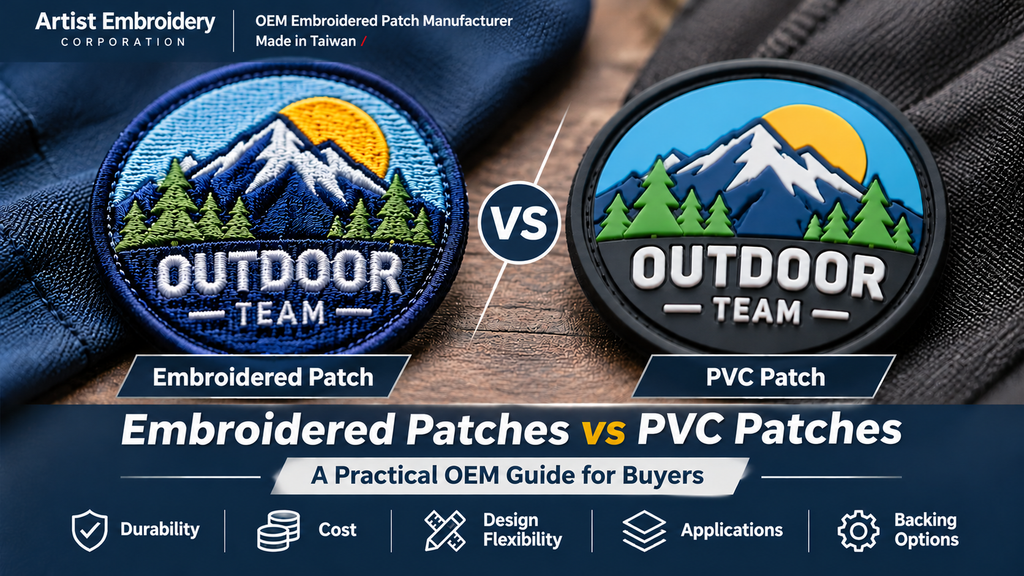
刺繡補丁 其製作方式是將彩色線縫製於布料基底上,通常選用斜紋布、毛氈或其他特殊材質。其獨特的立體線紋質感,營造出傳統且專業的外觀,這種風格常與軍用徽章、警服、企業品牌標識、運動隊伍以及時尚配件等廣泛相關。 根據圖案設計與刺繡覆蓋範圍,製造商可運用多種線色、針法方向及後處理選項,製作出精細的圖案。.
相比之下、, PVC 補丁 此類產品通常採用柔性聚氯乙烯材料製成,並可塑造成客製化的形狀與設計。其表面光滑且具橡膠般的質感,並可融入凸起或凹陷的元素,因此特別適合用於某些戶外配件、戰術裝備、包袋以及當代品牌商品。其材料特性在需要具備防潮性及易於表面清潔的應用場景中,亦能發揮優勢。.
然而,在刺繡貼片與 PVC 貼片之間做出選擇,不僅僅是比較兩者的外觀。在下達大宗訂單之前,應綜合考量設計複雜度、最低訂購量、生產成本、洗滌要求、固定方式以及長期使用等各項因素。.
舉例來說,當品牌希望呈現能自然融入服裝的經典紡織質感時,可能會偏好刺繡徽章;而當主要需求在於模壓表面、立體感鮮明的細節,或是防水材質時,PVC 徽章則可能更為合適。這兩種選擇並無絕對優劣之分;正確的選擇取決於預期的應用情境與採購優先考量。.
作為一家總部位於台灣、經驗豐富的 OEM 刺繡徽章製造商,, 藝術家刺繡公司 深知為不同商業應用選擇合適的材料與製造規格的重要性。透過將刺繡專業技術與專業生產設備及品質控制程序相結合,我們協助國際買家製造符合其設計與功能需求的客製化刺繡徽章。.
在這份全面指南中,我們針對刺繡徽章與 PVC 徽章,從材質、耐用性、價格、設計彈性、客製化選項及實際應用等面向進行比較。無論您是正在採購制服徽章、開發品牌周邊商品,還是為下一個 OEM 專案評估材料,這份比較分析都將協助您找出最適合您企業的徽章解決方案。.
何謂刺繡貼片與 PVC 貼片?
了解以下兩者之間的根本差異: 刺繡貼片 vs PVC 貼片 對於正在評估客製化徽章製造方案的國際買家、品牌所有者及採購專業人士而言,這點至關重要。雖然這兩款產品在品牌推廣與識別方面具有相似的功能,但其材質、生產技術、表面特性及整體外觀卻有顯著差異。.
刺繡貼片是透過機器刺繡製成的紡織品,而 PVC 貼片則是採用柔性合成材料製成的模壓製品。這些結構上的差異會影響每種貼片的外觀、觸感、性能,以及與不同產品的整合方式。.
在比較價格、耐用度及客製化選項之前,買家應先了解每種補丁的製造方式,以及哪些特性使其適合特定用途。.
了解刺繡貼片的製作結構
刺繡貼布是一種裝飾性或識別性的徽章,其製作方式是將彩色刺繡線縫製在布料基底上。透過刺繡工藝,表面會形成立體紋理,其中每針每線共同構成標誌、字樣、符號及其他視覺元素。.
布質基底在決定補片的外觀、柔韌性及整體結構方面扮演著重要角色。常見的材料包括:
- 斜紋布: 這是刺繡貼片中最廣泛使用的基底,具備穩定的表面、專業的外觀以及可靠的刺繡性能。.
- 毛氈布: 一種柔軟的無紡布材質,常被選用於傳統徽章、裝飾用途及特定設計需求。.
- 反光布料: 一種專門設計用於反射入射光的基底,使其適用於特定與能見度相關的應用。.
買家可於我們的網站上更詳細地瀏覽這些材料 刺繡貼布布料指南.
在製造過程中,電腦刺繡機透過精心編程的針腳圖案、線色及刺繡密度,將數位化的圖案呈現出來。成品設計可能呈現布料裸露的區域,或大面積的線跡覆蓋,這取決於所需的視覺效果。.
舉例來說,刺繡覆蓋率為 50% 的貼布,能讓底層布料有更多部分保持可見;而全刺繡設計則會以線跡覆蓋幾乎整個正面。不同的覆蓋率會影響質感、外觀、生產時間及製造成本。.
欲進一步了解這些差異,請參閱我們的 刺繡覆蓋範圍指南.
刺繡完成後,徽章會經過一系列後加工工序,其中可能包括加襯、裁切、邊緣處理及品質檢驗。根據設計與預期用途的不同,刺繡徽章可採用梅羅縫邊、熱切邊、縫製式結構、自黏背膠,或魔鬼氈固定系統。.
由於刺繡仰賴實體針腳,因此極小的字體、極細的線條以及複雜的漸層效果,可能需要對設計圖進行調整,才能達到可接受的再現效果。經驗豐富的 OEM 製造商會在生產前評估這些限制,以確保大批量訂單的成品品質一致。.
了解 PVC 修補材料
PVC 徽章是一種客製化徽章,主要由柔性聚氯乙烯(PVC)製成,這是一種可塑造成不同形狀、顏色及表面紋理的合成聚合物。.
與刺繡徽章不同,PVC 徽章並未仰賴縫線或紡織基底來呈現其主要視覺設計。相反地,製造商會利用模具及受控的材料加工工藝,來塑造標誌、字樣、符號及裝飾元素。.
許多客製化 PVC 徽章採用二維或三維壓模設計。凸起與凹陷的部位能使不同元素在視覺上相互區隔,讓製造商得以重現某些醒目的形狀、邊框及字體風格,並呈現出獨特的橡膠般質感。.
PVC 補丁通常與以下情況相關:
- 戰術裝備與戶外配件
- 背包、行李及裝備的標識
- 促銷商品與品牌周邊商品
- 運動器材及精選制服應用
- 需要具備柔韌且易於清潔表面之產品
PVC 材料的一大顯著特徵在於其抗吸水性。與紡織品刺繡不同,模壓 PVC 表面不會像布料和線材那樣吸收水分。然而,成品 PVC 徽章的整體性能,亦取決於其配方、厚度、固定系統以及製造品質。.
PVC 貼片可能需要專用的模具,尤其是針對客製化形狀和浮雕設計時。因此,初期模具費用可能會影響專案的總成本,特別是對於小批量生產而言。.
顏色選擇、立體效果、最小線寬以及模具複雜度,亦會影響製造可行性與定價。儘管 PVC 為某些模塑設計提供了相當大的自由度,但細節極為豐富的圖案與極細小的字體,仍可能需要進行簡化。.
對於 OEM 採購人員而言,在決定應選用模壓合成布標還是傳統刺繡徽章更適合最終產品時,了解這些材料特性至關重要。.
📊 表格:刺繡徽章與 PVC 徽章在基本結構上的差異
| 特點 | 刺繡襟章 | PVC 補丁 |
|---|---|---|
| 主要材料 | 刺繡線與布料 | 軟質聚氯乙烯 |
| 製造方法 | 電腦化機器刺繡 | 基於模具的製造 |
| 表面紋理 | 浮雕紡織針腳 | 光面或浮雕 |
| 基本結構 | 斜紋布、毛氈或反光布料 | 模塑合成材料 |
| 視覺外觀 | 傳統、富有質感、專業 | 現代感、立體感、橡膠般的質感 |
| 設計細節 | 取決於針腳大小與密度 | 取決於模具與材料的限制 |
| 防水性能 | 這取決於布料、線材和製作工藝 | PVC 材質的吸水率較低 |
| 常見應用 | 制服、徽章、服飾、配件 | 戰術裝備、包袋、戶外配件 |
| 客製化 | 線色、覆蓋範圍、邊框、底布 | 模壓造型、色彩、浮雕細節 |
| 初始設定 | 刺繡數位化 | 模具或工裝的準備 |
💡 買家小貼士:在選擇貼片材料前,請先了解製造流程
比較時 刺繡貼片 vs PVC 貼片, 買家在僅關注外觀或單價之前,應先評估預期的用途。.
就制服、企業標誌、傳統徽章及紡織配件而言,刺繡徽章通常能呈現自然的布料質感,並具備成熟的固定方式。至於裝備品牌標識、戶外配件,或是需要模壓橡膠般表面處理的設計,PVC 徽章則可能具備實用的優勢。.
在索取報價之前,請先準備好所需貼片的尺寸、設計圖稿、訂購數量、固定方式要求以及預期使用條件。這些規格有助於製造商評估生產可行性,並提供更精準的報價。.
若您的專案需要刺繡徽章,選擇一家經驗豐富的 OEM 刺繡製造商,有助於提升生產的一致性、材料選用及後加工品質。.
📖 延伸閱讀
刺繡貼片與 PVC 貼片:主要差異
比較時 刺繡貼片 vs PVC 貼片, 最顯著的差異不僅限於製造材料。表面質感、視覺外觀、柔韌性、厚度與重量,都會影響成品補丁在縫製於衣物、配件或裝備上的外觀與性能表現。.
對於國際 OEM 買家而言,了解這些特性至關重要,因為所選用的徽章材質不僅會影響最終產品的外觀,也會影響其適用於不同用途的適配性。專為正式制服設計的徽章,其所需特性可能與專為戰術背包或戶外配件設計的徽章有所不同。.
雖然刺繡貼片和 PVC 貼片都能重現客製化的標誌和徽章,但兩者的結構使其在視覺與物理特性上呈現出截然不同的特徵。.
質感、外觀與設計細節
刺繡徽章與 PVC 徽章之間最顯著的差異之一,在於它們的表面質感。.
刺繡貼布具有獨特的紡織品質感 由單一刺繡針法所構成。這些針法在布料基底上形成凸起的圖案,營造出層次分明的表面,其光線反射效果會因線材方向、針法密度及刺繡覆蓋範圍的不同而有所變化。.
這項特點賦予刺繡徽章一種傳統且高檔的紡織品質感,這種質感通常與專業制服、軍用徽章、企業標誌及品牌服飾相關聯。.
刺繡貼片的視覺品質取決於幾個製造因素:
- 線材品質: 使用質地一致的刺繡線,有助於呈現均勻的色澤、清晰的針腳以及整體美觀效果。.
- 針跡密度: 適當的針距有助於保持圖案的清晰度,同時避免布料產生不必要的變形。.
- 刺繡方向: 不同的針腳角度會產生質感與光線反射上的細微差異。.
- 布料選擇: 斜紋布、毛氈和反光布料呈現出不同的背景外觀與結構特性。.
- 刺繡範圍: 局部與全幅刺繡會產生不同的視覺效果,並影響生產要求。.
對於正在評估這些特徵的買家而言,我們的 刺繡貼片品質指南 闡述了有助於確保刺繡效果一致的製造因素。.
相較之下,, PVC 補丁的表面採用模壓合成材質製成 而非肉眼可見的刺繡針腳。其外觀主要取決於模具的幾何形狀、材料顏色,以及凸起或凹陷設計元素的排列方式。.
PVC 貼片能打造出輪廓分明的立體區域,特別適用於醒目的標誌、幾何圖形,以及需要橡膠般質感的設計。.
然而,模壓製程並不能自動保證能更精準地重現複雜的圖案。極小的字體、狹窄的間距以及複雜的形狀,仍可能需要進行調整,以適應模具與生產上的限制。.
從品牌形象的角度來看,刺繡徽章通常著重於紡織工藝與傳統的正宗感,而 PVC 徽章則呈現出更為現代、模壓成形的外觀。.
最佳選擇取決於該品牌的視覺識別系統、產品定位以及預期的應用情境。.
柔韌性、厚度與重量
在進行比較時,彈性、厚度和重量也是需要考量的因素 刺繡貼片 vs PVC 貼片, ,特別是對於需要為服裝、制服、背包或裝備採購徽章的買家而言。.
刺繡徽章由布料、線材及可選的背襯材料製成。其柔韌性取決於所選布料、刺繡密度、背襯結構以及徽章的整體尺寸。.
舉例來說,一塊部分繡花且斜紋布料外露的貼布,觸感可能比那塊繡花覆蓋範圍廣、且背襯堅硬的密針繡貼布更為柔軟。.
同樣地,背襯選項(例如熱封黏合劑或魔鬼氈系統)也會影響成品貼片的厚度與彎曲特性。.
由於刺繡貼片是以紡織品為基底,因此往往能與服裝及其他紡織品自然融合。這使得它們特別適合用於偏好傳統縫製外觀的應用情境。.
然而,不應自動假設刺繡徽章比 PVC 徽章更薄或更輕。實際厚度與重量會因製程規格、徽章尺寸、刺繡覆蓋範圍及後加工要求而有所不同。.
PVC 補片是採用柔性合成材料製造的,但其柔韌性在很大程度上取決於材料配方、厚度以及模塑設計結構。.
採用較柔軟配方製成的薄型 PVC 貼片可能相對容易彎曲,而具有明顯凸起細節的較厚貼片則會讓人感覺明顯更堅硬。.
同樣地,PVC 補片因材料密度、整體尺寸及模壓厚度不同,其重量可能會有顯著差異。.
對於涉及反覆彎折的應用,例如服飾或柔性配件,買家應評估貼片在固定後對動作的反應。.
就裝備、背包及戰術配件而言,當尺寸與外觀是設計意圖的一部分時,較厚的模壓貼片可能是可接受的,甚至更為理想。.
貼片的尺寸也會影響這些特性。較大的貼片可能需要額外考量其柔韌性、固定穩定性以及整體舒適度。.
我們的 刺繡貼片尺寸指南 針對不同刺繡貼布的應用情境,提供關於如何選擇合適尺寸的實用指引。.
歸根結底,買家應評估實際的生產樣品,而非假設刺繡貼片或 PVC 貼片在所有情況下都更輕、更薄或更具柔韌性。.
📊 表格:刺繡貼片與 PVC 貼片在物理特性與外觀上的主要差異
| 比較因子 | 刺繡襟章 | PVC 補丁 |
|---|---|---|
| 表面紋理 | 立體刺繡針法 | 光滑或模壓的合成表面 |
| 整體外觀 | 傳統紡織品後整理 | 現代橡膠質感的表面處理 |
| 視覺深度 | 透過針腳與線的方向所創造而成 | 透過模壓成型的凸起與凹陷元素所製成 |
| 材料結構 | 布料、刺繡線和襯布 | 柔性模塑聚氯乙烯(PVC)材料 |
| 彈性 | 這取決於刺繡的覆蓋範圍和底布 | 這取決於 PVC 的配方和厚度 |
| 厚度 | 視縫線與收邊方式而定 | 視模壓結構而定 |
| 重量 | 這取決於尺寸、線跡密度以及底布 | 這取決於尺寸、密度和厚度 |
| 詳細資訊 | 受縫線尺寸與布料穩定性的限制 | 受限於模具幾何形狀與材料加工 |
| 色彩呈現 | 彩色刺繡線 | 彩色 PVC 材料 |
| 布料整合 | 呈現天然紡織品般的質感 | 獨特的合成表面 |
| 常見的視覺偏好 | 制服、服飾、傳統徽章 | 戰術配件、包款、現代品牌設計 |
| 生產一致性 | 需要刺繡製程控制 | 需要對模具和材料進行製程控制 |
💡 買家小貼士:同時評估外觀與實際性能
在選擇刺繡徽章與 PVC 徽章時,請勿僅憑數位設計圖或產品照片來做出決定。.
某種設計在電腦螢幕上看起來很吸引人,但一旦轉化為刺繡針法或模製 PVC 元件後,外觀可能會有所不同。.
針對刺繡徽章,請索取能展現預期線色、刺繡密度、底布材質、邊緣處理及背襯結構的生產樣品。.
針對 PVC 補片,應評估其模壓細節的清晰度、材質的柔韌性、厚度以及安裝相容性。.
買家還應考量成品徽章與最終產品的搭配效果。對於某些服飾而言,柔軟的紡織徽章可能更為合適;而對於特定的戶外配件,模壓 PVC 徽章則可能更為相襯。.
對於大型 OEM 訂單而言,在量產前審查具代表性的實體樣品,有助於減少誤解,並確保所選用的材料能同時滿足視覺與功能方面的期望。.
📖 延伸閱讀
哪種補丁材質更耐用?
在進行比較時,耐用性是其中一項最重要的考量因素 刺繡貼片 vs PVC 貼片, ,特別是對於需要為制服、戶外裝備、工作服及品牌配件採購客製化徽章的國際買家而言。雖然這兩種材質都能提供可靠的長期性能,但由於其結構與材質特性不同,在耐洗滌性、耐磨性、耐濕性、耐日曬性以及日常磨損方面的表現也各不相同。.
刺繡貼片以紡織基布和刺繡線為基礎,而 PVC 貼片則由柔韌的合成材料製成。這些差異會影響各產品在反覆使用、環境暴露及清潔過程中的表現。.
然而,這兩種材料並非在所有情況下都必然更耐用。實際表現取決於製造品質、材料規格、安裝方式、使用條件以及保養方式。.
了解這些因素,有助於 OEM 採購人員選用符合其預期服務需求的補丁。.
耐洗性與日常耐磨性
對於制服、企業服飾、運動服及其他可水洗的紡織品而言,耐反覆洗滌性是一項重要考量因素。.
刺繡補丁 若採用合適的布料、優質的刺繡線、適當的針腳密度,以及穩固的固定方式進行製作,則可承受定期清洗。.
高品質的刺繡工藝有助於在日常使用中維持標誌、字樣及裝飾元素的完整性。妥善控制線張力與針腳密度,亦可減少針腳鬆脫、布料起皺及刺繡表面不平整等問題。.
然而,刺繡貼片並非完全不受磨損影響。過度的摩擦、強效洗滌劑、高溫洗滌以及不當的烘乾方式,都可能逐漸影響線材的外觀、布料的穩定性以及背襯的性能。.
有幾個製造因素會影響刺繡徽章的耐用性:
- 線材品質: 選用合適的刺繡線,有助於在正常使用過程中維持色彩的一致性與針腳的完整性。.
- 織物穩定性: 斜紋布及其他合適的底布能為刺繡圖案提供結構支撐。.
- 針跡密度: 均衡的刺繡密度有助於避免不必要的布料變形及縫線鬆脫。.
- 邊境建設: 妥善處理的邊緣有助於保護補丁邊緣,防止其脫線和受損。.
- 安裝方式: 牢固的縫合或符合規範的背襯系統,有助於防止使用時脫落。.
如欲進一步了解這些製造方面的考量,請參閱我們的 刺繡貼片品質指南.
PVC 補丁, 另一方面,這類產品沒有外露的刺繡線跡,因此不會出現線頭散開或線跡斷裂的情況。其模壓表面通常易於擦拭清潔,因此非常適合用於可能接觸灰塵、泥土或偶爾接觸濕氣的場合。.
儘管如此,PVC 補片仍可能出現其他形式的劣化。視材料配方與製造品質而定,反覆彎折、磨損、化學物質接觸或不適當的溫度,都可能導致表面受損、龜裂、變形或變色。.
固定系統同樣至關重要。即使補丁材質非常耐用,若縫線、黏合劑或魔鬼氈固定方式不適合預定的用途,仍可能過早失效。.
對於需要頻繁機洗的服飾,採購人員應同時評估標籤的結構與完整的固定系統,而非僅關注標籤材質。.
濕氣、戶外暴露與使用壽命
戶外應用會帶來額外的耐用性挑戰,包括雨水、濕度、紫外線照射、溫度波動,以及與設備或其他表面反覆接觸。.
評估時 刺繡貼片 vs PVC 貼片 若用於戶外,買家應區分「材質層級的防水性」與「成品的整體耐用性」。.
PVC 材質通常吸水極少,因此當修補片表面經常接觸濕氣或需要輕鬆清潔時,模壓 PVC 修補片便具有優勢。.
然而,不應自動將 PVC 補丁視為組裝完成後即具備防水功能。縫線孔洞、固定材料、背襯組件,以及底層的衣物或裝備,仍可能導致水分滲入。.
不同配方之聚氯乙烯(PVC)在抗紫外線及耐溫變性方面亦有所差異。長時間暴露於陽光下可能會導致某些材料或顏料褪色或劣化,而極端低溫或高溫則可能影響其柔韌性與尺寸穩定性。.
刺繡補丁 表現不同,因為其布料基底和紗線結構在淋雨或清洗後仍能保留水分。.
這並不表示刺繡徽章不適合用於戶外環境。製作得當的刺繡徽章廣泛應用於工作制服、戶外服飾、軍裝風格服飾、背包及裝備配件上。.
其長期表現取決於多個因素,包括線材成分、色牢度、布料選擇、刺繡結構以及縫合品質。.
例如,在需要良好色牢度及能抵禦一般環境暴露的應用場合中,通常會選用聚酯繡花線。然而,實際性能仍應根據預期的洗滌條件及戶外使用要求進行驗證。.
徽章的邊緣處理方式也會影響其耐用性。結構完善的梅羅縫邊或熱切邊,有助於保護刺繡徽章的邊緣;不過,最適合的收邊方法取決於徽章的形狀、布料類型及設計規格。.
對於預期會長時間暴露於戶外環境的產品,製造商和買家應考慮針對色牢度、耐磨性、洗滌性能及環境老化等項目進行適當的測試。.
僅憑材質類別,無法判定這兩種徽章的預期使用壽命。一款製造精良且在適當條件下使用的刺繡徽章,可能能維持功能長達數年;反之,一款規格不當的 PVC 徽章則可能過早損壞。在不同的環境條件下,情況也可能恰恰相反。.
歸根結底,要選擇最耐用的補片,必須將材料特性、製造品質及固定規格與預期的應用情境相匹配。.
📊 表格:刺繡貼片與 PVC 貼片的耐用性比較
| 耐用性係數 | 刺繡襟章 | PVC 補丁 |
|---|---|---|
| 定期清洗 | 一般而言,只要施工得當並妥善保養,即可適用 | 這取決於配方和安裝方式 |
| 表面磨損 | 線頭可能會出現磨損或勾絲的情況 | 模壓表面可能會出現刮痕或磨損 |
| 吸水率 | 布料和線材可能會殘留水分 | PVC 材質的吸水率較低 |
| 雨淋 | 適用於多種用途;可能需要進行乾燥處理 | 通常能抵抗表面濕氣 |
| 紫外線照射 | 這取決於線材與布料的色牢度 | 這取決於 PVC 的配方和顏料 |
| 反覆彎曲 | 這取決於針腳密度、布料以及襯布 | 這取決於配方和厚度 |
| 高溫 | 線、布料和襯布的耐熱限度各不相同 | 過熱可能會導致變形 |
| 低溫 | 這取決於紡織品和背襯的特性 | 某些配方可能會變得較不具彈性 |
| 邊緣耐用性 | 這取決於邊緣的加工品質 | 這取決於模壓邊緣的設計與材質 |
| 清潔 | 需採用適合紡織品的清潔方式 | 通常很容易擦拭乾淨 |
| 長期外觀 | 這取決於縫線、色牢度及保養方式 | 這取決於表面磨損、顏料以及老化程度 |
| 依附關係的持久性 | 視乎採用縫合、黏合或魔鬼氈系統而定 | 視乎採用縫合、黏合或魔鬼氈系統而定 |
註:實際耐用性會因材料等級、生產規格、安裝方式及操作條件而異。若應用需求嚴苛,建議進行性能測試。.
💡 購買小貼士:根據實際應用情況選擇合適的耐用性規格
在採購用於大量生產的客製化徽章時,買家應避免僅憑「防水」、「耐候」或「耐用」等籠統的宣傳標語來選擇材料。“
相反地,應明確界定成品補丁實際將被使用的條件。.
舉例來說,專為需頻繁清洗的制服設計的刺繡貼片,應就針腳完整性、布料穩定性、色牢度、邊緣品質及附著強度等項目進行評估。.
適用於戶外設備的 PVC 補片應針對其柔韌性、表面耐磨性、抗紫外線性、耐溫性及固定可靠性進行評估。.
對於要求嚴苛的應用,請在批准量產前,索取具代表性的生產樣品,並制定適當的測試要求。.
在 藝術家刺繡公司, 我們的 OEM 刺繡製造流程著重於針腳均勻、適當的材質選用、受控的生產流程,以及細緻的後製工序。這些因素有助於國際買家取得符合其核准規格所製造的刺繡徽章。.
一份定義明確的產品規格,加上可靠的製造品質,往往比僅憑外觀或籠統的耐用性聲明來選擇補丁材料更具價值。.
📖 延伸閱讀
成本比較:刺繡貼片與 PVC 貼片
在進行比較時,成本是一項重要的考量因素 刺繡貼片 vs PVC 貼片, ,特別是針對國際 OEM 買家、批發商、制服供應商,以及計畫下達大批量訂單的品牌。雖然這兩款產品均可透過標誌、文字及獨特造型進行客製化,但其製造流程涉及不同的開模費用、生產要求及成本結構。.
刺繡徽章是利用電腦刺繡機、布料底布及刺繡線製作而成,而 PVC 徽章則通常需要客製化模具及專用的材料加工工序。這些差異會影響初期投資、單價,以及不同訂購數量所帶來的經濟效益。.
然而,這兩種材料並沒有哪一種在所有情況下都更經濟實惠。最終成本取決於貼布的尺寸、設計複雜度、生產數量、顏色數量、製造規格、後加工要求以及供應商的能力。.
了解這些成本因素,有助於買方擬定精確的報價請求、評估供應商的提案,並找出在不影響產品品質的前提下優化製造成本的機會。.
生產成本與模具要求
刺繡徽章與 PVC 徽章之間的主要差異之一,在於初期生產的準備工作。.
刺繡補丁 通常需要進行刺繡數位化處理,這是一項將經核准的圖稿轉換為機器可讀的繡線指令的流程。數位化檔案會決定繡線類型、繡線方向、線色順序,以及生產所需的其他技術參數。.
藝術品的複雜程度會直接影響數位化需求。若設計中包含繁複的細節、細小的字體、多色區塊,或大面積的刺繡覆蓋範圍,可能需要進行額外的程式設計及生產調整。.
一旦刺繡程式準備就緒並獲得核准,製造商即可將其用於重複訂單,前提是設計規格仍與原始生產設定相容。.
與刺繡徽章製造相關的主要成本因素包括:
- 刺繡數位化: 準備刺繡程式並進行必要的生產調整。.
- 補丁大小: 較大的補丁通常需要更多的布料、刺繡針腳以及機縫時間。.
- 針數: 針數越多,通常會增加刺繡的生產時間和線材消耗量。.
- 刺繡範圍: 與留有大量裸露布料的圖案相比,全覆蓋刺繡通常需要更多的針腳。.
- 線色: 增加顏色會因需更換線材、安排顏色順序以及降低生產效率,進而提高生產成本。.
- 布料選擇: 斜紋布、毛氈和反光布料的材料成本及製造考量各不相同。.
- 邊緣處理: 梅羅縫邊、熱切邊及其他後加工方法,各有不同的加工要求。.
- 備份選項: 熱封黏合劑、魔鬼氈及其他固定系統會增加材料與人工成本。.
重要的是,, 增加刺繡線的顏色數量,通常會提高製造成本.
即使現代的電腦刺繡機能夠處理多種線色,但若要使用額外的顏色,仍可能需要更複雜的程式設計、線材準備、機器調整以及換色操作。.
在多頭刺繡機上,高效生產取決於一致的線材排列與最佳化的生產順序。需要使用多種顏色的設計可能會降低操作靈活性,特別是在生產涉及多種設計或需頻繁更換線材的情況下。.
因此,買家不應假設,一款使用十二種線色的拼布,其價格會與另一款在其他方面相近但僅使用三種顏色的設計相同。.
實際的價格差異取決於設計、設備配置、產量以及製造商的成本結構。.
如需更詳細的刺繡定價說明,請參閱我們的 客製化刺繡徽章價格指南.
PVC 補丁, 相較之下,通常需要使用專用的模具,才能製成所需的形狀、表面浮雕及設計細節。.
模具開發可能涉及額外的初期費用,尤其是針對複雜的形狀、多層次結構或精細的圖案設計時。.
一旦完成合適的模具,通常可重複用於後續的生產批次,但須視模具狀況及設計的一致性而定。.
PVC 的製造成本亦取決於材料配方、補片尺寸、厚度、顏色要求、加工方法及後處理工序。.
雖然這兩種製造方法都涉及開模費用,但刺繡數位化與 PVC 模具開發本質上是截然不同的製程。買家應比較完整的報價,而非僅單獨評估開模費用。.
數量與設計複雜度如何影響定價
訂購數量是影響總成本的另一項主要因素, 刺繡貼片 vs PVC 貼片.
就刺繡徽章而言,較大的生產數量能讓製造商將某些開機成本分攤到更多產品上,同時提升設備利用率與生產效率。.
舉例來說,生產 1,000 個相同的刺繡徽章,其單位成本可能比生產 100 個相同設計的徽章更低,因為準備時間、生產排程以及某些固定費用,可以分攤到較大的訂單中。.
然而,即使增加產量,也無法消除繡線、布料、機器運作、後加工、檢驗或包裝等成本。.
設計的複雜程度對定價也有顯著影響。.
相較於尺寸相近、但包含大量精細細節、多種顏色及全覆蓋刺繡的補丁,一款採用簡約標誌、線色有限且刺繡覆蓋範圍適中的刺繡補丁,所需的針數和機器加工時間可能較少。.
買家應特別留意以下因素:
1. 線色數量
刺繡顏色越多,通常會導致生產成本上升,這是因為需要額外的線材準備、換色作業,以及可能對生產效率造成的影響。.
2. 刺繡覆蓋範圍
相較於刺繡覆蓋範圍為 50% 的類似設計,刺繡覆蓋範圍為 100% 的設計通常需要更多的針數和線材用量,儘管實際成本取決於針距密度和圖稿。.
我們的 刺繡覆蓋範圍指南 說明不同的覆蓋程度如何影響刺繡徽章的製作。.
3. 補丁尺寸
較大的徽章通常需要更多材料和更長的製作時間。然而,成本並非僅由徽章大小決定;還必須考量針數、設計密度以及後製要求。.
4. 設計複雜度
精緻的字體、複雜的形狀、多色區塊以及繁複的針法,可能會增加數位化作業的難度,並延長刺繡的生產時間。.
5. 表面處理與安裝
其他製程,例如熱封背襯、魔鬼氈固定、特殊邊框以及獨立包裝等,都可能提高總製造成本。.
就 PVC 補片而言,當需要訂製模具時,訂購數量尤為重要。.
若將模具費分攤至小批量生產中,可能會大幅推高每片貼片的實際成本。隨著生產數量增加,初始模具費用便會分攤到更多產品單位上。.
For example, if a hypothetical mold costs US$200, allocating that cost across 100 patches adds US$2.00 per unit, while allocating it across 1,000 patches adds only US$0.20 per unit.
This illustration excludes material, production, finishing, shipping, and other costs and does not represent an actual supplier quotation.
Design complexity also affects PVC pricing. Multiple colors, raised details, intricate mold structures, and greater material thickness may increase manufacturing requirements.
Therefore, the most economical option depends on the combination of setup expenses, production quantity, design specifications, and long-term purchasing plans.
For international buyers, obtaining detailed quotations based on identical project requirements is the most reliable way to compare manufacturing costs.
📊 Table: Cost Factors for Embroidered vs PVC Patches
| 成本因素 | 刺繡襟章 | PVC 補丁 |
|---|---|---|
| 初始設定 | 刺繡數位化 | Mold development |
| Main Material | Fabric and embroidery threads | Flexible PVC compound |
| 設計複雜度 | Influences digitizing and stitch count | Influences mold and processing requirements |
| 顏色數量 | More colors generally increase production costs | Additional colors may increase processing complexity and costs |
| 補丁尺寸 | Affects fabric, stitching, and finishing | Affects material usage and mold dimensions |
| 生產時間 | Influenced by stitch count and machine efficiency | Influenced by molding and processing requirements |
| Small Orders | Setup and minimum production costs affect unit pricing | Mold expenses may significantly affect unit pricing |
| Large Orders | Potential savings from efficient bulk embroidery | Potential savings from spreading tooling costs |
| 重複訂單 | Existing digitizing files may be reusable | Existing molds may be reusable |
| 背膠選項 | Additional material and processing costs | Additional attachment and processing costs |
| 邊框修飾 | Merrowed or heat-cut finishing costs | Molded edge and finishing requirements |
| Overall Pricing | Depends on complete embroidery specifications | Depends on complete molding specifications |
Note: This table compares general manufacturing cost structures. Actual pricing must be confirmed through supplier quotations based on specific artwork, quantities, materials, and production requirements.
💡 Buyer Tip: Optimize Embroidery Costs Without Sacrificing Quality
For OEM buyers sourcing custom embroidered patches, cost optimization should focus on production efficiency rather than simply requesting the lowest possible unit price.
One effective approach is to evaluate whether the original artwork requires every specified thread color.
Because additional embroidery colors generally increase manufacturing costs, reducing unnecessary color variations may improve production efficiency while preserving the essential appearance of a logo or emblem.
Buyers can also evaluate embroidery coverage, patch dimensions, border construction, and backing options to identify practical opportunities for cost reduction.
For example, selecting a suitable twill background instead of requiring full embroidery coverage may reduce stitch count and machine time when the design allows exposed fabric.
However, reducing stitch density excessively or simplifying important artwork details may negatively affect appearance and quality. Any proposed changes should be evaluated against the buyer’s approved specifications.
Before requesting a quotation, prepare the following information:
- Final artwork and required dimensions
- 預估訂購數量
- Number of embroidery thread colors
- Preferred fabric and embroidery coverage
- Border and backing requirements
- Packaging instructions
- Expected delivery schedule
在 藝術家刺繡公司, we specialize in OEM embroidered patch manufacturing based on customer-provided artwork and production specifications. Our manufacturing experience helps international buyers evaluate practical embroidery requirements, production feasibility, and cost-related considerations.
By providing complete specifications and reviewing appropriate manufacturing options, buyers can obtain more accurate quotations and make informed purchasing decisions.
📖 延伸閱讀
Design Flexibility and Customization Options
Design flexibility is an important factor when comparing 刺繡貼片 vs PVC 貼片, especially for international OEM buyers who need to reproduce logos, lettering, symbols, and branded artwork accurately across large production quantities. Although both materials offer extensive customization possibilities, their manufacturing methods create different limitations in detail reproduction, color presentation, dimensional effects, and overall design appearance.
Embroidered patches transform digital artwork into physical stitches using embroidery threads and fabric foundations. PVC patches, in contrast, reproduce artwork through molded synthetic materials with raised, recessed, or flat surface elements.
These manufacturing differences influence which design features can be reproduced effectively and which may require technical adjustments before production.
For brands, uniform suppliers, promotional merchandise distributors, and other commercial buyers, understanding these limitations helps reduce production errors, improve consistency, and establish realistic expectations for finished products.
Fine Details, Gradients, and Color Limitations
One of the most important considerations in custom patch manufacturing is the ability to reproduce small lettering, intricate lines, and complex artwork.
刺繡補丁 create designs through individual stitches, meaning that the resolution of the finished artwork depends on stitch dimensions, thread thickness, fabric stability, and embroidery density.
Unlike digital printing, embroidery cannot reproduce unlimited detail at extremely small dimensions. Very thin lines, tightly spaced letters, and miniature design elements may become difficult to distinguish when converted into stitches.
For example, a logo containing extremely small lettering may appear perfectly clear on a computer screen but lose definition when embroidered onto a compact patch.
The minimum practical size of lettering depends on the font style, stitch direction, thread type, fabric, and embroidery equipment. Consequently, there is no single minimum lettering size that applies to every embroidered patch design.
Buyers should evaluate the actual production dimensions rather than relying exclusively on enlarged digital artwork.
我們的 刺繡貼片尺寸指南 explains how patch dimensions influence design readability and manufacturing feasibility.
Color reproduction is another important consideration.
Embroidered patches use physical embroidery threads selected from available thread color ranges. Although professional embroidery threads provide numerous color options, they cannot reproduce every digital color value with absolute precision.
Thread appearance may also vary depending on lighting, surface texture, and stitch direction.
Furthermore, increasing the number of embroidery thread colors generally increases production costs because additional colors can require more thread preparation, color changes, and production management.
For this reason, buyers should avoid adding unnecessary colors when a simpler thread palette can preserve the intended brand identity.
Gradients and photographic effects present additional challenges.
Traditional embroidery does not reproduce smooth digital gradients in the same way as full-color printing. However, experienced embroidery manufacturers can use stitch direction, thread selection, and controlled color transitions to create approximate shading effects.
The success of these techniques depends on design complexity, patch size, and acceptable visual tolerances.
PVC 補丁 offer different customization possibilities.
Molded PVC designs can feature distinct color sections, raised outlines, recessed areas, and relatively smooth surfaces. These characteristics are useful for bold logos, geometric artwork, and designs emphasizing clearly separated visual elements.
However, PVC molding also has limitations.
Extremely narrow lines, tiny lettering, complicated color boundaries, and intricate recessed details may be difficult to manufacture consistently.
Standard molded PVC patches are also not equivalent to full-color printed products. Smooth photographic gradients generally require specialized production methods rather than conventional solid-color molding.
For both embroidered and PVC patches, buyers should provide accurate artwork and confirm manufacturing feasibility before approving bulk production.
2D and 3D Effects
Dimensional appearance is another major difference between 刺繡貼片 vs PVC 貼片.
Both manufacturing methods can create raised visual elements, but they achieve these effects through fundamentally different techniques.
刺繡補丁 develop texture and dimensional variation through thread placement, stitch density, stitch direction, and specialized embroidery methods.
Standard flat embroidery already produces a slightly raised surface because threads sit above the fabric foundation.
By adjusting stitch directions and combining different stitch structures, manufacturers can create visual depth, highlights, and textured patterns.
Certain specialized embroidery techniques, such as 3D puff embroidery, use foam beneath selected stitches to produce more pronounced raised effects.
However, 3D puff embroidery is not suitable for every design. Extremely small details, narrow lettering, and intricate shapes may be difficult to reproduce using this method.
The feasibility of specialized embroidery effects depends on the manufacturer’s equipment, production capabilities, artwork, and approved specifications.
Traditional embroidered patches also offer various customization options beyond dimensional effects, including:
- 刺繡範圍: Partial or full thread coverage depending on the desired appearance.
- Fabric Foundations: Twill, felt, or reflective materials selected according to product requirements.
- 線色: Multiple embroidery colors based on approved artwork and manufacturing feasibility.
- 邊緣處理: Merrowed borders or heat-cut edges depending on patch shape and construction.
- 備份選項: Sew-on, heat-seal, or hook-and-loop attachment systems.
- Patch Shapes: Standard geometric shapes or custom outlines within production limitations.
Buyers can learn more about thread coverage and surface appearance in our Embroidery Coverage Guide.
相較之下,, PVC 補丁 create dimensional effects through mold geometry.
A 2D PVC patch generally uses relatively flat design elements with defined color sections and limited height variation.
A 3D PVC patch incorporates more pronounced raised and recessed features, creating a sculpted appearance.
These molded effects are particularly suitable for designs requiring strong dimensional separation, bold outlines, or a rubber-like surface.
However, the term “3D” does not automatically indicate superior quality or greater detail. Actual results depend on mold precision, material formulation, design specifications, and production control.
From a branding perspective, embroidered patches emphasize textile texture and traditional craftsmanship, while PVC patches emphasize molded contours and dimensional definition.
For OEM buyers, the most suitable customization method depends on the intended product, artwork characteristics, brand identity, and manufacturing budget.
📊 Table: Design and Customization Comparison Between Embroidered and PVC Patches
| 設計因素 | 刺繡襟章 | PVC 補丁 |
|---|---|---|
| 設計與施工 | Embroidery stitches on fabric | 模塑合成材料 |
| Fine Lettering | Limited by stitch size and fabric stability | Limited by mold geometry and processing |
| 細線 | May require thicker embroidery strokes | May require minimum molded line widths |
| Color Options | Available embroidery thread colors | Available PVC material colors |
| 其他顏色 | Generally increase production costs | May increase molding and processing costs |
| Smooth Gradients | Limited; approximated through thread techniques | Limited in standard solid-color molding |
| Photographic Details | Not suitable for exact photographic reproduction | Not suitable for exact reproduction using standard molding |
| 表面紋理 | Raised threads and stitch patterns | Smooth or molded surface |
| 2D Appearance | Flat embroidery with natural thread relief | Relatively flat molded elements |
| 3D Appearance | Specialized raised embroidery techniques | Raised and recessed molded structures |
| Background Materials | Twill, felt, reflective fabric | PVC material |
| Border Options | Merrowed or heat-cut edges | Molded edges |
| 背膠選項 | Sew-on, heat-seal, hook-and-loop | Attachment methods depend on construction |
| 自訂形狀 | Subject to embroidery and finishing limitations | Subject to mold design limitations |
| 生產一致性 | Depends on digitizing and embroidery control | Depends on mold and material processing control |
Note: The feasibility of specific customization features depends on the artwork, dimensions, equipment, materials, and individual manufacturer’s production capabilities.
💡 Buyer Tip: Prepare Production-Ready Artwork Before Requesting a Quotation
When sourcing custom embroidered patches or PVC patches, buyers should provide artwork that accurately represents the intended finished product.
For embroidered patches, vector artwork or sufficiently clear high-resolution files can help manufacturers evaluate stitch placement, lettering dimensions, thread colors, and embroidery coverage.
However, supplying a vector file does not automatically guarantee that every detail can be embroidered successfully. The design must still be evaluated against actual patch dimensions and embroidery limitations.
To improve manufacturing efficiency, buyers should confirm the following specifications before submitting an OEM inquiry:
- Final patch dimensions and shape
- Approved logo or artwork files
- Required thread or material colors
- Minimum acceptable lettering size
- Desired embroidery coverage or molded relief
- Fabric, border, and backing requirements
- 預估訂購數量
- Intended product application
For embroidered patches, reducing unnecessary thread colors, avoiding extremely small lettering, and selecting appropriate embroidery coverage can help improve production feasibility and cost efficiency.
在 藝術家刺繡公司, we specialize in OEM embroidered patch manufacturing based on customer-supplied artwork and specifications.
Our manufacturing process focuses on embroidery digitizing for production, material preparation, computerized embroidery, finishing, and quality inspection. We evaluate submitted artwork for manufacturing feasibility and communicate relevant production limitations before proceeding with approved orders.
We do not provide original artwork design services. Customers remain responsible for supplying and approving their designs and required specifications.
By preparing accurate artwork and understanding the capabilities of different manufacturing methods, international buyers can improve production consistency and obtain custom embroidered patches that meet their intended quality requirements.
📖 延伸閱讀
Best Applications for Embroidered and PVC Patches
Choosing the right patch material is essential for ensuring that custom emblems meet the visual, functional, and practical requirements of their intended applications. When comparing 刺繡貼片 vs PVC 貼片, international OEM buyers should consider more than appearance or manufacturing cost. The type of garment, equipment, environment, attachment method, and expected usage conditions all influence which material is most suitable.
Embroidered patches are widely used for professional uniforms, corporate branding, sports teams, fashion accessories, and traditional insignia because of their distinctive textile texture and versatile finishing options. PVC patches, on the other hand, are commonly selected for tactical equipment, outdoor accessories, backpacks, and promotional merchandise requiring a molded, rubber-like appearance.
However, these applications are not exclusive to either material. Both embroidered and PVC patches can be used across multiple industries, provided their construction and attachment systems meet the intended product requirements.
Understanding the strengths and limitations of each option helps buyers select suitable materials and prepare accurate specifications for OEM manufacturing.
Uniforms, Fashion, and Corporate Branding
Uniforms and branded apparel represent some of the most established applications for custom embroidered patches.
刺繡補丁 are particularly popular for police uniforms, military-style insignia, security personnel, corporate workwear, school uniforms, and organizational emblems. Their stitched surfaces provide a traditional textile appearance that integrates naturally with woven and knitted garments.
For professional uniforms, embroidery offers several practical advantages.
First, the combination of colored threads and fabric foundations creates a recognizable emblem style associated with official identification, departmental insignia, and organizational branding.
Second, embroidered patches can be manufactured in different shapes, dimensions, and embroidery coverage levels to accommodate specific uniform requirements.
Third, suitable backing and attachment systems allow patches to be sewn directly onto garments or attached using hook-and-loop fasteners when removable identification is required.
For police and security applications, custom embroidered patches may include department names, identification numbers, official emblems, and specialized unit markings. Buyers must ensure that artwork and insignia specifications are authorized and appropriate for the intended organization.
我們的 警察徽章名稱指南 provides additional information about embroidered identification patches used for professional uniforms.
企業品牌塑造 is another important application.
Companies frequently use embroidered patches on employee uniforms, jackets, work shirts, caps, and promotional apparel to reinforce brand identity.
Compared with direct embroidery on finished garments, separately manufactured patches can offer flexibility when the same logo must be applied to different apparel products.
For example, a company may order identical embroidered logo patches for work jackets, uniforms, and merchandise, then attach them according to the requirements of each garment.
This approach can support consistent branding across multiple product categories, although attachment labor and material compatibility should be considered.
Fashion brands and apparel manufacturers also use embroidered patches as decorative elements.
Common applications include denim jackets, streetwear, backpacks, hats, and limited-edition clothing collections. The visible thread texture adds a textile detail that may complement traditional, vintage, collegiate, or heritage-inspired designs.
Sports teams, clubs, and educational organizations similarly use embroidered patches for team logos, membership emblems, achievements, and commemorative merchandise.
PVC 補丁 can also be used on uniforms and apparel, especially when a contemporary molded appearance is desired.
However, buyers should consider the flexibility, thickness, weight, attachment method, and laundering requirements of the finished garment.
For applications involving frequent washing or direct contact with the body, the compatibility of the complete PVC patch assembly should be evaluated before bulk production.
Ultimately, embroidered patches are often a strong choice when textile appearance, traditional insignia styling, and integration with fabric garments are primary considerations.
Tactical Gear, Outdoor Products, and Accessories
Tactical equipment, outdoor accessories, and branded gear represent another major application category for custom patches.
Products such as backpacks, equipment bags, outdoor jackets, camping accessories, and tactical-style gear frequently incorporate patches for identification, decoration, or branding.
In these applications, PVC 補丁 are often selected because their molded surfaces are relatively easy to wipe clean and their base material absorbs very little water.
Their raised and recessed design elements can also provide a distinctive appearance that complements modern outdoor equipment and tactical accessories.
For example, a backpack manufacturer may select a molded PVC logo patch to create a bold dimensional branding element on an equipment bag.
However, material-level water resistance should not be confused with waterproof performance of the entire finished product. Stitching holes, backing systems, and attachment components can still influence moisture penetration and long-term durability.
刺繡補丁 are also widely used on tactical gear and outdoor products.
Their textile construction makes them suitable for backpacks, field uniforms, jackets, equipment organizers, and other fabric-based accessories where a stitched emblem appearance is preferred.
Depending on the application, embroidered patches may be manufactured with hook-and-loop backing for convenient attachment to compatible equipment panels.
This attachment method is particularly useful when patches must be removed, replaced, or repositioned without permanently altering the underlying product.
For buyers considering removable embroidered emblems, proper hook-and-loop specifications are important. The dimensions, fastening strength, backing construction, and compatibility with the receiving surface can all influence performance.
Outdoor apparel manufacturers may also prefer embroidered patches when they want their branding to match the textile character of jackets, vests, and other garments.
For example, a heritage outdoor brand may choose embroidered logo patches to reinforce a traditional appearance, while a contemporary equipment brand may prefer molded PVC emblems for a more technical visual style.
Neither choice automatically guarantees greater durability. Exposure to sunlight, moisture, abrasion, washing, and temperature changes should be considered when specifying either material.
Promotional accessories provide additional opportunities for both patch types.
Embroidered patches can be incorporated into fabric keychains, luggage tags, branded apparel, and other textile-based merchandise.
PVC patches may be suitable for molded decorative labels, bag accessories, and merchandise emphasizing raised shapes or rubber-like surfaces.
Buyers interested in textile-based promotional products can explore our Embroidered Flight Keychain Guide for an example of embroidery applications beyond traditional uniform patches.
For OEM sourcing, the best material depends on the final product’s intended use, appearance requirements, production quantity, and attachment specifications.
📊 Table: Best Applications for Embroidered and PVC Patches
| 應用 | 刺繡襟章 | PVC 補丁 |
|---|---|---|
| Police Uniforms | Traditional textile insignia and identification | Alternative molded appearance when permitted |
| Military-Style Uniforms | Classic embroidered emblems and unit patches | Molded identification and decorative patches |
| Corporate Workwear | Professional logo patches for fabric garments | Modern branding where garment compatibility allows |
| School Uniforms | Traditional school crests and emblems | Alternative decorative branding |
| 運動團隊 | Team logos, achievements, and club emblems | Molded logos and merchandise applications |
| 時尚服飾 | Denim, streetwear, jackets, and textile accessories | Contemporary decorative accents |
| 背包 | Textile branding and removable emblems | Molded logos and easy-to-clean surfaces |
| 戰術裝備 | Hook-and-loop identification patches | Dimensional tactical-style patches |
| 戶外外套 | Traditional fabric-based branding | Molded branding with suitable attachment |
| Camping Accessories | Embroidered identification and logos | Molded labels and decorative elements |
| 促銷商品 | Fabric keychains, apparel, and textile accessories | Molded branded accessories |
| Luggage and Travel Gear | Embroidered labels and luggage tags | Molded identification and decorative patches |
Note: These are general application examples. Actual suitability depends on material specifications, attachment construction, product requirements, and applicable organizational standards.
💡 Buyer Tip: Choose Patch Materials Based on the Final Product
When selecting between 刺繡貼片 vs PVC 貼片, buyers should begin by identifying the intended product rather than choosing a material based only on appearance.
For uniforms, corporate apparel, school emblems, and traditional organizational insignia, embroidered patches often provide a suitable combination of textile appearance, customization flexibility, and established attachment methods.
For backpacks, tactical accessories, and equipment requiring a molded surface, PVC patches may be worth considering.
Before submitting an OEM quotation request, buyers should confirm:
- 應用: Uniform, apparel, backpack, equipment, or promotional merchandise.
- Material Preference: Textile embroidery or molded synthetic construction.
- 尺寸: Finished patch width, height, and shape.
- 藝術作品: Approved logo, lettering, and color specifications.
- Attachment: Sew-on, heat-seal, hook-and-loop, or another compatible method.
- Usage Conditions: Washing frequency, outdoor exposure, abrasion, and handling.
- 訂購數量: Estimated initial production and repeat-order requirements.
- Quality Requirements: Appearance, durability, and any applicable testing standards.
For embroidered patches, selecting appropriate fabric, embroidery coverage, border finishing, and backing construction is essential for achieving consistent manufacturing results.
在 藝術家刺繡公司, we specialize in OEM embroidered patch manufacturing for international buyers who provide their own artwork and production specifications.
Our manufacturing capabilities support custom embroidered emblems for uniforms, corporate branding, sports organizations, apparel accessories, and other suitable textile applications.
We focus exclusively on OEM manufacturing rather than original artwork design services, helping buyers transform approved specifications into professionally manufactured embroidered products.
By matching the patch construction to the intended application, buyers can improve product suitability, reduce avoidable manufacturing issues, and achieve more consistent results across bulk orders.
📖 延伸閱讀
背襯選項與固定方式
Selecting the appropriate backing and attachment method is an essential part of custom patch manufacturing. When comparing 刺繡貼片 vs PVC 貼片, international OEM buyers should evaluate not only the patch material and visual appearance but also how the finished emblem will be attached to garments, uniforms, bags, and equipment.
Backing construction directly influences attachment strength, flexibility, thickness, maintenance requirements, and long-term performance. Even a professionally manufactured patch may fail prematurely if its attachment system is incompatible with the intended product or operating conditions.
Common attachment methods include sew-on construction, heat-seal adhesive backing, and hook-and-loop fasteners. However, these options are not equally suitable for every patch material.
Because embroidered patches are constructed from fabric and thread, they offer established textile attachment solutions. PVC patches, in contrast, require attachment systems compatible with their molded synthetic structure and specific material formulation.
Understanding these differences helps buyers select practical backing specifications and avoid unnecessary production or installation problems.
Sew-On, Iron-On, and Hook-and-Loop Backings
縫合背膠 is one of the most established attachment methods for embroidered patches.
With this construction, the finished patch is secured directly to the garment or accessory using stitching around its perimeter or through designated attachment areas.
Sew-on embroidered patches are commonly used for police uniforms, military-style insignia, corporate workwear, school uniforms, jackets, and fabric accessories.
When properly attached, sewing provides a secure mechanical connection that does not depend on heat-activated adhesives.
This makes sew-on construction particularly suitable for applications requiring reliable attachment during repeated handling or laundering.
However, sewing performance depends on the patch border, garment fabric, stitch specifications, and installation quality. Poorly positioned stitches or unsuitable sewing techniques may damage the garment or reduce attachment reliability.
熨燙背膠, also known as heat-seal backing, uses a heat-activated adhesive layer applied to the reverse side of an embroidered patch.
During installation, controlled heat, pressure, and dwell time activate the adhesive and bond the patch to a compatible fabric surface.
Heat-seal backing can be convenient for apparel production and certain promotional applications because it may reduce the need for additional sewing operations.
Nevertheless, successful bonding depends on several factors:
- Fabric Compatibility: The receiving material must be suitable for heat-seal attachment.
- Application Temperature: Excessive heat may damage sensitive fabrics or adhesive systems.
- Pressure: Adequate and consistent pressure is necessary for proper bonding.
- Dwell Time: Insufficient or excessive heating may affect adhesive performance.
- Washing Requirements: Repeated laundering can influence long-term bond strength.
- Surface Conditions: Coatings, finishes, and fabric treatments may interfere with adhesion.
Buyers should follow the specified application conditions and conduct attachment testing before approving large production runs.
鉤扣背膠 provides a removable attachment solution.
This system typically consists of a hook component attached to the patch and a compatible loop component installed on the garment or equipment.
Hook-and-loop embroidered patches are widely used for tactical-style uniforms, identification emblems, backpacks, equipment organizers, and applications requiring interchangeable patches.
The main advantage is convenience: users can remove, replace, or reposition patches without repeatedly sewing them onto the product.
However, fastening performance depends on the hook-and-loop material, attachment construction, patch dimensions, and condition of the receiving surface.
For OEM buyers, hook-and-loop backing may involve additional manufacturing processes, including cutting, alignment, bonding, or sewing.
The backing should be securely integrated with the embroidered patch to reduce the risk of separation during repeated use.
For more information about different attachment systems, explore our Embroidered Patch Backing Options Guide.
Choosing the Right Attachment for Each Material
Although embroidered patches and PVC patches can serve similar identification and branding purposes, their attachment requirements may differ considerably.
刺繡補丁 are textile-based products, making them compatible with several conventional garment attachment methods.
Sew-on construction is often appropriate for uniforms, workwear, and apparel requiring a durable mechanical attachment.
Heat-seal backing may be suitable for compatible fabrics when installation efficiency is important and the finished product does not exceed the adhesive system’s performance limitations.
Hook-and-loop backing is particularly useful for removable emblems, tactical accessories, and interchangeable identification patches.
However, the correct option depends on the final product’s intended use rather than the patch material alone.
For example, an embroidered patch intended for a frequently washed work uniform may benefit from perimeter sewing, while a removable identification emblem may require hook-and-loop backing.
PVC 補丁 require additional consideration because their molded synthetic structure behaves differently under heat and mechanical stress.
Certain PVC patches can be manufactured with sew-on channels, peripheral sewing areas, or other attachment features designed to accommodate stitching.
Other PVC products may use compatible adhesive systems or hook-and-loop components integrated into the finished construction.
However, conventional heat-seal backing designed for embroidered textile patches should not automatically be applied to PVC patches.
PVC materials can soften, deform, or experience changes in physical properties when exposed to unsuitable temperatures.
Additionally, adhesive bonding performance depends on the PVC formulation, surface characteristics, and compatibility with the selected adhesive system.
For this reason, buyers should confirm the attachment method directly with the relevant PVC manufacturer and follow validated processing specifications.
Patch size and shape also influence attachment performance.
Larger patches may require stronger attachment systems or additional securing points to prevent lifting, curling, or detachment.
Irregularly shaped patches can present further challenges because narrow extensions, sharp corners, or complicated outlines may be more difficult to secure consistently.
Buyers can review these considerations in our 刺繡貼片尺寸指南.
The intended receiving material is equally important.
Cotton uniforms, polyester jackets, nylon backpacks, coated fabrics, and synthetic equipment surfaces may respond differently to sewing, adhesive bonding, or heat application.
Therefore, OEM buyers should evaluate the complete assembly, including the patch, backing, attachment process, and receiving product.
Whenever possible, representative samples should be tested under conditions that reflect the final application.
📊 Table: Backing and Attachment Comparison for Embroidered vs PVC Patches
| Attachment Factor | 刺繡襟章 | PVC 補丁 |
|---|---|---|
| Sew-On Attachment | Common and widely used | Possible with suitable construction |
| 熱封背膠 | Common for compatible fabrics | Requires material-specific validation |
| 鉤環 | Common for removable patches | Available with compatible construction |
| Adhesive Bonding | Depends on adhesive and fabric | Depends on PVC formulation and adhesive |
| Direct Garment Sewing | Generally suitable | Requires appropriate sewing features |
| Removable Identification | Suitable with hook-and-loop | Suitable with compatible hook-and-loop |
| 頻繁清洗 | Depends on attachment construction | Depends on material and attachment system |
| Heat Sensitivity | Fabric, thread, and backing limits apply | PVC formulation may be heat-sensitive |
| Attachment Flexibility | Depends on backing and embroidery density | Depends on molded thickness and backing |
| Large Patch Attachment | May require additional securing | May require additional securing |
| Installation Equipment | Sewing machine or compatible heat press | Depends on attachment system |
| Best Selection Criteria | Fabric, usage, laundering, and backing | PVC formulation, usage, and attachment compatibility |
Note: Attachment suitability depends on the specific patch construction, receiving material, processing conditions, and supplier specifications. Testing is recommended before bulk production.
💡 Buyer Tip: Confirm Backing Specifications Before Mass Production
比較時 刺繡貼片 vs PVC 貼片, buyers should confirm the attachment method during the quotation stage rather than treating backing as a minor finishing detail.
For embroidered patches, specify whether the order requires sew-on construction, heat-seal adhesive, hook-and-loop backing, or another approved attachment method.
If heat-seal backing is required, provide information about the receiving fabric and expected washing conditions so that suitable application parameters can be evaluated.
For hook-and-loop patches, confirm the required fastening components, dimensions, alignment, and whether the corresponding loop material must be supplied.
Buyers should also clarify whether the backing must be integrated into the patch border or applied during a separate finishing process.
For PVC patches, request manufacturer-confirmed attachment specifications, particularly when heat or adhesive bonding is involved. Do not assume that textile heat-seal procedures are suitable for molded PVC products.
在 藝術家刺繡公司, we specialize in OEM embroidered patch manufacturing based on customer-provided artwork and production requirements.
Our manufacturing process includes embroidery production and appropriate finishing operations according to approved specifications. Backing requirements are evaluated in relation to patch construction, material compatibility, and intended use.
We do not provide original artwork design services or claim PVC patch manufacturing capabilities.
By specifying the correct backing and attachment method before production, international buyers can improve product consistency, reduce installation problems, and ensure that finished embroidered patches are suitable for their intended applications.
📖 延伸閱讀
How to Choose the Right Patch for Your Project
Selecting the right patch material requires balancing appearance, functionality, manufacturing cost, and long-term product requirements. When comparing 刺繡貼片 vs PVC 貼片, international OEM buyers should evaluate the specific needs of their project rather than assuming that one material is universally superior.
Both patch types offer customization possibilities, but their differences in manufacturing methods, surface textures, durability characteristics, and attachment systems can influence the final purchasing decision.
For example, embroidered patches are often preferred for professional uniforms, corporate apparel, traditional insignia, and textile-based accessories because of their distinctive stitched appearance. PVC patches may be suitable for outdoor equipment, tactical-style accessories, and branded products requiring a molded, rubber-like surface.
However, material selection should also account for order quantity, production setup expenses, design complexity, maintenance requirements, and the intended product’s expected service conditions.
A structured evaluation process helps buyers identify suitable manufacturing options, reduce unnecessary costs, and prepare more accurate OEM quotation requests.
Evaluating Budget, Quantity, and Usage
Budget is one of the first considerations when choosing between embroidered patches and PVC patches.
然而,買家應評估該 total project cost rather than comparing unit prices alone.
For embroidered patches, manufacturing expenses are influenced by embroidery digitizing, stitch count, thread colors, fabric selection, patch dimensions, embroidery coverage, border finishing, and backing requirements.
A relatively simple embroidered logo with limited thread colors and moderate stitch coverage may be more economical to manufacture than a complex design requiring extensive stitching and numerous color changes.
重要的是,, increasing the number of embroidery thread colors generally increases production costs, even when computerized embroidery machines support automatic color changes.
Additional colors can increase thread preparation, color sequencing, production adjustments, and overall manufacturing complexity.
Similarly, larger patch dimensions and higher embroidery coverage typically require additional thread consumption and machine time.
For buyers seeking to optimize embroidery expenses, evaluating the design’s actual production requirements can be more effective than focusing exclusively on the lowest quoted price.
我們的 客製化刺繡徽章價格指南 explains the manufacturing factors that influence embroidered patch pricing.
PVC patches involve a different cost structure.
Custom molds may be required to reproduce specific shapes, raised elements, and recessed details. These initial tooling expenses can influence the effective unit cost, particularly for smaller orders.
For larger quantities, mold expenses can be distributed across more units, potentially improving overall cost efficiency.
Nevertheless, the actual price depends on material formulation, mold complexity, color requirements, thickness, production methods, and finishing specifications.
訂購數量 should therefore be considered together with setup costs.
For embroidered patches, larger production runs can improve machine utilization and distribute certain preparation expenses across more pieces.
For PVC patches, larger orders may reduce the relative impact of initial mold development costs.
However, neither manufacturing method guarantees a lower price at a particular quantity. Buyers should request comparable quotations based on the same design dimensions, quantities, and functional requirements.
我們的 Custom Embroidered Patches MOQ Guide provides additional information about minimum order quantities and bulk embroidery production considerations.
Product usage is equally important.
For frequently washed uniforms, buyers should consider stitch integrity, colorfastness, fabric stability, and attachment durability.
For outdoor equipment, factors such as moisture exposure, abrasion, sunlight, temperature changes, and cleaning requirements may influence material selection.
Embroidered patches can perform well in many outdoor applications when appropriate materials and construction methods are used.
PVC patches generally offer low water absorption at the material level, but their performance still depends on formulation, attachment construction, and environmental conditions.
The best choice is the one that meets the intended application requirements at an acceptable total manufacturing cost.
Matching Patch Materials to Brand Identity
Beyond budget and functionality, patch material selection plays an important role in communicating brand identity.
A patch is often more than a decorative accessory. It can represent an organization’s professionalism, heritage, product positioning, or visual character.
刺繡補丁 provide a distinctive textile appearance created through colored threads, stitch patterns, and fabric foundations.
This traditional construction is commonly associated with military-style insignia, police uniforms, sports organizations, corporate branding, educational institutions, and heritage-inspired apparel.
For brands emphasizing craftsmanship, tradition, or textile authenticity, embroidered patches can reinforce the intended visual identity.
For example, a workwear brand may prefer an embroidered logo patch because its stitched texture complements durable jackets and uniforms.
Similarly, a sports organization may select embroidered emblems for team apparel, membership identification, or commemorative merchandise.
The combination of thread colors, embroidery coverage, and fabric selection allows buyers to achieve different visual effects while maintaining the recognizable characteristics of traditional embroidery.
For additional information about textile foundations, see our 刺繡貼布布料指南.
PVC 補丁, by comparison, provide a molded synthetic appearance that can communicate a more contemporary, technical, or equipment-oriented brand identity.
Their raised and recessed surfaces can emphasize bold logos, geometric shapes, and dimensional design elements.
For example, a manufacturer of outdoor accessories may prefer PVC branding when the product design incorporates synthetic materials, molded components, or technical styling.
However, brand identity should not be determined by material appearance alone.
Buyers should also consider how the patch interacts with the final product.
A thick molded patch may look appropriate on a structured equipment bag but may not provide the desired flexibility or comfort on lightweight apparel.
Likewise, an embroidered patch may complement a textile garment but require additional consideration when attached to certain coated or non-textile surfaces.
Consistency across production batches is another important factor.
For embroidered patches, manufacturers must control thread colors, embroidery density, stitch alignment, fabric selection, and finishing quality to achieve consistent results.
For PVC patches, consistent molding, color formulation, dimensional accuracy, and finishing are important.
Before approving mass production, buyers should review representative samples and confirm that the finished appearance meets their approved specifications.
Ultimately, choosing between embroidered and PVC patches involves aligning material characteristics with the brand’s intended appearance, product requirements, and commercial objectives.
📊 Table: How to Choose Between Embroidered and PVC Patches
| 採購考量 | 刺繡襟章 | PVC 補丁 |
|---|---|---|
| Traditional Brand Identity | Strong textile appearance | Less traditional, molded appearance |
| Modern Technical Branding | Suitable for selected applications | Often suitable for molded technical styling |
| 企業制服 | Commonly preferred | Possible with compatible construction |
| 戶外裝備 | 符合相關規格 | Often practical for easy-clean surfaces |
| Small Production Runs | Setup and production costs must be evaluated | Mold costs may significantly affect pricing |
| Large Production Runs | Efficient bulk embroidery may reduce unit costs | Tooling costs can be distributed across more units |
| Complex Color Designs | More thread colors generally increase costs | Multiple colors may increase processing costs |
| Fine Lettering | Limited by stitch dimensions | Limited by mold geometry |
| Textile Appearance | Natural embroidered texture | Molded synthetic texture |
| Water Exposure | 布料和線材可能會殘留水分 | PVC 材質的吸水率較低 |
| Flexible Garments | Depends on embroidery density and backing | Depends on material formulation and thickness |
| Removable Attachment | Hook-and-loop options available | Compatible attachment options may be available |
| 重複訂單 | Approved digitizing files may be reused | Existing molds may be reused |
| 品牌一致性 | Requires embroidery and finishing control | Requires molding and material process control |
Note: These recommendations are general guidelines. Final material selection should be based on actual artwork, production specifications, intended usage, and supplier-confirmed capabilities.
💡 Buyer Tip: Prepare a Complete OEM Specification Before Comparing Quotations
評估時 刺繡貼片 vs PVC 貼片, buyers should avoid requesting prices based only on a logo image and estimated quantity.
Incomplete specifications can lead to inconsistent quotations because different suppliers may assume different materials, dimensions, finishing methods, or production requirements.
Before contacting a manufacturer, prepare a clear purchasing specification that includes:
- Approved Artwork: Final logo or emblem design supplied by the buyer.
- 貼片尺寸: Exact width, height, and required shape.
- 訂購數量: Initial purchase volume and estimated repeat orders.
- Color Requirements: Required thread or material colors.
- Material Preference: Embroidered textile construction or molded PVC.
- 刺繡範圍: Partial or full coverage when applicable.
- Border Requirements: Merrowed, heat-cut, or another suitable finishing method.
- Backing Requirements: Sew-on, heat-seal, hook-and-loop, or another approved system.
- 應用: Uniform, apparel, backpack, equipment, or promotional merchandise.
- Performance Requirements: Washing, abrasion, environmental exposure, and attachment durability.
- Packaging and Delivery: Packing instructions, destination, and requested schedule.
For embroidered patches, providing complete specifications helps manufacturers evaluate stitch count, thread colors, material consumption, production efficiency, and finishing requirements.
Buyers should also confirm whether production samples are required before bulk manufacturing.
在 藝術家刺繡公司, we specialize in OEM embroidered patch manufacturing based on customer-supplied artwork and approved production specifications.
Our focus is on manufacturing feasibility, embroidery quality, material selection, production consistency, and appropriate finishing processes.
We do not provide original artwork design services or manufacture PVC patches.
By preparing accurate specifications and selecting a manufacturing partner whose capabilities match the project requirements, international buyers can improve quotation accuracy, reduce production misunderstandings, and achieve more consistent results.
📖 延伸閱讀
常見問題
評估時 刺繡貼片 vs PVC 貼片, international buyers often have questions about durability, manufacturing costs, customization, and suitability for different applications. Although both materials can be used for branding and identification, their manufacturing processes and physical characteristics influence their performance in different environments.
The following frequently asked questions address common purchasing considerations to help OEM buyers select appropriate patch materials, establish realistic expectations, and prepare more accurate production specifications.
Q1. Are PVC Patches Better Than Embroidered Patches?
PVC patches are not necessarily better than embroidered patches. The most suitable option depends on the intended application, desired appearance, manufacturing budget, and performance requirements.
刺繡補丁 offer a traditional textile appearance created through embroidery threads and fabric foundations. They are commonly selected for professional uniforms, corporate apparel, sports teams, organizational emblems, and fashion accessories.
Their distinctive stitched texture makes them particularly attractive for brands seeking a classic or heritage-inspired appearance.
PVC 補丁, in contrast, feature molded synthetic surfaces that can incorporate raised and recessed details. They are often used for tactical-style equipment, outdoor accessories, backpacks, and contemporary branded merchandise.
PVC material generally absorbs very little water and can be easy to wipe clean, making it practical for certain environments.
However, neither material is universally superior in durability, flexibility, or cost. Buyers should evaluate the complete patch construction, attachment method, and expected usage conditions before making a decision.
For brands prioritizing textile craftsmanship and traditional emblem styling, embroidered patches may be preferable. For projects requiring a molded rubber-like appearance, PVC patches may be more suitable.
Q2. Which Patch Type Lasts Longer?
The lifespan of embroidered patches and PVC patches depends on material quality, manufacturing specifications, attachment construction, environmental exposure, and maintenance.
High-quality embroidered patches can provide long-term performance when manufactured with suitable embroidery threads, stable fabric foundations, appropriate stitch density, and secure border finishing.
However, repeated abrasion, harsh washing conditions, and improper maintenance may gradually affect embroidery threads, fabric stability, and attachment strength.
PVC patches do not contain exposed embroidery stitches, eliminating certain risks associated with thread snagging or fraying.
Nevertheless, PVC materials may experience surface wear, discoloration, cracking, or deformation depending on formulation, temperature exposure, ultraviolet radiation, and repeated bending.
For frequently washed uniforms, embroidered patches with appropriate construction and secure attachment can be a practical choice.
For equipment exposed to moisture or requiring frequent surface cleaning, PVC patches may offer advantages.
Neither patch type has a universally guaranteed lifespan. Buyers should request suitable production samples and establish testing requirements based on actual operating conditions.
我們的 刺繡貼片品質指南 explains the manufacturing factors that contribute to consistent embroidered patch performance.
Q3. Are Embroidered Patches More Affordable Than PVC Patches?
Embroidered patches can be more economical than PVC patches for certain designs and quantities, but this is not always the case.
The manufacturing cost of embroidered patches depends on patch dimensions, stitch count, embroidery coverage, number of thread colors, fabric selection, border finishing, backing requirements, and order quantity.
Increasing the number of embroidery thread colors generally increases production costs, because additional colors may require more thread preparation, color changes, and production management.
Similarly, complex artwork and high embroidery coverage can increase stitch count and machine time.
PVC patches commonly require custom molds, creating initial tooling expenses that can influence the total project cost.
For small production quantities, mold development may represent a significant portion of the effective unit price. For larger orders, these costs can be distributed across more pieces.
However, PVC pricing also depends on material formulation, thickness, color requirements, mold complexity, and finishing processes.
Therefore, buyers should compare complete quotations based on identical artwork dimensions, quantities, attachment specifications, and delivery requirements.
For additional information about embroidery pricing, explore our 客製化刺繡徽章價格指南.
Q4. Can Embroidered Patches Be Used Outdoors?
Yes. Embroidered patches can be used outdoors when their materials, construction, and attachment systems are appropriate for the intended environment.
They are commonly used on outdoor jackets, backpacks, work uniforms, tactical-style apparel, and other textile accessories.
However, embroidered patches are not automatically waterproof. Fabric foundations and embroidery threads may retain moisture after exposure to rain or washing.
Their long-term outdoor performance depends on thread colorfastness, fabric stability, stitch quality, border finishing, and attachment construction.
For example, suitable polyester embroidery threads can provide good resistance to normal environmental exposure, although actual performance depends on material specifications and usage conditions.
PVC patches generally have low material-level water absorption, but the complete patch assembly may still be affected by attachment methods, sunlight exposure, temperature changes, and physical abrasion.
For demanding outdoor applications, buyers should evaluate appropriate testing requirements rather than relying on generalized waterproof or weather-resistant claims.
Q5. Which Patch Is Better for Uniforms?
Embroidered patches are often preferred for professional uniforms because their textile construction provides a traditional appearance that integrates naturally with fabric garments.
Police departments, security organizations, schools, sports teams, and corporate uniform suppliers commonly use embroidered emblems for identification and branding.
Embroidered patches can also be manufactured with different attachment options, including sew-on construction, heat-seal backing, and hook-and-loop fasteners.
The most suitable attachment method depends on garment material, washing requirements, and whether the patch needs to be permanently attached or removable.
PVC patches can also be used on uniforms, particularly when a molded appearance is desired. However, buyers should evaluate thickness, flexibility, garment compatibility, and laundering performance.
For traditional uniform insignia, embroidered patches are frequently a suitable choice because of their established manufacturing methods and recognizable stitched appearance.
Buyers should confirm authorized artwork, patch dimensions, thread colors, border construction, and backing specifications before approving production.
📊 Table: Frequently Asked Questions Summary
| 買家提問 | 刺繡襟章 | PVC 補丁 |
|---|---|---|
| Which looks more traditional? | Distinctive textile appearance | Modern molded appearance |
| 哪一種更耐用? | Depends on construction and usage | Depends on formulation and usage |
| Which costs less? | Depends on stitches, colors, and quantity | Depends on molds, materials, and quantity |
| Can it be used outdoors? | 是的,只要規格合適 | 是的,只要規格合適 |
| 哪種更適合做制服? | Often preferred for traditional insignia | Suitable for selected applications |
| Which is easier to clean? | Requires textile-appropriate care | Molded surface is generally easy to wipe |
| Which offers removable attachment? | Hook-and-loop options available | Compatible hook-and-loop options available |
Note: Actual performance and pricing depend on the approved specifications, production quality, and intended application.
💡 Buyer Tip: Compare Manufacturing Specifications, Not Just Materials
比較時 刺繡貼片 vs PVC 貼片, buyers should focus on the complete product specifications rather than choosing a material based only on photographs, advertised durability, or estimated unit prices.
For embroidered patches, confirm the required dimensions, artwork, embroidery coverage, thread colors, fabric foundation, border finishing, and backing construction.
For PVC patches, evaluate mold requirements, material formulation, thickness, color details, and attachment compatibility with the intended product.
If the order involves professional uniforms, outdoor equipment, or repeated washing, consider requesting representative samples and defining appropriate performance requirements before mass production.
在 藝術家刺繡公司, we specialize in OEM embroidered patch manufacturing based on customer-provided artwork and approved specifications.
Our focus is on embroidery manufacturing quality, production consistency, appropriate material selection, and finishing processes. We do not provide original artwork design services or manufacture PVC patches.
Clear purchasing specifications and reliable manufacturing communication help international buyers reduce misunderstandings and achieve more consistent production results.
📖 延伸閱讀
CTA: Partner With an Experienced OEM Embroidered Patch Manufacturer
After comparing 刺繡貼片 vs PVC 貼片, choosing the appropriate material is only the first step toward successful custom patch production. For international buyers, working with a reliable manufacturing partner is equally important to achieving consistent quality, accurate specifications, competitive production costs, and dependable order fulfillment.
Although both embroidered and PVC patches serve valuable purposes, embroidered patches remain a popular choice for professional uniforms, corporate branding, sports organizations, fashion accessories, and traditional textile emblems.
However, the quality of a finished embroidered patch depends on much more than its appearance. Embroidery digitizing, thread selection, fabric stability, stitch density, equipment performance, border finishing, and quality control all contribute to manufacturing consistency.
For brands, importers, distributors, and uniform suppliers, selecting an experienced OEM embroidered patch manufacturer helps reduce production uncertainties and supports long-term sourcing relationships.
在 藝術家刺繡公司, we specialize in Taiwan-based OEM embroidered patch manufacturing, producing custom embroidery products according to customer-provided artwork and approved production specifications.
Why Manufacturing Experience Matters
Manufacturing experience plays a critical role in producing consistent embroidered patches, especially when buyers require large quantities, detailed artwork, multiple thread colors, or specialized finishing specifications.
Professional embroidery manufacturing requires a combination of appropriate equipment, technical knowledge, material control, and efficient production management.
在 藝術家刺繡公司, our manufacturing operations utilize professional Tajima computerized embroidery machines to produce custom embroidered patches for international OEM customers.
Tajima embroidery equipment supports controlled stitch execution, multiple thread colors, and repeatable production processes. However, machine capabilities alone do not guarantee high-quality results.
Effective production also requires careful embroidery programming, appropriate thread selection, suitable fabric foundations, and consistent inspection procedures.
Our manufacturing approach emphasizes several important factors:
1. Professional Embroidery Equipment
Computerized multi-head embroidery machines support efficient bulk production while maintaining consistent embroidery programs across multiple production positions.
Our manufacturing operations utilize equipment from 田島, a recognized manufacturer of professional embroidery machinery.
2. Quality Embroidery Threads
Thread selection affects color appearance, stitch definition, and finished product consistency.
We use professional embroidery threads, including products from FuFu 的主題, according to applicable production requirements.
3. Appropriate Fabric Selection
Twill, felt, and reflective fabrics provide different surface characteristics and manufacturing properties.
Twill is our most commonly used fabric foundation because of its stability, versatility, and suitability for a wide range of embroidered patch applications.
4. Controlled Embroidery Production
Stitch density, thread tension, embroidery direction, and color sequencing must be appropriately managed to achieve consistent results.
Designs with additional thread colors may also require more preparation and production management, which can influence manufacturing costs.
5. Professional Finishing Processes
Border finishing, backing application, cutting, and inspection contribute to the final appearance and functionality of embroidered patches.
Depending on approved specifications, finishing options may include merrowed borders, heat-cut edges, heat-seal backing, and hook-and-loop attachment.
6.品質檢驗
Consistent inspection helps identify visible manufacturing issues, including loose threads, embroidery defects, incorrect dimensions, color inconsistencies, and finishing irregularities.
For international OEM buyers, these manufacturing considerations are especially important when sourcing patches for repeat orders or consistent branding across multiple product lines.
Learn more about evaluating manufacturing standards in our Embroidered Patch Quality Guide.
Request a Custom Embroidered Patch Quotation
When requesting a quotation for custom embroidered patches, providing accurate production specifications is essential for obtaining reliable pricing and evaluating manufacturing feasibility.
Unlike PVC patches, which commonly involve mold development, embroidered patches require embroidery digitizing, thread preparation, fabric selection, and computerized stitching.
The manufacturing cost depends on several interconnected factors, including patch dimensions, embroidery coverage, stitch count, number of thread colors, order quantity, and finishing requirements.
For example, a simple embroidered logo with limited colors and moderate embroidery coverage may require less machine time than a complex design featuring extensive stitching and numerous color changes.
Additional embroidery thread colors generally increase production costs, even when automated embroidery equipment supports multiple color changes.
Similarly, full embroidery coverage typically requires more stitching than designs with substantial exposed fabric areas, although actual costs depend on the approved artwork and embroidery specifications.
For a detailed explanation of pricing considerations, review our 客製化刺繡徽章價格指南.
To receive an accurate OEM quotation, buyers should provide the following information:
- Approved Artwork: Customer-supplied logo, emblem, or design file.
- 貼片尺寸: Exact finished width and height.
- 訂購數量: Required production volume and potential repeat-order quantities.
- 線色: Number of colors and any specific color requirements.
- Fabric Material: Twill, felt, or reflective fabric.
- 刺繡範圍: Partial or full embroidery coverage.
- 邊緣處理: Merrowed border, heat-cut edge, or another applicable finishing specification.
- Backing Requirements: Sew-on, heat-seal, hook-and-loop, or another approved attachment method.
- Packaging Requirements: Bulk packaging or other specified packing arrangements.
- 送貨要求: Requested production schedule and shipping destination.
Complete specifications allow manufacturers to assess embroidery feasibility, estimate material consumption, evaluate machine time, and calculate finishing requirements more accurately.
For buyers comparing suppliers, it is also important to confirm whether quotations include embroidery digitizing, backing materials, packaging, and other applicable charges.
Minimum order quantities and production lead times should be evaluated according to the actual design and order requirements rather than assumed to be identical for every project.
在 藝術家刺繡公司, we focus exclusively on OEM embroidery manufacturing based on customer-provided artwork and approved specifications.
We do not provide original artwork design services or manufacture PVC patches.
Our objective is to support international buyers seeking reliable Taiwan-based embroidered patch production, consistent manufacturing standards, and clear communication throughout the OEM sourcing process.
Whether your project involves corporate logo patches, uniform emblems, organizational insignia, sports team patches, or branded textile accessories, our team welcomes inquiries for custom embroidered patch manufacturing.
📊 Table: Why Choose an Experienced OEM Embroidered Patch Manufacturer?
| 製造因素 | Why It Matters for OEM Buyers | Artist Embroidery Approach |
|---|---|---|
| 製造經驗 | Supports production feasibility and consistency | Specialized OEM embroidery manufacturing |
| Production Equipment | Influences efficiency and repeatability | Professional Tajima embroidery machines |
| 線材選型 | Affects appearance and stitch quality | Professional embroidery threads |
| Fabric Options | Determines texture and construction | Twill, felt, and reflective fabric |
| 刺繡數碼化 | Converts artwork into production instructions | Production digitizing based on supplied artwork |
| 色彩管理 | Influences appearance and production costs | Thread color and production sequence planning |
| 大量生產 | Supports larger order quantities | Computerized multi-head embroidery production |
| 邊框修飾 | Affects appearance and edge construction | Suitable finishing based on specifications |
| 背膠選項 | Determines attachment compatibility | Application-specific backing requirements |
| 品質檢驗 | Helps identify manufacturing defects | Embroidery and finishing quality checks |
| 重複訂單 | Requires consistent approved specifications | Production based on established order requirements |
| OEM Specialization | Supports buyer-supplied designs | Manufacturing only; no original design service |
💡 Buyer Tip: Choose a Manufacturer Based on Production Capability, Not Price Alone
When evaluating OEM embroidered patch suppliers, the lowest quoted unit price should not be the only purchasing consideration.
Buyers should also evaluate embroidery quality, equipment capabilities, material selection, finishing consistency, communication, and the manufacturer’s ability to meet approved specifications.
Before confirming a bulk order, compare quotations based on identical artwork, dimensions, thread colors, embroidery coverage, border finishing, and backing requirements.
A quotation that excludes certain finishing operations or uses different material specifications may appear less expensive without representing an equivalent product.
For long-term sourcing relationships, production consistency and reliable communication can be just as important as initial pricing.
在 藝術家刺繡公司, our focus is on manufacturing custom embroidered patches according to customer-provided designs and production requirements.
By combining professional embroidery equipment, practical manufacturing experience, and appropriate quality control procedures, we aim to support international OEM buyers seeking dependable embroidered patch production in Taiwan.
📖 延伸閱讀
聯絡我們
藝術家刺繡公司
Your Taiwan-based OEM manufacturing partner for custom embroidered patches, uniform emblems, corporate logo patches, and branded embroidery products.
We specialize in manufacturing based on customer-supplied artwork and approved specifications, helping international buyers source custom embroidered patches with consistent production quality and professional finishing.
📞 電話:+886-2-8245-8989
🌐 網站: artistembroidery.com
📧 電子郵件: service@artistembroidery.com
🏢辦公室:235026 新北市中和區巧安街21號7樓
🏭工廠511006 彰化縣社頭鄉志和二路12號
台灣製造 | 為全球 B2B 買家提供 OEM 刺繡代工服務
Looking for a reliable OEM embroidered patch manufacturer in Taiwan? Send us your artwork, dimensions, quantity, and production requirements to request a customized quotation.
🔗 開始
關於作者
藝術家刺繡工程團隊
本指南由 的工程與銷售專家編撰, 廣營實業, ,這是一家總部位於台灣的刺繡徽章代工製造商,擁有豐富的經驗,長期為全球各地的軍方、執法機關、企業、時尚、促銷及工業領域客戶提供服務。.
我們的團隊專精於客製化刺繡徽章製造、刺繡數位化、品質管控、材料選用,以及國際代工生產。本指南中的每項建議,皆基於我們為全球品牌及組織生產客製化刺繡徽章所累積的實際製造經驗與實務知識。.
最後更新時間: November 2026
 English
 Japanese
 Chinese
 Korean
 Spanish
 French
 Russian
 Portuguese
 German