
はじめに
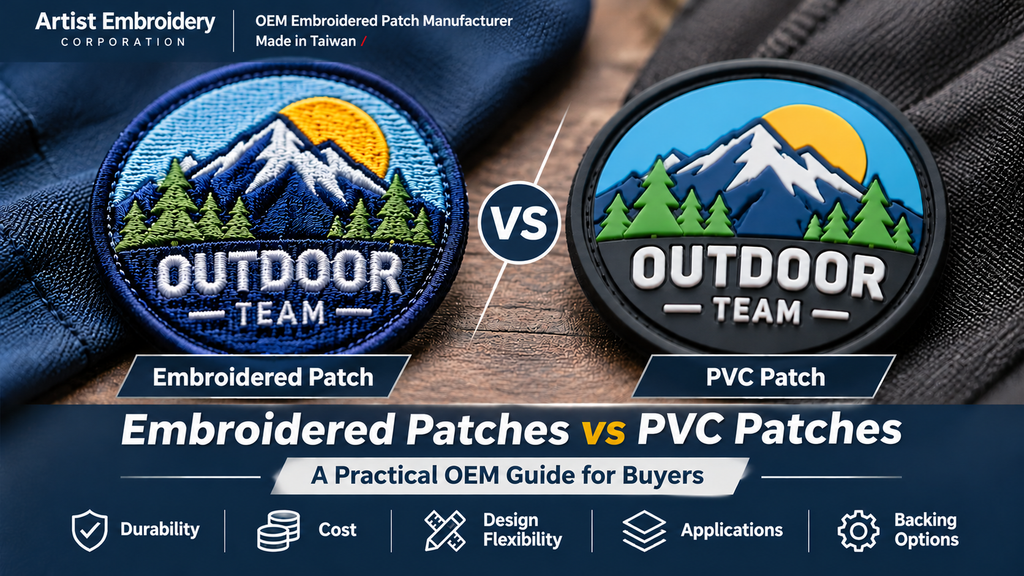
ユニフォーム、アパレル、アクセサリー、あるいは販促グッズ用のオリジナルパッチを選ぶ際、適切な素材を選定することは、ブランドや購買担当者にとって最も重要な決定事項の一つです。数ある選択肢の中でも、, 刺繍パッチとPVCパッチの比較 これは、外観、耐久性、コスト、機能性の理想的なバランスを求める企業にとって、よく用いられる比較基準です。.
どちらのタイプのパッチもロゴやエンブレム、オリジナルのデザインを表示することは可能ですが、素材、製造工程、表面の質感、そして全体的な見た目の魅力において大きな違いがあります。これらの違いを理解することで、OEMのバイヤーは、不必要な製造コストや不適切な素材の選択を避けつつ、情報に基づいた購買決定を下すことができます。.
刺繍ワッペン これらは、通常、ツイル生地やフェルト、その他の特殊素材などの基布に色糸を縫い付けて製造されます。その特徴的な浮き出た糸の質感が、軍隊の徽章、警察の制服、企業のブランディング、スポーツチーム、ファッションアクセサリーなどで広く親しまれている、伝統的でプロフェッショナルな外観を生み出しています。 デザインや刺繍の範囲に応じて、メーカーはさまざまな糸の色、ステッチの方向、仕上げのオプションを用いて、精巧なデザインを制作することができます。.
対照的だ、, PVCパッチ これらは一般的に、柔軟なポリ塩化ビニル素材を独自の形状やデザインに成形して製造されます。滑らかでゴムのような表面を持ち、盛り上がりや凹みといった要素を取り入れることができるため、特定のアウトドア用品、タクティカルギア、バッグ、そして現代的なブランドグッズに特に適しています。また、その素材特性により、耐湿性や表面の洗浄のしやすさが重要な用途においても利点をもたらします。.
しかし、刺繍パッチとPVCパッチのどちらを選ぶかは、単に外観を比較するだけでは決まりません。大量注文を行う前には、デザインの複雑さ、最小注文数量、製造コスト、洗濯時の取り扱い、取り付け方法、長期的な使用状況といった要素をすべて考慮する必要があります。.
例えば、ブランドが衣服に自然に溶け込むクラシックなテキスタイルの風合いを求める場合には、刺繍パッチが好まれることがあります。一方、成形された表面、際立った立体的なディテール、あるいは耐水性素材が主な要件となる場合には、PVCパッチの方が適している場合があります。どちらの選択肢も一概に優れているわけではなく、適切な選択は用途や購入時の優先事項によって異なります。.
台湾を拠点とする、刺繍パッチの製造において豊富な実績を持つOEMメーカーとして、, アーティスト・エンブロイダリー株式会社 当社は、さまざまな商業用途に応じて適切な素材や製造仕様を選定することの重要性を理解しています。刺繍の専門知識と、プロ仕様の生産設備、そして品質管理手順を組み合わせることで、海外のバイヤーが、デザインや機能面の要件を満たすオーダーメイドの刺繍パッチを製造できるよう支援しています。.
この包括的なガイドでは、刺繍パッチとPVCパッチを、素材、耐久性、価格、デザインの自由度、カスタマイズオプション、実用的な用途といった観点から比較します。ユニフォーム用のパッチを調達する場合でも、ブランドグッズを開発する場合でも、あるいは次回のOEMプロジェクトに向けた素材の評価を行う場合でも、この比較を参考に、貴社のビジネスに最適なパッチソリューションを見極める一助となるでしょう。.
刺繍パッチとPVCパッチとは何ですか?
以下の間の根本的な違いを理解する 刺繍パッチとPVCパッチの比較 これは、カスタムパッチの製造オプションを検討している海外のバイヤー、ブランドオーナー、および購買担当者にとって不可欠な情報です。両製品ともブランディングや識別という同様の目的を果たしますが、素材、製造技術、表面特性、そして全体的な外観には大きな違いがあります。.
刺繍パッチは、機械刺繍によって作られる繊維製品であるのに対し、PVCパッチは、柔軟な合成素材から成形された製品です。こうした構造上の違いは、各パッチの外観、手触り、性能、およびさまざまな製品への取り付け方に影響を与えます。.
価格、耐久性、カスタマイズ性を比較する前に、購入者は各パッチの種類がどのように製造されているか、またどのような特性によって特定の用途に適しているかを理解しておく必要があります。.
刺繍パッチの構造について
刺繍パッチとは、布地を土台として、色付きの刺繍糸を縫い付けて作られる装飾用または識別用のエンブレムです。刺繍工程によって表面に凹凸が生まれ、一針一針のステッチがロゴ、文字、記号、その他の視覚的要素を形成します。.
生地の土台は、パッチの外観、柔軟性、そして全体的な構造を決定する上で重要な役割を果たします。一般的に使用される素材には、次のようなものがあります:
- ツイル生地: 刺繍パッチの土台として最も広く使用されており、安定した表面、プロフェッショナルな仕上がり、そして信頼性の高い刺繍性能を実現します。.
- フェルト生地: 伝統的なエンブレムや装飾用途、特定のデザイン要件に広く用いられる、柔らかな不織布素材です。.
- 反射素材: 入射光を反射するように設計された特殊な基盤であり、特定の視認性関連の用途に有用です。.
購入をご検討のお客様は、当社の 刺繍パッチの生地ガイド.
製造工程では、コンピュータ制御の刺繍機が、綿密にプログラムされたステッチパターン、糸の色、刺繍の密度を用いて、デジタル化されたデザインを再現します。完成したデザインは、意図する視覚効果に応じて、生地が露出している部分がある場合もあれば、糸で全面が覆われている場合もあります。.
例えば、刺繍のカバー率が50%のパッチでは、下地の生地がより多く見えるのに対し、全面刺繍のデザインでは、表側のほぼ全体が糸で覆われます。カバー率の違いによって、質感、外観、生産時間、製造コストに影響が出ます。.
これらの違いについて詳しくは、当社の 刺繍の適用範囲ガイド.
刺繍加工後、パッチは裏地の貼り付け、裁断、縁の仕上げ、品質検査などを含む仕上げ工程を経ます。デザインや用途に応じて、刺繍パッチにはメロー縁、熱裁断縁、縫い付け仕様、粘着裏地、またはマジックテープ式留め具などが採用される場合があります。.
刺繍は物理的なステッチに依存するため、非常に小さな文字、極めて細い線、複雑なグラデーションについては、満足のいく再現性を得るためにデザイン調整が必要になる場合があります。経験豊富なOEMメーカーは、大量注文においても一貫した仕上がりを確保できるよう、生産前にこうした制約を評価します。.
PVCパッチの素材について
PVCパッチは、主に柔軟なポリ塩化ビニル(PVC)を素材として製造されるオーダーメイドのエンブレムであり、この合成ポリマーはさまざまな形状、色、表面仕上げに成形することが可能です。.
刺繍パッチとは異なり、PVCパッチは、その主要な視覚的デザインを形成するために、縫い糸や布地を基盤としていません。その代わりに、メーカーは金型と精密な素材加工を用いて、ロゴ、文字、シンボル、装飾要素を成形しています。.
多くの特注PVCパッチには、2次元または3次元の成形デザインが施されています。盛り上がった部分やくぼんだ部分を用いることで、異なる要素を視覚的に区別することができ、メーカーは、ゴムのような独特の質感を持った大胆な形状、縁取り、文字スタイルを再現することができます。.
PVCパッチは、一般的に次のようなものと関連付けられています:
- 戦術装備およびアウトドア用品
- リュックサック、スーツケース、および装備の識別
- 販促グッズおよびブランドアクセサリー
- スポーツ用具および一部のユニフォーム用途
- 柔軟性があり、お手入れが簡単な表面が求められる製品
PVC素材の注目すべき特徴の一つは、吸水しにくい点です。テキスタイルの刺繍とは異なり、成形されたPVCの表面は、布や糸のように水分を吸収することはありません。ただし、完成したPVCパッチの総合的な性能は、その配合、厚さ、取り付け方式、および製造品質にも左右されます。.
PVCパッチの製造には、特にカスタム形状や浮き彫りデザインの場合、専用の金型が必要になることがあります。そのため、初期の金型製作費がプロジェクトの総コストに影響を与える可能性があり、特に生産数量が少ない場合にはその影響が大きくなります。.
色の選択、立体効果、最小線幅、金型の複雑さも、製造の可否や価格に影響を与える可能性があります。PVCは特定の成形デザインにおいてかなりの自由度を提供しますが、非常に精細な図柄や極めて小さな文字については、依然として簡略化が必要となる場合があります。.
OEMバイヤーにとって、成形された合成パッチと従来の刺繍エンブレムのどちらが最終製品に適しているかを判断する際には、こうした素材の特性を理解することが重要です。.
📊 表:刺繍パッチとPVCパッチの基本的な構造上の違い
| 特徴 | 刺繍ワッペン | PVCパッチ |
|---|---|---|
| 主原料 | 刺繍糸と布 | 柔軟性のあるポリ塩化ビニル |
| 製造方法 | コンピュータ制御の刺繍機 | 金型を用いた製造 |
| 表面の質感 | 浮き出た織物のステッチ | 滑らかなもの、または浮き彫りのもの |
| 基本構造 | ツイル、フェルト、または反射素材 | 成形合成樹脂 |
| 外観 | 伝統的、質感豊か、プロフェッショナル | モダンで、立体感があり、ゴムのような質感 |
| デザインの詳細 | ステッチのサイズと密度によって決まる | 金型および材料の制約によって決まる |
| 耐水性 | 生地、糸、そして仕立て方によって異なります | PVC素材は吸水率が低い |
| 一般的なアプリケーション | ユニフォーム、エンブレム、アパレル、アクセサリー | タクティカルギア、バッグ、アウトドア用品 |
| カスタマイズ | 糸の色、織り密度、縁取り、裏地 | 成形された形状、色、浮き出たディテール |
| 初期設定 | 刺繍のデジタル化 | 金型または治具の準備 |
💡 購入のヒント:パッチの素材を選ぶ前に、製造工程を理解しておきましょう
比較する場合 刺繍パッチとPVCパッチの比較, 、購入者は、外観や単価だけに注目する前に、その製品の使用目的を十分に検討すべきです。.
ユニフォーム、企業エンブレム、伝統的な記章、繊維製品などのアクセサリーにおいては、刺繍パッチが自然な布地の風合いと、定評のある取り付け方法をしばしば提供します。一方、装備品のブランディング、アウトドア用品、あるいは成形ゴムのような仕上げが求められるデザインの場合、PVCパッチには実用的な利点がある場合があります。.
お見積りをご依頼いただく前に、パッチの希望サイズ、デザインデータ、注文数量、取り付け要件、および想定される使用条件をご用意ください。これらの仕様情報により、メーカーは生産の実現可能性を評価し、より正確な価格をご提示することができます。.
プロジェクトで刺繍パッチが必要な場合、経験豊富なOEM刺繍メーカーを選定することで、生産の一貫性、素材の選定、仕上げの品質を向上させることができます。.
📖 エクステンデッド・リーディング
刺繍パッチとPVCパッチ:主な違い
比較する場合 刺繍パッチとPVCパッチの比較, 、最も顕著な違いは、製造材料だけにとどまりません。表面の質感、外観、柔軟性、厚さ、重量はすべて、完成したパッチを衣類、アクセサリー、あるいは装備に取り付けた際の見た目や機能性に影響を与えます。.
海外のOEMバイヤーにとって、これらの特性を理解することは不可欠です。なぜなら、選定するパッチの素材は、最終製品の外観だけでなく、さまざまな用途への適合性にも影響を与えるからです。フォーマルな制服用に設計されたパッチと、タクティカルバックパックやアウトドア用品用に設計されたパッチでは、求められる特性が異なる場合があります。.
刺繍パッチもPVCパッチも、どちらもオリジナルのロゴやエンブレムを再現できますが、その構造の違いにより、視覚的・物理的な特性には明確な違いがあります。.
質感、外観、およびデザインの詳細
刺繍パッチとPVCパッチの最も大きな違いの一つは、その表面の質感です。.
刺繍パッチは、独特なテキスタイルの風合いが特徴です 個々の刺繍のステッチによって作り出されます。これらのステッチは、生地の地肌に浮き出た模様を形成し、糸の方向、ステッチの密度、刺繍のカバー率によって光を異なるように反射する、層状の表面を生み出します。.
この特徴により、刺繍パッチは、プロ用の制服、軍隊の記章、企業のエンブレム、ブランドアパレルなどでよく見られる、伝統的で高級感のあるテキスタイルの外観を醸し出しています。.
刺繍パッチの見た目の品質は、製造上のいくつかの要因によって決まります:
- スレッドの品質: 品質が安定した刺繍糸は、色の均一性、ステッチの鮮明さ、そして全体的な仕上がりの良さに寄与します。.
- ステッチ密度: 適切なステッチ密度は、デザインの鮮明さを保ちつつ、生地の不必要な歪みを防ぐのに役立ちます。.
- 刺繍の向き: ステッチの角度を変えることで、質感や光の反射に微妙な変化が生まれます。.
- 生地の選び方: ツイル、フェルト、反射性生地は、それぞれ異なる背景の見た目や構造的特性を備えています。.
- 刺繍の適用範囲: 刺繍の範囲が部分的か全面的かによって、視覚的な効果が異なり、生産要件にも影響を及ぼします。.
これらの特性を評価している購入者の皆様には、当社の 刺繍パッチの品質ガイド 一貫した刺繍仕上がりを実現する製造上の要因について解説しています。.
これに対し、, PVCパッチは、成形された合成素材の表面が特徴です 目に見える刺繍のステッチではなく、その外観は主に金型の形状、素材の色、および浮き彫りや凹みのあるデザイン要素の配置によって決まります。.
PVCパッチを使用すると、特に大胆なロゴや幾何学的な形状、ゴムのような質感が求められるデザインにおいて、輪郭がはっきりとした立体的な部分を作り出すことができます。.
しかし、成形構造を採用したからといって、複雑なアートワークの再現性が必ずしも向上するとは限りません。非常に小さな文字、狭い文字間隔、複雑な形状については、金型や製造上の制約に対応するために、依然として修正が必要になる場合があります。.
ブランディングの観点から見ると、刺繍パッチは一般的にテキスタイルの職人技や伝統的な本物らしさを強調するのに対し、PVCパッチはより現代的で成形されたような外観を特徴としています。.
どの選択肢が最適かは、ブランドのビジュアルアイデンティティ、製品のポジショニング、および想定される用途によって異なります。.
柔軟性、厚さ、および重量
比較する際には、柔軟性、厚さ、重量も考慮すべき点となります。 刺繍パッチとPVCパッチの比較, 、特に衣類、制服、リュックサック、あるいは装備用のパッチを調達するバイヤーにとっては。.
刺繍パッチは、生地、糸、および必要に応じて裏地素材を用いて作られます。その柔軟性は、選択した生地、刺繍の密度、裏地の構造、およびパッチ全体の寸法によって異なります。.
例えば、ツイル生地が露出している部分刺繍のパッチは、刺繍の面積が広く、裏地が硬い高密度のパッチよりも柔軟性があるように感じられるかもしれません。.
同様に、ヒートシール用接着剤や面ファスナーなどの裏打ち材も、完成したパッチの厚みや曲げ特性に影響を与える可能性があります。.
刺繍パッチは布地を素材としているため、衣類やその他の布製品に自然に溶け込むことがよくあります。このため、伝統的な縫い付けの風合いが好まれる用途に特に適しています。.
ただし、刺繍パッチは、必ずしもPVCパッチよりも薄く、あるいは軽いとは限りません。実際の厚みや重量は、製造仕様、パッチのサイズ、刺繍の面積、仕上げの要件などによって異なります。.
PVCパッチは柔軟な合成素材を用いて製造されますが、その柔軟性は、素材の配合、厚さ、および成形設計構造に大きく左右されます。.
柔らかい配合で作られた薄いPVCパッチは比較的簡単に曲がる一方、凹凸がはっきりとした厚めのパッチは、かなり硬く感じられることがあります。.
同様に、PVCパッチの重量は、材料の密度、外形寸法、成形厚さによって大きく異なる場合があります。.
衣類や柔軟性のあるアクセサリーなど、繰り返し曲げられる用途の場合、購入者は、パッチを取り付けた後の動きに対してパッチがどのように反応するかを評価する必要があります。.
装備品、バックパック、および戦術用アクセサリーについては、寸法や外観が意図されたデザインの一部である場合、厚みのある成形パッチが許容されるだけでなく、むしろ望ましい場合もあります。.
パッチのサイズも、これらの特性に影響を与えます。パッチが大きい場合は、柔軟性、装着時の安定性、および全体的な快適性について、さらに配慮が必要になる場合があります。.
当社の 刺繍パッチのサイズガイド さまざまな刺繍パッチの用途に応じて、適切なサイズを選ぶための実践的な指針を提供しています。.
結局のところ、購入者は、刺繍パッチやPVCパッチのいずれもが、一概に軽量で、薄く、柔軟性が高いと決めつけるのではなく、実際の生産サンプルを評価すべきです。.
📊 表:刺繍パッチとPVCパッチの主な物理的・視覚的な違い
| 比較係数 | 刺繍ワッペン | PVCパッチ |
|---|---|---|
| 表面の質感 | 浮き刺繍のステッチ | 滑らかな、または成形された合成素材の表面 |
| 全体的な外観 | 伝統的な織物の仕上げ | モダンでゴムのような質感の仕上げ |
| 視覚的深度 | 縫い目と糸の向きによって生み出された | 成形による盛り上がりや窪みのある要素によって作られています |
| 材料の構造 | 生地、刺繍糸、裏地 | 柔軟な成形PVC素材 |
| 柔軟性 | 刺繍の面積や裏地によって異なります | PVCの配合や厚さによって異なります |
| 厚さ | 縫製や仕上げによって異なります | 成形構造によって異なります |
| 重量 | サイズ、糸の密度、裏地によって異なります | 大きさ、密度、厚さによって異なります |
| 詳細 | ステッチの寸法と生地の安定性による制約 | 金型の形状および材料の加工特性による制約 |
| カラープレゼンテーション | 色付き刺繍糸 | 着色PVC素材 |
| ファブリックの統合 | 天然繊維のような風合い | 独特な合成表面 |
| 一般的な視覚的な好み | ユニフォーム、アパレル、伝統的なエンブレム | タクティカルアクセサリー、バッグ、モダンなブランディング |
| 生産の一貫性 | 刺繍工程の管理が必要 | 金型および材料の工程管理が必要 |
💡 購入のヒント:外観と実用性を合わせて評価しましょう
刺繍パッチとPVCパッチのどちらを選ぶか決める際は、デジタルデータや商品写真だけに基づいて判断しないでください。.
コンピュータの画面上では魅力的に見えるデザインでも、刺繍のステッチや成形されたPVC部品に落とし込むと、印象が異なって見えることがあります。.
刺繍パッチについては、希望する糸の色、刺繍の密度、生地、縁の仕上げ、裏地の構造が確認できる試作品をご依頼ください。.
PVC製のパッチについては、成形部分の細部の鮮明さ、素材の柔軟性、厚さ、および取り付けの適合性を評価してください。.
購入者は、完成したパッチが最終製品とどのように調和するかも考慮すべきです。特定の衣類には柔軟性のあるテキスタイル製のパッチが適している場合もありますが、特定のアウトドア用アクセサリーには成形されたPVC製のパッチの方がよく合う場合もあります。.
大規模なOEM受注の場合、量産前に代表的な実物サンプルを確認することで、誤解を減らすことができ、選定した材料が外観および機能の両面において期待に応えるものであることを確実にすることができます。.
📖 エクステンデッド・リーディング
どちらのパッチ素材の方が耐久性が高いでしょうか?
耐久性は、比較する際に最も重要な考慮事項の一つです。 刺繍パッチとPVCパッチの比較, 、特にユニフォーム、アウトドア用品、作業着、ブランドアクセサリー用の特注パッチを調達する海外のバイヤーにとってはなおさらです。どちらの素材も長期にわたって信頼性の高い性能を発揮しますが、その構造や素材特性の違いにより、洗濯、摩耗、湿気、日光、日常的な使用に対する耐性には違いがあります。.
刺繍パッチは布地と刺繍糸を素材としていますが、PVCパッチは柔軟な合成素材から製造されています。こうした違いにより、繰り返しの取り扱い、環境への曝露、および洗浄に対して、各製品がどのように反応するかが異なります。.
しかし、どちらの素材も、あらゆる状況において自動的に耐久性が高いというわけではありません。実際の性能は、製造品質、素材の仕様、取り付け方法、使用条件、およびメンテナンス方法によって異なります。.
これらの要因を理解することで、OEMの購買担当者は、想定される運用要件を満たすパッチを選定しやすくなります。.
洗濯や日常の使用に対する耐久性
ユニフォーム、企業向けアパレル、スポーツウェア、その他の洗濯可能な繊維製品においては、繰り返し洗濯に耐えることが重要な考慮事項となります。.
刺繍ワッペン 適切な生地、高品質の刺繍糸、適切なステッチ密度、そして確実な取り付け方法を用いて製造されていれば、通常の洗濯に耐えることができます。.
高品質な刺繍仕上げにより、日常の使用においてもロゴ、文字、装飾要素の形が損なわれるのを防ぎます。また、糸の張力やステッチ密度を適切に調整することで、ステッチのほつれ、シワ、刺繍面の凹凸といった問題も軽減できます。.
ただし、刺繍パッチも摩耗の影響を完全に免れるわけではありません。過度な摩擦、刺激の強い洗剤、高温での洗濯、不適切な乾燥条件などは、徐々に糸の見た目、生地の安定性、裏地の性能に影響を及ぼす可能性があります。.
刺繍パッチの耐久性には、いくつかの製造上の要因が影響します:
- スレッドの品質: 適切な刺繍糸を使用することで、通常の使用において色の一貫性とステッチの品質を維持することができます。.
- 生地の安定性: ツイルやその他の適切な裏地生地は、刺繍柄に構造的な支えを与えます。.
- ステッチ密度: 刺繍の密度を均一に保つことで、生地の不必要な歪みや縫い目の弱さを防ぐことができます。.
- 国境の建設: 縁をきちんと仕上げることで、パッチの周囲がほつれたり傷ついたりするのを防ぐことができます。.
- 取り付け方法: しっかりと縫い付けるか、適切に指定された裏打ちシステムを用いることで、使用中の剥がれを防ぐことができます。.
これらの製造上の考慮事項に関する詳細については、当社の 刺繍パッチの品質ガイド.
PVCパッチ, 一方、これらの製品には刺繍の縫い目が露出していないため、糸のほつれや縫い目の切れが生じる心配がありません。成形された表面は一般的に拭き取りが容易であるため、汚れや泥、あるいは時折湿気にさらされるような用途にも実用的です。.
とはいえ、PVCパッチにはその他の劣化現象が生じることもあります。材料の配合や製造品質によっては、繰り返しの曲げ、摩耗、化学物質への曝露、あるいは不適切な温度などが原因で、表面の損傷、ひび割れ、変形、あるいは変色が生じる可能性があります。.
取り付け方式も同様に重要です。たとえ耐久性の高いパッチ素材であっても、縫製、接着剤、あるいは面ファスナーによる取り付け方法が用途に適していない場合、早期に破損してしまう可能性があります。.
頻繁に洗濯機で洗う必要がある衣類については、バイヤーはパッチの素材だけに注目するのではなく、パッチの構造と取り付けシステム全体を評価すべきである。.
湿気、屋外での使用、および耐久性
屋外での使用では、雨、湿度、紫外線、温度変化、機器やその他の表面との繰り返しの接触など、耐久性に関するさらなる課題が生じます。.
評価 刺繍パッチとPVCパッチの比較 屋外で使用する場合は、購入者は素材自体の耐水性と、完成品の全体的な耐久性を区別する必要があります。.
PVC素材は一般的に吸水性が極めて低いため、成形されたPVCパッチは、パッチの表面が頻繁に湿気にさらされる場合や、簡単に洗浄できることが求められる場合に有利です。.
ただし、PVCパッチは、組み立てられた製品として自動的に防水であると見なすべきではありません。縫い目の穴、取り付け材、裏地、およびその下にある衣類や装備によって、依然として水が浸入する可能性があります。.
また、PVCの配合によって、紫外線や温度変化に対する耐性も異なります。長時間日光にさらされると、特定の材料や顔料が退色したり劣化したりする恐れがあり、一方、極端な低温や高温は、柔軟性や寸法安定性に影響を与える可能性があります。.
刺繍ワッペン 雨に濡れたり洗濯したりした後、生地の基材や糸の構造によって水分を保持してしまうため、通常とは異なる挙動を示すことがあります。.
だからといって、刺繍パッチがアウトドア環境に適さないというわけではありません。適切に製造された刺繍パッチは、作業服、アウトドアウェア、ミリタリースタイルの衣類、リュックサック、装備のアクセサリーなどに広く使用されています。.
その長期的な耐久性は、糸の組成、色堅牢度、生地の選定、刺繍の仕立て、および取り付けの品質など、いくつかの要因に左右されます。.
例えば、優れた色堅牢度や通常の環境暴露に対する耐性が求められる用途では、ポリエステル製の刺繍糸が一般的に選ばれます。とはいえ、実際の性能については、想定される洗濯条件や屋外での使用要件に基づいて確認する必要があります。.
パッチの縁の仕上げも耐久性に影響を与えます。適切に仕上げられたメロー縫いまたはヒートカットの縁は、刺繍パッチの周囲を保護するのに役立ちますが、最適な仕上げ方法はパッチの形状、生地の種類、およびデザインの仕様に依存します。.
購入希望者は、当社の 刺繍入りパtch ボーダーズ・ガイド.
屋外での長期使用を目的とした製品については、製造業者および購入者は、色堅牢度、耐摩耗性、洗濯耐久性、および環境老化に対する適切な試験を検討すべきである。.
どちらのタイプのパッチについても、素材の種類だけではその予想寿命を判断することはできません。適切に製造され、適切な条件下で使用される刺繍パッチは、何年にもわたって機能し続ける可能性がありますが、仕様が不十分なPVCパッチは早期に劣化してしまう可能性があります。また、環境条件が異なれば、その逆のケースも起こり得ます。.
結局のところ、最も耐久性の高いパッチを選ぶには、素材の特性、製造品質、および取り付け仕様を、その用途に合わせて選定する必要があります。.
📊 表:刺繍パッチとPVCパッチの耐久性比較
| 耐久性係数 | 刺繍ワッペン | PVCパッチ |
|---|---|---|
| 定期的な洗濯 | 適切な構造と手入れを行えば、一般的に使用に適しています | 配合や取り付け方法によって異なります |
| 表面摩耗 | 糸に摩耗やほつれが生じる場合があります | 成形面には、傷や擦り傷が生じる場合があります |
| 吸水性 | 生地や糸には湿気が残っている場合があります | PVC素材は吸水率が低い |
| 雨にさらされる | さまざまな用途に適しています。乾燥が必要な場合があります。 | 一般的に、表面の湿気に対して耐性がある |
| 紫外線への曝露 | 糸や生地の色落ちのしやすさによって異なります | PVCの配合や顔料によって異なります |
| 繰り返しの曲げ | ステッチの密度、生地、裏地によって異なります | 配合や厚さによって異なります |
| 高温 | 糸、生地、裏地はそれぞれ耐熱温度が異なります | 過度の熱により変形が生じるおそれがあります |
| 低温 | 繊維や裏地の特性によって異なります | 製品によっては、柔軟性が低下する場合があります |
| エッジの耐久性 | 縁の仕上げの品質次第です | 成形エッジの設計や材質によって異なります |
| 掃除 | その生地に適したお手入れが必要です | 一般的に拭き取りやすい |
| 長期的な外観 | 縫い目、色落ちのしにくさ、お手入れ方法によって異なります | 表面の摩耗、顔料、経年変化によって異なります |
| 愛着の持続性 | 縫製、接着、またはマジックテープ式のいずれかによって異なります | 縫製、接着、またはマジックテープ式のいずれかによって異なります |
注:実際の耐久性は、材料のグレード、製造仕様、取り付け方法、および使用条件によって異なります。過酷な使用環境では、性能試験の実施をお勧めします。.
💡 購入のヒント:耐久性の要件を実際の用途に合わせて選ぶ
カスタムパッチを大量生産用に調達する際、購入者は「防水」「耐候性」「耐久性」といった一般的な謳い文句だけを頼りに素材を選定することは避けるべきです。“
その代わりに、完成したパッチが実際にどのような状況で使用されるのかを明確に定義してください。.
例えば、頻繁に洗濯される制服に使用する刺繍パッチについては、ステッチの強度、生地の安定性、色落ちの有無、縁の仕上げの品質、および取り付け強度について評価を行う必要があります。.
屋外用機器向けのPVCパッチについては、柔軟性、表面の耐摩耗性、耐紫外線性、耐熱性、および取り付けの信頼性について評価を行う必要があります。.
要求の厳しい用途については、量産を承認する前に、代表的な生産サンプルを請求し、適切な試験要件を定めてください。.
で アーティスト・エンブロイダリー株式会社, 当社のOEM刺繍製造におけるアプローチでは、一貫したステッチ、適切な素材の選定、管理された製造工程、そして丁寧な仕上げを重視しています。これらの要素により、海外のバイヤーは、承認された仕様に基づいて製造された刺繍パッチを入手することができます。.
明確に定義された製品仕様と、信頼性の高い製造品質を組み合わせることは、外観や一般的な耐久性の主張のみに基づいてパッチ材を選ぶことよりも、多くの場合、より価値がある。.
📖 さらに読み進める
コスト比較:刺繍パッチとPVCパッチ
比較する際、コストは重要な考慮事項となります 刺繍パッチとPVCパッチの比較, 、特に海外のOEMバイヤー、卸売業者、ユニフォーム供給業者、および大量注文を計画しているブランド様向けです。どちらの製品もロゴや文字、独自の形状によるカスタマイズが可能ですが、製造プロセスにはそれぞれ異なるセットアップ費用、生産要件、およびコスト構造が伴います。.
刺繍パッチは、コンピュータ制御の刺繍機、布地、刺繍糸を用いて製造されますが、PVCパッチは一般的に特注の金型や特殊な素材加工を必要とします。こうした違いは、初期投資額、単価、および注文数量ごとの経済的メリットに影響を与えます。.
しかし、どちらの素材も一概に安価だとは言えません。最終的なコストは、パッチのサイズ、デザインの複雑さ、生産数量、色数、製造仕様、仕上げの要件、およびサプライヤーの能力によって異なります。.
これらのコスト要因を理解することで、購買担当者は正確な見積依頼書を作成し、サプライヤーからの提案を評価し、製品の品質を損なうことなく製造コストを最適化できる機会を見極めることができます。.
Production Costs and Tooling Requirements
One of the primary differences between embroidered patches and PVC patches is the initial production setup.
刺繍ワッペン typically require embroidery digitizing, a process that converts approved artwork into machine-readable stitch instructions. The digitized file determines stitch types, stitch directions, thread color sequences, and other technical parameters necessary for production.
The complexity of the artwork directly influences digitizing requirements. Designs containing intricate details, small lettering, multiple color sections, or extensive embroidery coverage may require additional programming and production adjustments.
Once the embroidery program has been prepared and approved, manufacturers can use it for repeat orders, provided the design specifications remain compatible with the original production setup.
The main cost factors associated with embroidered patch manufacturing include:
- Embroidery Digitizing: Preparing the embroidery program and necessary production adjustments.
- パッチのサイズ Larger patches often require more fabric, embroidery stitches, and machine time.
- Stitch Count: Higher stitch counts generally increase embroidery production time and thread consumption.
- 刺繍の適用範囲: Full embroidery coverage typically requires more stitching than designs with substantial exposed fabric.
- 糸の色: Additional colors can increase production costs through thread changes, color sequencing, and reduced production efficiency.
- 生地の選び方: Twill, felt, and reflective fabrics have different material costs and manufacturing considerations.
- Border Finishing: Merrowed borders, heat-cut edges, and other finishing methods involve different processing requirements.
- Backing Options: Heat-seal adhesive, hook-and-loop fasteners, and other attachment systems add material and labor costs.
Importantly, increasing the number of embroidery thread colors generally increases manufacturing costs.
Even when modern computerized embroidery machines can accommodate multiple thread colors, additional colors may require more complicated programming, thread preparation, machine adjustments, and color-change operations.
On multi-head embroidery machines, efficient production depends on consistent thread arrangements and optimized manufacturing sequences. A design requiring numerous colors can reduce operational flexibility, particularly when production involves multiple designs or frequent thread changes.
Therefore, buyers should not assume that a patch using twelve thread colors will cost the same as an otherwise comparable design using three colors.
The actual price difference depends on the design, equipment configuration, production volume, and manufacturer’s cost structure.
For a more detailed explanation of embroidery pricing, see our オーダーメイド刺繍パッチの価格ガイド.
PVCパッチ, by comparison, commonly require dedicated molds to create the desired shape, surface relief, and design details.
Mold development may involve additional initial expenses, especially for complicated shapes, multiple dimensional levels, or intricate artwork.
Once an appropriate mold is completed, it can generally be reused for subsequent production runs, subject to mold condition and design consistency.
PVC manufacturing costs also depend on material formulation, patch dimensions, thickness, color requirements, processing methods, and finishing operations.
Although both manufacturing methods involve setup costs, embroidery digitizing and PVC mold development are fundamentally different processes. Buyers should compare the complete quotation rather than evaluating setup fees in isolation.
How Quantity and Design Complexity Affect Pricing
Order quantity is another major factor influencing the total cost of 刺繍パッチとPVCパッチの比較.
For embroidered patches, larger production quantities allow manufacturers to distribute certain setup expenses across more units while improving equipment utilization and production efficiency.
For example, producing 1,000 identical embroidered patches may result in a lower unit cost than producing 100 pieces of the same design because preparation time, production scheduling, and certain fixed expenses can be allocated across a larger order.
However, increasing quantity does not eliminate the cost of embroidery threads, fabric, machine operation, finishing, inspection, or packaging.
Design complexity also has a significant influence on pricing.
An embroidered patch featuring a simple logo, limited thread colors, and moderate embroidery coverage may require fewer stitches and less machine time than a similarly sized patch containing extensive fine details, numerous colors, and full embroidery coverage.
Buyers should pay particular attention to the following factors:
1. Number of Thread Colors
More embroidery colors generally lead to higher production costs because of additional thread preparation, color-change operations, and potential effects on production efficiency.
2. 刺繍の範囲
A design with 100% embroidery coverage usually requires more stitches and thread consumption than a comparable design with 50% coverage, although actual costs depend on stitch density and artwork.
当社の 刺繍の適用範囲ガイド explains how different coverage levels affect embroidered patch construction.
3. Patch Dimensions
Larger patches often require more material and production time. However, patch size alone does not determine cost; stitch count, design density, and finishing requirements must also be considered.
4. Design Complexity
Fine lettering, intricate shapes, multiple color sections, and complicated stitch patterns may increase digitizing requirements and embroidery production time.
5. Finishing and Attachment
Additional processes such as heat-seal backing, hook-and-loop attachment, specialized borders, and individual packaging can increase the total manufacturing cost.
For PVC patches, order quantity is especially relevant when custom tooling is required.
A mold fee distributed across a small production run may contribute substantially to the effective cost per patch. As production quantities increase, the initial tooling expense is spread across more units.
For example, if a hypothetical mold costs US$200, allocating that cost across 100 patches adds US$2.00 per unit, while allocating it across 1,000 patches adds only US$0.20 per unit.
This illustration excludes material, production, finishing, shipping, and other costs and does not represent an actual supplier quotation.
Design complexity also affects PVC pricing. Multiple colors, raised details, intricate mold structures, and greater material thickness may increase manufacturing requirements.
Therefore, the most economical option depends on the combination of setup expenses, production quantity, design specifications, and long-term purchasing plans.
For international buyers, obtaining detailed quotations based on identical project requirements is the most reliable way to compare manufacturing costs.
📊 Table: Cost Factors for Embroidered vs PVC Patches
| コスト係数 | 刺繍ワッペン | PVCパッチ |
|---|---|---|
| 初期設定 | 刺繍のデジタル化 | Mold development |
| Main Material | Fabric and embroidery threads | Flexible PVC compound |
| 設計の複雑さ | Influences digitizing and stitch count | Influences mold and processing requirements |
| 色数 | More colors generally increase production costs | Additional colors may increase processing complexity and costs |
| パッチサイズ | Affects fabric, stitching, and finishing | Affects material usage and mold dimensions |
| 生産時間 | Influenced by stitch count and machine efficiency | Influenced by molding and processing requirements |
| Small Orders | Setup and minimum production costs affect unit pricing | Mold expenses may significantly affect unit pricing |
| Large Orders | Potential savings from efficient bulk embroidery | Potential savings from spreading tooling costs |
| リピート注文 | Existing digitizing files may be reusable | Existing molds may be reusable |
| バッキング・オプション | Additional material and processing costs | Additional attachment and processing costs |
| ボーダー仕上げ | Merrowed or heat-cut finishing costs | Molded edge and finishing requirements |
| Overall Pricing | Depends on complete embroidery specifications | Depends on complete molding specifications |
Note: This table compares general manufacturing cost structures. Actual pricing must be confirmed through supplier quotations based on specific artwork, quantities, materials, and production requirements.
💡 Buyer Tip: Optimize Embroidery Costs Without Sacrificing Quality
For OEM buyers sourcing custom embroidered patches, cost optimization should focus on production efficiency rather than simply requesting the lowest possible unit price.
One effective approach is to evaluate whether the original artwork requires every specified thread color.
Because additional embroidery colors generally increase manufacturing costs, reducing unnecessary color variations may improve production efficiency while preserving the essential appearance of a logo or emblem.
Buyers can also evaluate embroidery coverage, patch dimensions, border construction, and backing options to identify practical opportunities for cost reduction.
For example, selecting a suitable twill background instead of requiring full embroidery coverage may reduce stitch count and machine time when the design allows exposed fabric.
However, reducing stitch density excessively or simplifying important artwork details may negatively affect appearance and quality. Any proposed changes should be evaluated against the buyer’s approved specifications.
Before requesting a quotation, prepare the following information:
- Final artwork and required dimensions
- 予想注文数量
- Number of embroidery thread colors
- Preferred fabric and embroidery coverage
- Border and backing requirements
- Packaging instructions
- Expected delivery schedule
で アーティスト・エンブロイダリー株式会社, we specialize in OEM embroidered patch manufacturing based on customer-provided artwork and production specifications. Our manufacturing experience helps international buyers evaluate practical embroidery requirements, production feasibility, and cost-related considerations.
By providing complete specifications and reviewing appropriate manufacturing options, buyers can obtain more accurate quotations and make informed purchasing decisions.
📖 エクステンデッド・リーディング
Design Flexibility and Customization Options
Design flexibility is an important factor when comparing 刺繍パッチとPVCパッチの比較, especially for international OEM buyers who need to reproduce logos, lettering, symbols, and branded artwork accurately across large production quantities. Although both materials offer extensive customization possibilities, their manufacturing methods create different limitations in detail reproduction, color presentation, dimensional effects, and overall design appearance.
Embroidered patches transform digital artwork into physical stitches using embroidery threads and fabric foundations. PVC patches, in contrast, reproduce artwork through molded synthetic materials with raised, recessed, or flat surface elements.
These manufacturing differences influence which design features can be reproduced effectively and which may require technical adjustments before production.
For brands, uniform suppliers, promotional merchandise distributors, and other commercial buyers, understanding these limitations helps reduce production errors, improve consistency, and establish realistic expectations for finished products.
Fine Details, Gradients, and Color Limitations
One of the most important considerations in custom patch manufacturing is the ability to reproduce small lettering, intricate lines, and complex artwork.
刺繍ワッペン create designs through individual stitches, meaning that the resolution of the finished artwork depends on stitch dimensions, thread thickness, fabric stability, and embroidery density.
Unlike digital printing, embroidery cannot reproduce unlimited detail at extremely small dimensions. Very thin lines, tightly spaced letters, and miniature design elements may become difficult to distinguish when converted into stitches.
For example, a logo containing extremely small lettering may appear perfectly clear on a computer screen but lose definition when embroidered onto a compact patch.
The minimum practical size of lettering depends on the font style, stitch direction, thread type, fabric, and embroidery equipment. Consequently, there is no single minimum lettering size that applies to every embroidered patch design.
Buyers should evaluate the actual production dimensions rather than relying exclusively on enlarged digital artwork.
当社の 刺繍パッチのサイズガイド explains how patch dimensions influence design readability and manufacturing feasibility.
Color reproduction is another important consideration.
Embroidered patches use physical embroidery threads selected from available thread color ranges. Although professional embroidery threads provide numerous color options, they cannot reproduce every digital color value with absolute precision.
Thread appearance may also vary depending on lighting, surface texture, and stitch direction.
Furthermore, increasing the number of embroidery thread colors generally increases production costs because additional colors can require more thread preparation, color changes, and production management.
For this reason, buyers should avoid adding unnecessary colors when a simpler thread palette can preserve the intended brand identity.
Gradients and photographic effects present additional challenges.
Traditional embroidery does not reproduce smooth digital gradients in the same way as full-color printing. However, experienced embroidery manufacturers can use stitch direction, thread selection, and controlled color transitions to create approximate shading effects.
The success of these techniques depends on design complexity, patch size, and acceptable visual tolerances.
PVCパッチ offer different customization possibilities.
Molded PVC designs can feature distinct color sections, raised outlines, recessed areas, and relatively smooth surfaces. These characteristics are useful for bold logos, geometric artwork, and designs emphasizing clearly separated visual elements.
However, PVC molding also has limitations.
Extremely narrow lines, tiny lettering, complicated color boundaries, and intricate recessed details may be difficult to manufacture consistently.
Standard molded PVC patches are also not equivalent to full-color printed products. Smooth photographic gradients generally require specialized production methods rather than conventional solid-color molding.
For both embroidered and PVC patches, buyers should provide accurate artwork and confirm manufacturing feasibility before approving bulk production.
2D and 3D Effects
Dimensional appearance is another major difference between 刺繍パッチとPVCパッチの比較.
Both manufacturing methods can create raised visual elements, but they achieve these effects through fundamentally different techniques.
刺繍ワッペン develop texture and dimensional variation through thread placement, stitch density, stitch direction, and specialized embroidery methods.
Standard flat embroidery already produces a slightly raised surface because threads sit above the fabric foundation.
By adjusting stitch directions and combining different stitch structures, manufacturers can create visual depth, highlights, and textured patterns.
Certain specialized embroidery techniques, such as 3D puff embroidery, use foam beneath selected stitches to produce more pronounced raised effects.
However, 3D puff embroidery is not suitable for every design. Extremely small details, narrow lettering, and intricate shapes may be difficult to reproduce using this method.
The feasibility of specialized embroidery effects depends on the manufacturer’s equipment, production capabilities, artwork, and approved specifications.
Traditional embroidered patches also offer various customization options beyond dimensional effects, including:
- 刺繍の適用範囲: Partial or full thread coverage depending on the desired appearance.
- Fabric Foundations: Twill, felt, or reflective materials selected according to product requirements.
- 糸の色: Multiple embroidery colors based on approved artwork and manufacturing feasibility.
- Border Finishing: Merrowed borders or heat-cut edges depending on patch shape and construction.
- Backing Options: Sew-on, heat-seal, or hook-and-loop attachment systems.
- Patch Shapes: Standard geometric shapes or custom outlines within production limitations.
Buyers can learn more about thread coverage and surface appearance in our Embroidery Coverage Guide.
これに対し、, PVCパッチ create dimensional effects through mold geometry.
A 2D PVC patch generally uses relatively flat design elements with defined color sections and limited height variation.
A 3D PVC patch incorporates more pronounced raised and recessed features, creating a sculpted appearance.
These molded effects are particularly suitable for designs requiring strong dimensional separation, bold outlines, or a rubber-like surface.
However, the term “3D” does not automatically indicate superior quality or greater detail. Actual results depend on mold precision, material formulation, design specifications, and production control.
From a branding perspective, embroidered patches emphasize textile texture and traditional craftsmanship, while PVC patches emphasize molded contours and dimensional definition.
For OEM buyers, the most suitable customization method depends on the intended product, artwork characteristics, brand identity, and manufacturing budget.
📊 Table: Design and Customization Comparison Between Embroidered and PVC Patches
| 設計係数 | 刺繍ワッペン | PVCパッチ |
|---|---|---|
| 設計・施工 | Embroidery stitches on fabric | 成形合成樹脂 |
| Fine Lettering | Limited by stitch size and fabric stability | Limited by mold geometry and processing |
| 細い線 | May require thicker embroidery strokes | May require minimum molded line widths |
| Color Options | Available embroidery thread colors | Available PVC material colors |
| その他のカラー | Generally increase production costs | May increase molding and processing costs |
| Smooth Gradients | Limited; approximated through thread techniques | Limited in standard solid-color molding |
| Photographic Details | Not suitable for exact photographic reproduction | Not suitable for exact reproduction using standard molding |
| 表面の質感 | Raised threads and stitch patterns | Smooth or molded surface |
| 2D Appearance | Flat embroidery with natural thread relief | Relatively flat molded elements |
| 3D Appearance | Specialized raised embroidery techniques | Raised and recessed molded structures |
| Background Materials | Twill, felt, reflective fabric | PVC material |
| Border Options | Merrowed or heat-cut edges | Molded edges |
| バッキング・オプション | Sew-on, heat-seal, hook-and-loop | Attachment methods depend on construction |
| カスタムシェイプ | Subject to embroidery and finishing limitations | Subject to mold design limitations |
| 生産の一貫性 | Depends on digitizing and embroidery control | Depends on mold and material processing control |
Note: The feasibility of specific customization features depends on the artwork, dimensions, equipment, materials, and individual manufacturer’s production capabilities.
💡 Buyer Tip: Prepare Production-Ready Artwork Before Requesting a Quotation
When sourcing custom embroidered patches or PVC patches, buyers should provide artwork that accurately represents the intended finished product.
For embroidered patches, vector artwork or sufficiently clear high-resolution files can help manufacturers evaluate stitch placement, lettering dimensions, thread colors, and embroidery coverage.
However, supplying a vector file does not automatically guarantee that every detail can be embroidered successfully. The design must still be evaluated against actual patch dimensions and embroidery limitations.
To improve manufacturing efficiency, buyers should confirm the following specifications before submitting an OEM inquiry:
- Final patch dimensions and shape
- Approved logo or artwork files
- Required thread or material colors
- Minimum acceptable lettering size
- Desired embroidery coverage or molded relief
- Fabric, border, and backing requirements
- 予想注文数量
- Intended product application
For embroidered patches, reducing unnecessary thread colors, avoiding extremely small lettering, and selecting appropriate embroidery coverage can help improve production feasibility and cost efficiency.
で アーティスト・エンブロイダリー株式会社, we specialize in OEM embroidered patch manufacturing based on customer-supplied artwork and specifications.
Our manufacturing process focuses on embroidery digitizing for production, material preparation, computerized embroidery, finishing, and quality inspection. We evaluate submitted artwork for manufacturing feasibility and communicate relevant production limitations before proceeding with approved orders.
We do not provide original artwork design services. Customers remain responsible for supplying and approving their designs and required specifications.
By preparing accurate artwork and understanding the capabilities of different manufacturing methods, international buyers can improve production consistency and obtain custom embroidered patches that meet their intended quality requirements.
📖 エクステンデッド・リーディング
Best Applications for Embroidered and PVC Patches
Choosing the right patch material is essential for ensuring that custom emblems meet the visual, functional, and practical requirements of their intended applications. When comparing 刺繍パッチとPVCパッチの比較, international OEM buyers should consider more than appearance or manufacturing cost. The type of garment, equipment, environment, attachment method, and expected usage conditions all influence which material is most suitable.
Embroidered patches are widely used for professional uniforms, corporate branding, sports teams, fashion accessories, and traditional insignia because of their distinctive textile texture and versatile finishing options. PVC patches, on the other hand, are commonly selected for tactical equipment, outdoor accessories, backpacks, and promotional merchandise requiring a molded, rubber-like appearance.
However, these applications are not exclusive to either material. Both embroidered and PVC patches can be used across multiple industries, provided their construction and attachment systems meet the intended product requirements.
Understanding the strengths and limitations of each option helps buyers select suitable materials and prepare accurate specifications for OEM manufacturing.
Uniforms, Fashion, and Corporate Branding
Uniforms and branded apparel represent some of the most established applications for custom embroidered patches.
刺繍ワッペン are particularly popular for police uniforms, military-style insignia, security personnel, corporate workwear, school uniforms, and organizational emblems. Their stitched surfaces provide a traditional textile appearance that integrates naturally with woven and knitted garments.
For professional uniforms, embroidery offers several practical advantages.
First, the combination of colored threads and fabric foundations creates a recognizable emblem style associated with official identification, departmental insignia, and organizational branding.
Second, embroidered patches can be manufactured in different shapes, dimensions, and embroidery coverage levels to accommodate specific uniform requirements.
Third, suitable backing and attachment systems allow patches to be sewn directly onto garments or attached using hook-and-loop fasteners when removable identification is required.
For police and security applications, custom embroidered patches may include department names, identification numbers, official emblems, and specialized unit markings. Buyers must ensure that artwork and insignia specifications are authorized and appropriate for the intended organization.
当社の 警察のパッチ名称ガイド provides additional information about embroidered identification patches used for professional uniforms.
コーポレート・ブランディング is another important application.
Companies frequently use embroidered patches on employee uniforms, jackets, work shirts, caps, and promotional apparel to reinforce brand identity.
Compared with direct embroidery on finished garments, separately manufactured patches can offer flexibility when the same logo must be applied to different apparel products.
For example, a company may order identical embroidered logo patches for work jackets, uniforms, and merchandise, then attach them according to the requirements of each garment.
This approach can support consistent branding across multiple product categories, although attachment labor and material compatibility should be considered.
Fashion brands and apparel manufacturers also use embroidered patches as decorative elements.
Common applications include denim jackets, streetwear, backpacks, hats, and limited-edition clothing collections. The visible thread texture adds a textile detail that may complement traditional, vintage, collegiate, or heritage-inspired designs.
Sports teams, clubs, and educational organizations similarly use embroidered patches for team logos, membership emblems, achievements, and commemorative merchandise.
PVCパッチ can also be used on uniforms and apparel, especially when a contemporary molded appearance is desired.
However, buyers should consider the flexibility, thickness, weight, attachment method, and laundering requirements of the finished garment.
For applications involving frequent washing or direct contact with the body, the compatibility of the complete PVC patch assembly should be evaluated before bulk production.
Ultimately, embroidered patches are often a strong choice when textile appearance, traditional insignia styling, and integration with fabric garments are primary considerations.
Tactical Gear, Outdoor Products, and Accessories
Tactical equipment, outdoor accessories, and branded gear represent another major application category for custom patches.
Products such as backpacks, equipment bags, outdoor jackets, camping accessories, and tactical-style gear frequently incorporate patches for identification, decoration, or branding.
In these applications, PVCパッチ are often selected because their molded surfaces are relatively easy to wipe clean and their base material absorbs very little water.
Their raised and recessed design elements can also provide a distinctive appearance that complements modern outdoor equipment and tactical accessories.
For example, a backpack manufacturer may select a molded PVC logo patch to create a bold dimensional branding element on an equipment bag.
However, material-level water resistance should not be confused with waterproof performance of the entire finished product. Stitching holes, backing systems, and attachment components can still influence moisture penetration and long-term durability.
刺繍ワッペン are also widely used on tactical gear and outdoor products.
Their textile construction makes them suitable for backpacks, field uniforms, jackets, equipment organizers, and other fabric-based accessories where a stitched emblem appearance is preferred.
Depending on the application, embroidered patches may be manufactured with hook-and-loop backing for convenient attachment to compatible equipment panels.
This attachment method is particularly useful when patches must be removed, replaced, or repositioned without permanently altering the underlying product.
For buyers considering removable embroidered emblems, proper hook-and-loop specifications are important. The dimensions, fastening strength, backing construction, and compatibility with the receiving surface can all influence performance.
Outdoor apparel manufacturers may also prefer embroidered patches when they want their branding to match the textile character of jackets, vests, and other garments.
For example, a heritage outdoor brand may choose embroidered logo patches to reinforce a traditional appearance, while a contemporary equipment brand may prefer molded PVC emblems for a more technical visual style.
Neither choice automatically guarantees greater durability. Exposure to sunlight, moisture, abrasion, washing, and temperature changes should be considered when specifying either material.
Promotional accessories provide additional opportunities for both patch types.
Embroidered patches can be incorporated into fabric keychains, luggage tags, branded apparel, and other textile-based merchandise.
PVC patches may be suitable for molded decorative labels, bag accessories, and merchandise emphasizing raised shapes or rubber-like surfaces.
Buyers interested in textile-based promotional products can explore our Embroidered Flight Keychain Guide for an example of embroidery applications beyond traditional uniform patches.
For OEM sourcing, the best material depends on the final product’s intended use, appearance requirements, production quantity, and attachment specifications.
📊 Table: Best Applications for Embroidered and PVC Patches
| 申し込み | 刺繍ワッペン | PVCパッチ |
|---|---|---|
| Police Uniforms | Traditional textile insignia and identification | Alternative molded appearance when permitted |
| Military-Style Uniforms | Classic embroidered emblems and unit patches | Molded identification and decorative patches |
| Corporate Workwear | Professional logo patches for fabric garments | Modern branding where garment compatibility allows |
| School Uniforms | Traditional school crests and emblems | Alternative decorative branding |
| スポーツチーム | Team logos, achievements, and club emblems | Molded logos and merchandise applications |
| ファッション・アパレル | Denim, streetwear, jackets, and textile accessories | Contemporary decorative accents |
| バックパック | Textile branding and removable emblems | Molded logos and easy-to-clean surfaces |
| 戦術装備 | Hook-and-loop identification patches | Dimensional tactical-style patches |
| アウトドアジャケット | Traditional fabric-based branding | Molded branding with suitable attachment |
| Camping Accessories | Embroidered identification and logos | Molded labels and decorative elements |
| 販促グッズ | Fabric keychains, apparel, and textile accessories | Molded branded accessories |
| Luggage and Travel Gear | Embroidered labels and luggage tags | Molded identification and decorative patches |
Note: These are general application examples. Actual suitability depends on material specifications, attachment construction, product requirements, and applicable organizational standards.
💡 Buyer Tip: Choose Patch Materials Based on the Final Product
When selecting between 刺繍パッチとPVCパッチの比較, buyers should begin by identifying the intended product rather than choosing a material based only on appearance.
For uniforms, corporate apparel, school emblems, and traditional organizational insignia, embroidered patches often provide a suitable combination of textile appearance, customization flexibility, and established attachment methods.
For backpacks, tactical accessories, and equipment requiring a molded surface, PVC patches may be worth considering.
Before submitting an OEM quotation request, buyers should confirm:
- 用途: Uniform, apparel, backpack, equipment, or promotional merchandise.
- Material Preference: Textile embroidery or molded synthetic construction.
- 寸法: Finished patch width, height, and shape.
- イラスト: Approved logo, lettering, and color specifications.
- Attachment: Sew-on, heat-seal, hook-and-loop, or another compatible method.
- Usage Conditions: Washing frequency, outdoor exposure, abrasion, and handling.
- 注文数量: Estimated initial production and repeat-order requirements.
- Quality Requirements: Appearance, durability, and any applicable testing standards.
For embroidered patches, selecting appropriate fabric, embroidery coverage, border finishing, and backing construction is essential for achieving consistent manufacturing results.
で アーティスト・エンブロイダリー株式会社, we specialize in OEM embroidered patch manufacturing for international buyers who provide their own artwork and production specifications.
Our manufacturing capabilities support custom embroidered emblems for uniforms, corporate branding, sports organizations, apparel accessories, and other suitable textile applications.
We focus exclusively on OEM manufacturing rather than original artwork design services, helping buyers transform approved specifications into professionally manufactured embroidered products.
By matching the patch construction to the intended application, buyers can improve product suitability, reduce avoidable manufacturing issues, and achieve more consistent results across bulk orders.
📖 エクステンデッド・リーディング
裏地の種類と取り付け方法
Selecting the appropriate backing and attachment method is an essential part of custom patch manufacturing. When comparing 刺繍パッチとPVCパッチの比較, international OEM buyers should evaluate not only the patch material and visual appearance but also how the finished emblem will be attached to garments, uniforms, bags, and equipment.
Backing construction directly influences attachment strength, flexibility, thickness, maintenance requirements, and long-term performance. Even a professionally manufactured patch may fail prematurely if its attachment system is incompatible with the intended product or operating conditions.
Common attachment methods include sew-on construction, heat-seal adhesive backing, and hook-and-loop fasteners. However, these options are not equally suitable for every patch material.
Because embroidered patches are constructed from fabric and thread, they offer established textile attachment solutions. PVC patches, in contrast, require attachment systems compatible with their molded synthetic structure and specific material formulation.
Understanding these differences helps buyers select practical backing specifications and avoid unnecessary production or installation problems.
Sew-On, Iron-On, and Hook-and-Loop Backings
縫い付けバック is one of the most established attachment methods for embroidered patches.
With this construction, the finished patch is secured directly to the garment or accessory using stitching around its perimeter or through designated attachment areas.
Sew-on embroidered patches are commonly used for police uniforms, military-style insignia, corporate workwear, school uniforms, jackets, and fabric accessories.
When properly attached, sewing provides a secure mechanical connection that does not depend on heat-activated adhesives.
This makes sew-on construction particularly suitable for applications requiring reliable attachment during repeated handling or laundering.
However, sewing performance depends on the patch border, garment fabric, stitch specifications, and installation quality. Poorly positioned stitches or unsuitable sewing techniques may damage the garment or reduce attachment reliability.
アイロン接着, also known as heat-seal backing, uses a heat-activated adhesive layer applied to the reverse side of an embroidered patch.
During installation, controlled heat, pressure, and dwell time activate the adhesive and bond the patch to a compatible fabric surface.
Heat-seal backing can be convenient for apparel production and certain promotional applications because it may reduce the need for additional sewing operations.
Nevertheless, successful bonding depends on several factors:
- Fabric Compatibility: The receiving material must be suitable for heat-seal attachment.
- Application Temperature: Excessive heat may damage sensitive fabrics or adhesive systems.
- Pressure: Adequate and consistent pressure is necessary for proper bonding.
- Dwell Time: Insufficient or excessive heating may affect adhesive performance.
- Washing Requirements: Repeated laundering can influence long-term bond strength.
- Surface Conditions: Coatings, finishes, and fabric treatments may interfere with adhesion.
Buyers should follow the specified application conditions and conduct attachment testing before approving large production runs.
面ファスナー裏地 provides a removable attachment solution.
This system typically consists of a hook component attached to the patch and a compatible loop component installed on the garment or equipment.
Hook-and-loop embroidered patches are widely used for tactical-style uniforms, identification emblems, backpacks, equipment organizers, and applications requiring interchangeable patches.
The main advantage is convenience: users can remove, replace, or reposition patches without repeatedly sewing them onto the product.
However, fastening performance depends on the hook-and-loop material, attachment construction, patch dimensions, and condition of the receiving surface.
For OEM buyers, hook-and-loop backing may involve additional manufacturing processes, including cutting, alignment, bonding, or sewing.
The backing should be securely integrated with the embroidered patch to reduce the risk of separation during repeated use.
For more information about different attachment systems, explore our Embroidered Patch Backing Options Guide.
Choosing the Right Attachment for Each Material
Although embroidered patches and PVC patches can serve similar identification and branding purposes, their attachment requirements may differ considerably.
刺繍ワッペン are textile-based products, making them compatible with several conventional garment attachment methods.
Sew-on construction is often appropriate for uniforms, workwear, and apparel requiring a durable mechanical attachment.
Heat-seal backing may be suitable for compatible fabrics when installation efficiency is important and the finished product does not exceed the adhesive system’s performance limitations.
Hook-and-loop backing is particularly useful for removable emblems, tactical accessories, and interchangeable identification patches.
However, the correct option depends on the final product’s intended use rather than the patch material alone.
For example, an embroidered patch intended for a frequently washed work uniform may benefit from perimeter sewing, while a removable identification emblem may require hook-and-loop backing.
PVCパッチ require additional consideration because their molded synthetic structure behaves differently under heat and mechanical stress.
Certain PVC patches can be manufactured with sew-on channels, peripheral sewing areas, or other attachment features designed to accommodate stitching.
Other PVC products may use compatible adhesive systems or hook-and-loop components integrated into the finished construction.
However, conventional heat-seal backing designed for embroidered textile patches should not automatically be applied to PVC patches.
PVC materials can soften, deform, or experience changes in physical properties when exposed to unsuitable temperatures.
Additionally, adhesive bonding performance depends on the PVC formulation, surface characteristics, and compatibility with the selected adhesive system.
For this reason, buyers should confirm the attachment method directly with the relevant PVC manufacturer and follow validated processing specifications.
Patch size and shape also influence attachment performance.
Larger patches may require stronger attachment systems or additional securing points to prevent lifting, curling, or detachment.
Irregularly shaped patches can present further challenges because narrow extensions, sharp corners, or complicated outlines may be more difficult to secure consistently.
Buyers can review these considerations in our 刺繍パッチのサイズガイド.
The intended receiving material is equally important.
Cotton uniforms, polyester jackets, nylon backpacks, coated fabrics, and synthetic equipment surfaces may respond differently to sewing, adhesive bonding, or heat application.
Therefore, OEM buyers should evaluate the complete assembly, including the patch, backing, attachment process, and receiving product.
Whenever possible, representative samples should be tested under conditions that reflect the final application.
📊 Table: Backing and Attachment Comparison for Embroidered vs PVC Patches
| Attachment Factor | 刺繍ワッペン | PVCパッチ |
|---|---|---|
| Sew-On Attachment | Common and widely used | Possible with suitable construction |
| ヒートシール・バッキング | Common for compatible fabrics | Requires material-specific validation |
| 面ファスナー | Common for removable patches | Available with compatible construction |
| Adhesive Bonding | Depends on adhesive and fabric | Depends on PVC formulation and adhesive |
| Direct Garment Sewing | Generally suitable | Requires appropriate sewing features |
| Removable Identification | Suitable with hook-and-loop | Suitable with compatible hook-and-loop |
| 頻繁な洗濯 | Depends on attachment construction | Depends on material and attachment system |
| Heat Sensitivity | Fabric, thread, and backing limits apply | PVC formulation may be heat-sensitive |
| Attachment Flexibility | Depends on backing and embroidery density | Depends on molded thickness and backing |
| Large Patch Attachment | May require additional securing | May require additional securing |
| Installation Equipment | Sewing machine or compatible heat press | Depends on attachment system |
| Best Selection Criteria | Fabric, usage, laundering, and backing | PVC formulation, usage, and attachment compatibility |
Note: Attachment suitability depends on the specific patch construction, receiving material, processing conditions, and supplier specifications. Testing is recommended before bulk production.
💡 Buyer Tip: Confirm Backing Specifications Before Mass Production
比較する場合 刺繍パッチとPVCパッチの比較, buyers should confirm the attachment method during the quotation stage rather than treating backing as a minor finishing detail.
For embroidered patches, specify whether the order requires sew-on construction, heat-seal adhesive, hook-and-loop backing, or another approved attachment method.
If heat-seal backing is required, provide information about the receiving fabric and expected washing conditions so that suitable application parameters can be evaluated.
For hook-and-loop patches, confirm the required fastening components, dimensions, alignment, and whether the corresponding loop material must be supplied.
Buyers should also clarify whether the backing must be integrated into the patch border or applied during a separate finishing process.
For PVC patches, request manufacturer-confirmed attachment specifications, particularly when heat or adhesive bonding is involved. Do not assume that textile heat-seal procedures are suitable for molded PVC products.
で アーティスト・エンブロイダリー株式会社, we specialize in OEM embroidered patch manufacturing based on customer-provided artwork and production requirements.
Our manufacturing process includes embroidery production and appropriate finishing operations according to approved specifications. Backing requirements are evaluated in relation to patch construction, material compatibility, and intended use.
We do not provide original artwork design services or claim PVC patch manufacturing capabilities.
By specifying the correct backing and attachment method before production, international buyers can improve product consistency, reduce installation problems, and ensure that finished embroidered patches are suitable for their intended applications.
📖 エクステンデッド・リーディング
How to Choose the Right Patch for Your Project
Selecting the right patch material requires balancing appearance, functionality, manufacturing cost, and long-term product requirements. When comparing 刺繍パッチとPVCパッチの比較, international OEM buyers should evaluate the specific needs of their project rather than assuming that one material is universally superior.
Both patch types offer customization possibilities, but their differences in manufacturing methods, surface textures, durability characteristics, and attachment systems can influence the final purchasing decision.
For example, embroidered patches are often preferred for professional uniforms, corporate apparel, traditional insignia, and textile-based accessories because of their distinctive stitched appearance. PVC patches may be suitable for outdoor equipment, tactical-style accessories, and branded products requiring a molded, rubber-like surface.
However, material selection should also account for order quantity, production setup expenses, design complexity, maintenance requirements, and the intended product’s expected service conditions.
A structured evaluation process helps buyers identify suitable manufacturing options, reduce unnecessary costs, and prepare more accurate OEM quotation requests.
Evaluating Budget, Quantity, and Usage
Budget is one of the first considerations when choosing between embroidered patches and PVC patches.
ただし、購入者は以下の点を評価すべきです。 total project cost rather than comparing unit prices alone.
For embroidered patches, manufacturing expenses are influenced by embroidery digitizing, stitch count, thread colors, fabric selection, patch dimensions, embroidery coverage, border finishing, and backing requirements.
A relatively simple embroidered logo with limited thread colors and moderate stitch coverage may be more economical to manufacture than a complex design requiring extensive stitching and numerous color changes.
Importantly, increasing the number of embroidery thread colors generally increases production costs, even when computerized embroidery machines support automatic color changes.
Additional colors can increase thread preparation, color sequencing, production adjustments, and overall manufacturing complexity.
Similarly, larger patch dimensions and higher embroidery coverage typically require additional thread consumption and machine time.
For buyers seeking to optimize embroidery expenses, evaluating the design’s actual production requirements can be more effective than focusing exclusively on the lowest quoted price.
当社の オーダーメイド刺繍パッチの価格ガイド explains the manufacturing factors that influence embroidered patch pricing.
PVC patches involve a different cost structure.
Custom molds may be required to reproduce specific shapes, raised elements, and recessed details. These initial tooling expenses can influence the effective unit cost, particularly for smaller orders.
For larger quantities, mold expenses can be distributed across more units, potentially improving overall cost efficiency.
Nevertheless, the actual price depends on material formulation, mold complexity, color requirements, thickness, production methods, and finishing specifications.
注文数量 should therefore be considered together with setup costs.
For embroidered patches, larger production runs can improve machine utilization and distribute certain preparation expenses across more pieces.
For PVC patches, larger orders may reduce the relative impact of initial mold development costs.
However, neither manufacturing method guarantees a lower price at a particular quantity. Buyers should request comparable quotations based on the same design dimensions, quantities, and functional requirements.
当社の Custom Embroidered Patches MOQ Guide provides additional information about minimum order quantities and bulk embroidery production considerations.
Product usage is equally important.
For frequently washed uniforms, buyers should consider stitch integrity, colorfastness, fabric stability, and attachment durability.
For outdoor equipment, factors such as moisture exposure, abrasion, sunlight, temperature changes, and cleaning requirements may influence material selection.
Embroidered patches can perform well in many outdoor applications when appropriate materials and construction methods are used.
PVC patches generally offer low water absorption at the material level, but their performance still depends on formulation, attachment construction, and environmental conditions.
The best choice is the one that meets the intended application requirements at an acceptable total manufacturing cost.
Matching Patch Materials to Brand Identity
Beyond budget and functionality, patch material selection plays an important role in communicating brand identity.
A patch is often more than a decorative accessory. It can represent an organization’s professionalism, heritage, product positioning, or visual character.
刺繍ワッペン provide a distinctive textile appearance created through colored threads, stitch patterns, and fabric foundations.
This traditional construction is commonly associated with military-style insignia, police uniforms, sports organizations, corporate branding, educational institutions, and heritage-inspired apparel.
For brands emphasizing craftsmanship, tradition, or textile authenticity, embroidered patches can reinforce the intended visual identity.
For example, a workwear brand may prefer an embroidered logo patch because its stitched texture complements durable jackets and uniforms.
Similarly, a sports organization may select embroidered emblems for team apparel, membership identification, or commemorative merchandise.
The combination of thread colors, embroidery coverage, and fabric selection allows buyers to achieve different visual effects while maintaining the recognizable characteristics of traditional embroidery.
For additional information about textile foundations, see our 刺繍パッチの生地ガイド.
PVCパッチ, by comparison, provide a molded synthetic appearance that can communicate a more contemporary, technical, or equipment-oriented brand identity.
Their raised and recessed surfaces can emphasize bold logos, geometric shapes, and dimensional design elements.
For example, a manufacturer of outdoor accessories may prefer PVC branding when the product design incorporates synthetic materials, molded components, or technical styling.
However, brand identity should not be determined by material appearance alone.
Buyers should also consider how the patch interacts with the final product.
A thick molded patch may look appropriate on a structured equipment bag but may not provide the desired flexibility or comfort on lightweight apparel.
Likewise, an embroidered patch may complement a textile garment but require additional consideration when attached to certain coated or non-textile surfaces.
Consistency across production batches is another important factor.
For embroidered patches, manufacturers must control thread colors, embroidery density, stitch alignment, fabric selection, and finishing quality to achieve consistent results.
For PVC patches, consistent molding, color formulation, dimensional accuracy, and finishing are important.
Before approving mass production, buyers should review representative samples and confirm that the finished appearance meets their approved specifications.
Ultimately, choosing between embroidered and PVC patches involves aligning material characteristics with the brand’s intended appearance, product requirements, and commercial objectives.
📊 Table: How to Choose Between Embroidered and PVC Patches
| 購入時の検討事項 | 刺繍ワッペン | PVCパッチ |
|---|---|---|
| Traditional Brand Identity | Strong textile appearance | Less traditional, molded appearance |
| Modern Technical Branding | Suitable for selected applications | Often suitable for molded technical styling |
| 企業ユニフォーム | Commonly preferred | Possible with compatible construction |
| アウトドア用品 | 適切な仕様であれば使用可能です | Often practical for easy-clean surfaces |
| Small Production Runs | Setup and production costs must be evaluated | Mold costs may significantly affect pricing |
| Large Production Runs | Efficient bulk embroidery may reduce unit costs | Tooling costs can be distributed across more units |
| Complex Color Designs | More thread colors generally increase costs | Multiple colors may increase processing costs |
| Fine Lettering | Limited by stitch dimensions | Limited by mold geometry |
| Textile Appearance | Natural embroidered texture | Molded synthetic texture |
| Water Exposure | 生地や糸には湿気が残っている場合があります | PVC素材は吸水率が低い |
| Flexible Garments | Depends on embroidery density and backing | Depends on material formulation and thickness |
| Removable Attachment | Hook-and-loop options available | Compatible attachment options may be available |
| リピート注文 | Approved digitizing files may be reused | Existing molds may be reused |
| ブランドの一貫性 | Requires embroidery and finishing control | Requires molding and material process control |
Note: These recommendations are general guidelines. Final material selection should be based on actual artwork, production specifications, intended usage, and supplier-confirmed capabilities.
💡 Buyer Tip: Prepare a Complete OEM Specification Before Comparing Quotations
評価 刺繍パッチとPVCパッチの比較, buyers should avoid requesting prices based only on a logo image and estimated quantity.
Incomplete specifications can lead to inconsistent quotations because different suppliers may assume different materials, dimensions, finishing methods, or production requirements.
Before contacting a manufacturer, prepare a clear purchasing specification that includes:
- Approved Artwork: Final logo or emblem design supplied by the buyer.
- パッチの寸法: Exact width, height, and required shape.
- 注文数量: Initial purchase volume and estimated repeat orders.
- Color Requirements: Required thread or material colors.
- Material Preference: Embroidered textile construction or molded PVC.
- 刺繍の適用範囲: Partial or full coverage when applicable.
- Border Requirements: Merrowed, heat-cut, or another suitable finishing method.
- Backing Requirements: Sew-on, heat-seal, hook-and-loop, or another approved system.
- 用途: Uniform, apparel, backpack, equipment, or promotional merchandise.
- Performance Requirements: Washing, abrasion, environmental exposure, and attachment durability.
- Packaging and Delivery: Packing instructions, destination, and requested schedule.
For embroidered patches, providing complete specifications helps manufacturers evaluate stitch count, thread colors, material consumption, production efficiency, and finishing requirements.
Buyers should also confirm whether production samples are required before bulk manufacturing.
で アーティスト・エンブロイダリー株式会社, we specialize in OEM embroidered patch manufacturing based on customer-supplied artwork and approved production specifications.
Our focus is on manufacturing feasibility, embroidery quality, material selection, production consistency, and appropriate finishing processes.
We do not provide original artwork design services or manufacture PVC patches.
By preparing accurate specifications and selecting a manufacturing partner whose capabilities match the project requirements, international buyers can improve quotation accuracy, reduce production misunderstandings, and achieve more consistent results.
📖 エクステンデッド・リーディング
よくある質問
評価 刺繍パッチとPVCパッチの比較, international buyers often have questions about durability, manufacturing costs, customization, and suitability for different applications. Although both materials can be used for branding and identification, their manufacturing processes and physical characteristics influence their performance in different environments.
The following frequently asked questions address common purchasing considerations to help OEM buyers select appropriate patch materials, establish realistic expectations, and prepare more accurate production specifications.
Q1. Are PVC Patches Better Than Embroidered Patches?
PVC patches are not necessarily better than embroidered patches. The most suitable option depends on the intended application, desired appearance, manufacturing budget, and performance requirements.
刺繍ワッペン offer a traditional textile appearance created through embroidery threads and fabric foundations. They are commonly selected for professional uniforms, corporate apparel, sports teams, organizational emblems, and fashion accessories.
Their distinctive stitched texture makes them particularly attractive for brands seeking a classic or heritage-inspired appearance.
PVCパッチ, in contrast, feature molded synthetic surfaces that can incorporate raised and recessed details. They are often used for tactical-style equipment, outdoor accessories, backpacks, and contemporary branded merchandise.
PVC material generally absorbs very little water and can be easy to wipe clean, making it practical for certain environments.
However, neither material is universally superior in durability, flexibility, or cost. Buyers should evaluate the complete patch construction, attachment method, and expected usage conditions before making a decision.
For brands prioritizing textile craftsmanship and traditional emblem styling, embroidered patches may be preferable. For projects requiring a molded rubber-like appearance, PVC patches may be more suitable.
Q2. Which Patch Type Lasts Longer?
The lifespan of embroidered patches and PVC patches depends on material quality, manufacturing specifications, attachment construction, environmental exposure, and maintenance.
High-quality embroidered patches can provide long-term performance when manufactured with suitable embroidery threads, stable fabric foundations, appropriate stitch density, and secure border finishing.
However, repeated abrasion, harsh washing conditions, and improper maintenance may gradually affect embroidery threads, fabric stability, and attachment strength.
PVC patches do not contain exposed embroidery stitches, eliminating certain risks associated with thread snagging or fraying.
Nevertheless, PVC materials may experience surface wear, discoloration, cracking, or deformation depending on formulation, temperature exposure, ultraviolet radiation, and repeated bending.
For frequently washed uniforms, embroidered patches with appropriate construction and secure attachment can be a practical choice.
For equipment exposed to moisture or requiring frequent surface cleaning, PVC patches may offer advantages.
Neither patch type has a universally guaranteed lifespan. Buyers should request suitable production samples and establish testing requirements based on actual operating conditions.
当社の 刺繍パッチの品質ガイド explains the manufacturing factors that contribute to consistent embroidered patch performance.
Q3. Are Embroidered Patches More Affordable Than PVC Patches?
Embroidered patches can be more economical than PVC patches for certain designs and quantities, but this is not always the case.
The manufacturing cost of embroidered patches depends on patch dimensions, stitch count, embroidery coverage, number of thread colors, fabric selection, border finishing, backing requirements, and order quantity.
Increasing the number of embroidery thread colors generally increases production costs, because additional colors may require more thread preparation, color changes, and production management.
Similarly, complex artwork and high embroidery coverage can increase stitch count and machine time.
PVC patches commonly require custom molds, creating initial tooling expenses that can influence the total project cost.
For small production quantities, mold development may represent a significant portion of the effective unit price. For larger orders, these costs can be distributed across more pieces.
However, PVC pricing also depends on material formulation, thickness, color requirements, mold complexity, and finishing processes.
Therefore, buyers should compare complete quotations based on identical artwork dimensions, quantities, attachment specifications, and delivery requirements.
For additional information about embroidery pricing, explore our オーダーメイド刺繍パッチの価格ガイド.
Q4. Can Embroidered Patches Be Used Outdoors?
Yes. Embroidered patches can be used outdoors when their materials, construction, and attachment systems are appropriate for the intended environment.
They are commonly used on outdoor jackets, backpacks, work uniforms, tactical-style apparel, and other textile accessories.
However, embroidered patches are not automatically waterproof. Fabric foundations and embroidery threads may retain moisture after exposure to rain or washing.
Their long-term outdoor performance depends on thread colorfastness, fabric stability, stitch quality, border finishing, and attachment construction.
For example, suitable polyester embroidery threads can provide good resistance to normal environmental exposure, although actual performance depends on material specifications and usage conditions.
PVC patches generally have low material-level water absorption, but the complete patch assembly may still be affected by attachment methods, sunlight exposure, temperature changes, and physical abrasion.
For demanding outdoor applications, buyers should evaluate appropriate testing requirements rather than relying on generalized waterproof or weather-resistant claims.
Q5. Which Patch Is Better for Uniforms?
Embroidered patches are often preferred for professional uniforms because their textile construction provides a traditional appearance that integrates naturally with fabric garments.
Police departments, security organizations, schools, sports teams, and corporate uniform suppliers commonly use embroidered emblems for identification and branding.
Embroidered patches can also be manufactured with different attachment options, including sew-on construction, heat-seal backing, and hook-and-loop fasteners.
The most suitable attachment method depends on garment material, washing requirements, and whether the patch needs to be permanently attached or removable.
PVC patches can also be used on uniforms, particularly when a molded appearance is desired. However, buyers should evaluate thickness, flexibility, garment compatibility, and laundering performance.
For traditional uniform insignia, embroidered patches are frequently a suitable choice because of their established manufacturing methods and recognizable stitched appearance.
Buyers should confirm authorized artwork, patch dimensions, thread colors, border construction, and backing specifications before approving production.
📊 Table: Frequently Asked Questions Summary
| 購入者からの質問 | 刺繍ワッペン | PVCパッチ |
|---|---|---|
| Which looks more traditional? | Distinctive textile appearance | Modern molded appearance |
| どちらがより耐久性が高いでしょうか? | Depends on construction and usage | Depends on formulation and usage |
| Which costs less? | Depends on stitches, colors, and quantity | Depends on molds, materials, and quantity |
| Can it be used outdoors? | はい、適切な仕様であれば | はい、適切な仕様であれば |
| 制服にはどちらが良いでしょうか? | Often preferred for traditional insignia | Suitable for selected applications |
| Which is easier to clean? | Requires textile-appropriate care | Molded surface is generally easy to wipe |
| Which offers removable attachment? | Hook-and-loop options available | Compatible hook-and-loop options available |
Note: Actual performance and pricing depend on the approved specifications, production quality, and intended application.
💡 Buyer Tip: Compare Manufacturing Specifications, Not Just Materials
比較する場合 刺繍パッチとPVCパッチの比較, buyers should focus on the complete product specifications rather than choosing a material based only on photographs, advertised durability, or estimated unit prices.
For embroidered patches, confirm the required dimensions, artwork, embroidery coverage, thread colors, fabric foundation, border finishing, and backing construction.
For PVC patches, evaluate mold requirements, material formulation, thickness, color details, and attachment compatibility with the intended product.
If the order involves professional uniforms, outdoor equipment, or repeated washing, consider requesting representative samples and defining appropriate performance requirements before mass production.
で アーティスト・エンブロイダリー株式会社, we specialize in OEM embroidered patch manufacturing based on customer-provided artwork and approved specifications.
Our focus is on embroidery manufacturing quality, production consistency, appropriate material selection, and finishing processes. We do not provide original artwork design services or manufacture PVC patches.
Clear purchasing specifications and reliable manufacturing communication help international buyers reduce misunderstandings and achieve more consistent production results.
📖 エクステンデッド・リーディング
CTA: Partner With an Experienced OEM Embroidered Patch Manufacturer
After comparing 刺繍パッチとPVCパッチの比較, choosing the appropriate material is only the first step toward successful custom patch production. For international buyers, working with a reliable manufacturing partner is equally important to achieving consistent quality, accurate specifications, competitive production costs, and dependable order fulfillment.
Although both embroidered and PVC patches serve valuable purposes, embroidered patches remain a popular choice for professional uniforms, corporate branding, sports organizations, fashion accessories, and traditional textile emblems.
However, the quality of a finished embroidered patch depends on much more than its appearance. Embroidery digitizing, thread selection, fabric stability, stitch density, equipment performance, border finishing, and quality control all contribute to manufacturing consistency.
For brands, importers, distributors, and uniform suppliers, selecting an experienced OEM embroidered patch manufacturer helps reduce production uncertainties and supports long-term sourcing relationships.
で アーティスト・エンブロイダリー株式会社, we specialize in Taiwan-based OEM embroidered patch manufacturing, producing custom embroidery products according to customer-provided artwork and approved production specifications.
Why Manufacturing Experience Matters
Manufacturing experience plays a critical role in producing consistent embroidered patches, especially when buyers require large quantities, detailed artwork, multiple thread colors, or specialized finishing specifications.
Professional embroidery manufacturing requires a combination of appropriate equipment, technical knowledge, material control, and efficient production management.
で アーティスト・エンブロイダリー株式会社, our manufacturing operations utilize professional Tajima computerized embroidery machines to produce custom embroidered patches for international OEM customers.
Tajima embroidery equipment supports controlled stitch execution, multiple thread colors, and repeatable production processes. However, machine capabilities alone do not guarantee high-quality results.
Effective production also requires careful embroidery programming, appropriate thread selection, suitable fabric foundations, and consistent inspection procedures.
Our manufacturing approach emphasizes several important factors:
1. Professional Embroidery Equipment
Computerized multi-head embroidery machines support efficient bulk production while maintaining consistent embroidery programs across multiple production positions.
Our manufacturing operations utilize equipment from 田嶋, a recognized manufacturer of professional embroidery machinery.
2. Quality Embroidery Threads
Thread selection affects color appearance, stitch definition, and finished product consistency.
We use professional embroidery threads, including products from FuFuのスレッド, according to applicable production requirements.
3. Appropriate Fabric Selection
Twill, felt, and reflective fabrics provide different surface characteristics and manufacturing properties.
Twill is our most commonly used fabric foundation because of its stability, versatility, and suitability for a wide range of embroidered patch applications.
4. Controlled Embroidery Production
Stitch density, thread tension, embroidery direction, and color sequencing must be appropriately managed to achieve consistent results.
Designs with additional thread colors may also require more preparation and production management, which can influence manufacturing costs.
5. Professional Finishing Processes
Border finishing, backing application, cutting, and inspection contribute to the final appearance and functionality of embroidered patches.
Depending on approved specifications, finishing options may include merrowed borders, heat-cut edges, heat-seal backing, and hook-and-loop attachment.
6.品質検査
Consistent inspection helps identify visible manufacturing issues, including loose threads, embroidery defects, incorrect dimensions, color inconsistencies, and finishing irregularities.
For international OEM buyers, these manufacturing considerations are especially important when sourcing patches for repeat orders or consistent branding across multiple product lines.
Learn more about evaluating manufacturing standards in our Embroidered Patch Quality Guide.
Request a Custom Embroidered Patch Quotation
When requesting a quotation for custom embroidered patches, providing accurate production specifications is essential for obtaining reliable pricing and evaluating manufacturing feasibility.
Unlike PVC patches, which commonly involve mold development, embroidered patches require embroidery digitizing, thread preparation, fabric selection, and computerized stitching.
The manufacturing cost depends on several interconnected factors, including patch dimensions, embroidery coverage, stitch count, number of thread colors, order quantity, and finishing requirements.
For example, a simple embroidered logo with limited colors and moderate embroidery coverage may require less machine time than a complex design featuring extensive stitching and numerous color changes.
Additional embroidery thread colors generally increase production costs, even when automated embroidery equipment supports multiple color changes.
Similarly, full embroidery coverage typically requires more stitching than designs with substantial exposed fabric areas, although actual costs depend on the approved artwork and embroidery specifications.
For a detailed explanation of pricing considerations, review our オーダーメイド刺繍パッチの価格ガイド.
To receive an accurate OEM quotation, buyers should provide the following information:
- Approved Artwork: Customer-supplied logo, emblem, or design file.
- パッチの寸法: Exact finished width and height.
- 注文数量: Required production volume and potential repeat-order quantities.
- 糸の色: Number of colors and any specific color requirements.
- Fabric Material: Twill, felt, or reflective fabric.
- 刺繍の適用範囲: Partial or full embroidery coverage.
- Border Finishing: Merrowed border, heat-cut edge, or another applicable finishing specification.
- Backing Requirements: Sew-on, heat-seal, hook-and-loop, or another approved attachment method.
- Packaging Requirements: Bulk packaging or other specified packing arrangements.
- 配送に関する要件: Requested production schedule and shipping destination.
Complete specifications allow manufacturers to assess embroidery feasibility, estimate material consumption, evaluate machine time, and calculate finishing requirements more accurately.
For buyers comparing suppliers, it is also important to confirm whether quotations include embroidery digitizing, backing materials, packaging, and other applicable charges.
Minimum order quantities and production lead times should be evaluated according to the actual design and order requirements rather than assumed to be identical for every project.
で アーティスト・エンブロイダリー株式会社, we focus exclusively on OEM embroidery manufacturing based on customer-provided artwork and approved specifications.
We do not provide original artwork design services or manufacture PVC patches.
Our objective is to support international buyers seeking reliable Taiwan-based embroidered patch production, consistent manufacturing standards, and clear communication throughout the OEM sourcing process.
Whether your project involves corporate logo patches, uniform emblems, organizational insignia, sports team patches, or branded textile accessories, our team welcomes inquiries for custom embroidered patch manufacturing.
📊 Table: Why Choose an Experienced OEM Embroidered Patch Manufacturer?
| 製造係数 | Why It Matters for OEM Buyers | Artist Embroidery Approach |
|---|---|---|
| 製造経験 | Supports production feasibility and consistency | Specialized OEM embroidery manufacturing |
| Production Equipment | Influences efficiency and repeatability | Professional Tajima embroidery machines |
| ねじの選定 | Affects appearance and stitch quality | Professional embroidery threads |
| Fabric Options | Determines texture and construction | Twill, felt, and reflective fabric |
| 刺繍のデジタル化 | Converts artwork into production instructions | Production digitizing based on supplied artwork |
| カラーマネジメント | Influences appearance and production costs | Thread color and production sequence planning |
| バルク生産 | Supports larger order quantities | Computerized multi-head embroidery production |
| ボーダー仕上げ | Affects appearance and edge construction | Suitable finishing based on specifications |
| バッキング・オプション | Determines attachment compatibility | Application-specific backing requirements |
| 品質検査 | Helps identify manufacturing defects | Embroidery and finishing quality checks |
| リピート注文 | Requires consistent approved specifications | Production based on established order requirements |
| OEM Specialization | Supports buyer-supplied designs | Manufacturing only; no original design service |
💡 Buyer Tip: Choose a Manufacturer Based on Production Capability, Not Price Alone
When evaluating OEM embroidered patch suppliers, the lowest quoted unit price should not be the only purchasing consideration.
Buyers should also evaluate embroidery quality, equipment capabilities, material selection, finishing consistency, communication, and the manufacturer’s ability to meet approved specifications.
Before confirming a bulk order, compare quotations based on identical artwork, dimensions, thread colors, embroidery coverage, border finishing, and backing requirements.
A quotation that excludes certain finishing operations or uses different material specifications may appear less expensive without representing an equivalent product.
For long-term sourcing relationships, production consistency and reliable communication can be just as important as initial pricing.
で アーティスト・エンブロイダリー株式会社, our focus is on manufacturing custom embroidered patches according to customer-provided designs and production requirements.
By combining professional embroidery equipment, practical manufacturing experience, and appropriate quality control procedures, we aim to support international OEM buyers seeking dependable embroidered patch production in Taiwan.
📖 さらに読み進める
お問い合わせ
アーティスト・エンブロイダリー株式会社
Your Taiwan-based OEM manufacturing partner for custom embroidered patches, uniform emblems, corporate logo patches, and branded embroidery products.
We specialize in manufacturing based on customer-supplied artwork and approved specifications, helping international buyers source custom embroidered patches with consistent production quality and professional finishing.
📞 電話:+886-2-8245-8989
🌐 ウェブサイト: artistembroidery.com
📧 Eメール: service@artistembroidery.com
🏢 事務所235026 台湾新北市中和區喬安街21號7樓
🏭 工場511006 台湾彰化県蛇口郷紫波二路12号
台湾製 | 世界中のB2Bバイヤー向けOEM刺繍製造
Looking for a reliable OEM embroidered patch manufacturer in Taiwan? Send us your artwork, dimensions, quantity, and production requirements to request a customized quotation.
🔗 はじめに
著者について
アーティスト・エンブロイダリー・エンジニアリングチーム
このガイドは、以下の企業のエンジニアリングおよび営業の専門家によって作成されました。 アーティスト刺繍, 、台湾を拠点とするOEM刺繍パッチメーカーであり、世界中の軍、法執行機関、企業、ファッション、販促、産業分野の顧客に長年にわたりサービスを提供してきた豊富な実績を有しています。.
当社のチームは、オーダーメイドの刺繍パッチの製造、刺繍データ化、品質管理、素材選定、および国際的なOEM生産を専門としています。このガイドに記載されているすべてのアドバイスは、世界中のブランドや組織向けにオーダーメイドの刺繍パッチを製造してきた中で得た、実際の製造経験と実践的な知識に基づいています。.
最終更新日: November 2026
 English
 Japanese
 Chinese
 Korean
 Spanish
 French
 Russian
 Portuguese
 German