
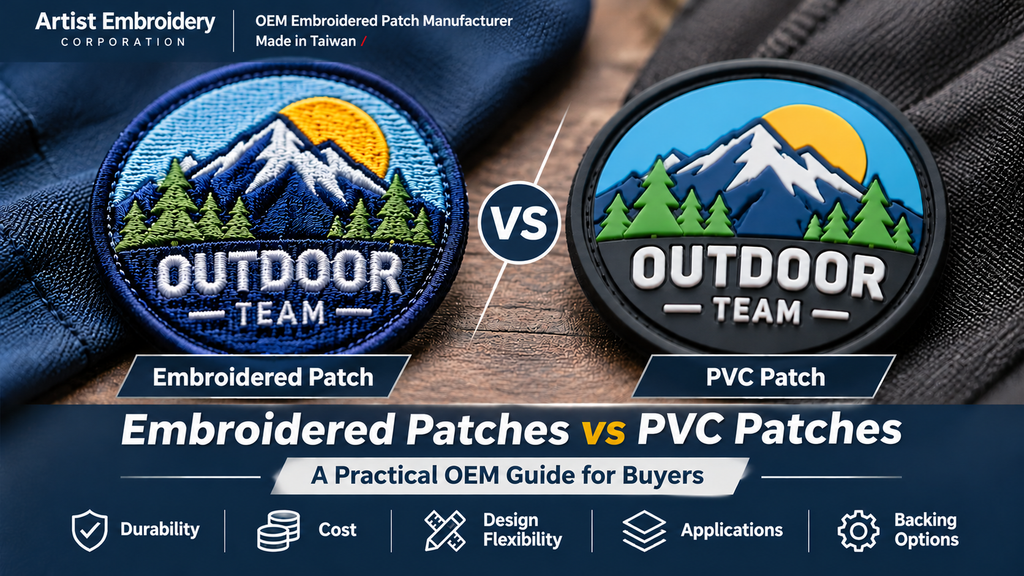
Введение
При выборе индивидуальных нашивок для униформы, одежды, аксессуаров или рекламной продукции выбор подходящего материала является одним из важнейших решений для брендов и специалистов по закупкам. Среди множества доступных вариантов, вышитые нашивки против нашивок из ПВХ Это типичное сравнение для компаний, стремящихся найти идеальный баланс между внешним видом, долговечностью, стоимостью и функциональностью.
Хотя оба типа нашивок позволяют наносить логотипы, эмблемы и индивидуальные рисунки, они существенно различаются по материалам, технологиям изготовления, текстуре поверхности и общему внешнему виду. Понимание этих различий помогает покупателям-производителям оригинального оборудования принимать обоснованные решения о закупках, избегая при этом ненужных производственных затрат или выбора неподходящих материалов.
Вышитые нашивки изготавливаются путем нанесения цветных нитей на тканевую основу, как правило, из твила, фетра или других специальных материалов. Их характерная рельефная текстура нитей придает изделию традиционный, профессиональный вид, который широко ассоциируется с военными знаками отличия, полицейской формой, корпоративным брендингом, спортивными командами и модными аксессуарами. В зависимости от макета и площади вышивки производители могут создавать детализированные рисунки с использованием ниток различных цветов, направлений стежков и вариантов отделки.
В отличие от, ПВХ заплатки Как правило, они изготавливаются из гибких поливинилхлоридных материалов, формованных в индивидуальные формы и конструкции. Они обладают гладкой, резиноподобной поверхностью и могут иметь рельефные или углублённые элементы, что делает их особенно подходящими для изготовления определённых аксессуаров для использования на открытом воздухе, тактического снаряжения, сумок и современной брендовой продукции. Характеристики материала также обеспечивают преимущества в тех случаях, когда важны влагостойкость и простота очистки поверхности.
Однако выбор между вышитыми нашивками и нашивками из ПВХ — это не просто сравнение их внешнего вида. Перед размещением оптового заказа следует учитывать такие факторы, как сложность дизайна, минимальный объем заказа, производственные затраты, требования к стирке, способы крепления и срок службы.
Например, вышитые нашивки могут быть предпочтительны в тех случаях, когда бренды стремятся к классическому текстильному виду, органично вписывающемуся в одежду. Нашивки из ПВХ могут оказаться более подходящими, если основными требованиями являются рельефная поверхность, выраженные объемные детали или водостойкий материал. Ни один из этих вариантов не является универсально лучшим; правильный выбор зависит от предполагаемого применения и приоритетов при закупке.
Являясь опытным производителем вышитых нашивок по заказу (OEM) из Тайваня, Вышивальная корпорация "Артист понимает важность подбора подходящих материалов и технологических параметров для различных коммерческих целей. Сочетая опыт в области вышивки с профессиональным производственным оборудованием и процедурами контроля качества, мы помогаем международным покупателям изготавливать вышитые нашивки на заказ, отвечающие их требованиям к дизайну и функциональности.
В этом подробном руководстве мы сравниваем вышитые нашивки и нашивки из ПВХ по таким критериям, как материалы, долговечность, стоимость, гибкость дизайна, возможности персонализации и области применения. Независимо от того, занимаетесь ли вы закупкой нашивок для униформы, разработкой брендированной продукции или оценкой материалов для вашего следующего проекта по производству под заказ (OEM), это сравнение поможет вам выбрать наиболее подходящее решение для вашего бизнеса.
Что такое вышитые нашивки и нашивки из ПВХ?
Понимание принципиальных различий между вышитые нашивки против нашивок из ПВХ имеет решающее значение для международных покупателей, владельцев брендов и специалистов по закупкам, оценивающих варианты производства нашивок на заказ. Хотя оба продукта служат схожим целям брендинга и идентификации, их материалы, технологии производства, характеристики поверхности и общий внешний вид значительно различаются.
Вышитые нашивки — это изделия на текстильной основе, изготовленные методом машинной вышивки, тогда как нашивки из ПВХ представляют собой формованные изделия, изготовленные из гибких синтетических материалов. Эти конструктивные различия влияют на внешний вид, тактильные ощущения, эксплуатационные характеристики и возможность крепления каждой нашивки к различным изделиям.
Прежде чем сравнивать цены, срок службы и возможности индивидуальной настройки, покупателям следует разобраться в том, как изготавливается каждый тип патча и какие его характеристики делают его подходящим для конкретных задач.
Как устроена вышитая нашивка
Вышитые нашивки — это декоративные или идентификационные эмблемы, изготавливаемые путем нанесения цветных вышивальных ниток на тканевую основу. В процессе вышивания образуется фактурная поверхность, на которой отдельные стежки формируют логотипы, надписи, символы и другие визуальные элементы.
Тканевая основа играет важную роль в определении внешнего вида, эластичности и общей конструкции заплатки. К распространенным материалам относятся:
- Ткань саржа: Наиболее широко используемая основа для вышитых нашивок, обеспечивающая устойчивую поверхность, профессиональный вид и надежное качество вышивки.
- Фетровая ткань: Мягкий нетканый текстильный материал, который обычно используется для изготовления традиционных эмблем, в декоративных целях, а также при выполнении специфических дизайнерских задач.
- Светоотражающая ткань: Специализированная основа, предназначенная для отражения падающего света, что делает её полезной для определённых задач, связанных с обеспечением видимости.
Покупатели могут более подробно ознакомиться с этими материалами на нашем сайте Руководство по вышитым нашивкам.
В процессе производства компьютеризированные вышивальные машины воспроизводят оцифрованные рисунки с помощью тщательно запрограммированных узоров стежков, цветов ниток и плотности вышивки. Готовый рисунок может иметь открытые участки ткани или плотное покрытие нитками, в зависимости от желаемого визуального эффекта.
Например, нашивка с плотностью вышивки 50% позволяет оставить видимой большую часть ткани, лежащей под ней, в то время как полностью вышитый рисунок покрывает нитками практически всю лицевую поверхность. Различные уровни плотности вышивки влияют на текстуру, внешний вид, время изготовления и производственные затраты.
Узнайте больше об этих различиях в нашем Руководство по плотности вышивки.
После вышивания нашивки проходят процессы последующей обработки, которые могут включать нанесение подложки, раскрой, обработку краёв и контроль качества. В зависимости от дизайна и предполагаемого применения вышитые нашивки могут иметь краёвку методом «мерроу», термообрезанные края, конструкцию для пришивания, клеевую подложку или системы крепления на липучках.
Поскольку вышивка основана на физических стежках, для обеспечения приемлемого качества воспроизведения очень мелких надписей, чрезвычайно тонких линий и сложных градиентов может потребоваться корректировка макета. Опытные производители-OEM оценивают эти ограничения до начала производства, чтобы гарантировать стабильные результаты при выполнении крупных заказов.
Обзор материалов для заплаток из ПВХ
Нашивки из ПВХ — это эмблемы, изготавливаемые на заказ преимущественно из гибкого поливинилхлорида — синтетического полимера, из которого можно формировать изделия различной формы, цвета и с различной текстурой поверхности.
В отличие от вышитых нашивок, при изготовлении нашивок из ПВХ основной визуальный рисунок создается не с помощью ниток и текстильной основы. Вместо этого производители используют формы и контролируемую обработку материала для формирования логотипов, надписей, символов и декоративных элементов.
Многие индивидуальные нашивки из ПВХ отличаются двухмерными или трехмерными рельефными узорами. Выпуклые и углубленные участки позволяют визуально разграничить различные элементы, благодаря чему производители могут воспроизводить определённые чёткие формы, бордюры и стили шрифтов с характерным резиноподобным внешним видом.
ПВХ-накладки обычно ассоциируются со следующим:
- Тактическое снаряжение и аксессуары для активного отдыха
- Идентификация рюкзаков, багажа и снаряжения
- Рекламная продукция и фирменные аксессуары
- Спортивное снаряжение и отдельные виды формы
- Изделия, для которых требуется гибкая и легко очищаемая поверхность
Одной из отличительных особенностей материала ПВХ является его устойчивость к впитыванию воды. В отличие от текстильной вышивки, формованная поверхность ПВХ не впитывает влагу так же, как ткань и нитки. Однако общие эксплуатационные характеристики готовой нашивки из ПВХ также зависят от состава материала, толщины, системы крепления и качества изготовления.
Для изготовления наклеек из ПВХ могут потребоваться специальные пресс-формы, особенно в случае нестандартных форм и рельефных рисунков. В связи с этим первоначальные затраты на изготовление пресс-форм могут повлиять на общую стоимость проекта, особенно при небольших объемах производства.
Выбор цвета, объемные эффекты, минимальная толщина линии и сложность формы также могут повлиять на технологичность изготовления и стоимость. Хотя ПВХ обеспечивает значительную свободу при создании определенных форм, для очень детализированных изображений и чрезвычайно мелких надписей по-прежнему может потребоваться упрощение.
Для покупателей-производителей оригинального оборудования (OEM) понимание этих характеристик материалов имеет важное значение при определении того, что лучше подходит для конечного продукта: формованная синтетическая нашивка или традиционная вышитая эмблема.
📊 Таблица: Основные конструктивные различия между вышитыми нашивками и нашивками из ПВХ
| Характеристика | Вышитые нашивки | Накладки из ПВХ |
|---|---|---|
| Исходное сырье | Нитки для вышивания и ткань | Гибкий поливинилхлорид |
| Метод изготовления | Компьютеризированная машинная вышивка | Производство с использованием форм |
| Текстура поверхности | Рельефные текстильные стежки | Гладкий или рельефный |
| Базовая структура | Твил, фетр или светоотражающая ткань | Формованный синтетический материал |
| Визуальный облик | Традиционный, фактурный, профессиональный | Современный, объемный, похожий на резину |
| Детали конструкции | Зависит от размера и плотности стежков | Определяется ограничениями, связанными с формой и материалом |
| Водонепроницаемость | Зависит от ткани, ниток и способа пошива | Материал ПВХ обладает низкой водопоглощаемостью |
| Общие приложения | Униформа, эмблемы, одежда, аксессуары | Тактическое снаряжение, сумки, аксессуары для активного отдыха |
| Настройка | Цвета ниток, плотность стежка, каймы, подкладки | Формы, цвета, рельефные детали |
| Первоначальная настройка | Оцифровка вышивок | Изготовление пресс-формы или оснастки |
💡 Совет покупателю: прежде чем выбрать материал для нашивки, ознакомьтесь с процессом производства
При сравнении вышитые нашивки против нашивок из ПВХ, покупателям следует оценить предполагаемое назначение товара, прежде чем ориентироваться исключительно на внешний вид или цену за единицу.
В случае с униформой, корпоративными эмблемами, традиционными знаками отличия и текстильными аксессуарами вышитые нашивки часто обеспечивают естественный вид, характерный для ткани, и предлагают проверенные способы крепления. Для брендирования оборудования, аксессуаров для активного отдыха или дизайнов, требующих формованной резиноподобной поверхности, нашивки из ПВХ могут иметь ряд практических преимуществ.
Прежде чем запрашивать коммерческое предложение, подготовьте данные о предполагаемых размерах нашивки, макет, количество заказа, требования к креплению и предполагаемые условия эксплуатации. Эти сведения помогут производителям оценить технологическую осуществимость заказа и составить более точную ценовую предложение.
Если для вашего проекта требуются вышитые нашивки, выбор опытного производителя, специализирующегося на вышивке по заказу (OEM), поможет обеспечить стабильность производства, правильный подбор материалов и высокое качество отделки.
📖 Расширенное чтение
- Ткань для вышитых нашивок: виды, особенности и области применения
- Плотность вышивки: что нужно знать о различных уровнях плотности стежков
- Вышитые нашивки против тканых нашивок: полное сравнение OEM-продукции
Вышитые нашивки и нашивки из ПВХ: основные различия
При сравнении вышитые нашивки против нашивок из ПВХ, при этом наиболее заметные различия выходят за рамки материалов, из которых они изготовлены. Текстура поверхности, внешний вид, гибкость, толщина и вес — все эти факторы влияют на то, как готовый накладной элемент выглядит и ведет себя при креплении к одежде, аксессуарам или снаряжению.
Для международных покупателей-производителей оригинального оборудования (OEM) понимание этих характеристик имеет решающее значение, поскольку выбранный материал нашивки влияет как на внешний вид конечного продукта, так и на его пригодность для различных областей применения. Нашивка, предназначенная для парадной формы, может требовать иных характеристик, чем та, которая предназначена для тактического рюкзака или аксессуара для активного отдыха.
Хотя и вышитые нашивки, и нашивки из ПВХ позволяют воспроизводить индивидуальные логотипы и эмблемы, их конструкция обусловливает существенные различия в визуальных и физических свойствах.
Текстура, внешний вид и детали дизайна
Одно из наиболее существенных отличий вышитых нашивок от нашивок из ПВХ заключается в текстуре их поверхности.
Вышитые нашивки отличаются характерным текстильным внешним видом создаются отдельными вышивальными стежками. Эти стежки образуют рельефные узоры на тканевой основе, создавая многослойную поверхность, которая по-разному отражает свет в зависимости от направления нити, плотности стежков и плотности вышивки.
Эта особенность придает вышитым нашивкам традиционный вид высококачественного текстиля, который обычно ассоциируется с профессиональной формой, военными знаками различия, корпоративными эмблемами и брендовой одеждой.
Качество внешнего вида вышитой нашивки зависит от ряда производственных факторов:
- Качество нити: Использование ниток для вышивания одинакового качества способствует равномерности цвета, четкости стежков и общему внешнему виду изделия.
- Плотность стежков: Правильная плотность стежков позволяет сохранить четкость рисунка и предотвратить ненужное деформирование ткани.
- Направление вышивания: Различные углы простегивания создают едва заметные различия в текстуре и отражении света.
- Выбор ткани: Твиловые, войлочные и светоотражающие ткани отличаются по внешнему виду фона и структурным характеристикам.
- Объем вышивки: Частичное и полное покрытие вышивкой создают разные визуальные эффекты и влияют на производственные требования.
Для покупателей, которые обращают внимание на эти характеристики, наш Руководство по качеству вышитых нашивок объясняет производственные факторы, которые способствуют получению стабильных результатов вышивания.
Для сравнения, Накладки из ПВХ имеют формованную синтетическую поверхность а не видимыми стежками вышивки. Их внешний вид определяется в первую очередь геометрией формы, цветом материалов и расположением выпуклых или углубленных элементов рисунка.
Нашивки из ПВХ позволяют создавать четко очерченные объемные элементы, особенно для выразительных логотипов, геометрических фигур и дизайнов, требующих резиноподобной поверхности.
Однако литьевая технология не всегда гарантирует более качественное воспроизведение сложных изображений. Очень мелкий шрифт, узкие промежутки и сложные формы по-прежнему могут потребовать внесения изменений с учётом ограничений, связанных с инструментами и производством.
С точки зрения брендинга вышитые нашивки, как правило, подчеркивают мастерство текстильного ремесла и традиционную аутентичность, тогда как нашивки из ПВХ отличаются более современным, формованным внешним видом.
Выбор оптимального варианта зависит от визуальной идентичности бренда, позиционирования продукта и предполагаемого применения.
Гибкость, толщина и вес
Гибкость, толщина и вес — это дополнительные факторы, которые следует учитывать при сравнении вышитые нашивки против нашивок из ПВХ, особенно для покупателей, заказывающих нашивки для одежды, униформы, рюкзаков или снаряжения.
Вышитые нашивки изготавливаются из ткани, ниток и дополнительных материалов для основы. Их гибкость зависит от выбранной ткани, плотности вышивки, конструкции основы и общих размеров нашивки.
Например, нашивка с частичной вышивкой и открытой саржевой тканью на ощупь может казаться более гибкой, чем нашивка с плотной вышивкой, покрывающая большую площадь, и жесткой основой.
Кроме того, такие варианты крепления, как термоклеящийся материал или застежки-липучки, могут влиять на толщину готовой нашивки и её характеристики при изгибе.
Поскольку вышитые нашивки изготавливаются на текстильной основе, они часто органично вписываются в одежду и другие изделия из ткани. Благодаря этому они особенно подходят для случаев, когда предпочтительным является традиционный вид пришитого элемента.
Однако вышитые нашивки не следует автоматически считать более тонкими или легкими, чем нашивки из ПВХ. Фактическая толщина и вес зависят от технических характеристик изделия, размера нашивки, площади вышивки и требований к отделке.
Накладки из ПВХ изготавливаются из гибких синтетических материалов, однако их гибкость в значительной степени зависит от состава материала, толщины и конструкции формы.
Тонкая накладка из ПВХ, изготовленная из более мягкого материала, может относительно легко сгибаться, в то время как более толстая накладка с выраженными рельефными элементами может казаться значительно более жесткой.
Аналогичным образом, вес ПВХ-пластинок может значительно варьироваться в зависимости от плотности материала, габаритных размеров и толщины изделия.
В случае изделий, подвергающихся многократному сгибанию, таких как одежда или гибкие аксессуары, покупателям следует оценить, как накладка реагирует на движения после крепления.
Что касается снаряжения, рюкзаков и тактических аксессуаров, более толстая формованная нашивка может быть приемлемой или даже предпочтительной, если внешний вид, определяемый размерами, является частью задуманного дизайна.
На эти характеристики также влияют размеры пластырей. При использовании более крупных пластырей может потребоваться уделить дополнительное внимание гибкости, надежности фиксации и общему комфорту.
Наш Таблица размеров вышитых нашивок содержит практические рекомендации по выбору подходящих размеров для различных вариантов использования вышитых нашивок.
В конечном итоге покупателям следует оценивать реальные образцы продукции, а не исходить из того, что нашивки — будь то вышитые или из ПВХ — всегда легче, тоньше или гибче.
📊 Таблица: Основные физические и визуальные различия между вышитыми нашивками и нашивками из ПВХ
| Коэффициент сравнения | Вышитые нашивки | Накладки из ПВХ |
|---|---|---|
| Текстура поверхности | Рельефные стежки вышивки | Гладкая или рельефная синтетическая поверхность |
| Общий вид | Традиционная обработка текстиля | Современное покрытие, напоминающее резину |
| Визуальная глубина | Создано с помощью стежков и направления нити | Создано с помощью формованных выпуклых и углубленных элементов |
| Структура материала | Ткань, нитки для вышивания и подкладка | Гибкий формованный ПВХ-материал |
| Гибкость | Зависит от плотности вышивки и подложки | Зависит от состава ПВХ и его толщины |
| Толщина | Зависит от типа строчки и отделки | Зависит от конструкции литого изделия |
| Вес | Зависит от размера, плотности нитей и подложки | Зависит от размера, плотности и толщины |
| Тонкие детали | Ограничено размерами стежка и стабильностью ткани | Ограничения, связанные с геометрией пресс-формы и технологией обработки материала |
| Цветовая презентация | Цветные нитки для вышивания | Цветной ПВХ-материал |
| Интеграция тканей | Внешний вид, имитирующий натуральный текстиль | Характерная синтетическая поверхность |
| Общие визуальные предпочтения | Униформа, одежда, традиционные символы | Тактические аксессуары, сумки, современный брендинг |
| Стабильность производства | Требуется контроль процесса вышивания | Требуется контроль технологического процесса изготовления пресс-форм и материалов |
💡 Совет покупателю: оценивайте внешний вид и эксплуатационные характеристики в совокупности
При выборе между вышитыми нашивками и нашивками из ПВХ не следует основывать своё решение исключительно на цифровых макетах или фотографиях продукции.
Дизайн, который выглядит привлекательно на экране компьютера, может преобразиться после воплощения в виде вышивальных стежков или формованных элементов из ПВХ.
В случае вышитых нашивок запрашивайте производственные образцы, на которых будут продемонстрированы предполагаемые цвета ниток, плотность вышивки, основа ткани, обработка краев и конструкция подкладки.
В случае накладок из ПВХ следует оценить четкость деталей формования, гибкость материала, толщину и совместимость креплений.
Покупателям также следует учитывать, как готовая нашивка будет сочетаться с конечным изделием. Для некоторых видов одежды предпочтительнее будет гибкая текстильная нашивка, тогда как формованная нашивка из ПВХ может лучше подойти к определенным аксессуарам для активного отдыха.
В случае крупных заказов от производителей оригинального оборудования (OEM) предварительный осмотр типовых физических образцов перед запуском серийного производства помогает избежать недоразумений и гарантирует, что выбранный материал соответствует как визуальным, так и функциональным требованиям.
📖 Расширенное чтение
- Качество вышитых нашивок: ключевые факторы для покупателей-производителей оригинального оборудования (OEM)
- Руководство по размерам вышитых нашивок: как выбрать подходящие размеры
- Вышитые бордюры для нашивок: виды и способы изготовления
Какой материал для заплаток более прочный?
Долговечность — один из важнейших факторов, которые следует учитывать при сравнении вышитые нашивки против нашивок из ПВХ, особенно для зарубежных покупателей, заказывающих нашивки на заказ для униформы, снаряжения для активного отдыха, спецодежды и брендовых аксессуаров. Хотя оба материала обеспечивают надежную долговечность, их устойчивость к стирке, истиранию, влаге, солнечному свету и повседневной эксплуатации различается ввиду особенностей конструкции и свойств материалов.
Вышитые нашивки изготавливаются на текстильной основе с использованием вышивальных ниток, тогда как нашивки из ПВХ производятся из гибких синтетических материалов. Эти различия влияют на то, как каждый из этих изделий реагирует на многократное использование, воздействие внешних факторов и чистку.
Однако ни один из этих материалов не является автоматически более долговечным в любой ситуации. Фактические эксплуатационные характеристики зависят от качества изготовления, технических характеристик материала, способов крепления, условий эксплуатации и методов ухода.
Понимание этих факторов помогает покупателям, приобретающим оборудование у производителей оригинального оборудования (OEM), выбирать запчасти, отвечающие предъявляемым к ним эксплуатационным требованиям.
Стойкость к стирке и повседневной носке
В случае униформы, корпоративной одежды, спортивной одежды и других текстильных изделий, поддающихся стирке, одним из основных факторов является устойчивость к многократной стирке.
Вышитые нашивки могут выдерживать регулярную стирку, если при их изготовлении используются подходящие ткани, качественные нитки для вышивания, соответствующая плотность стежков и надежные способы крепления.
Высококачественное исполнение вышивки позволяет сохранить целостность логотипов, надписей и декоративных элементов при повседневном использовании. Правильно отрегулированное натяжение нити и плотность стежков также позволяют избежать таких проблем, как выпадение стежков, образование складок и неровности поверхности вышивки.
Однако вышитые нашивки не являются полностью устойчивыми к износу. Чрезмерное истирание, агрессивные моющие средства, высокие температуры стирки и ненадлежащие условия сушки могут постепенно повлиять на внешний вид ниток, прочность ткани и эксплуатационные характеристики подложки.
На долговечность вышитых нашивок влияют несколько производственных факторов:
- Качество нити: Подходящие нитки для вышивания позволяют сохранить стабильность цвета и целостность стежков при нормальном использовании.
- Стабильность ткани: Твил и другие подходящие ткани-основы обеспечивают структурную поддержку вышитых узоров.
- Плотность стежков: Сбалансированная плотность вышивки помогает избежать ненужных деформаций ткани и слабых стежков.
- Строительство пограничных сооружений: Качественно обработанные края помогают защитить периметр заплатки от распускания и повреждений.
- Способ крепления: Надежная прошивка или правильно подобранная система крепления помогают предотвратить отрыв во время использования.
Чтобы узнать больше об этих аспектах производства, ознакомьтесь с нашим Руководство по качеству вышитых нашивок.
ПВХ заплатки, с другой стороны, не имеют открытых вышивальных стежков, поэтому нитки на них не распускаются, а стежки не рвутся. Их формованные поверхности, как правило, легко очищаются, что делает их практичными для использования в условиях, где имеется грязь, глина или периодическое воздействие влаги.
Тем не менее, на ПВХ-накладках могут возникать и другие виды износа. В зависимости от состава материала и качества изготовления многократные изгибы, истирание, воздействие химических веществ или несоответствующие температурные режимы могут привести к повреждению поверхности, растрескиванию, деформации или изменению цвета.
Не менее важна и система крепления. Даже прочный материал пластыря может преждевременно выйти из строя, если швы, клей или застежка «липучка» не подходят для предполагаемого применения.
В случае одежды, требующей частой машинной стирки, покупателям следует оценивать как конструкцию нашивки, так и всю систему её крепления в целом, а не сосредотачиваться исключительно на материале нашивки.
Влажность, воздействие внешних факторов и срок службы
Использование на открытом воздухе сопряжено с дополнительными проблемами, связанными с долговечностью, в том числе с дождем, влажностью, воздействием ультрафиолета, перепадами температур и постоянным контактом с оборудованием или другими поверхностями.
При оценке вышитые нашивки против нашивок из ПВХ При использовании на открытом воздухе покупателям следует проводить различие между водостойкостью материала и общей долговечностью готового изделия.
Материал ПВХ, как правило, практически не впитывает воду, что делает формованные ПВХ-накладки предпочтительным выбором в тех случаях, когда поверхность накладки часто подвергается воздействию влаги или требует простой очистки.
Однако не следует автоматически считать, что заплатка из ПВХ в готовом виде является водонепроницаемой. Отверстия от стежков, крепежные материалы, элементы подкладки, а также находящаяся под ней одежда или снаряжение по-прежнему могут допускать проникновение воды.
Составы ПВХ также различаются по устойчивости к ультрафиолетовому излучению и перепадам температуры. Длительное воздействие солнечных лучей может привести к выцветанию или разрушению некоторых материалов или пигментов, а сильный холод или жара могут повлиять на гибкость и стабильность размеров.
Вышитые нашивки ведут себя по-разному, поскольку их тканевая основа и структура нитей могут удерживать влагу после дождя или стирки.
Это не означает, что вышитые нашивки не подходят для использования на открытом воздухе. Качественно изготовленные вышитые нашивки широко используются на рабочей форме, одежде для активного отдыха, одежде в военном стиле, рюкзаках и аксессуарах для снаряжения.
Их долговечность зависит от ряда факторов, в том числе от состава ниток, стойкости цвета, выбора ткани, конструкции вышивки и качества крепления.
Например, нитки для вышивания из полиэстера обычно выбирают для применений, требующих хорошей цветостойкости и устойчивости к обычным воздействиям окружающей среды. Тем не менее, их фактические эксплуатационные характеристики следует проверять с учетом предполагаемых условий стирки и требований к использованию на открытом воздухе.
Края нашивок также влияют на их долговечность. Правильно выполненная окантовка методом «мерроу» или термической обрезки помогает защитить края вышитых нашивок, хотя выбор наиболее подходящего метода отделки зависит от формы нашивки, типа ткани и технических требований к дизайну.
Покупатели могут ознакомиться с этими вариантами на нашем сайте Вышитый PatРуководство по границам.
В отношении продукции, предназначенной для длительного нахождения на открытом воздухе, производители и покупатели должны предусмотреть проведение соответствующих испытаний на стойкость цвета, стойкость к истиранию, качество стирки и старение под воздействием окружающей среды.
Ожидаемый срок службы любого из этих типов нашивок невозможно определить, исходя только из категории материала. Качественно изготовленная вышитая нашивка, используемая в подходящих условиях, может оставаться пригодной к использованию в течение многих лет, в то время как нашивка из ПВХ, изготовленная с нарушением технических требований, может преждевременно прийти в негодность. В разных условиях окружающей среды может произойти и обратное.
В конечном итоге, чтобы выбрать наиболее долговечную заплатку, необходимо сопоставить свойства материала, качество изготовления и характеристики крепления с условиями предполагаемого применения.
📊 Таблица: Сравнение срока службы вышитых нашивок и нашивок из ПВХ
| Коэффициент долговечности | Вышитые нашивки | Накладки из ПВХ |
|---|---|---|
| Регулярная стирка | Как правило, подходит при надлежащем устройстве и уходе | Зависит от состава и способа крепления |
| Истирание поверхности | На нитях может наблюдаться износ или зацепки | На литых поверхностях могут появляться царапины или потертости |
| Водопоглощение | Ткань и нитки могут впитывать влагу | Материал ПВХ обладает низкой водопоглощаемостью |
| Воздействие дождя | Подходит для различных целей; может потребоваться сушка | В целом устойчива к воздействию поверхностной влаги |
| Воздействие ультрафиолета | Зависит от нити и стойкости цвета ткани | Зависит от состава ПВХ и пигментов |
| Многократное изгибание | Зависит от плотности стежков, ткани и подкладки | Зависит от состава и толщины слоя |
| Высокие температуры | Нитки, ткань и подкладка имеют разные пределы термостойкости | Чрезмерное нагревание может привести к деформации |
| Низкие температуры | Зависит от свойств текстиля и подложки | Некоторые составы могут утратить свою эластичность |
| Долговечность кромок | Зависит от качества отделки кромок | Зависит от конструкции и материала формованного края |
| Уборка | Требуется чистка, подходящая для текстиля | Как правило, легко очищается |
| Внешний вид в долгосрочной перспективе | Зависит от качества швов, стойкости цвета и условий ухода | Зависит от степени износа поверхности, пигментов и срока эксплуатации |
| Долговечность крепления | Зависит от того, используется ли сшивание, клей или система «липучка» | Зависит от того, используется ли сшивание, клей или система «липучка» |
Примечание: Фактический срок службы зависит от марки материала, технологических характеристик, способа крепления и условий эксплуатации. Для условий жесткой эксплуатации рекомендуется провести испытания на работоспособность.
💡 Совет покупателю: соотносите требования к долговечности с фактическими условиями эксплуатации
При закупке нашивок на заказ для массового производства покупателям следует избегать выбора материалов, руководствуясь исключительно общими заявлениями, такими как “водонепроницаемый”, “устойчив к воздействию погодных условий” или “долговечный”.”
Вместо этого определите реальные условия, в которых будут использоваться готовые заплатки.
Например, вышитые нашивки, предназначенные для униформы, подвергающейся частой стирке, следует оценивать по прочности стежков, устойчивости ткани, стойкости цвета, качеству окантовки и прочности крепления.
ПВХ-накладки, предназначенные для оборудования, используемого на открытом воздухе, следует оценивать по таким критериям, как гибкость, стойкость поверхности к истиранию, устойчивость к ультрафиолетовому излучению, температурные характеристики и надежность крепления.
Для сложных задач запрашивайте у представителя производственные образцы и определяйте соответствующие требования к испытаниям до утверждения серийного производства.
На сайте Вышивальная корпорация "Артист, наш подход к производству вышивок по заказу (OEM) основан на обеспечении равномерности стежков, правильном подборе материалов, контролируемых производственных процессах и тщательной отделке. Эти факторы помогают международным покупателям получать вышитые нашивки, изготовленные в соответствии с утвержденными ими техническими требованиями.
Чётко сформулированная спецификация продукта в сочетании с надёжным качеством изготовления зачастую имеет большее значение, чем выбор материала для заплатки исключительно на основании внешнего вида или общих заявлений о долговечности.
📖 Дополнительная литература
Сравнение стоимости: вышитые нашивки и нашивки из ПВХ
Стоимость является одним из основных факторов, которые следует учитывать при сравнении вышитые нашивки против нашивок из ПВХ, особенно для международных OEM-заказчиков, оптовых покупателей, поставщиков униформы и брендов, планирующих оптовые заказы. Хотя оба вида продукции можно персонализировать с помощью логотипов, надписей и оригинальных форм, процессы их производства предполагают разные затраты на настройку оборудования, производственные требования и структуру затрат.
Вышитые нашивки изготавливаются с использованием компьютеризированных вышивальных машин, тканевой основы и вышивальных ниток, тогда как для производства нашивок из ПВХ, как правило, требуются индивидуальные формы и специальная обработка материала. Эти различия влияют на размер начальных инвестиций, цену за единицу и экономическую выгоду при различных объемах заказа.
Однако ни один из этих материалов не является безусловно более доступным по цене. Окончательная стоимость зависит от размеров нашивки, сложности дизайна, объема производства, количества цветов, технологических требований, требований к отделке и возможностей поставщика.
Понимание этих факторов, влияющих на затраты, помогает покупателям составлять точные запросы на предоставление коммерческих предложений, оценивать предложения поставщиков и выявлять возможности для оптимизации производственных расходов без ущерба для качества продукции.
Production Costs and Tooling Requirements
One of the primary differences between embroidered patches and PVC patches is the initial production setup.
Вышитые нашивки typically require embroidery digitizing, a process that converts approved artwork into machine-readable stitch instructions. The digitized file determines stitch types, stitch directions, thread color sequences, and other technical parameters necessary for production.
The complexity of the artwork directly influences digitizing requirements. Designs containing intricate details, small lettering, multiple color sections, or extensive embroidery coverage may require additional programming and production adjustments.
Once the embroidery program has been prepared and approved, manufacturers can use it for repeat orders, provided the design specifications remain compatible with the original production setup.
The main cost factors associated with embroidered patch manufacturing include:
- Embroidery Digitizing: Preparing the embroidery program and necessary production adjustments.
- Размер заплатки: Larger patches often require more fabric, embroidery stitches, and machine time.
- Stitch Count: Higher stitch counts generally increase embroidery production time and thread consumption.
- Объем вышивки: Full embroidery coverage typically requires more stitching than designs with substantial exposed fabric.
- Цвета ниток: Additional colors can increase production costs through thread changes, color sequencing, and reduced production efficiency.
- Выбор ткани: Twill, felt, and reflective fabrics have different material costs and manufacturing considerations.
- Border Finishing: Merrowed borders, heat-cut edges, and other finishing methods involve different processing requirements.
- Backing Options: Heat-seal adhesive, hook-and-loop fasteners, and other attachment systems add material and labor costs.
Importantly, increasing the number of embroidery thread colors generally increases manufacturing costs.
Even when modern computerized embroidery machines can accommodate multiple thread colors, additional colors may require more complicated programming, thread preparation, machine adjustments, and color-change operations.
On multi-head embroidery machines, efficient production depends on consistent thread arrangements and optimized manufacturing sequences. A design requiring numerous colors can reduce operational flexibility, particularly when production involves multiple designs or frequent thread changes.
Therefore, buyers should not assume that a patch using twelve thread colors will cost the same as an otherwise comparable design using three colors.
The actual price difference depends on the design, equipment configuration, production volume, and manufacturer’s cost structure.
For a more detailed explanation of embroidery pricing, see our Прайс-лист на вышитые нашивки на заказ.
ПВХ заплатки, by comparison, commonly require dedicated molds to create the desired shape, surface relief, and design details.
Mold development may involve additional initial expenses, especially for complicated shapes, multiple dimensional levels, or intricate artwork.
Once an appropriate mold is completed, it can generally be reused for subsequent production runs, subject to mold condition and design consistency.
PVC manufacturing costs also depend on material formulation, patch dimensions, thickness, color requirements, processing methods, and finishing operations.
Although both manufacturing methods involve setup costs, embroidery digitizing and PVC mold development are fundamentally different processes. Buyers should compare the complete quotation rather than evaluating setup fees in isolation.
How Quantity and Design Complexity Affect Pricing
Order quantity is another major factor influencing the total cost of вышитые нашивки против нашивок из ПВХ.
For embroidered patches, larger production quantities allow manufacturers to distribute certain setup expenses across more units while improving equipment utilization and production efficiency.
For example, producing 1,000 identical embroidered patches may result in a lower unit cost than producing 100 pieces of the same design because preparation time, production scheduling, and certain fixed expenses can be allocated across a larger order.
However, increasing quantity does not eliminate the cost of embroidery threads, fabric, machine operation, finishing, inspection, or packaging.
Design complexity also has a significant influence on pricing.
An embroidered patch featuring a simple logo, limited thread colors, and moderate embroidery coverage may require fewer stitches and less machine time than a similarly sized patch containing extensive fine details, numerous colors, and full embroidery coverage.
Buyers should pay particular attention to the following factors:
1. Number of Thread Colors
More embroidery colors generally lead to higher production costs because of additional thread preparation, color-change operations, and potential effects on production efficiency.
2. Площадь вышивки
A design with 100% embroidery coverage usually requires more stitches and thread consumption than a comparable design with 50% coverage, although actual costs depend on stitch density and artwork.
Наш Руководство по плотности вышивки explains how different coverage levels affect embroidered patch construction.
3. Patch Dimensions
Larger patches often require more material and production time. However, patch size alone does not determine cost; stitch count, design density, and finishing requirements must also be considered.
4. Design Complexity
Fine lettering, intricate shapes, multiple color sections, and complicated stitch patterns may increase digitizing requirements and embroidery production time.
5. Finishing and Attachment
Additional processes such as heat-seal backing, hook-and-loop attachment, specialized borders, and individual packaging can increase the total manufacturing cost.
For PVC patches, order quantity is especially relevant when custom tooling is required.
A mold fee distributed across a small production run may contribute substantially to the effective cost per patch. As production quantities increase, the initial tooling expense is spread across more units.
For example, if a hypothetical mold costs US$200, allocating that cost across 100 patches adds US$2.00 per unit, while allocating it across 1,000 patches adds only US$0.20 per unit.
This illustration excludes material, production, finishing, shipping, and other costs and does not represent an actual supplier quotation.
Design complexity also affects PVC pricing. Multiple colors, raised details, intricate mold structures, and greater material thickness may increase manufacturing requirements.
Therefore, the most economical option depends on the combination of setup expenses, production quantity, design specifications, and long-term purchasing plans.
For international buyers, obtaining detailed quotations based on identical project requirements is the most reliable way to compare manufacturing costs.
📊 Table: Cost Factors for Embroidered vs PVC Patches
| Фактор стоимости | Вышитые нашивки | Накладки из ПВХ |
|---|---|---|
| Первоначальная настройка | Оцифровка вышивок | Mold development |
| Main Material | Fabric and embroidery threads | Flexible PVC compound |
| Сложность проектирования | Influences digitizing and stitch count | Influences mold and processing requirements |
| Количество цветов | More colors generally increase production costs | Additional colors may increase processing complexity and costs |
| Размер патча | Affects fabric, stitching, and finishing | Affects material usage and mold dimensions |
| Время производства | Influenced by stitch count and machine efficiency | Influenced by molding and processing requirements |
| Small Orders | Setup and minimum production costs affect unit pricing | Mold expenses may significantly affect unit pricing |
| Large Orders | Potential savings from efficient bulk embroidery | Potential savings from spreading tooling costs |
| Повторные заказы | Existing digitizing files may be reusable | Existing molds may be reusable |
| Варианты подложки | Additional material and processing costs | Additional attachment and processing costs |
| Отделка бордюра | Merrowed or heat-cut finishing costs | Molded edge and finishing requirements |
| Overall Pricing | Depends on complete embroidery specifications | Depends on complete molding specifications |
Note: This table compares general manufacturing cost structures. Actual pricing must be confirmed through supplier quotations based on specific artwork, quantities, materials, and production requirements.
💡 Buyer Tip: Optimize Embroidery Costs Without Sacrificing Quality
For OEM buyers sourcing custom embroidered patches, cost optimization should focus on production efficiency rather than simply requesting the lowest possible unit price.
One effective approach is to evaluate whether the original artwork requires every specified thread color.
Because additional embroidery colors generally increase manufacturing costs, reducing unnecessary color variations may improve production efficiency while preserving the essential appearance of a logo or emblem.
Buyers can also evaluate embroidery coverage, patch dimensions, border construction, and backing options to identify practical opportunities for cost reduction.
For example, selecting a suitable twill background instead of requiring full embroidery coverage may reduce stitch count and machine time when the design allows exposed fabric.
However, reducing stitch density excessively or simplifying important artwork details may negatively affect appearance and quality. Any proposed changes should be evaluated against the buyer’s approved specifications.
Before requesting a quotation, prepare the following information:
- Final artwork and required dimensions
- Предполагаемый объем заказа
- Number of embroidery thread colors
- Preferred fabric and embroidery coverage
- Border and backing requirements
- Packaging instructions
- Expected delivery schedule
На сайте Вышивальная корпорация "Артист, we specialize in OEM embroidered patch manufacturing based on customer-provided artwork and production specifications. Our manufacturing experience helps international buyers evaluate practical embroidery requirements, production feasibility, and cost-related considerations.
By providing complete specifications and reviewing appropriate manufacturing options, buyers can obtain more accurate quotations and make informed purchasing decisions.
📖 Расширенное чтение
- Стоимость нашивок с индивидуальной вышивкой
- Минимальный объем заказа на вышитые нашивки с индивидуальным дизайном
- Покрытие для вышивки
Design Flexibility and Customization Options
Design flexibility is an important factor when comparing вышитые нашивки против нашивок из ПВХ, especially for international OEM buyers who need to reproduce logos, lettering, symbols, and branded artwork accurately across large production quantities. Although both materials offer extensive customization possibilities, their manufacturing methods create different limitations in detail reproduction, color presentation, dimensional effects, and overall design appearance.
Embroidered patches transform digital artwork into physical stitches using embroidery threads and fabric foundations. PVC patches, in contrast, reproduce artwork through molded synthetic materials with raised, recessed, or flat surface elements.
These manufacturing differences influence which design features can be reproduced effectively and which may require technical adjustments before production.
For brands, uniform suppliers, promotional merchandise distributors, and other commercial buyers, understanding these limitations helps reduce production errors, improve consistency, and establish realistic expectations for finished products.
Fine Details, Gradients, and Color Limitations
One of the most important considerations in custom patch manufacturing is the ability to reproduce small lettering, intricate lines, and complex artwork.
Вышитые нашивки create designs through individual stitches, meaning that the resolution of the finished artwork depends on stitch dimensions, thread thickness, fabric stability, and embroidery density.
Unlike digital printing, embroidery cannot reproduce unlimited detail at extremely small dimensions. Very thin lines, tightly spaced letters, and miniature design elements may become difficult to distinguish when converted into stitches.
For example, a logo containing extremely small lettering may appear perfectly clear on a computer screen but lose definition when embroidered onto a compact patch.
The minimum practical size of lettering depends on the font style, stitch direction, thread type, fabric, and embroidery equipment. Consequently, there is no single minimum lettering size that applies to every embroidered patch design.
Buyers should evaluate the actual production dimensions rather than relying exclusively on enlarged digital artwork.
Наш Таблица размеров вышитых нашивок explains how patch dimensions influence design readability and manufacturing feasibility.
Color reproduction is another important consideration.
Embroidered patches use physical embroidery threads selected from available thread color ranges. Although professional embroidery threads provide numerous color options, they cannot reproduce every digital color value with absolute precision.
Thread appearance may also vary depending on lighting, surface texture, and stitch direction.
Furthermore, increasing the number of embroidery thread colors generally increases production costs because additional colors can require more thread preparation, color changes, and production management.
For this reason, buyers should avoid adding unnecessary colors when a simpler thread palette can preserve the intended brand identity.
Gradients and photographic effects present additional challenges.
Traditional embroidery does not reproduce smooth digital gradients in the same way as full-color printing. However, experienced embroidery manufacturers can use stitch direction, thread selection, and controlled color transitions to create approximate shading effects.
The success of these techniques depends on design complexity, patch size, and acceptable visual tolerances.
ПВХ заплатки offer different customization possibilities.
Molded PVC designs can feature distinct color sections, raised outlines, recessed areas, and relatively smooth surfaces. These characteristics are useful for bold logos, geometric artwork, and designs emphasizing clearly separated visual elements.
However, PVC molding also has limitations.
Extremely narrow lines, tiny lettering, complicated color boundaries, and intricate recessed details may be difficult to manufacture consistently.
Standard molded PVC patches are also not equivalent to full-color printed products. Smooth photographic gradients generally require specialized production methods rather than conventional solid-color molding.
For both embroidered and PVC patches, buyers should provide accurate artwork and confirm manufacturing feasibility before approving bulk production.
2D and 3D Effects
Dimensional appearance is another major difference between вышитые нашивки против нашивок из ПВХ.
Both manufacturing methods can create raised visual elements, but they achieve these effects through fundamentally different techniques.
Вышитые нашивки develop texture and dimensional variation through thread placement, stitch density, stitch direction, and specialized embroidery methods.
Standard flat embroidery already produces a slightly raised surface because threads sit above the fabric foundation.
By adjusting stitch directions and combining different stitch structures, manufacturers can create visual depth, highlights, and textured patterns.
Certain specialized embroidery techniques, such as 3D puff embroidery, use foam beneath selected stitches to produce more pronounced raised effects.
However, 3D puff embroidery is not suitable for every design. Extremely small details, narrow lettering, and intricate shapes may be difficult to reproduce using this method.
The feasibility of specialized embroidery effects depends on the manufacturer’s equipment, production capabilities, artwork, and approved specifications.
Traditional embroidered patches also offer various customization options beyond dimensional effects, including:
- Объем вышивки: Partial or full thread coverage depending on the desired appearance.
- Fabric Foundations: Twill, felt, or reflective materials selected according to product requirements.
- Цвета ниток: Multiple embroidery colors based on approved artwork and manufacturing feasibility.
- Border Finishing: Merrowed borders or heat-cut edges depending on patch shape and construction.
- Backing Options: Sew-on, heat-seal, or hook-and-loop attachment systems.
- Patch Shapes: Standard geometric shapes or custom outlines within production limitations.
Buyers can learn more about thread coverage and surface appearance in our Embroidery Coverage Guide.
Для сравнения, ПВХ заплатки create dimensional effects through mold geometry.
A 2D PVC patch generally uses relatively flat design elements with defined color sections and limited height variation.
A 3D PVC patch incorporates more pronounced raised and recessed features, creating a sculpted appearance.
These molded effects are particularly suitable for designs requiring strong dimensional separation, bold outlines, or a rubber-like surface.
However, the term “3D” does not automatically indicate superior quality or greater detail. Actual results depend on mold precision, material formulation, design specifications, and production control.
From a branding perspective, embroidered patches emphasize textile texture and traditional craftsmanship, while PVC patches emphasize molded contours and dimensional definition.
For OEM buyers, the most suitable customization method depends on the intended product, artwork characteristics, brand identity, and manufacturing budget.
📊 Table: Design and Customization Comparison Between Embroidered and PVC Patches
| Коэффициент проектирования | Вышитые нашивки | Накладки из ПВХ |
|---|---|---|
| Проектирование и строительство | Embroidery stitches on fabric | Формованный синтетический материал |
| Fine Lettering | Limited by stitch size and fabric stability | Limited by mold geometry and processing |
| Тонкие линии | May require thicker embroidery strokes | May require minimum molded line widths |
| Color Options | Available embroidery thread colors | Available PVC material colors |
| Дополнительные цвета | Generally increase production costs | May increase molding and processing costs |
| Smooth Gradients | Limited; approximated through thread techniques | Limited in standard solid-color molding |
| Photographic Details | Not suitable for exact photographic reproduction | Not suitable for exact reproduction using standard molding |
| Текстура поверхности | Raised threads and stitch patterns | Smooth or molded surface |
| 2D Appearance | Flat embroidery with natural thread relief | Relatively flat molded elements |
| 3D Appearance | Specialized raised embroidery techniques | Raised and recessed molded structures |
| Background Materials | Twill, felt, reflective fabric | PVC material |
| Border Options | Merrowed or heat-cut edges | Molded edges |
| Варианты подложки | Sew-on, heat-seal, hook-and-loop | Attachment methods depend on construction |
| Пользовательские формы | Subject to embroidery and finishing limitations | Subject to mold design limitations |
| Стабильность производства | Depends on digitizing and embroidery control | Depends on mold and material processing control |
Note: The feasibility of specific customization features depends on the artwork, dimensions, equipment, materials, and individual manufacturer’s production capabilities.
💡 Buyer Tip: Prepare Production-Ready Artwork Before Requesting a Quotation
When sourcing custom embroidered patches or PVC patches, buyers should provide artwork that accurately represents the intended finished product.
For embroidered patches, vector artwork or sufficiently clear high-resolution files can help manufacturers evaluate stitch placement, lettering dimensions, thread colors, and embroidery coverage.
However, supplying a vector file does not automatically guarantee that every detail can be embroidered successfully. The design must still be evaluated against actual patch dimensions and embroidery limitations.
To improve manufacturing efficiency, buyers should confirm the following specifications before submitting an OEM inquiry:
- Final patch dimensions and shape
- Approved logo or artwork files
- Required thread or material colors
- Minimum acceptable lettering size
- Desired embroidery coverage or molded relief
- Fabric, border, and backing requirements
- Предполагаемый объем заказа
- Intended product application
For embroidered patches, reducing unnecessary thread colors, avoiding extremely small lettering, and selecting appropriate embroidery coverage can help improve production feasibility and cost efficiency.
На сайте Вышивальная корпорация "Артист, we specialize in OEM embroidered patch manufacturing based on customer-supplied artwork and specifications.
Our manufacturing process focuses on embroidery digitizing for production, material preparation, computerized embroidery, finishing, and quality inspection. We evaluate submitted artwork for manufacturing feasibility and communicate relevant production limitations before proceeding with approved orders.
We do not provide original artwork design services. Customers remain responsible for supplying and approving their designs and required specifications.
By preparing accurate artwork and understanding the capabilities of different manufacturing methods, international buyers can improve production consistency and obtain custom embroidered patches that meet their intended quality requirements.
📖 Расширенное чтение
Best Applications for Embroidered and PVC Patches
Choosing the right patch material is essential for ensuring that custom emblems meet the visual, functional, and practical requirements of their intended applications. When comparing вышитые нашивки против нашивок из ПВХ, international OEM buyers should consider more than appearance or manufacturing cost. The type of garment, equipment, environment, attachment method, and expected usage conditions all influence which material is most suitable.
Embroidered patches are widely used for professional uniforms, corporate branding, sports teams, fashion accessories, and traditional insignia because of their distinctive textile texture and versatile finishing options. PVC patches, on the other hand, are commonly selected for tactical equipment, outdoor accessories, backpacks, and promotional merchandise requiring a molded, rubber-like appearance.
However, these applications are not exclusive to either material. Both embroidered and PVC patches can be used across multiple industries, provided their construction and attachment systems meet the intended product requirements.
Understanding the strengths and limitations of each option helps buyers select suitable materials and prepare accurate specifications for OEM manufacturing.
Uniforms, Fashion, and Corporate Branding
Uniforms and branded apparel represent some of the most established applications for custom embroidered patches.
Вышитые нашивки are particularly popular for police uniforms, military-style insignia, security personnel, corporate workwear, school uniforms, and organizational emblems. Their stitched surfaces provide a traditional textile appearance that integrates naturally with woven and knitted garments.
For professional uniforms, embroidery offers several practical advantages.
First, the combination of colored threads and fabric foundations creates a recognizable emblem style associated with official identification, departmental insignia, and organizational branding.
Second, embroidered patches can be manufactured in different shapes, dimensions, and embroidery coverage levels to accommodate specific uniform requirements.
Third, suitable backing and attachment systems allow patches to be sewn directly onto garments or attached using hook-and-loop fasteners when removable identification is required.
For police and security applications, custom embroidered patches may include department names, identification numbers, official emblems, and specialized unit markings. Buyers must ensure that artwork and insignia specifications are authorized and appropriate for the intended organization.
Наш Справочник по значкам полиции provides additional information about embroidered identification patches used for professional uniforms.
Корпоративный брендинг is another important application.
Companies frequently use embroidered patches on employee uniforms, jackets, work shirts, caps, and promotional apparel to reinforce brand identity.
Compared with direct embroidery on finished garments, separately manufactured patches can offer flexibility when the same logo must be applied to different apparel products.
For example, a company may order identical embroidered logo patches for work jackets, uniforms, and merchandise, then attach them according to the requirements of each garment.
This approach can support consistent branding across multiple product categories, although attachment labor and material compatibility should be considered.
Fashion brands and apparel manufacturers also use embroidered patches as decorative elements.
Common applications include denim jackets, streetwear, backpacks, hats, and limited-edition clothing collections. The visible thread texture adds a textile detail that may complement traditional, vintage, collegiate, or heritage-inspired designs.
Sports teams, clubs, and educational organizations similarly use embroidered patches for team logos, membership emblems, achievements, and commemorative merchandise.
ПВХ заплатки can also be used on uniforms and apparel, especially when a contemporary molded appearance is desired.
However, buyers should consider the flexibility, thickness, weight, attachment method, and laundering requirements of the finished garment.
For applications involving frequent washing or direct contact with the body, the compatibility of the complete PVC patch assembly should be evaluated before bulk production.
Ultimately, embroidered patches are often a strong choice when textile appearance, traditional insignia styling, and integration with fabric garments are primary considerations.
Tactical Gear, Outdoor Products, and Accessories
Tactical equipment, outdoor accessories, and branded gear represent another major application category for custom patches.
Products such as backpacks, equipment bags, outdoor jackets, camping accessories, and tactical-style gear frequently incorporate patches for identification, decoration, or branding.
In these applications, ПВХ заплатки are often selected because their molded surfaces are relatively easy to wipe clean and their base material absorbs very little water.
Their raised and recessed design elements can also provide a distinctive appearance that complements modern outdoor equipment and tactical accessories.
For example, a backpack manufacturer may select a molded PVC logo patch to create a bold dimensional branding element on an equipment bag.
However, material-level water resistance should not be confused with waterproof performance of the entire finished product. Stitching holes, backing systems, and attachment components can still influence moisture penetration and long-term durability.
Вышитые нашивки are also widely used on tactical gear and outdoor products.
Their textile construction makes them suitable for backpacks, field uniforms, jackets, equipment organizers, and other fabric-based accessories where a stitched emblem appearance is preferred.
Depending on the application, embroidered patches may be manufactured with hook-and-loop backing for convenient attachment to compatible equipment panels.
This attachment method is particularly useful when patches must be removed, replaced, or repositioned without permanently altering the underlying product.
For buyers considering removable embroidered emblems, proper hook-and-loop specifications are important. The dimensions, fastening strength, backing construction, and compatibility with the receiving surface can all influence performance.
Outdoor apparel manufacturers may also prefer embroidered patches when they want their branding to match the textile character of jackets, vests, and other garments.
For example, a heritage outdoor brand may choose embroidered logo patches to reinforce a traditional appearance, while a contemporary equipment brand may prefer molded PVC emblems for a more technical visual style.
Neither choice automatically guarantees greater durability. Exposure to sunlight, moisture, abrasion, washing, and temperature changes should be considered when specifying either material.
Promotional accessories provide additional opportunities for both patch types.
Embroidered patches can be incorporated into fabric keychains, luggage tags, branded apparel, and other textile-based merchandise.
PVC patches may be suitable for molded decorative labels, bag accessories, and merchandise emphasizing raised shapes or rubber-like surfaces.
Buyers interested in textile-based promotional products can explore our Embroidered Flight Keychain Guide for an example of embroidery applications beyond traditional uniform patches.
For OEM sourcing, the best material depends on the final product’s intended use, appearance requirements, production quantity, and attachment specifications.
📊 Table: Best Applications for Embroidered and PVC Patches
| Приложение | Вышитые нашивки | Накладки из ПВХ |
|---|---|---|
| Police Uniforms | Traditional textile insignia and identification | Alternative molded appearance when permitted |
| Military-Style Uniforms | Classic embroidered emblems and unit patches | Molded identification and decorative patches |
| Corporate Workwear | Professional logo patches for fabric garments | Modern branding where garment compatibility allows |
| School Uniforms | Traditional school crests and emblems | Alternative decorative branding |
| Спортивные команды | Team logos, achievements, and club emblems | Molded logos and merchandise applications |
| Модная одежда | Denim, streetwear, jackets, and textile accessories | Contemporary decorative accents |
| Рюкзаки | Textile branding and removable emblems | Molded logos and easy-to-clean surfaces |
| Тактическое снаряжение | Hook-and-loop identification patches | Dimensional tactical-style patches |
| Куртки для активного отдыха | Traditional fabric-based branding | Molded branding with suitable attachment |
| Camping Accessories | Embroidered identification and logos | Molded labels and decorative elements |
| Рекламная продукция | Fabric keychains, apparel, and textile accessories | Molded branded accessories |
| Luggage and Travel Gear | Embroidered labels and luggage tags | Molded identification and decorative patches |
Note: These are general application examples. Actual suitability depends on material specifications, attachment construction, product requirements, and applicable organizational standards.
💡 Buyer Tip: Choose Patch Materials Based on the Final Product
When selecting between вышитые нашивки против нашивок из ПВХ, buyers should begin by identifying the intended product rather than choosing a material based only on appearance.
For uniforms, corporate apparel, school emblems, and traditional organizational insignia, embroidered patches often provide a suitable combination of textile appearance, customization flexibility, and established attachment methods.
For backpacks, tactical accessories, and equipment requiring a molded surface, PVC patches may be worth considering.
Before submitting an OEM quotation request, buyers should confirm:
- Применение: Uniform, apparel, backpack, equipment, or promotional merchandise.
- Material Preference: Textile embroidery or molded synthetic construction.
- Размеры: Finished patch width, height, and shape.
- Иллюстрация: Approved logo, lettering, and color specifications.
- Attachment: Sew-on, heat-seal, hook-and-loop, or another compatible method.
- Usage Conditions: Washing frequency, outdoor exposure, abrasion, and handling.
- Количество заказов: Estimated initial production and repeat-order requirements.
- Quality Requirements: Appearance, durability, and any applicable testing standards.
For embroidered patches, selecting appropriate fabric, embroidery coverage, border finishing, and backing construction is essential for achieving consistent manufacturing results.
На сайте Вышивальная корпорация "Артист, we specialize in OEM embroidered patch manufacturing for international buyers who provide their own artwork and production specifications.
Our manufacturing capabilities support custom embroidered emblems for uniforms, corporate branding, sports organizations, apparel accessories, and other suitable textile applications.
We focus exclusively on OEM manufacturing rather than original artwork design services, helping buyers transform approved specifications into professionally manufactured embroidered products.
By matching the patch construction to the intended application, buyers can improve product suitability, reduce avoidable manufacturing issues, and achieve more consistent results across bulk orders.
📖 Расширенное чтение
Варианты оснований и способы крепления
Selecting the appropriate backing and attachment method is an essential part of custom patch manufacturing. When comparing вышитые нашивки против нашивок из ПВХ, international OEM buyers should evaluate not only the patch material and visual appearance but also how the finished emblem will be attached to garments, uniforms, bags, and equipment.
Backing construction directly influences attachment strength, flexibility, thickness, maintenance requirements, and long-term performance. Even a professionally manufactured patch may fail prematurely if its attachment system is incompatible with the intended product or operating conditions.
Common attachment methods include sew-on construction, heat-seal adhesive backing, and hook-and-loop fasteners. However, these options are not equally suitable for every patch material.
Because embroidered patches are constructed from fabric and thread, they offer established textile attachment solutions. PVC patches, in contrast, require attachment systems compatible with their molded synthetic structure and specific material formulation.
Understanding these differences helps buyers select practical backing specifications and avoid unnecessary production or installation problems.
Sew-On, Iron-On, and Hook-and-Loop Backings
Пришитая основа is one of the most established attachment methods for embroidered patches.
With this construction, the finished patch is secured directly to the garment or accessory using stitching around its perimeter or through designated attachment areas.
Sew-on embroidered patches are commonly used for police uniforms, military-style insignia, corporate workwear, school uniforms, jackets, and fabric accessories.
When properly attached, sewing provides a secure mechanical connection that does not depend on heat-activated adhesives.
This makes sew-on construction particularly suitable for applications requiring reliable attachment during repeated handling or laundering.
However, sewing performance depends on the patch border, garment fabric, stitch specifications, and installation quality. Poorly positioned stitches or unsuitable sewing techniques may damage the garment or reduce attachment reliability.
Железная основа, also known as heat-seal backing, uses a heat-activated adhesive layer applied to the reverse side of an embroidered patch.
During installation, controlled heat, pressure, and dwell time activate the adhesive and bond the patch to a compatible fabric surface.
Heat-seal backing can be convenient for apparel production and certain promotional applications because it may reduce the need for additional sewing operations.
Nevertheless, successful bonding depends on several factors:
- Fabric Compatibility: The receiving material must be suitable for heat-seal attachment.
- Application Temperature: Excessive heat may damage sensitive fabrics or adhesive systems.
- Pressure: Adequate and consistent pressure is necessary for proper bonding.
- Dwell Time: Insufficient or excessive heating may affect adhesive performance.
- Washing Requirements: Repeated laundering can influence long-term bond strength.
- Surface Conditions: Coatings, finishes, and fabric treatments may interfere with adhesion.
Buyers should follow the specified application conditions and conduct attachment testing before approving large production runs.
Подложка с крючками и петлями provides a removable attachment solution.
This system typically consists of a hook component attached to the patch and a compatible loop component installed on the garment or equipment.
Hook-and-loop embroidered patches are widely used for tactical-style uniforms, identification emblems, backpacks, equipment organizers, and applications requiring interchangeable patches.
The main advantage is convenience: users can remove, replace, or reposition patches without repeatedly sewing them onto the product.
However, fastening performance depends on the hook-and-loop material, attachment construction, patch dimensions, and condition of the receiving surface.
For OEM buyers, hook-and-loop backing may involve additional manufacturing processes, including cutting, alignment, bonding, or sewing.
The backing should be securely integrated with the embroidered patch to reduce the risk of separation during repeated use.
For more information about different attachment systems, explore our Embroidered Patch Backing Options Guide.
Choosing the Right Attachment for Each Material
Although embroidered patches and PVC patches can serve similar identification and branding purposes, their attachment requirements may differ considerably.
Вышитые нашивки are textile-based products, making them compatible with several conventional garment attachment methods.
Sew-on construction is often appropriate for uniforms, workwear, and apparel requiring a durable mechanical attachment.
Heat-seal backing may be suitable for compatible fabrics when installation efficiency is important and the finished product does not exceed the adhesive system’s performance limitations.
Hook-and-loop backing is particularly useful for removable emblems, tactical accessories, and interchangeable identification patches.
However, the correct option depends on the final product’s intended use rather than the patch material alone.
For example, an embroidered patch intended for a frequently washed work uniform may benefit from perimeter sewing, while a removable identification emblem may require hook-and-loop backing.
ПВХ заплатки require additional consideration because their molded synthetic structure behaves differently under heat and mechanical stress.
Certain PVC patches can be manufactured with sew-on channels, peripheral sewing areas, or other attachment features designed to accommodate stitching.
Other PVC products may use compatible adhesive systems or hook-and-loop components integrated into the finished construction.
However, conventional heat-seal backing designed for embroidered textile patches should not automatically be applied to PVC patches.
PVC materials can soften, deform, or experience changes in physical properties when exposed to unsuitable temperatures.
Additionally, adhesive bonding performance depends on the PVC formulation, surface characteristics, and compatibility with the selected adhesive system.
For this reason, buyers should confirm the attachment method directly with the relevant PVC manufacturer and follow validated processing specifications.
Patch size and shape also influence attachment performance.
Larger patches may require stronger attachment systems or additional securing points to prevent lifting, curling, or detachment.
Irregularly shaped patches can present further challenges because narrow extensions, sharp corners, or complicated outlines may be more difficult to secure consistently.
Buyers can review these considerations in our Таблица размеров вышитых нашивок.
The intended receiving material is equally important.
Cotton uniforms, polyester jackets, nylon backpacks, coated fabrics, and synthetic equipment surfaces may respond differently to sewing, adhesive bonding, or heat application.
Therefore, OEM buyers should evaluate the complete assembly, including the patch, backing, attachment process, and receiving product.
Whenever possible, representative samples should be tested under conditions that reflect the final application.
📊 Table: Backing and Attachment Comparison for Embroidered vs PVC Patches
| Attachment Factor | Вышитые нашивки | Накладки из ПВХ |
|---|---|---|
| Sew-On Attachment | Common and widely used | Possible with suitable construction |
| Теплоизолирующая основа | Common for compatible fabrics | Requires material-specific validation |
| Крючок и петля | Common for removable patches | Available with compatible construction |
| Adhesive Bonding | Depends on adhesive and fabric | Depends on PVC formulation and adhesive |
| Direct Garment Sewing | Generally suitable | Requires appropriate sewing features |
| Removable Identification | Suitable with hook-and-loop | Suitable with compatible hook-and-loop |
| Частое стирание | Depends on attachment construction | Depends on material and attachment system |
| Heat Sensitivity | Fabric, thread, and backing limits apply | PVC formulation may be heat-sensitive |
| Attachment Flexibility | Depends on backing and embroidery density | Depends on molded thickness and backing |
| Large Patch Attachment | May require additional securing | May require additional securing |
| Installation Equipment | Sewing machine or compatible heat press | Depends on attachment system |
| Best Selection Criteria | Fabric, usage, laundering, and backing | PVC formulation, usage, and attachment compatibility |
Note: Attachment suitability depends on the specific patch construction, receiving material, processing conditions, and supplier specifications. Testing is recommended before bulk production.
💡 Buyer Tip: Confirm Backing Specifications Before Mass Production
При сравнении вышитые нашивки против нашивок из ПВХ, buyers should confirm the attachment method during the quotation stage rather than treating backing as a minor finishing detail.
For embroidered patches, specify whether the order requires sew-on construction, heat-seal adhesive, hook-and-loop backing, or another approved attachment method.
If heat-seal backing is required, provide information about the receiving fabric and expected washing conditions so that suitable application parameters can be evaluated.
For hook-and-loop patches, confirm the required fastening components, dimensions, alignment, and whether the corresponding loop material must be supplied.
Buyers should also clarify whether the backing must be integrated into the patch border or applied during a separate finishing process.
For PVC patches, request manufacturer-confirmed attachment specifications, particularly when heat or adhesive bonding is involved. Do not assume that textile heat-seal procedures are suitable for molded PVC products.
На сайте Вышивальная корпорация "Артист, we specialize in OEM embroidered patch manufacturing based on customer-provided artwork and production requirements.
Our manufacturing process includes embroidery production and appropriate finishing operations according to approved specifications. Backing requirements are evaluated in relation to patch construction, material compatibility, and intended use.
We do not provide original artwork design services or claim PVC patch manufacturing capabilities.
By specifying the correct backing and attachment method before production, international buyers can improve product consistency, reduce installation problems, and ensure that finished embroidered patches are suitable for their intended applications.
📖 Расширенное чтение
How to Choose the Right Patch for Your Project
Selecting the right patch material requires balancing appearance, functionality, manufacturing cost, and long-term product requirements. When comparing вышитые нашивки против нашивок из ПВХ, international OEM buyers should evaluate the specific needs of their project rather than assuming that one material is universally superior.
Both patch types offer customization possibilities, but their differences in manufacturing methods, surface textures, durability characteristics, and attachment systems can influence the final purchasing decision.
For example, embroidered patches are often preferred for professional uniforms, corporate apparel, traditional insignia, and textile-based accessories because of their distinctive stitched appearance. PVC patches may be suitable for outdoor equipment, tactical-style accessories, and branded products requiring a molded, rubber-like surface.
However, material selection should also account for order quantity, production setup expenses, design complexity, maintenance requirements, and the intended product’s expected service conditions.
A structured evaluation process helps buyers identify suitable manufacturing options, reduce unnecessary costs, and prepare more accurate OEM quotation requests.
Evaluating Budget, Quantity, and Usage
Budget is one of the first considerations when choosing between embroidered patches and PVC patches.
Однако покупателям следует оценить total project cost rather than comparing unit prices alone.
For embroidered patches, manufacturing expenses are influenced by embroidery digitizing, stitch count, thread colors, fabric selection, patch dimensions, embroidery coverage, border finishing, and backing requirements.
A relatively simple embroidered logo with limited thread colors and moderate stitch coverage may be more economical to manufacture than a complex design requiring extensive stitching and numerous color changes.
Importantly, increasing the number of embroidery thread colors generally increases production costs, even when computerized embroidery machines support automatic color changes.
Additional colors can increase thread preparation, color sequencing, production adjustments, and overall manufacturing complexity.
Similarly, larger patch dimensions and higher embroidery coverage typically require additional thread consumption and machine time.
For buyers seeking to optimize embroidery expenses, evaluating the design’s actual production requirements can be more effective than focusing exclusively on the lowest quoted price.
Наш Прайс-лист на вышитые нашивки на заказ explains the manufacturing factors that influence embroidered patch pricing.
PVC patches involve a different cost structure.
Custom molds may be required to reproduce specific shapes, raised elements, and recessed details. These initial tooling expenses can influence the effective unit cost, particularly for smaller orders.
For larger quantities, mold expenses can be distributed across more units, potentially improving overall cost efficiency.
Nevertheless, the actual price depends on material formulation, mold complexity, color requirements, thickness, production methods, and finishing specifications.
Количество в заказе should therefore be considered together with setup costs.
For embroidered patches, larger production runs can improve machine utilization and distribute certain preparation expenses across more pieces.
For PVC patches, larger orders may reduce the relative impact of initial mold development costs.
However, neither manufacturing method guarantees a lower price at a particular quantity. Buyers should request comparable quotations based on the same design dimensions, quantities, and functional requirements.
Наш Custom Embroidered Patches MOQ Guide provides additional information about minimum order quantities and bulk embroidery production considerations.
Product usage is equally important.
For frequently washed uniforms, buyers should consider stitch integrity, colorfastness, fabric stability, and attachment durability.
For outdoor equipment, factors such as moisture exposure, abrasion, sunlight, temperature changes, and cleaning requirements may influence material selection.
Embroidered patches can perform well in many outdoor applications when appropriate materials and construction methods are used.
PVC patches generally offer low water absorption at the material level, but their performance still depends on formulation, attachment construction, and environmental conditions.
The best choice is the one that meets the intended application requirements at an acceptable total manufacturing cost.
Matching Patch Materials to Brand Identity
Beyond budget and functionality, patch material selection plays an important role in communicating brand identity.
A patch is often more than a decorative accessory. It can represent an organization’s professionalism, heritage, product positioning, or visual character.
Вышитые нашивки provide a distinctive textile appearance created through colored threads, stitch patterns, and fabric foundations.
This traditional construction is commonly associated with military-style insignia, police uniforms, sports organizations, corporate branding, educational institutions, and heritage-inspired apparel.
For brands emphasizing craftsmanship, tradition, or textile authenticity, embroidered patches can reinforce the intended visual identity.
For example, a workwear brand may prefer an embroidered logo patch because its stitched texture complements durable jackets and uniforms.
Similarly, a sports organization may select embroidered emblems for team apparel, membership identification, or commemorative merchandise.
The combination of thread colors, embroidery coverage, and fabric selection allows buyers to achieve different visual effects while maintaining the recognizable characteristics of traditional embroidery.
For additional information about textile foundations, see our Руководство по вышитым нашивкам.
ПВХ заплатки, by comparison, provide a molded synthetic appearance that can communicate a more contemporary, technical, or equipment-oriented brand identity.
Their raised and recessed surfaces can emphasize bold logos, geometric shapes, and dimensional design elements.
For example, a manufacturer of outdoor accessories may prefer PVC branding when the product design incorporates synthetic materials, molded components, or technical styling.
However, brand identity should not be determined by material appearance alone.
Buyers should also consider how the patch interacts with the final product.
A thick molded patch may look appropriate on a structured equipment bag but may not provide the desired flexibility or comfort on lightweight apparel.
Likewise, an embroidered patch may complement a textile garment but require additional consideration when attached to certain coated or non-textile surfaces.
Consistency across production batches is another important factor.
For embroidered patches, manufacturers must control thread colors, embroidery density, stitch alignment, fabric selection, and finishing quality to achieve consistent results.
For PVC patches, consistent molding, color formulation, dimensional accuracy, and finishing are important.
Before approving mass production, buyers should review representative samples and confirm that the finished appearance meets their approved specifications.
Ultimately, choosing between embroidered and PVC patches involves aligning material characteristics with the brand’s intended appearance, product requirements, and commercial objectives.
📊 Table: How to Choose Between Embroidered and PVC Patches
| Факторы, которые следует учитывать при покупке | Вышитые нашивки | Накладки из ПВХ |
|---|---|---|
| Traditional Brand Identity | Strong textile appearance | Less traditional, molded appearance |
| Modern Technical Branding | Suitable for selected applications | Often suitable for molded technical styling |
| Корпоративная униформа | Commonly preferred | Possible with compatible construction |
| Оборудование для активного отдыха | Подходит при соблюдении соответствующих технических характеристик | Often practical for easy-clean surfaces |
| Small Production Runs | Setup and production costs must be evaluated | Mold costs may significantly affect pricing |
| Large Production Runs | Efficient bulk embroidery may reduce unit costs | Tooling costs can be distributed across more units |
| Complex Color Designs | More thread colors generally increase costs | Multiple colors may increase processing costs |
| Fine Lettering | Limited by stitch dimensions | Limited by mold geometry |
| Textile Appearance | Natural embroidered texture | Molded synthetic texture |
| Water Exposure | Ткань и нитки могут впитывать влагу | Материал ПВХ обладает низкой водопоглощаемостью |
| Flexible Garments | Depends on embroidery density and backing | Depends on material formulation and thickness |
| Removable Attachment | Hook-and-loop options available | Compatible attachment options may be available |
| Повторные заказы | Approved digitizing files may be reused | Existing molds may be reused |
| Согласованность бренда | Requires embroidery and finishing control | Requires molding and material process control |
Note: These recommendations are general guidelines. Final material selection should be based on actual artwork, production specifications, intended usage, and supplier-confirmed capabilities.
💡 Buyer Tip: Prepare a Complete OEM Specification Before Comparing Quotations
При оценке вышитые нашивки против нашивок из ПВХ, buyers should avoid requesting prices based only on a logo image and estimated quantity.
Incomplete specifications can lead to inconsistent quotations because different suppliers may assume different materials, dimensions, finishing methods, or production requirements.
Before contacting a manufacturer, prepare a clear purchasing specification that includes:
- Approved Artwork: Final logo or emblem design supplied by the buyer.
- Размеры заплатки: Exact width, height, and required shape.
- Количество заказов: Initial purchase volume and estimated repeat orders.
- Color Requirements: Required thread or material colors.
- Material Preference: Embroidered textile construction or molded PVC.
- Объем вышивки: Partial or full coverage when applicable.
- Border Requirements: Merrowed, heat-cut, or another suitable finishing method.
- Backing Requirements: Sew-on, heat-seal, hook-and-loop, or another approved system.
- Применение: Uniform, apparel, backpack, equipment, or promotional merchandise.
- Performance Requirements: Washing, abrasion, environmental exposure, and attachment durability.
- Packaging and Delivery: Packing instructions, destination, and requested schedule.
For embroidered patches, providing complete specifications helps manufacturers evaluate stitch count, thread colors, material consumption, production efficiency, and finishing requirements.
Buyers should also confirm whether production samples are required before bulk manufacturing.
На сайте Вышивальная корпорация "Артист, we specialize in OEM embroidered patch manufacturing based on customer-supplied artwork and approved production specifications.
Our focus is on manufacturing feasibility, embroidery quality, material selection, production consistency, and appropriate finishing processes.
We do not provide original artwork design services or manufacture PVC patches.
By preparing accurate specifications and selecting a manufacturing partner whose capabilities match the project requirements, international buyers can improve quotation accuracy, reduce production misunderstandings, and achieve more consistent results.
📖 Расширенное чтение
- Стоимость нашивок с индивидуальной вышивкой
- Минимальный объем заказа на вышитые нашивки с индивидуальным дизайном
- Качество вышитых нашивок
Часто задаваемые вопросы
При оценке вышитые нашивки против нашивок из ПВХ, international buyers often have questions about durability, manufacturing costs, customization, and suitability for different applications. Although both materials can be used for branding and identification, their manufacturing processes and physical characteristics influence their performance in different environments.
The following frequently asked questions address common purchasing considerations to help OEM buyers select appropriate patch materials, establish realistic expectations, and prepare more accurate production specifications.
Q1. Are PVC Patches Better Than Embroidered Patches?
PVC patches are not necessarily better than embroidered patches. The most suitable option depends on the intended application, desired appearance, manufacturing budget, and performance requirements.
Вышитые нашивки offer a traditional textile appearance created through embroidery threads and fabric foundations. They are commonly selected for professional uniforms, corporate apparel, sports teams, organizational emblems, and fashion accessories.
Their distinctive stitched texture makes them particularly attractive for brands seeking a classic or heritage-inspired appearance.
ПВХ заплатки, in contrast, feature molded synthetic surfaces that can incorporate raised and recessed details. They are often used for tactical-style equipment, outdoor accessories, backpacks, and contemporary branded merchandise.
PVC material generally absorbs very little water and can be easy to wipe clean, making it practical for certain environments.
However, neither material is universally superior in durability, flexibility, or cost. Buyers should evaluate the complete patch construction, attachment method, and expected usage conditions before making a decision.
For brands prioritizing textile craftsmanship and traditional emblem styling, embroidered patches may be preferable. For projects requiring a molded rubber-like appearance, PVC patches may be more suitable.
Q2. Which Patch Type Lasts Longer?
The lifespan of embroidered patches and PVC patches depends on material quality, manufacturing specifications, attachment construction, environmental exposure, and maintenance.
High-quality embroidered patches can provide long-term performance when manufactured with suitable embroidery threads, stable fabric foundations, appropriate stitch density, and secure border finishing.
However, repeated abrasion, harsh washing conditions, and improper maintenance may gradually affect embroidery threads, fabric stability, and attachment strength.
PVC patches do not contain exposed embroidery stitches, eliminating certain risks associated with thread snagging or fraying.
Nevertheless, PVC materials may experience surface wear, discoloration, cracking, or deformation depending on formulation, temperature exposure, ultraviolet radiation, and repeated bending.
For frequently washed uniforms, embroidered patches with appropriate construction and secure attachment can be a practical choice.
For equipment exposed to moisture or requiring frequent surface cleaning, PVC patches may offer advantages.
Neither patch type has a universally guaranteed lifespan. Buyers should request suitable production samples and establish testing requirements based on actual operating conditions.
Наш Руководство по качеству вышитых нашивок explains the manufacturing factors that contribute to consistent embroidered patch performance.
Q3. Are Embroidered Patches More Affordable Than PVC Patches?
Embroidered patches can be more economical than PVC patches for certain designs and quantities, but this is not always the case.
The manufacturing cost of embroidered patches depends on patch dimensions, stitch count, embroidery coverage, number of thread colors, fabric selection, border finishing, backing requirements, and order quantity.
Increasing the number of embroidery thread colors generally increases production costs, because additional colors may require more thread preparation, color changes, and production management.
Similarly, complex artwork and high embroidery coverage can increase stitch count and machine time.
PVC patches commonly require custom molds, creating initial tooling expenses that can influence the total project cost.
For small production quantities, mold development may represent a significant portion of the effective unit price. For larger orders, these costs can be distributed across more pieces.
However, PVC pricing also depends on material formulation, thickness, color requirements, mold complexity, and finishing processes.
Therefore, buyers should compare complete quotations based on identical artwork dimensions, quantities, attachment specifications, and delivery requirements.
For additional information about embroidery pricing, explore our Прайс-лист на вышитые нашивки на заказ.
Q4. Can Embroidered Patches Be Used Outdoors?
Yes. Embroidered patches can be used outdoors when their materials, construction, and attachment systems are appropriate for the intended environment.
They are commonly used on outdoor jackets, backpacks, work uniforms, tactical-style apparel, and other textile accessories.
However, embroidered patches are not automatically waterproof. Fabric foundations and embroidery threads may retain moisture after exposure to rain or washing.
Their long-term outdoor performance depends on thread colorfastness, fabric stability, stitch quality, border finishing, and attachment construction.
For example, suitable polyester embroidery threads can provide good resistance to normal environmental exposure, although actual performance depends on material specifications and usage conditions.
PVC patches generally have low material-level water absorption, but the complete patch assembly may still be affected by attachment methods, sunlight exposure, temperature changes, and physical abrasion.
For demanding outdoor applications, buyers should evaluate appropriate testing requirements rather than relying on generalized waterproof or weather-resistant claims.
Q5. Which Patch Is Better for Uniforms?
Embroidered patches are often preferred for professional uniforms because their textile construction provides a traditional appearance that integrates naturally with fabric garments.
Police departments, security organizations, schools, sports teams, and corporate uniform suppliers commonly use embroidered emblems for identification and branding.
Embroidered patches can also be manufactured with different attachment options, including sew-on construction, heat-seal backing, and hook-and-loop fasteners.
The most suitable attachment method depends on garment material, washing requirements, and whether the patch needs to be permanently attached or removable.
PVC patches can also be used on uniforms, particularly when a molded appearance is desired. However, buyers should evaluate thickness, flexibility, garment compatibility, and laundering performance.
For traditional uniform insignia, embroidered patches are frequently a suitable choice because of their established manufacturing methods and recognizable stitched appearance.
Buyers should confirm authorized artwork, patch dimensions, thread colors, border construction, and backing specifications before approving production.
📊 Table: Frequently Asked Questions Summary
| Вопрос покупателя | Вышитые нашивки | Накладки из ПВХ |
|---|---|---|
| Which looks more traditional? | Distinctive textile appearance | Modern molded appearance |
| Что более долговечно? | Depends on construction and usage | Depends on formulation and usage |
| Which costs less? | Depends on stitches, colors, and quantity | Depends on molds, materials, and quantity |
| Can it be used outdoors? | Да, при наличии соответствующих технических характеристик | Да, при наличии соответствующих технических характеристик |
| Что лучше подходит для униформы? | Often preferred for traditional insignia | Suitable for selected applications |
| Which is easier to clean? | Requires textile-appropriate care | Molded surface is generally easy to wipe |
| Which offers removable attachment? | Hook-and-loop options available | Compatible hook-and-loop options available |
Note: Actual performance and pricing depend on the approved specifications, production quality, and intended application.
💡 Buyer Tip: Compare Manufacturing Specifications, Not Just Materials
При сравнении вышитые нашивки против нашивок из ПВХ, buyers should focus on the complete product specifications rather than choosing a material based only on photographs, advertised durability, or estimated unit prices.
For embroidered patches, confirm the required dimensions, artwork, embroidery coverage, thread colors, fabric foundation, border finishing, and backing construction.
For PVC patches, evaluate mold requirements, material formulation, thickness, color details, and attachment compatibility with the intended product.
If the order involves professional uniforms, outdoor equipment, or repeated washing, consider requesting representative samples and defining appropriate performance requirements before mass production.
На сайте Вышивальная корпорация "Артист, we specialize in OEM embroidered patch manufacturing based on customer-provided artwork and approved specifications.
Our focus is on embroidery manufacturing quality, production consistency, appropriate material selection, and finishing processes. We do not provide original artwork design services or manufacture PVC patches.
Clear purchasing specifications and reliable manufacturing communication help international buyers reduce misunderstandings and achieve more consistent production results.
📖 Расширенное чтение
- Качество вышитых нашивок
- Стоимость нашивок с индивидуальной вышивкой
- Embroidered Patch Backing Options
CTA: Partner With an Experienced OEM Embroidered Patch Manufacturer
After comparing вышитые нашивки против нашивок из ПВХ, choosing the appropriate material is only the first step toward successful custom patch production. For international buyers, working with a reliable manufacturing partner is equally important to achieving consistent quality, accurate specifications, competitive production costs, and dependable order fulfillment.
Although both embroidered and PVC patches serve valuable purposes, embroidered patches remain a popular choice for professional uniforms, corporate branding, sports organizations, fashion accessories, and traditional textile emblems.
However, the quality of a finished embroidered patch depends on much more than its appearance. Embroidery digitizing, thread selection, fabric stability, stitch density, equipment performance, border finishing, and quality control all contribute to manufacturing consistency.
For brands, importers, distributors, and uniform suppliers, selecting an experienced OEM embroidered patch manufacturer helps reduce production uncertainties and supports long-term sourcing relationships.
На сайте Вышивальная корпорация "Артист, we specialize in Taiwan-based OEM embroidered patch manufacturing, producing custom embroidery products according to customer-provided artwork and approved production specifications.
Why Manufacturing Experience Matters
Manufacturing experience plays a critical role in producing consistent embroidered patches, especially when buyers require large quantities, detailed artwork, multiple thread colors, or specialized finishing specifications.
Professional embroidery manufacturing requires a combination of appropriate equipment, technical knowledge, material control, and efficient production management.
На сайте Вышивальная корпорация "Артист, our manufacturing operations utilize professional Tajima computerized embroidery machines to produce custom embroidered patches for international OEM customers.
Tajima embroidery equipment supports controlled stitch execution, multiple thread colors, and repeatable production processes. However, machine capabilities alone do not guarantee high-quality results.
Effective production also requires careful embroidery programming, appropriate thread selection, suitable fabric foundations, and consistent inspection procedures.
Our manufacturing approach emphasizes several important factors:
1. Professional Embroidery Equipment
Computerized multi-head embroidery machines support efficient bulk production while maintaining consistent embroidery programs across multiple production positions.
Our manufacturing operations utilize equipment from Тадзима, a recognized manufacturer of professional embroidery machinery.
2. Quality Embroidery Threads
Thread selection affects color appearance, stitch definition, and finished product consistency.
We use professional embroidery threads, including products from Нить ФуФу, according to applicable production requirements.
3. Appropriate Fabric Selection
Twill, felt, and reflective fabrics provide different surface characteristics and manufacturing properties.
Twill is our most commonly used fabric foundation because of its stability, versatility, and suitability for a wide range of embroidered patch applications.
4. Controlled Embroidery Production
Stitch density, thread tension, embroidery direction, and color sequencing must be appropriately managed to achieve consistent results.
Designs with additional thread colors may also require more preparation and production management, which can influence manufacturing costs.
5. Professional Finishing Processes
Border finishing, backing application, cutting, and inspection contribute to the final appearance and functionality of embroidered patches.
Depending on approved specifications, finishing options may include merrowed borders, heat-cut edges, heat-seal backing, and hook-and-loop attachment.
6. Проверка качества
Consistent inspection helps identify visible manufacturing issues, including loose threads, embroidery defects, incorrect dimensions, color inconsistencies, and finishing irregularities.
For international OEM buyers, these manufacturing considerations are especially important when sourcing patches for repeat orders or consistent branding across multiple product lines.
Learn more about evaluating manufacturing standards in our Embroidered Patch Quality Guide.
Request a Custom Embroidered Patch Quotation
When requesting a quotation for custom embroidered patches, providing accurate production specifications is essential for obtaining reliable pricing and evaluating manufacturing feasibility.
Unlike PVC patches, which commonly involve mold development, embroidered patches require embroidery digitizing, thread preparation, fabric selection, and computerized stitching.
The manufacturing cost depends on several interconnected factors, including patch dimensions, embroidery coverage, stitch count, number of thread colors, order quantity, and finishing requirements.
For example, a simple embroidered logo with limited colors and moderate embroidery coverage may require less machine time than a complex design featuring extensive stitching and numerous color changes.
Additional embroidery thread colors generally increase production costs, even when automated embroidery equipment supports multiple color changes.
Similarly, full embroidery coverage typically requires more stitching than designs with substantial exposed fabric areas, although actual costs depend on the approved artwork and embroidery specifications.
For a detailed explanation of pricing considerations, review our Прайс-лист на вышитые нашивки на заказ.
To receive an accurate OEM quotation, buyers should provide the following information:
- Approved Artwork: Customer-supplied logo, emblem, or design file.
- Размеры заплатки: Exact finished width and height.
- Количество заказов: Required production volume and potential repeat-order quantities.
- Цвета ниток: Number of colors and any specific color requirements.
- Fabric Material: Twill, felt, or reflective fabric.
- Объем вышивки: Partial or full embroidery coverage.
- Border Finishing: Merrowed border, heat-cut edge, or another applicable finishing specification.
- Backing Requirements: Sew-on, heat-seal, hook-and-loop, or another approved attachment method.
- Packaging Requirements: Bulk packaging or other specified packing arrangements.
- Требования к доставке: Requested production schedule and shipping destination.
Complete specifications allow manufacturers to assess embroidery feasibility, estimate material consumption, evaluate machine time, and calculate finishing requirements more accurately.
For buyers comparing suppliers, it is also important to confirm whether quotations include embroidery digitizing, backing materials, packaging, and other applicable charges.
Minimum order quantities and production lead times should be evaluated according to the actual design and order requirements rather than assumed to be identical for every project.
На сайте Вышивальная корпорация "Артист, we focus exclusively on OEM embroidery manufacturing based on customer-provided artwork and approved specifications.
We do not provide original artwork design services or manufacture PVC patches.
Our objective is to support international buyers seeking reliable Taiwan-based embroidered patch production, consistent manufacturing standards, and clear communication throughout the OEM sourcing process.
Whether your project involves corporate logo patches, uniform emblems, organizational insignia, sports team patches, or branded textile accessories, our team welcomes inquiries for custom embroidered patch manufacturing.
📊 Table: Why Choose an Experienced OEM Embroidered Patch Manufacturer?
| Производственный фактор | Why It Matters for OEM Buyers | Artist Embroidery Approach |
|---|---|---|
| Опыт работы в производственной сфере | Supports production feasibility and consistency | Specialized OEM embroidery manufacturing |
| Production Equipment | Influences efficiency and repeatability | Professional Tajima embroidery machines |
| Выбор резьбы | Affects appearance and stitch quality | Professional embroidery threads |
| Fabric Options | Determines texture and construction | Twill, felt, and reflective fabric |
| Оцифровка вышивки | Converts artwork into production instructions | Production digitizing based on supplied artwork |
| Управление цветом | Influences appearance and production costs | Thread color and production sequence planning |
| Производство сыпучих продуктов | Supports larger order quantities | Computerized multi-head embroidery production |
| Отделка бордюра | Affects appearance and edge construction | Suitable finishing based on specifications |
| Варианты подложки | Determines attachment compatibility | Application-specific backing requirements |
| Проверка качества | Helps identify manufacturing defects | Embroidery and finishing quality checks |
| Повторные заказы | Requires consistent approved specifications | Production based on established order requirements |
| OEM Specialization | Supports buyer-supplied designs | Manufacturing only; no original design service |
💡 Buyer Tip: Choose a Manufacturer Based on Production Capability, Not Price Alone
When evaluating OEM embroidered patch suppliers, the lowest quoted unit price should not be the only purchasing consideration.
Buyers should also evaluate embroidery quality, equipment capabilities, material selection, finishing consistency, communication, and the manufacturer’s ability to meet approved specifications.
Before confirming a bulk order, compare quotations based on identical artwork, dimensions, thread colors, embroidery coverage, border finishing, and backing requirements.
A quotation that excludes certain finishing operations or uses different material specifications may appear less expensive without representing an equivalent product.
For long-term sourcing relationships, production consistency and reliable communication can be just as important as initial pricing.
На сайте Вышивальная корпорация "Артист, our focus is on manufacturing custom embroidered patches according to customer-provided designs and production requirements.
By combining professional embroidery equipment, practical manufacturing experience, and appropriate quality control procedures, we aim to support international OEM buyers seeking dependable embroidered patch production in Taiwan.
📖 Дополнительная литература
- Производители вышитых нашивок для OEM: полное руководство для покупателей
- Качество вышитых нашивок
- Стоимость нашивок с индивидуальной вышивкой
Свяжитесь с нами
Вышивальная корпорация "Артист
Your Taiwan-based OEM manufacturing partner for custom embroidered patches, uniform emblems, corporate logo patches, and branded embroidery products.
We specialize in manufacturing based on customer-supplied artwork and approved specifications, helping international buyers source custom embroidered patches with consistent production quality and professional finishing.
📞 Тел.: +886-2-8245-8989
🌐 Веб-сайт: artistembroidery.com
📧 Электронная почта: service@artistembroidery.com
🏢 Офис: 7 F., No. 21, Qiao'an St., Zhonghe Dist., New Taipei City 235026, Taiwan
🏭 Завод: № 12, Zhiwa 2nd Rd., Shetou Township, Changhua County 511006, Taiwan
Произведено на Тайване | Производство вышивок по заказу (OEM) для международных B2B-покупателей
Looking for a reliable OEM embroidered patch manufacturer in Taiwan? Send us your artwork, dimensions, quantity, and production requirements to request a customized quotation.
Об авторе
Команда инженеров по художественной вышивке
Данное руководство было подготовлено инженерами и специалистами по продажам компании Художественная вышивка, тайваньский производитель вышитых нашивок по заказу (OEM), обладающий обширным опытом работы с заказчиками из военной сферы, правоохранительных органов, корпоративного сектора, индустрии моды, рекламной отрасли и промышленности по всему миру.
Наша команда специализируется на изготовлении вышитых нашивок на заказ, оцифровке вышивок, контроле качества, подборе материалов и международном производстве по схеме OEM. Каждая рекомендация, приведенная в данном руководстве, основана на реальном производственном опыте и практических знаниях, полученных в ходе изготовления вышитых нашивок на заказ для мировых брендов и организаций.
Последнее обновление: November 2026
 English
 Japanese
 Chinese
 Korean
 Spanish
 French
 Russian
 Portuguese
 German