
Введение
При заказе индивидуальных нашивок для униформы, одежды, военного снаряжения, спортивных команд или рекламной продукции необходимо выбрать между вышитые нашивки против тканых нашивок является одним из важнейших решений для покупателей, заказывающих продукцию у производителей оригинального оборудования. Хотя оба варианта широко используются для брендинга, идентификации и декоративного оформления, они существенно различаются по методам изготовления, структуре нити, текстуре поверхности, разрешению рисунка и общему внешнему виду.
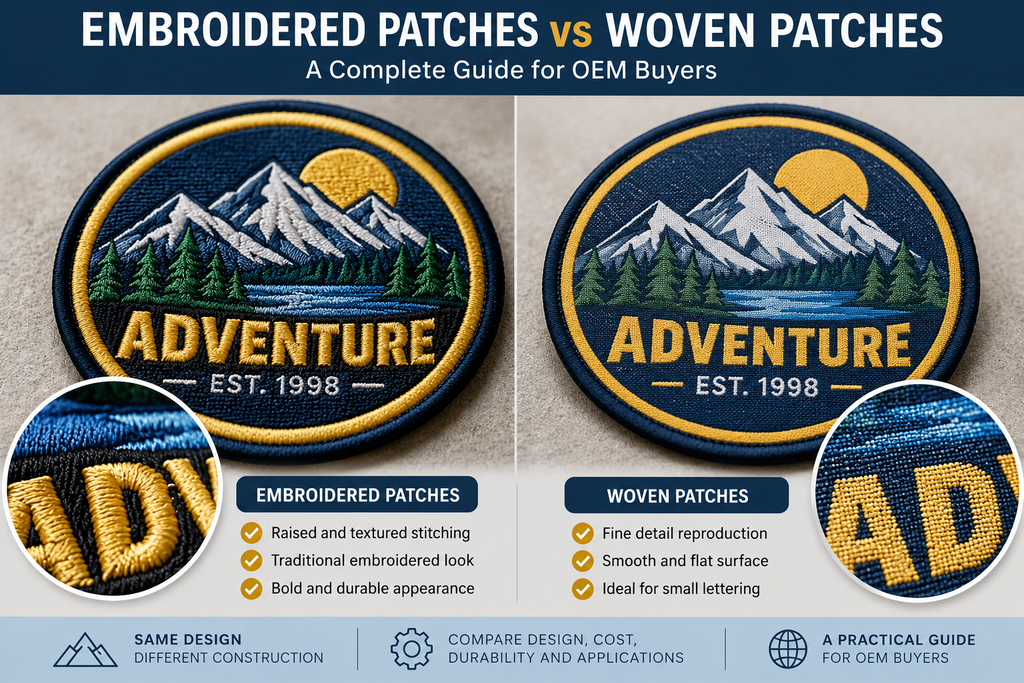
Вышитые нашивки изготавливаются путем пришивания вышивальных нитей к тканевой основе, что придаёт им характерную рельефную текстуру и объёмный вид. Благодаря традиционному мастерству изготовления, видимым стежкам и высококачественной вышивке они широко используются для изготовления военных знаков различия, полицейской формы, скаутских значков, спортивных эмблем и брендовой одежды. В отличие от этого, тканые нашивки изготавливаются путем переплетения тонких нитей, что позволяет создавать рисунок непосредственно в самой тканой структуре. Данный производственный процесс обеспечивает более ровные поверхности, более точные детали и более качественное воспроизведение мелких надписей или сложных рисунков.
Для международных брендов, оптовых компаний, поставщиков униформы и специалистов по закупкам понимание разница между ткаными и вышитыми нашивками имеет решающее значение для принятия обоснованных решений о покупке. Такие факторы, как сложность логотипа, размеры нашивки, цвета ниток, требования к долговечности, объемы заказа, производственные затраты и предполагаемое назначение, могут повлиять на выбор наиболее подходящего метода изготовления.
Однако выбор подходящего типа нашивки — это не только сравнение внешнего вида. Заказчики, заказывающие продукцию у оригинальных производителей (OEM), должны также учитывать стабильность производства, технические характеристики материалов, варианты отделки, процедуры контроля качества, а также способность производителя обеспечивать повторные заказы. Выбор неподходящего метода изготовления может ухудшить четкость дизайна, увеличить производственные затраты или привести к тому, что продукция не будет соответствовать заданным эксплуатационным требованиям.
На сайте Вышивальная корпорация "Артист, мы специализируемся на Собственное производство вышитых нашивок по заказу OEM на Тайване, предлагая индивидуальные решения в области вышивки для международных клиентов в сегменте B2B. Помимо наших основных производственных мощностей по вышивке, мы можем организовать изготовление тканых нашивок через проверенных производственных партнеров, что позволяет покупателям оценить различные варианты конструкции нашивок в соответствии с требованиями их проектов.
В этом исчерпывающем Руководство: вышитые нашивки против тканых нашивок, мы сравним производственные процессы, возможности дизайна, текстуру, долговечность, ценовые аспекты и области практического применения. Независимо от того, разрабатываете ли вы военные нашивки, корпоративные эмблемы, модные ярлыки или индивидуальные знаки отличия для униформы, это руководство поможет вам определить, какой тип нашивки наилучшим образом соответствует вашим требованиям к дизайну, бюджету и долгосрочным потребностям в поставках от производителей оригинального оборудования (OEM).
Что такое вышитые и тканые нашивки?
При сравнении вышитые нашивки против тканых нашивок, понимание основных методов их изготовления имеет решающее значение для выбора наиболее подходящего варианта при производстве продукции по индивидуальному заказу (OEM). Хотя оба вида продукции служат схожим целям в области брендинга, идентификации и декорирования, они изготавливаются с использованием различных технологий текстильного производства, которые напрямую влияют на их внешний вид, текстуру, возможности дизайна и производственные требования.
Вышитые нашивки представляют собой декоративную вышивку, нанесенную на основу из ткани, тогда как тканые нашивки включают рисунок, непосредственно вплетенный в структуру ткани. Эти различия влияют на то, насколько точно производители могут воспроизводить сложные логотипы, мелкий шрифт, детализированные иллюстрации и характерные визуальные эффекты.
Для покупателей, являющихся производителями оригинального оборудования (OEM), понимание этих производственных характеристик помогает сформировать реалистичные ожидания в отношении конструкции, оценить производственные технические условия и выбрать подходящую конструкцию заплатки для каждого конкретного случая применения.
Как устроена вышитая нашивка
Вышитые нашивки изготавливаются путем нанесения вышивки нитками на основную ткань с помощью компьютеризированных вышивальных машин. Рисунок преобразуется в цифровой файл вышивки, который определяет направление стежков, плотность вышивки, цвета ниток и последовательность операций вышивания.
К числу распространенных материалов основы относятся саржа, фетр и светоотражающая ткань, в зависимости от предполагаемого назначения и технических характеристик изделия.
В процессе производства вышивальные нитки наносятся на выбранную ткань для воссоздания необходимого логотипа, эмблемы, надписи или декоративного рисунка. Вышитые участки образуют рельефную поверхность, которая придает вышитым нашивкам их характерную объемную текстуру.
Одним из важных аспектов производства является площадь вышивки, который обозначает долю поверхности нашивки, покрытую вышивальными стежками. Различные уровни покрытия влияют на видимость ткани, лежащей в основе, общую текстуру, время изготовления, расход ниток и себестоимость продукции.
Вышитые нашивки особенно хорошо подходят для дизайнов, в которых выгодно смотрятся видимые стежки, четкие очертания, характерная текстура ниток и традиционный вид вышивки.
Их широко используют для изготовления военных знаков отличия, нашивок для полиции и служб безопасности, скаутских значков, эмблем спортивных команд, корпоративной формы и рекламной продукции.
Особенности конструкции тканых нашивок
В отличие от вышитых нашивок, тканые нашивки изготавливаются путем переплетения тонких нитей, образующих узор непосредственно в структуре ткани.
Вместо нанесения вышивальных стежков на отдельную основу в процессе ткацкого производства рисунок интегрируется непосредственно в сам текстиль. В результате получается относительно плоская, гладкая и легкая поверхность нашивки.
Поскольку при изготовлении тканых нашивок, как правило, используются нитки более тонкого калибра, чем при традиционной вышивке, при соблюдении надлежащих условий производства они позволяют с большей точностью воспроизводить мелкий шрифт, узкие линии, детализированные иллюстрации и сложные элементы логотипов.
Благодаря этому тканые нашивки особенно удобны для изображений, требующих высокой степени детализации при ограниченных размерах.
Например, небольшой модный логотип с тонким шрифтом или сложный корпоративный символ могут лучше смотреться в виде тканого изображения, если обычные вышивальные стежки не позволяют четко воспроизвести рисунок в требуемом размере.
Однако тканые нашивки не обладают той же рельефной текстурой стежков, которая характерна для традиционных вышитых нашивок. Их внешний вид, как правило, более плоский и однородный, что может быть предпочтительным для некоторых вариантов брендирования одежды, но менее желательным в тех случаях, когда выраженная текстура вышивки является важным требованием к дизайну.
Поэтому заказчики, заказывающие продукцию у производителей оригинального оборудования (OEM), должны учитывать как эстетические требования, так и технические ограничения конструкции, прежде чем принимать решение о производстве тканых нашивок.
Основные различия в методах производства
Основное отличие между вышитыми и ткаными нашивками заключается в том, что как нити используются для создания рисунка.
При производстве вышитых нашивок компьютеризированные вышивальные машины наносят декоративные стежки на основу. Производители могут регулировать плотность стежков, их направление, выбор ниток и площадь вышивки для достижения различных визуальных эффектов.
При изготовлении тканых нашивок рисунок создается за счет контролируемого переплетения нитей. Получающаяся в результате структура ткани позволяет воспроизводить детализированные изображения без использования рельефных узоров, характерных для вышивки.
Эти различия в технологиях производства также влияют на планирование производства, потребности в оборудовании, подготовку макетов, процессы послепечатной обработки и стандарты контроля качества.
При производстве вышитых нашивок производители должны тщательно контролировать совмещение стежков, натяжение нити, стабильность ткани и равномерность вышивки. Производство тканых нашивок требует надлежащего контроля параметров ткачества, выбора нитей, разрешения рисунка и структуры ткани.
Оба типа накладок могут использоваться с различными вариантами отделки и крепления, хотя доступные варианты зависят от конкретного производственного процесса и возможностей поставщика.
Для международных покупателей-производителей оригинального оборудования наиболее эффективным подходом является оценка конструкции заплаток с учетом сложности конструкции, назначения, требуемого внешнего вида и производственных характеристик, а не исхождение из того, что какой-то один метод является универсально лучшим.
📊 Таблица: Вышитые нашивки и тканые нашивки — сравнительный анализ основных технологий изготовления
| Коэффициент сравнения | Вышитые нашивки | Тканые нашивки |
|---|---|---|
| Метод изготовления | Нити, пришитые к основной ткани | Нити, переплетенные так, что образуют узор |
| Базовая структура | Основа с вышивкой | Композитная тканая текстильная структура |
| Характеристики резьбы | Относительно толстые нитки для вышивания | В целом более тонкие нити для ткачества |
| Текстура поверхности | Рельефные и объемные | Плоские и гладкие |
| Точная передача мелких деталей | Зависит от размера стежка и рисунка | В целом лучше подходит для мелких деталей |
| Мелкий шрифт | Ограничено разрешением вышивки | Часто подходит для текста меньшего размера |
| Визуальный облик | Традиционная вышитая фактура | Изысканная, тщательно проработанная тканая отделка |
| Толщина | В целом более толстые | В целом более тонкий |
| Общие приложения | Военная, полицейская, спортивная, скаутская, униформа | Модные бренды, детализированные логотипы, брендинг |
| Аспекты, которые следует учитывать при OEM-производстве | Плотность стежков, степень покрытия, ткань, цвета ниток | Разрешение плетения, цвета нитей, структура ткани |
💡 Советы покупателям: как выбрать подходящую конструкцию заплатки
Перед передачей макетов для производства по схеме OEM заказчики должны выяснить, текстура поверхности или воспроизведение мелких деталей является основным требованием к конструкции.
Если для проекта требуются жирные буквы, заметные стежки и традиционный вид вышивки, то вышитые нашивки могут оказаться более подходящим выбором.
Если на рисунке присутствует очень мелкий текст, тонкие линии или сложные детали в пределах ограниченного размера нашивки, тканые нашивки могут обеспечить более качественную передачу деталей.
В случае конструкций, которые не полностью соответствуют этим требованиям, запрос на проведение экспертизы технологической осуществимости или получение физического образца может помочь определить наиболее подходящий метод изготовления перед началом серийного производства.
📖 Расширенное чтение
- Ткань для вышитых нашивок: виды, особенности и руководство по выбору для OEM-производителей
- Покрытие вышивкой: что нужно знать о плотности стежков и внешнем виде нашивки
- Руководство по размерам вышитых нашивок: как выбрать подходящие размеры
Вышитые и тканые нашивки: основные различия
При оценке вышитые нашивки против тканых нашивок, Заказчикам, заказывающим продукцию у производителей оригинального оборудования (OEM), следует выйти за рамки своих основных методов производства и учесть, как каждая конструкция влияет на конечный продукт. Хотя оба типа накладок позволяют воспроизводить индивидуальные логотипы, эмблемы, надписи и декоративные элементы, их физические характеристики могут приводить к заметно разным результатам в плане текстуры, четкости изображения, гибкости и общего внешнего вида.
Вышитые нашивки широко известны благодаря объёмной вышивке и традиционному внешнему виду, тогда как тканые нашивки, как правило, предпочтительнее в тех случаях, когда приоритетными являются мелкие детали, гладкая поверхность и лёгкая конструкция. Однако ни один из этих вариантов не является универсально лучшим. Правильный выбор зависит от макета, предполагаемого применения, требуемого внешнего вида и производственных характеристик.
Понимание этих различий помогает зарубежным покупателям более точно формулировать свои требования, оценивать производственные образцы и избегать выбора конструкции нашивки, не соответствующей их ожиданиям.
Толщина нити и текстура поверхности
Одно из наиболее заметных отличий между вышитыми и ткаными нашивками заключается в толщине нитей и, как следствие, в текстуре поверхности.
Вышитые нашивки изготавливаются с использованием вышивальных ниток, которые накладываются стежками на основу. Эти нитки образуют видимые узоры стежков, создающие рельефную, фактурную поверхность. В зависимости от площади вышивки, направления стежков и их плотности готовый значок может иметь различную степень объемности.
Эта характерная текстура вышивки особенно востребована для изготовления военных знаков различия, полицейских нашивок, скаутских значков, эмблем спортивных команд и традиционных опознавательных знаков на униформе. Видимые стежки создают узнаваемый вид вышивки, который многие покупатели ассоциируют с мастерством исполнения и устоявшейся идентичностью организации.
На визуальный эффект также влияет направление нити при вышивании. Например, атласными стежками можно создавать гладкие, слегка приподнятые надписи и контуры, а стежками заполнения — более широкие фактурные участки с узорами, имеющими определённое направление.
В отличие от, тканые нашивки изготавливаются с использованием более тонких нитей, переплетенных в тканую структуру. Поскольку рисунок является неотъемлемой частью ткани, а не нанесен на ее поверхность с помощью стежков, тканые нашивки, как правило, выглядят более плоскими, гладкими и тонкими.
Благодаря такой конструкции тканые нашивки подходят для применения в тех случаях, когда требуется изысканная поверхность и минимальная толщина, например, для модных этикеток, детализированных логотипов брендов и некоторых аксессуаров для одежды.
Для покупателей, заказывающих продукцию по OEM-контрактам, выбор между рельефной вышивкой и плоским ткачеством должен основываться на желаемом визуальном образе, а не на предположении, что одна из текстур свидетельствует о более высоком качестве.
Разрешение деталей и мелкий шрифт
Еще одно важное различие в вышитые и тканые нашивки Сравнительным критерием является способность воспроизводить мелкие детали и мелкий шрифт.
При вышивании используются физические стежки с определённой толщиной нити, длиной стежка и требованиями к расстоянию между ними. Если в макете присутствует очень мелкий текст, узкие контуры или сложные внутренние элементы, эти физические ограничения могут повлиять на чёткость готового рисунка.
Например, небольшая вышитая нашивка, содержащая несколько строк мелкого шрифта, может потребовать упрощения шрифта, увеличения межбуквенного интервала или увеличения общих размеров для обеспечения читаемости.
Важное значение имеет также качество оцифровки вышивки. Правильное направление стежков, плотность, подложка и корректировка рисунка помогают производителям воспроизводить изображение с максимально возможной точностью в рамках ограничений, налагаемых техникой вышивания.
Однако увеличение плотности стежков не всегда приводит к улучшению детализации. Чрезмерная концентрация стежков может привести к появлению нежелательного объёма, искажениям или перекрытию участков нити, особенно в компактных рисунках.
Тканые нашивки, как правило, обеспечивают более высокую детализацию, поскольку более тонкие нити позволяют вплетать в тканую структуру мелкие элементы рисунка.
Это может быть особенно полезно при вышивании сложных корпоративных логотипов, детализированных иллюстраций, тонких линий и мелкого шрифта, которые может быть сложно воспроизвести с помощью традиционной вышивки.
Тем не менее, у тканых нашивок также есть технические ограничения. Для воспроизведения чрезвычайно мелких деталей, элементов, расположенных вплотную друг к другу, и сложных цветовых переходов по-прежнему может потребоваться корректировка макета в зависимости от разрешения ткачества и производственных характеристик.
Для обоих типов нашивок покупатели, заказывающие продукцию у оригинальных производителей (OEM), должны оценивать макет в предполагаемом окончательном размере и запрашивать производственный образец в тех случаях, когда точность исполнения дизайна имеет особое значение.
Внешний вид, гибкость и долговечность
Различия между вышитыми и ткаными нашивками также влияют на внешний вид, тактильные ощущения и эксплуатационные характеристики готовых изделий при повседневном использовании.
Вышитые нашивки, как правило, имеют более плотную структуру, поскольку вышивальные нитки наносятся на основную ткань. В зависимости от плотности стежков, подложки и метода отделки готовая нашивка может казаться более толстой и менее гибкой, чем аналогичная тканая нашивка.
Такая конструкция часто предпочтительна для униформенных знаков различия, тактических нашивок, организационных эмблем, а также в тех случаях, когда требуется выразительный вышитый вид.
Тканые нашивки, как правило, имеют более тонкую и гибкую структуру, благодаря чему они подходят для одежды и аксессуаров, где важна неброская отделка.
Однако гибкость не следует путать с прочностью.
Как вышитые, так и тканые нашивки могут обеспечить надежную и долговечную эксплуатацию, если они изготовлены из подходящих материалов и правильно нанесены.
Их долговечность зависит от ряда факторов, в том числе от состава нитей, структуры ткани, материалов основы, обработки краёв, способов крепления, условий стирки и подверженности истиранию.
Например, вышитая нашивка, выполненная высококачественными нитками и с надлежащим образом закреплёнными краями, может хорошо сохранять свои свойства при многократном использовании, в то время как тканая нашивка, изготовленная из подходящих материалов и с надлежащей отделкой, также может сохранять свой внешний вид при обычном уходе за одеждой.
Ни одну из этих конструкций не следует автоматически считать более долговечной без оценки фактических технических характеристик изделия и условий его эксплуатации.
Поэтому покупателям, заказывающим продукцию по схеме OEM, следует учитывать конструкцию заплатки в целом, а не оценивать её долговечность исключительно по толщине или текстуре поверхности.
📊 Таблица: Вышитые и тканые нашивки — основные физические и визуальные различия
| Коэффициент сравнения | Вышитые нашивки | Тканые нашивки |
|---|---|---|
| Толщина нити | Как правило, более толстые нитки для вышивания | В целом более тонкие нити для ткачества |
| Текстура поверхности | Рельефные и фактурные | Плоские и гладкие |
| Внешний вид деталей | Более выраженная глубина прошивки | Более сдержанный внешний вид |
| Высокая детализация | Ограничено конструкцией стежка | Как правило, лучше подходит для мелких деталей |
| Мелкий шрифт | Может потребоваться увеличение размера шрифта или упрощение иллюстраций | Часто используется для нанесения мелкого шрифта |
| Видимость стежков | Видны отдельные стежки вышивки | Тонкая тканая структура отличается большей однородностью |
| Общая толщина | В целом более толстые | В целом более тонкий |
| Гибкость | Зависит от плотности, материала и подкладки | Как правило, более гибкий |
| Визуальный стиль | Традиционная вышивка с рельефным рисунком | Изысканный, тщательно проработанный вид ткани |
| Долговечность | Зависит от материалов и конструкции | Зависит от материалов и конструкции |
| Приоритет лучшего дизайна | Текстура, выразительные формы, заметные швы | Мелкие детали, мелкий шрифт, гладкая поверхность |
Примечание: Данные сравнения отражают типичные производственные характеристики, а не универсальные стандарты качества. Фактические результаты зависят от характеристик нити, сложности рисунка, размеров нашивки, подложки, методов отделки и качества изготовления.
💡 Советы покупателям: отдавайте предпочтение требованиям к дизайну, а не типу накладки
При выборе между вышитыми и ткаными нашивками покупателям следует в первую очередь определить наиболее важные характеристики готового изделия.
Если дизайн предполагает использование жирного шрифта, заметных стежков, рельефной текстуры или традиционного вида вышивки, вышитые нашивки может дать наиболее подходящий результат.
Если в графическом материале присутствуют сложные иллюстрации, мелкий шрифт, тонкие линии или детализированные элементы в ограниченных размерах, тканые нашивки может обеспечить большую ясность конструкции.
При выборе накладок для применения в условиях частой стирки, истирания или длительного равномерного использования покупателям следует также обратить внимание на материалы нитей, обработку краёв, подкладку и требования к креплению, а не исходить из того, что более толстые накладки автоматически являются более долговечными.
В случаях, когда требования к внешнему виду или эксплуатационным характеристикам имеют решающее значение, запрос физических образцов обеих конструкций может помочь покупателям принять более обоснованное решение перед размещением крупного заказа на производство по спецификации заказчика (OEM).
📖 Расширенное чтение
- Качество вышитых нашивок: что нужно знать покупателям-производителям оригинального оборудования (OEM)
- Руководство по размерам вышитых нашивок: как выбрать подходящий размер
- Руководство по плотности вышивки: 50%, 75% и 100%
Design Complexity and Artwork Requirements
При сравнении вышитые нашивки против тканых нашивок, design complexity and artwork preparation are critical factors that influence manufacturing feasibility, visual accuracy, and overall production costs. Even when two patches use identical artwork and dimensions, the final results may differ significantly because embroidery and weaving reproduce graphic elements through different textile construction methods.
For OEM buyers, understanding these limitations before submitting artwork can reduce unnecessary revisions, improve production efficiency, and help manufacturers achieve more consistent results.
Important design considerations include minimum line thickness, lettering size, color separation, spacing between elements, and the relationship between artwork complexity and finished patch dimensions.
Although modern manufacturing equipment can reproduce a wide range of designs, not every digital illustration can be transferred directly into textile production without modification. Artwork must be evaluated according to the physical characteristics and technical limitations of the selected manufacturing method.
For additional guidance on selecting appropriate dimensions for detailed logos and small lettering, explore our Таблица размеров вышитых нашивок.
Which Patch Type Handles Fine Details Better?
One of the most important considerations when choosing between embroidered and woven patches is how accurately each manufacturing method can reproduce intricate design elements.
Вышитые нашивки use individual embroidery stitches to create shapes, outlines, lettering, and decorative patterns. Each stitch occupies physical space, meaning extremely thin lines, closely positioned elements, and miniature details may become difficult to reproduce clearly at smaller patch sizes.
For example, a complex military insignia containing detailed aircraft illustrations, narrow borders, and small lettering may require adjustments to the original artwork before embroidery production.
Manufacturers may need to simplify certain elements, increase spacing, enlarge specific details, or modify stitch directions to maintain visual clarity.
However, embroidery also provides unique design advantages. Different stitch directions, satin stitches, and fill stitches can create distinctive textures and dimensional effects that are difficult to reproduce through conventional weaving.
Тканые нашивки, on the other hand, generally offer better reproduction of fine details because the design is constructed using relatively fine interlaced threads.
This allows woven patches to reproduce narrow lines, small symbols, and detailed artwork with greater precision under suitable weaving conditions.
Nevertheless, woven production is not unlimited in resolution. Extremely small design elements may still require simplification, particularly when the artwork contains complicated color transitions or tightly spaced details.
For OEM buyers, the most reliable approach is to evaluate artwork at its actual production size rather than judging design clarity from an enlarged digital image.
Logo Design and Small Text Limitations
Logo reproduction and lettering readability are particularly important for corporate branding, military identification, police insignia, scouting emblems, and promotional patches.
When preparing artwork for вышитые на заказ нашивки, buyers should consider the relationship between lettering height, font style, stroke thickness, and available embroidery space.
Very small letters may become difficult to read because embroidery threads cannot reproduce extremely narrow strokes or tiny gaps with the same precision as printed graphics.
For example, thin serif fonts, tightly spaced lettering, and complex decorative typography may require modification before embroidery digitizing.
Using slightly larger lettering, increasing character spacing, selecting clearer font styles, or enlarging the overall patch can often improve embroidery readability.
The minimum practical lettering size varies according to thread thickness, stitch type, fabric stability, equipment, and the specific font design. Therefore, manufacturers should evaluate each artwork individually rather than guarantee a universal minimum text size.
Woven patches may provide an advantage when logos contain smaller typography or fine graphic elements because their construction generally supports greater detail resolution.
However, woven lettering must still remain within the production capabilities of the selected weaving process.
For international OEM buyers, providing original vector artwork in formats such as AI, EPS, or PDF can help manufacturers review design proportions and prepare suitable production files.
High-resolution raster files may also be acceptable for initial evaluation, although additional artwork preparation may be necessary.
Clear artwork specifications reduce misunderstandings and help ensure that the finished patches match the intended brand identity.
Color Selection and Design Reproduction
Color selection is another important consideration in вышитые и тканые нашивки, particularly for OEM buyers managing corporate branding, uniform specifications, or repeat production orders.
Both manufacturing methods use colored threads to reproduce the artwork, but the available color combinations and production requirements depend on the equipment, thread specifications, and manufacturing process.
For embroidered patches, each thread color must be assigned during embroidery digitizing and incorporated into the machine’s production sequence.
Increasing the number of thread colors may require additional thread preparation, color changes, machine setup, and production management.
As a result, designs containing more thread colors can increase manufacturing costs, particularly when frequent color changes or additional production adjustments are required.
The actual cost impact depends on the embroidery machine configuration, order quantity, production sequence, and number of color changes.
Woven patches also require careful color planning. The number of available colors and the complexity of color transitions depend on the weaving equipment and production specifications.
Designs containing numerous colors, gradients, photographic effects, or extremely detailed shading may require simplification or alternative production techniques.
For both patch types, buyers should understand that thread colors do not always reproduce the exact appearance of colors displayed on digital screens.
Color matching should be evaluated using available thread color references, approved samples, or agreed color specifications.
When brand consistency is essential, OEM buyers should communicate their color requirements before production and confirm whether the requested shades can be achieved using the available thread materials.
For repeat orders, maintaining approved artwork files, thread color references, and production specifications can help improve consistency between manufacturing batches.
📊 Table: Artwork Requirements for Embroidered vs Woven Patches
| Коэффициент проектирования | Вышитые нашивки | Тканые нашивки |
|---|---|---|
| Fine Line Reproduction | Limited by stitch thickness and spacing | Generally better for narrow lines |
| Мелкий шрифт | May require larger fonts or simplified text | Often supports smaller typography |
| Complex Logos | May require artwork simplification | Generally suitable for finer details |
| Raised Design Effects | Achievable through embroidery stitches | Typically limited |
| Stitch Direction Effects | Can create visible texture and dimension | Not applicable in the same manner |
| Color Reproduction | Based on embroidery thread selection | Based on weaving thread selection |
| Additional Colors | May increase setup and production costs | May increase weaving complexity and costs |
| Gradients and Shading | Often require stitch-based interpretation | Limited by weaving resolution and thread colors |
| Preferred Artwork | Vector files or clear high-resolution images | Vector files or clear high-resolution images |
| Production Preparation | Embroidery digitizing and stitch planning | Weaving pattern development |
| Sample Evaluation | Recommended for complex embroidery designs | Recommended for detailed woven designs |
Примечание: Artwork limitations vary according to patch dimensions, thread specifications, machine capabilities, and manufacturing requirements. Both patch types should undergo a technical feasibility review before bulk production.
💡 Buyer Tips: Prepare Production-Ready Artwork Before Ordering
Before requesting an OEM quotation, buyers should provide the original artwork together with the intended patch dimensions, required thread colors, backing preferences, and estimated order quantity.
For embroidered patches, avoid assuming that extremely small lettering or intricate illustrations can be reproduced without modification. Manufacturers may recommend enlarging the design, simplifying details, or adjusting lettering to achieve better embroidery results.
For woven patches, confirm whether the selected weaving process can reproduce the required fine details and color combinations.
When comparing manufacturing costs, remember that additional thread colors, complicated artwork, and special production requirements may influence the final quotation.
И самое главное, approve artwork specifications and production samples before proceeding with large-volume orders, particularly when consistent logo reproduction and brand colors are essential.
📖 Расширенное чтение
Manufacturing Process and Quality Control
При оценке вышитые нашивки против тканых нашивок, understanding the manufacturing process and quality control requirements is essential for international OEM buyers. Although both products are designed to reproduce custom logos, insignia, and decorative artwork, their production workflows involve different equipment, technical parameters, and inspection considerations.
Manufacturing quality depends not only on the appearance of an individual sample but also on the supplier’s ability to maintain consistent specifications throughout bulk production. Factors such as thread selection, machine settings, design preparation, finishing accuracy, and production monitoring can influence the final results.
For wholesalers, uniform suppliers, apparel brands, and distributors, reliable manufacturing processes help minimize product variations, reduce potential defects, and support consistent repeat orders.
Understanding how each patch type is manufactured also enables buyers to communicate more effectively with suppliers, establish realistic quality expectations, and evaluate production capabilities before placing large-volume OEM orders.
Embroidery Production and Stitch Density
The manufacturing process for вышитые на заказ нашивки begins with artwork evaluation and embroidery digitizing. During this stage, the original design is converted into a machine-readable embroidery file containing instructions for stitch placement, stitch direction, thread colors, and production sequences.
Unlike ordinary digital image conversion, embroidery digitizing requires technical adjustments based on fabric characteristics, design complexity, stitch density, and the intended patch dimensions.
After digitizing, the appropriate base fabric is selected. Common materials include twill, felt, and reflective fabric, depending on the product’s intended use and customer specifications.
The prepared fabric is then positioned on computerized embroidery equipment, where embroidery threads are stitched according to the programmed design.
One of the most important technical parameters is stitch density, which determines how closely embroidery stitches are positioned within the design.
Appropriate stitch density helps achieve consistent coverage, maintain design definition, and reduce unwanted gaps between stitches.
However, excessive stitch density can create unnecessary thread buildup, fabric distortion, increased production time, and additional manufacturing costs.
Insufficient stitch density may result in uneven coverage, visible fabric gaps, or reduced design clarity.
Manufacturers must therefore balance stitch density, stitch direction, underlay, thread tension, and fabric stability to achieve the desired appearance.
Additional production considerations include thread color changes, machine speed, thread breakage, and the accuracy of embroidery registration.
After embroidery, patches undergo the required finishing operations, which may include trimming, edge finishing, backing application, and final inspection.
For OEM buyers, the quality of embroidery production should be evaluated through stitch consistency, lettering clarity, surface appearance, and conformity with approved artwork specifications.
Woven Patch Production and Finishing
Тканые нашивки are manufactured through a weaving process in which fine threads are interlaced to reproduce the required artwork directly within a textile structure.
Unlike embroidered patches, which apply decorative stitches onto a supporting fabric, woven patches incorporate the design into the woven material itself.
The production process begins with artwork evaluation and the preparation of weaving instructions. Design elements such as lettering, line thickness, thread colors, and overall dimensions must be reviewed according to the capabilities of the selected weaving equipment.
During manufacturing, the weaving equipment controls the arrangement of threads to create the required design pattern.
Because woven patches generally use finer threads, they can reproduce intricate details and smaller lettering under suitable production conditions.
However, the manufacturing process requires careful control of weaving resolution, thread tension, pattern alignment, and color placement.
After weaving, the material may undergo cutting, edge finishing, backing application, and other processing operations according to the customer’s specifications.
Common finishing requirements may include heat-cut edges, merrowed borders where suitable, sew-on configurations, iron-on backing, or hook-and-loop attachment systems.
The availability and suitability of these options depend on the woven patch construction and the production partner’s capabilities.
Quality inspection should focus on design clarity, weaving consistency, dimensional accuracy, thread defects, color matching, and finishing quality.
На сайте Вышивальная корпорация "Артист, embroidered patches are our primary in-house manufacturing specialty. Woven patch production can also be coordinated through trusted external manufacturing partners according to customer requirements.
This sourcing arrangement allows OEM buyers to discuss both product types while maintaining a clear distinction between in-house embroidery manufacturing and partner-supported woven patch production.
Quality Inspection for OEM Orders
Quality control is a critical consideration when comparing embroidered and woven patches, especially for buyers purchasing large quantities or managing recurring OEM programs.
A well-defined inspection process helps verify whether the finished products meet the approved specifications for appearance, dimensions, colors, construction, and finishing.
For embroidered patches, inspection typically focuses on embroidery registration, stitch consistency, thread tension, lettering readability, and the absence of significant thread defects.
Inspectors may also evaluate fabric distortion, unwanted gaps in embroidered areas, loose threads, and the consistency of borders or backing applications.
For woven patches, inspection should focus on weaving accuracy, pattern alignment, fine-detail reproduction, thread irregularities, and the uniformity of the finished textile structure.
Regardless of the manufacturing method, dimensional accuracy is particularly important for uniform patches, military insignia, and products that must fit designated placement areas.
Color consistency is another key consideration. Buyers may provide approved thread references, physical samples, or agreed color specifications to establish production expectations.
For large-volume OEM orders, evaluating only one finished patch may not adequately represent the entire production batch.
Instead, buyers and manufacturers should establish appropriate inspection procedures based on order quantity, product complexity, and agreed acceptance criteria.
These procedures may include pre-production sample approval, in-process monitoring, and final inspection before shipment.
When repeat orders are expected, retaining approved artwork, color references, dimensions, backing specifications, and finishing requirements can help reduce variation between production batches.
For international buyers, clear communication and documented specifications are essential for maintaining reliable product quality across long-term manufacturing relationships.
📊 Table: Embroidered vs Woven Patches – Manufacturing and Quality Control Comparison
| Производственный фактор | Вышитые нашивки | Тканые нашивки |
|---|---|---|
| Технология производства | Computerized embroidery machines | Weaving equipment |
| Подготовка к работе | Оцифровка вышивок | Weaving pattern development |
| Design Construction | Нити, пришитые к основной ткани | Threads interlaced into textile |
| Primary Technical Parameters | Stitch density, direction, tension | Weaving resolution, thread alignment |
| Material Considerations | Base fabric and embroidery threads | Weaving threads and fabric structure |
| Color Management | Thread selection and color changes | Thread selection and weaving configuration |
| Common Production Issues | Thread breaks, puckering, stitch gaps | Weaving irregularities, pattern distortion |
| Design Accuracy Inspection | Stitch registration and lettering clarity | Weaving alignment and detail clarity |
| Dimensional Inspection | Finished size and border consistency | Finished size and cutting accuracy |
| Finishing Options | Cutting, borders, backing, attachment | Cutting, borders, backing, attachment |
| Bulk Production Consistency | Requires embroidery process control | Requires weaving process control |
| Artist Embroidery Production | In-house manufacturing | Trusted external production partners |
Примечание: Manufacturing workflows, inspection methods, and available finishing options vary according to product specifications, equipment capabilities, and individual supplier arrangements.
💡 Buyer Tips: Establish Clear Quality Standards Before Bulk Production
When sourcing custom patches for OEM manufacturing, buyers should establish clear product specifications before confirming production.
Important information includes finished dimensions, approved artwork, thread colors, material requirements, border construction, backing type, attachment method, and acceptable production tolerances.
For embroidered patches, buyers should pay particular attention to stitch quality, embroidery coverage, lettering clarity, and fabric stability.
For woven patches, fine-detail reproduction, weaving consistency, and dimensional accuracy should receive additional consideration.
When ordering large quantities, requesting a pre-production sample can help confirm the expected appearance before full manufacturing begins.
For repeat orders, maintaining an approved reference sample and documented specifications can help improve consistency between production batches.
The most effective OEM quality control strategy is to define measurable acceptance criteria rather than relying solely on subjective visual impressions.
📖 Расширенное чтение
- Качество вышитых нашивок
- Сроки изготовления нашивок с индивидуальной вышивкой
- Вышитые бордюры на нашивках
Embroidered vs Woven Patches: Cost Comparison
При сравнении вышитые нашивки против тканых нашивок, manufacturing cost is one of the most important considerations for international OEM buyers, wholesalers, uniform suppliers, and apparel brands. Although both patch types can reproduce custom logos and decorative designs, their pricing structures differ because they use different manufacturing technologies, materials, production workflows, and finishing processes.
Стоимость вышитые на заказ нашивки is influenced by factors such as embroidery stitch count, thread colors, embroidery coverage, fabric selection, machine operating time, and finishing requirements. Woven patch pricing, on the other hand, depends on weaving specifications, design complexity, thread configurations, production setup, and finishing methods.
Order quantity also plays a significant role in determining unit pricing. Larger production volumes may allow manufacturers to distribute certain setup and preparation expenses across more pieces, while smaller orders generally carry higher unit costs.
For OEM buyers, understanding these cost factors is essential for comparing quotations accurately and selecting the most cost-effective manufacturing method without compromising product quality or design requirements.
To better understand how stitch count, embroidery coverage, thread colors, and order quantity influence manufacturing costs, read our custom embroidered patches cost guide.
How Design Complexity Affects Pricing
Design complexity directly influences the manufacturing cost of both embroidered and woven patches, although the specific cost drivers differ between the two production methods.
Для вышитые нашивки, one of the primary pricing factors is the total embroidery stitch count. Designs requiring extensive embroidery coverage, large filled areas, or intricate stitch patterns generally consume more thread and require longer machine operating times.
For example, a patch with approximately 50% embroidery coverage may require fewer stitches than a comparable design with nearly 100% coverage, assuming similar dimensions and stitch specifications.
However, embroidery coverage alone does not determine the final price. Stitch density, stitch direction, underlay requirements, lettering complexity, and the number of thread color changes also influence production efficiency.
Thread color quantity is another important cost consideration. Designs containing more colors may require additional thread preparation, machine setup, color changes, and production management.
Even when two designs have similar stitch counts, the design requiring more frequent color changes may involve greater labor and machine interruption costs.
Embroidery digitizing complexity can also affect initial preparation expenses, particularly when artwork requires extensive adjustments to maintain clarity and production efficiency.
Для тканые нашивки, design complexity affects the weaving pattern, thread arrangement, color configuration, and manufacturing setup.
Intricate artwork, numerous colors, or specialized weaving requirements may increase preparation and production costs. However, woven patch pricing is not typically determined by embroidery stitch count because the design is produced through weaving rather than embroidery.
OEM buyers should therefore avoid comparing the two products using embroidery-specific pricing metrics alone.
The Impact of Order Quantity and Size
Patch dimensions and order quantity are two major factors affecting the unit cost of both embroidered and woven patches.
For embroidered patches, increasing the finished dimensions generally increases material consumption and may increase stitch count, machine operating time, and finishing requirements.
However, size alone does not determine embroidery cost. A large patch with limited embroidery coverage may require fewer stitches than a smaller patch containing dense, highly detailed embroidery.
The relationship between patch size, stitch count, and design complexity should therefore be evaluated together.
For woven patches, larger dimensions generally require more woven material and may affect production efficiency, cutting requirements, and finishing costs.
Order quantity influences pricing because certain preparation and setup costs can be distributed across the total production volume.
For example, an OEM order of 100 pieces may have a higher unit cost than an otherwise identical order of 1,000 pieces because fixed preparation expenses are allocated across fewer products.
However, larger orders do not always result in proportional cost reductions.
For embroidered patches, additional production batches may require thread replenishment, machine adjustments, bobbin replacement, material handling, or repeated setup operations.
Similarly, woven patch production may involve additional weaving runs, material preparation, or finishing operations depending on production capacity and order requirements.
As a result, unit pricing often decreases with increasing quantity, but the rate of reduction depends on the actual manufacturing process and production efficiency.
For international OEM buyers, requesting quotations at several quantity levels can help identify the most economical purchasing volume.
Which Patch Type Is More Cost-Effective?
Determining whether embroidered or woven patches are more cost-effective requires evaluating the complete product specifications rather than comparing manufacturing methods in isolation.
Вышитые нашивки may offer competitive pricing for designs featuring bold shapes, moderate embroidery coverage, limited thread colors, and relatively straightforward production requirements.
They are also particularly suitable when customers specifically require the raised texture and traditional appearance of embroidery.
However, designs involving extensive embroidery coverage, high stitch counts, numerous color changes, or complicated stitch patterns may require additional production time and labor.
Тканые нашивки may be economically attractive for certain designs requiring fine details, small lettering, or a flat textile appearance.
Because woven patches do not use the same stitch-based construction as embroidered patches, their pricing responds to different production factors.
Nevertheless, woven patches are not automatically less expensive.
Small order quantities, complicated weaving patterns, specialized thread configurations, finishing requirements, and supplier-specific setup costs may increase the final unit price.
Additional considerations include backing selection, border finishing, packaging, quality requirements, and shipping arrangements.
For example, sew-on patches, iron-on patches, and hook-and-loop patches may involve different material and processing costs regardless of whether the base patch is embroidered or woven.
For OEM buyers comparing quotations, the most meaningful approach is to evaluate both products using equivalent dimensions, artwork requirements, order quantities, finishing specifications, and delivery conditions.
The lowest unit price does not necessarily represent the best overall value if the selected manufacturing method cannot reproduce the required artwork or meet the intended application requirements.
📊 Table: Embroidered vs Woven Patches – Manufacturing Cost Comparison
| Фактор стоимости | Вышитые нашивки | Тканые нашивки |
|---|---|---|
| Primary Production Cost Driver | Stitch count and machine operating time | Weaving configuration and production efficiency |
| Подготовка к работе | Оцифровка вышивок | Weaving pattern preparation |
| Сложность проектирования | Affects stitch count, density, and production time | Affects weaving pattern and setup requirements |
| Thread Color Quantity | Additional colors may increase setup and changeover costs | Additional colors may increase weaving complexity and setup costs |
| Размеры заплатки | Affect fabric usage and potential stitch count | Affect woven material consumption and production requirements |
| Покрытие для вышивки | Major influence on thread usage and operating time | Not applicable in the same manner |
| Small Order Quantities | Setup costs distributed across fewer pieces | Setup costs distributed across fewer pieces |
| Large Order Quantities | May reduce unit cost through production efficiency | May reduce unit cost through production efficiency |
| Backing and Borders | Additional materials and processing costs | Additional materials and processing costs |
| Сложные мелкие детали | May require digitizing adjustments and more stitches | May require more complex weaving specifications |
| Production Setup | Machine preparation, thread arrangement, digitizing | Weaving setup, pattern configuration |
| Overall Cost Advantage | Depends on design and production requirements | Depends on design and production requirements |
Примечание: This table provides a general comparison of manufacturing cost factors rather than fixed pricing rules. Actual quotations depend on artwork, specifications, quantity, production capacity, finishing requirements, and supplier conditions.
💡 Buyer Tips: Compare Total Manufacturing Value, Not Just Unit Price
When requesting quotations for custom embroidered patches or woven patches, OEM buyers should provide identical project specifications to each manufacturer or supplier.
These should include the finished patch dimensions, artwork, estimated quantity, required thread colors, backing type, border finishing, packaging requirements, and delivery destination.
For embroidered patches, buyers should understand that higher stitch counts, increased embroidery coverage, and additional thread colors can increase manufacturing costs.
For woven patches, detailed weaving requirements, color configurations, and setup complexity may influence pricing.
Buyers should also request quotations at multiple order quantities, such as 100, 300, 500, and 1,000 pieces, when appropriate for their purchasing plans.
This approach makes it easier to evaluate volume pricing, setup expenses, and potential cost savings.
И самое главное, compare the total landed cost and expected product quality rather than selecting a supplier solely based on the lowest quoted unit price.
A well-matched manufacturing method can reduce artwork revisions, minimize production problems, and improve overall purchasing efficiency.
📖 Дополнительная литература
- Стоимость нашивок с индивидуальной вышивкой
- Минимальный объем заказа на вышитые нашивки с индивидуальным дизайном
- Сроки изготовления нашивок с индивидуальной вышивкой
Durability, Washing, and Long-Term Performance
При сравнении вышитые нашивки против тканых нашивок, durability is an important consideration for OEM buyers sourcing products for uniforms, workwear, military apparel, sportswear, and branded merchandise. While embroidered and woven patches are manufactured using different textile construction methods, both can provide reliable long-term performance when appropriate materials, finishing techniques, and attachment methods are selected.
The durability of a custom patch depends on more than its thickness or surface texture. Thread composition, fabric construction, edge finishing, backing materials, attachment methods, washing conditions, and exposure to abrasion can all influence how well a patch maintains its appearance and structural integrity over time.
For international wholesalers, uniform suppliers, and apparel brands, understanding these factors helps ensure that finished patches meet practical performance expectations and remain suitable for their intended applications.
Rather than assuming that one patch type is universally more durable, OEM buyers should evaluate the complete product specifications and consider the conditions under which the patches will be used.
Attachment methods can also influence long-term performance. Learn more about sew-on, iron-on, adhesive, and hook-and-loop options in our сравнение основы для вышитых нашивок.
For OEM projects requiring documented textile performance, buyers may refer to recognized testing methods published by the American Association of Textile Chemists and Colorists (AATCC). Relevant methods include AATCC TM61 for accelerated laundering colorfastness and AATCC TM8 for color transfer through rubbing.
These methods provide useful references when establishing testing requirements. However, compliance or performance claims should only be made when the relevant materials or finished products have actually been tested under the specified conditions.
Thread Wear and Surface Appearance
One of the primary differences between embroidered and woven patches is how their thread construction responds to repeated handling, friction, and everyday wear.
Вышитые нашивки feature raised embroidery stitches applied to a supporting fabric. This dimensional structure creates the recognizable texture associated with traditional embroidered insignia, but the exposed stitches may also come into contact with surrounding surfaces during use.
For example, patches attached to backpacks, tactical equipment, work uniforms, or frequently handled garments may experience repeated friction against straps, equipment, or other materials.
Depending on the thread composition, stitch construction, and intensity of abrasion, prolonged friction may contribute to surface fuzzing, thread wear, or changes in the appearance of individual stitches.
However, these effects are not inevitable. Proper stitch density, suitable thread selection, secure embroidery construction, and appropriate finishing can help improve resistance to normal wear.
Тканые нашивки, by comparison, generally feature a flatter textile surface with finer threads integrated into the woven structure.
Their lower-profile construction may reduce the exposure of raised thread elements to certain types of friction, although woven surfaces can still experience abrasion, snagging, fraying, or other forms of wear.
The actual performance depends on the weaving structure, thread materials, edge finishing, and intended application.
Thread composition is particularly important for both patch types. Polyester threads are commonly selected for applications requiring good color retention and resistance to routine washing, while other thread materials may offer different visual or physical characteristics.
For OEM buyers, evaluating thread quality and finished patch construction is more meaningful than judging durability solely by whether the patch is embroidered or woven.
Washing and Maintenance Considerations
Washing performance is another important factor when selecting embroidered or woven patches for garments that require regular cleaning.
Uniforms, workwear, sports apparel, and corporate clothing may undergo repeated washing cycles throughout their service life. Therefore, the patch must be compatible with the garment fabric, attachment method, and recommended cleaning conditions.
For embroidered patches, washing performance depends on the embroidery thread, supporting fabric, backing material, border construction, and method used to attach the patch to the garment.
A properly sewn embroidered patch may remain securely attached during routine laundering, provided that the garment and patch materials are suitable for the selected washing conditions.
However, aggressive washing, excessive heat, strong chemical detergents, or unsuitable drying temperatures may affect thread appearance, backing adhesion, or fabric stability.
Woven patches also require appropriate care. Although their flatter construction can be advantageous for certain apparel applications, their washing performance still depends on thread composition, weaving structure, edge finishing, and attachment quality.
For both patch types, backing and attachment methods can significantly influence long-term washing performance.
Sew-on attachment provides a mechanical connection between the patch and garment, while iron-on backing relies on heat-activated adhesive bonding.
The suitability of iron-on backing depends on the adhesive formulation, garment fabric, application temperature, pressure, and washing conditions.
Hook-and-loop backing offers removability and replacement convenience, but the attachment components should also be evaluated for repeated washing and use.
OEM buyers should avoid assuming that every backing option offers the same laundering performance.
When patches are intended for industrial laundering, high-temperature washing, or specialized workwear applications, manufacturers should review the expected cleaning requirements before confirming production specifications.
Choosing Patches for Frequent Use
For OEM buyers purchasing patches intended for frequent use, the most appropriate construction depends on the application environment and expected service conditions.
Вышитые нашивки are commonly used for military insignia, police uniforms, security apparel, scouting badges, sports team emblems, and organizational identification.
Their raised stitching and traditional embroidered appearance make them particularly suitable when visual prominence and recognizable textile texture are important design requirements.
However, applications involving frequent abrasion, repeated washing, or exposure to demanding environments require careful consideration of thread materials, backing, borders, and attachment methods.
For example, a tactical patch attached to equipment using hook-and-loop backing may experience different wear conditions from an embroidered emblem permanently sewn onto a uniform sleeve.
Similarly, a patch used on outdoor equipment may require greater attention to abrasion resistance, moisture exposure, and color stability than a decorative patch used on occasional-wear apparel.
Тканые нашивки may be suitable for applications where flexibility, fine detail reproduction, and a low-profile surface are priorities.
They are often considered for fashion apparel, branded accessories, detailed identification labels, and garments where a thinner patch construction is desirable.
Nevertheless, woven patches are not automatically superior for frequent washing or heavy use.
Both construction methods should be evaluated according to the complete product specification and the environmental conditions in which the patches will operate.
For critical applications, OEM buyers may request relevant material information, approved production samples, or application-specific testing.
Testing may include repeated laundering, abrasion resistance, colorfastness, attachment strength, or dimensional stability, depending on the product requirements and available testing arrangements.
By defining performance expectations before production, buyers can select a patch construction that balances visual appearance, durability, comfort, and long-term usability.
📊 Table: Embroidered vs Woven Patches – Durability and Maintenance Comparison
| Performance Factor | Вышитые нашивки | Тканые нашивки |
|---|---|---|
| Surface Construction | Raised embroidery stitches | Flat woven textile structure |
| Thread Exposure | Raised stitches may experience surface friction | Flatter surface, but still subject to abrasion |
| Устойчивость к истиранию | Depends on thread, stitches, and construction | Depends on thread and weaving structure |
| Surface Fuzzing | Possible with repeated friction | Possible depending on thread and use |
| Thread Snagging | Exposed stitches may snag | Woven threads may also snag |
| Washing Durability | Depends on materials, backing, and attachment | Depends on materials, backing, and attachment |
| Color Retention | Influenced by thread quality and washing conditions | Influenced by thread quality and washing conditions |
| Edge Durability | Depends on border construction and finishing | Depends on edge construction and finishing |
| Гибкость | Varies with embroidery coverage and backing | Generally more flexible |
| Frequent Uniform Use | Suitable with appropriate specifications | Suitable with appropriate specifications |
| Outdoor Applications | Requires suitable materials and construction | Requires suitable materials and construction |
| Long-Term Performance | Should be verified against intended conditions | Should be verified against intended conditions |
Примечание: Neither patch type should be considered universally more durable without evaluating its materials, construction, finishing, attachment method, and actual service conditions. Performance testing may be necessary for demanding applications.
💡 Buyer Tips: Match Patch Durability to Real-World Applications
При поиске поставщиков custom embroidered patches or woven patches, OEM buyers should clearly communicate the expected conditions of use before confirming production.
For uniforms and workwear requiring frequent washing, consider thread composition, garment compatibility, attachment strength, and laundering requirements.
For tactical equipment, backpacks, and outdoor accessories, evaluate potential abrasion, friction, moisture exposure, and the suitability of edge finishing.
For fashion apparel and lightweight garments, flexibility, thickness, and comfort may be equally important considerations.
If patches will be exposed to industrial laundering, repeated mechanical abrasion, or other demanding conditions, request suitable material specifications and discuss whether performance testing is necessary.
The most reliable way to evaluate patch durability is to assess the complete construction under realistic use conditions rather than assuming that thicker or more textured patches will always last longer.
📖 Расширенное чтение
Best Applications for Embroidered and Woven Patches
При оценке вышитые нашивки против тканых нашивок, selecting the right construction depends heavily on the intended application, design requirements, and expectations of the end user. Although both patch types are widely used for identification, branding, decoration, and organizational insignia, their different textures, thicknesses, and design capabilities make them suitable for different purposes.
Embroidered patches are commonly preferred for applications requiring traditional stitching, dimensional texture, and prominent visual identification. Woven patches, on the other hand, are often selected for designs containing intricate details, small lettering, or applications where a flatter and more flexible textile structure is desirable.
For international OEM buyers, understanding these application differences helps determine which manufacturing method best supports product functionality, brand presentation, and long-term purchasing requirements.
The following industries illustrate how embroidered and woven patches can be selected according to specific design and application priorities.
Military, Police, and Tactical Patches
Military, police, security, and tactical equipment manufacturers frequently use custom patches for identification, unit insignia, rank designation, organizational emblems, and specialized uniform applications.
Вышитые нашивки are widely associated with military and law enforcement insignia because their raised stitching creates a distinctive, traditional appearance. The visible embroidery texture is particularly suitable for unit emblems, shoulder patches, flight-related insignia, security badges, and other organizational identifiers.
For example, military aviation patches featuring aircraft silhouettes, squadron symbols, or bold lettering can benefit from embroidery’s dimensional surface and recognizable textile finish.
Embroidered patches can also be manufactured with different backing configurations, including sew-on and hook-and-loop attachments, depending on the intended uniform or equipment application.
Hook-and-loop backing is especially useful when patches must be removed, replaced, or transferred between compatible garments and equipment.
However, woven patches can also be appropriate for military and tactical applications.
When an insignia contains extremely fine details, small identification text, or complicated graphic elements within limited dimensions, woven construction may offer improved design clarity.
For tactical equipment manufacturers and uniform suppliers, the decision should therefore consider insignia specifications, visual requirements, attachment methods, and expected service conditions.
Additional requirements may include subdued thread colors, consistent dimensions, approved artwork, and compatibility with specific uniform regulations.
OEM buyers should confirm these requirements before production, particularly when supplying patches for government agencies, military units, or regulated uniform programs.
Fashion Brands and Corporate Logos
Fashion brands, apparel manufacturers, corporate uniform suppliers, and promotional merchandise companies often use custom patches to communicate brand identity and enhance product appearance.
The choice between embroidered and woven patches can significantly influence how a logo or decorative element is presented on the finished garment.
Вышитые нашивки are particularly suitable for brands seeking a traditional textile appearance with visible stitching and dimensional texture.
They are commonly used on jackets, hats, denim apparel, workwear, backpacks, and branded accessories where a prominent logo or decorative emblem is desirable.
For example, a corporate logo featuring bold lettering and a relatively simple graphic design may translate effectively into embroidery, creating a recognizable and professional appearance.
Embroidery can also contribute to a heritage-inspired or premium visual style, depending on the artwork, thread selection, and overall garment design.
Тканые нашивки may be more appropriate for fashion labels, small brand identifiers, and detailed corporate logos containing fine lettering or intricate visual elements.
Their flatter construction can be advantageous for lightweight garments or applications where reduced thickness and greater flexibility are preferred.
For apparel brands, comfort and garment compatibility may be important considerations in addition to visual appearance.
A thick embroidered patch may be desirable on a structured jacket or backpack, while a thinner woven patch may be more suitable for certain lightweight garments.
However, these are general application considerations rather than fixed rules.
OEM buyers should evaluate the patch dimensions, garment fabric, attachment method, design complexity, and desired brand presentation before selecting the manufacturing process.
Sports Teams, Scouts, and Promotional Products
Sports organizations, scouting groups, educational institutions, clubs, and promotional merchandise suppliers represent another important market for custom embroidered and woven patches.
Вышитые нашивки are widely used for sports team logos, scouting badges, achievement emblems, club insignia, and commemorative patches.
Their visible stitching and dimensional appearance make them suitable for designs that emphasize organizational identity, tradition, and recognition.
For example, scouting patches often feature colorful illustrations, symbols, lettering, and decorative borders that can be reproduced through embroidery when the artwork is appropriately prepared.
Similarly, sports teams may use embroidered patches for uniforms, jackets, caps, bags, and collectible merchandise.
Embroidered patches are also popular for promotional applications where customers want a distinctive textile product rather than a printed graphic.
Тканые нашивки can provide an alternative when sports logos, school emblems, or promotional designs contain fine details that are difficult to reproduce clearly with embroidery.
They may also be suitable for smaller branded accessories or lightweight apparel requiring a flatter patch surface.
For event organizers and promotional merchandise buyers, order quantity, budget, delivery schedule, and product presentation are important purchasing considerations.
Large-scale events may require consistent logo reproduction across hundreds or thousands of pieces, while limited-edition merchandise may prioritize detailed artwork and distinctive visual effects.
In both situations, the selected patch construction should support the intended design and manufacturing requirements.
For international OEM buyers, reviewing physical samples and confirming production specifications can help ensure that the finished products meet expectations for appearance, quality, and application.
📊 Table: Best Applications for Embroidered vs Woven Patches
| Приложение | Вышитые нашивки | Тканые нашивки | Ключевой фактор выбора |
|---|---|---|---|
| Military Unit Insignia | Excellent for traditional embroidered emblems | Suitable for detailed insignia | Design specifications and uniform requirements |
| Полицейские нашивки на плечах | Popular for textured identification | Suitable for fine-detail designs | Appearance and lettering clarity |
| Tactical Equipment | Suitable with hook-and-loop backing | Suitable for low-profile detailed patches | Attachment and intended use |
| Aviation and Squadron Patches | Excellent for traditional aviation insignia | Suitable for intricate aircraft graphics | Artwork complexity |
| Корпоративная униформа | Suitable for prominent embroidered logos | Suitable for detailed or smaller logos | Brand presentation |
| Модная одежда | Ideal for textured decorative patches | Ideal for flatter, detailed branding | Garment compatibility |
| Hats and Caps | Common for bold embroidered emblems | Suitable for detailed logo patches | Patch dimensions and design |
| Спортивные команды | Popular for team logos and insignia | Suitable for intricate team graphics | Logo complexity |
| Scout Badges | Traditional embroidered appearance | Suitable for detailed artwork | Design and organizational requirements |
| School and Club Emblems | Suitable for traditional insignia | Suitable for small lettering | Artwork clarity |
| Рекламная продукция | Suitable for distinctive textile branding | Suitable for detailed promotional graphics | Budget and design |
| Backpacks and Accessories | Suitable for raised decorative patches | Suitable for low-profile branding | Appearance and application |
Примечание: These recommendations describe common application preferences rather than exclusive uses. Both embroidered and woven patches can be suitable for many of the same industries when their construction meets the required specifications.
💡 Buyer Tips: Choose Patch Construction Based on End-Use Requirements
When selecting custom embroidered patches or woven patches for OEM orders, buyers should begin by identifying the intended product application.
For military, police, security, scouting, and traditional organizational insignia, embroidered patches may be preferred when raised stitching and a classic embroidered appearance are important.
For fashion labels, small corporate logos, and intricate artwork, woven patches may offer advantages in detail reproduction and flexibility.
For sports merchandise, promotional products, and branded accessories, both manufacturing methods can be appropriate depending on the artwork, patch dimensions, and desired presentation.
Buyers should also confirm attachment requirements, including sew-on, iron-on, adhesive, or hook-and-loop backing, before requesting quotations.
The best patch type is the one that meets the application’s visual, functional, and manufacturing requirements—not simply the one most commonly used in a particular industry.
📖 Дополнительная литература
- Производитель вышитых нашивок для OEM-производителей
- Сравнение основы для вышитых нашивок
- Таблица размеров вышитых нашивок
How to Choose Between Embroidered and Woven Patches
Выбор между вышитые нашивки против тканых нашивок requires more than comparing their appearance or manufacturing costs. For international OEM buyers, the most suitable patch construction should align with the intended design, application requirements, purchasing budget, order quantity, and long-term branding objectives.
Although embroidered and woven patches can serve many of the same purposes, their manufacturing characteristics make them better suited to different design priorities. Embroidered patches offer distinctive raised stitching and traditional textile texture, while woven patches generally provide finer detail reproduction and a flatter surface.
A well-informed purchasing decision should consider the complete product specifications rather than relying on a single factor such as price, thickness, or popularity.
By evaluating artwork requirements, production economics, and brand presentation together, OEM buyers can select a manufacturing method that balances visual quality, functionality, and purchasing efficiency.
Choosing Based on Design Requirements
The first step in selecting the right patch type is to evaluate the original artwork and determine which visual characteristics are most important.
Для вышитые на заказ нашивки, designs featuring bold lettering, clearly defined shapes, recognizable symbols, and relatively straightforward graphic elements are often well suited to embroidery production.
Embroidery creates visible stitching and dimensional texture, making it particularly attractive for military insignia, police patches, scouting badges, sports emblems, and traditional organizational identification.
However, embroidery has physical limitations related to thread thickness, stitch spacing, lettering size, and design complexity.
When artwork contains extremely small text, narrow lines, intricate illustrations, or closely positioned elements, manufacturers may need to simplify certain details or increase the patch dimensions.
Тканые нашивки generally provide greater flexibility for reproducing fine artwork because their designs are constructed using relatively fine interlaced threads.
This makes woven construction suitable for small corporate logos, detailed fashion labels, intricate illustrations, and designs requiring a smoother textile appearance.
Nevertheless, woven patches also have manufacturing limitations, particularly when artwork contains complicated color transitions, extremely small elements, or specialized visual effects.
For OEM buyers, the most effective approach is to submit the original artwork together with the intended finished dimensions and request a technical feasibility review.
If the design can be reproduced effectively using either method, physical samples may help determine which construction provides the preferred visual result.
Choosing Based on Budget and Quantity
Budget and order quantity are important considerations when evaluating вышитые и тканые нашивки, particularly for wholesale purchasing and recurring OEM programs.
The manufacturing cost of embroidered patches is influenced by embroidery stitch count, thread color quantity, embroidery coverage, machine operating time, fabric selection, and finishing requirements.
Designs requiring extensive embroidery coverage, high stitch density, or numerous thread color changes may involve additional production time and labor.
Woven patch pricing depends on different manufacturing factors, including weaving setup, pattern complexity, thread configuration, material consumption, and finishing processes.
Neither manufacturing method is automatically less expensive for every project.
For example, a relatively simple embroidered design with moderate stitch coverage may be competitively priced, while a complicated woven design requiring specialized production arrangements may involve higher setup expenses.
Order quantity also affects unit pricing because preparation and setup costs can be distributed across the total number of patches produced.
Larger orders may benefit from improved production efficiency, but additional manufacturing batches, material preparation, and finishing requirements can influence the final pricing structure.
For buyers planning recurring orders, evaluating production consistency and supplier reliability is just as important as comparing the initial quotation.
OEM buyers should request quotations using identical artwork, dimensions, quantities, backing requirements, and finishing specifications whenever possible.
Comparing multiple quantity levels can also help identify an economical purchasing volume without creating unnecessary inventory.
The most cost-effective option is not necessarily the one with the lowest unit price, but the one that meets the required specifications at an acceptable total purchasing cost.
Choosing Based on Brand Positioning
Brand positioning is another important factor when deciding between embroidered and woven patches.
The texture, thickness, and overall appearance of a patch can influence how customers perceive a product, especially when patches are used as visible branding elements.
Вышитые нашивки are often associated with traditional craftsmanship, organizational heritage, and distinctive textile decoration.
Their raised stitching can create a recognizable appearance that complements military uniforms, scouting badges, sports merchandise, workwear, and heritage-inspired apparel.
For brands seeking a bold, textured, or traditional visual identity, embroidered patches may provide the desired presentation.
Тканые нашивки, in contrast, generally offer a flatter and more refined surface that can complement minimalist branding, detailed logos, and certain contemporary apparel designs.
Their ability to reproduce fine lettering and intricate artwork can be valuable for fashion brands and companies that require precise visual identification within limited dimensions.
However, brand positioning should not be reduced to the assumption that embroidery represents premium quality while weaving represents a lower-cost alternative.
Both manufacturing methods can support high-quality branded products when the materials, artwork, finishing, and production standards are appropriate.
For OEM buyers managing multiple product categories, it may also be practical to use different patch constructions across a product collection.
For example, a brand might select embroidered patches for jackets and backpacks while using woven patches for smaller apparel labels or detailed accessories.
This approach allows the manufacturing method to support the intended product design rather than forcing every application into a single construction type.
На сайте Вышивальная корпорация "Артист, our primary expertise is in-house OEM embroidered patch manufacturing in Taiwan. We can also coordinate woven patch production through trusted external manufacturing partners when project specifications call for woven construction.
This allows international buyers to discuss their artwork, application requirements, and sourcing priorities before selecting the most appropriate patch type.
📊 Table: How to Choose Between Embroidered and Woven Patches
| Purchasing Consideration | Вышитые нашивки | Тканые нашивки | Recommended Decision |
|---|---|---|---|
| Bold Logos and Symbols | Превосходно | Подходящий | Consider embroidery for raised texture |
| Мелкий шрифт | May require artwork adjustments | Generally better detail resolution | Consider weaving for very small text |
| Intricate Illustrations | Возможно, потребуется упрощение | Often reproduces finer details | Evaluate woven construction |
| Traditional Appearance | Raised embroidered texture | Flat woven appearance | Consider embroidery |
| Minimalist Branding | Suitable depending on design | Often suitable for low-profile branding | Evaluate woven construction |
| Military and Police Insignia | Common traditional choice | Suitable for detailed insignia | Follow approved specifications |
| Модная одежда | Suitable for textured branding | Suitable for thin, detailed labels | Consider garment compatibility |
| Budget Constraints | Depends on stitch count and setup | Depends on weaving requirements | Compare equivalent quotations |
| Small Order Quantities | Setup costs influence unit pricing | Setup costs influence unit pricing | Compare MOQ and total cost |
| Large OEM Orders | Production efficiency affects pricing | Production efficiency affects pricing | Evaluate volume quotations |
| Frequent Washing | Depends on materials and attachment | Depends on materials and attachment | Confirm care requirements |
| Long-Term Brand Programs | Suitable for consistent repeat production | Suitable for consistent repeat production | Retain approved specifications |
Примечание: These recommendations are intended as general purchasing guidelines. Final manufacturing decisions should be based on artwork feasibility, product specifications, approved samples, and supplier capabilities.
💡 Buyer Tips: Use a Practical OEM Patch Selection Checklist
Before confirming an OEM order, buyers should evaluate the following questions:
- Иллюстрация: Does the design contain small lettering, intricate details, or bold graphic elements?
- Appearance: Is raised embroidery texture or a smooth woven surface more appropriate?
- Application: Will the patches be used on uniforms, apparel, backpacks, tactical equipment, or promotional products?
- Budget: Have manufacturing costs been compared using equivalent product specifications?
- Количество: Does the selected order volume provide a reasonable balance between unit pricing and inventory requirements?
- Finishing: Are the required borders, backing materials, and attachment methods compatible with the selected construction?
- Quality: Has the manufacturer confirmed design feasibility and appropriate inspection requirements?
For projects where both constructions are technically suitable, requesting samples can help buyers compare texture, detail clarity, flexibility, and overall presentation.
The best choice between embroidered and woven patches is the construction that meets the design requirements, intended application, and purchasing objectives—not simply the option with the lowest quoted price.
📖 Дополнительная литература
- Полное руководство по вышитым нашивкам
- Стоимость нашивок с индивидуальной вышивкой
- Как заказать вышитые на заказ нашивки
FAQ: About Embroidered and Woven Patches
При сравнении вышитые нашивки против тканых нашивок, international OEM buyers often have questions about manufacturing costs, design limitations, durability, minimum order quantities, and production requirements.
The following frequently asked questions address practical considerations for wholesalers, apparel brands, uniform suppliers, and businesses sourcing custom patches in bulk. Understanding these factors can help buyers select suitable patch constructions, prepare accurate specifications, and communicate more effectively with manufacturers.
Q1. What Is the Main Difference Between Embroidered and Woven Patches?
The main difference is how the design is manufactured.
Вышитые нашивки are created by stitching embroidery threads onto a supporting fabric, producing a raised and textured appearance.
Тканые нашивки are manufactured by interlacing fine threads to form the design directly within the textile structure, resulting in a generally flatter and smoother surface.
Embroidered patches are often selected for traditional insignia and dimensional branding, while woven patches are frequently preferred for fine details and smaller lettering.
Q2. Are Embroidered Patches More Expensive Than Woven Patches?
Not necessarily. The price depends on artwork complexity, dimensions, order quantity, materials, and finishing requirements.
Embroidered patch pricing is influenced by stitch count, embroidery coverage, thread colors, and machine operating time.
Woven patch pricing depends on weaving specifications, pattern complexity, thread configuration, and production setup.
Neither manufacturing method is consistently cheaper for every project. OEM buyers should compare quotations using equivalent product specifications.
Q3. Which Patch Type Is Better for Small Lettering and Detailed Logos?
Woven patches generally provide better reproduction of small lettering and intricate artwork because they use finer threads within a woven textile structure.
Embroidered patches can also reproduce detailed designs, but very small text or narrow lines may require artwork adjustments.
The final result depends on patch dimensions, thread specifications, equipment capabilities, and design complexity.
For critical logos, buyers should request a technical artwork review or production sample before placing a bulk order.
Q4. Are Woven Patches Thinner Than Embroidered Patches?
Generally, yes.
Woven patches typically have a flatter and thinner structure because the design is integrated directly into the woven fabric.
Embroidered patches contain embroidery stitches applied over a supporting fabric, which usually creates additional thickness and dimensional texture.
However, actual thickness depends on embroidery coverage, fabric construction, backing materials, and finishing methods.
Buyers should compare physical samples when thickness or garment flexibility is an important requirement.
Q5. Which Is More Durable: Embroidered or Woven Patches?
Both patch types can provide reliable durability when manufactured using suitable materials and finishing techniques.
Embroidered patches feature raised stitches that may experience surface friction, while woven patches have flatter textile structures that can also be affected by abrasion or snagging.
Durability depends on thread quality, fabric construction, border finishing, attachment methods, and usage conditions.
Neither patch type should automatically be considered more durable without evaluating its complete construction and intended application.
Q6. Can Embroidered and Woven Patches Be Machine Washed?
Both embroidered and woven patches can be suitable for machine-washable garments, provided that the materials, backing, and attachment methods are compatible with the washing conditions.
Sew-on attachment generally provides a secure mechanical connection, while iron-on backing depends on adhesive performance and proper application.
High temperatures, aggressive detergents, and unsuitable drying conditions may affect certain materials or backing systems.
OEM buyers should confirm washing requirements with their manufacturer and request appropriate testing when necessary.
Q7. Can Both Patch Types Use Iron-On or Hook-and-Loop Backing?
Yes. Both embroidered and woven patches can be produced with various backing and attachment options, depending on their construction and supplier capabilities.
Common options include sew-on, iron-on, adhesive, and hook-and-loop backing.
However, not every backing configuration is equally suitable for every fabric or application.
For example, hook-and-loop backing is useful for removable uniform insignia, while sew-on attachment may be preferred for permanent applications.
Buyers should confirm the intended garment material, attachment method, and performance requirements before production.
Q8. What Is the Minimum Order Quantity for Custom Embroidered and Woven Patches?
Сайт minimum order quantity (MOQ) varies according to the manufacturer, patch dimensions, design complexity, materials, and production requirements.
Embroidered patch manufacturers may establish different minimum quantities based on embroidery setup, machine efficiency, and finishing operations.
Woven patch suppliers may have separate minimum quantities because weaving setup and production configurations differ from embroidery.
OEM buyers should provide their artwork, required specifications, and estimated quantity to obtain accurate MOQ information.
For recurring orders, discussing annual purchasing volumes may also help suppliers evaluate suitable production arrangements.
Q9. Which Patch Type Is Better for Military and Police Uniforms?
Both embroidered and woven patches can be suitable for military and police uniforms, depending on official specifications and design requirements.
Embroidered patches are commonly associated with traditional shoulder insignia, unit emblems, and organizational identification.
Woven patches may be appropriate when fine lettering, intricate graphics, or a lower-profile construction is required.
Uniform suppliers should prioritize approved artwork, dimensions, colors, attachment methods, and applicable organizational requirements.
The final selection should follow the purchaser’s specifications rather than general appearance preferences alone.
Q10. Do Woven Patches Take Longer to Manufacture Than Embroidered Patches?
Не обязательно.
Production lead time depends on artwork preparation, order quantity, equipment availability, material requirements, finishing processes, and supplier production schedules.
Embroidered patch production requires digitizing, embroidery setup, stitching, and finishing operations.
Woven patch production involves weaving pattern preparation, weaving, cutting, and finishing.
Complex artwork or specialized backing requirements may increase lead times for either construction.
OEM buyers should confirm the estimated production schedule before placing an order, particularly when working with fixed event dates or delivery deadlines.
Q11. Can I Order Both Embroidered and Woven Patches From the Same Supplier?
Yes. Some OEM patch suppliers can provide both constructions through in-house manufacturing, external production partnerships, or a combination of sourcing arrangements.
На сайте Вышивальная корпорация "Артист, our primary manufacturing specialty is in-house OEM embroidered patch production in Taiwan.
We can also coordinate woven patch manufacturing through trusted external production partners according to customer requirements.
This allows buyers to discuss different patch construction options while maintaining transparency regarding manufacturing arrangements.
Customers should provide complete artwork and product specifications so the appropriate production method can be evaluated.
Q12. How Do I Choose the Best Patch Type for My OEM Order?
Start by evaluating the artwork, intended application, desired texture, patch dimensions, budget, and expected order quantity.
Choose embroidered patches when raised stitching, traditional appearance, and dimensional texture are important design priorities.
Consider woven patches when fine details, small lettering, or a flatter textile surface are preferred.
Next, confirm backing requirements, finishing options, production feasibility, and supplier capabilities.
For projects where both constructions are suitable, comparing approved samples and equivalent quotations can help buyers make an informed purchasing decision.
📊 Table: Embroidered vs Woven Patches – Frequently Asked Questions Summary
| Вопрос покупателя | Вышитые нашивки | Тканые нашивки |
|---|---|---|
| Which has raised texture? | Yes, typically | Generally flat |
| Which handles fine details better? | Depends on stitch limitations | Generally woven |
| Which is thinner? | Usually thicker | Usually thinner |
| Which is cheaper? | Depends on specifications | Depends on specifications |
| Which is more durable? | Depends on construction | Depends on construction |
| Can they be machine washed? | Yes, with suitable specifications | Yes, with suitable specifications |
| Can they use hook-and-loop backing? | Да | Yes, where compatible |
| Can they use iron-on backing? | Да | Yes, where compatible |
| Which is better for uniforms? | Подходящий | Подходящий |
| Which supports small lettering? | May require adjustments | Generally better |
| Is MOQ fixed? | Supplier-dependent | Supplier-dependent |
| Is lead time always shorter? | Нет | Нет |
Примечание: These answers represent general manufacturing considerations. Final specifications, pricing, minimum order quantities, and production schedules should be confirmed with the selected supplier.
💡 Buyer Tips: Prepare Complete Specifications Before Requesting a Quote
Before requesting an OEM quotation, prepare the following information:
- Иллюстрация: Original logo or design file, preferably in vector format.
- Dimensions: Required finished patch width and height.
- Construction: Embroidered, woven, or both options for comparison.
- Цвета ниток: Required colors and available references.
- Количество заказов: Estimated purchasing volume and possible repeat orders.
- Backing and Borders: Preferred attachment and finishing methods.
- Delivery Requirements: Destination and requested delivery schedule.
Providing complete specifications helps manufacturers evaluate production feasibility, prepare more accurate quotations, and reduce unnecessary communication delays.
For projects involving detailed artwork or strict quality requirements, request a sample or technical review before approving bulk production.
📖 Дополнительная литература
- Полное руководство по вышитым нашивкам
- Минимальный объем заказа на вышитые нашивки с индивидуальным дизайном
- Сравнение основы для вышитых нашивок
CTA: Partner With an Experienced OEM Patch Manufacturer
Выбор между вышитые нашивки против тканых нашивок is an important step in developing custom patches that meet your design requirements, product applications, and purchasing objectives. However, selecting the appropriate construction is only part of a successful OEM sourcing process. Working with an experienced manufacturing partner is equally important for achieving consistent quality, reliable communication, and efficient production coordination.
For international wholesalers, uniform suppliers, apparel brands, promotional merchandise companies, and distributors, sourcing custom patches requires careful consideration of artwork specifications, material selection, manufacturing feasibility, finishing options, production quantities, and delivery requirements.
На сайте Вышивальная корпорация "Артист, мы специализируемся на Собственное производство вышитых нашивок по заказу OEM на Тайване, supporting international B2B customers with custom embroidered patches for a wide range of commercial and organizational applications.
In addition to our primary embroidery manufacturing capabilities, we can coordinate woven patch production through trusted external manufacturing partners when customers require alternative textile constructions.
Our objective is to help OEM buyers evaluate their project requirements and select appropriate manufacturing solutions based on design feasibility, product specifications, and intended applications.
In-House Embroidered Patch Manufacturing
At Artist Embroidery Corporation, embroidered patch manufacturing is our core specialty.
Our in-house production focuses on transforming customer-provided artwork into custom embroidered patches using computerized embroidery equipment and established manufacturing processes.
We manufacture embroidered patches for applications including military insignia, police and security uniforms, aviation emblems, scouting badges, sports team logos, corporate identification, promotional merchandise, and branded apparel.
Depending on the customer’s specifications, embroidered patches can incorporate different fabric materials, embroidery coverage levels, thread colors, border constructions, and backing options.
Common fabric choices include twill, felt, and reflective materials, while available attachment options include sew-on, iron-on, adhesive, and hook-and-loop configurations.
Our OEM manufacturing approach emphasizes the practical relationship between artwork preparation, embroidery digitizing, stitch density, thread selection, production efficiency, and finishing requirements.
For designs containing small lettering, intricate details, or extensive embroidery coverage, technical evaluation helps determine whether artwork adjustments may be necessary before production.
By reviewing design specifications and manufacturing requirements, we aim to support consistent embroidered patch production for wholesale orders and recurring B2B purchasing programs.
As an OEM manufacturer, our primary role is to produce patches according to customer-provided designs and approved specifications rather than provide original logo or graphic design services.
This manufacturing-focused approach allows international buyers to maintain control over their brand artwork while working with a supplier specializing in embroidered patch production.
Woven Patch Sourcing Through Trusted Partners
Although embroidered patches are our primary in-house manufacturing specialty, certain projects may require the finer detail reproduction and flatter construction associated with woven patches.
To accommodate these requirements, Artist Embroidery Corporation can coordinate woven patch production through trusted external manufacturing partners.
This arrangement allows buyers to discuss alternative patch construction methods without assuming that every manufacturing process is performed within the same production facility.
Woven patches may be appropriate for designs containing small lettering, narrow lines, intricate logos, or applications where a lightweight and low-profile textile appearance is preferred.
When evaluating woven patch requirements, important considerations include artwork resolution, thread colors, patch dimensions, finishing methods, backing configurations, and production quantities.
Depending on the project, technical specifications and production feasibility may need to be reviewed with the relevant manufacturing partner before quotation or order confirmation.
For international OEM buyers, transparency regarding manufacturing arrangements is an important part of supplier evaluation.
Understanding whether products are manufactured in-house or through external production partners helps buyers establish realistic expectations regarding production coordination, lead times, and technical capabilities.
Our goal is to support appropriate product sourcing while maintaining clear communication about the manufacturing method selected for each project.
Request a Custom OEM Patch Quotation
Занимаетесь ли вы поиском custom embroidered patches or woven patches, preparing complete product specifications is the most effective way to begin the quotation process.
At Artist Embroidery Corporation, we welcome inquiries from international wholesalers, uniform suppliers, apparel brands, promotional merchandise companies, and other B2B buyers seeking custom patch manufacturing solutions.
To help us evaluate your project efficiently, please provide your original artwork, required dimensions, estimated order quantity, preferred patch construction, thread color requirements, and desired finishing options.
If you are uncertain whether embroidery or weaving is more suitable for your artwork, you may submit your specifications for a manufacturing feasibility review.
For embroidered patch projects, we can evaluate relevant production considerations such as embroidery coverage, stitch complexity, fabric selection, and finishing requirements.
For woven patch inquiries, production feasibility and quotation details can be coordinated with our external manufacturing partners.
Additional information, such as the intended application, delivery destination, and requested schedule, can help clarify project requirements.
For recurring OEM orders, buyers may also provide expected purchasing volumes or reference specifications from previous production runs.
Our team can review the submitted information and communicate the relevant manufacturing considerations before quotation and order confirmation.
By working with a manufacturing-focused supplier, international buyers can make more informed decisions about patch construction, product specifications, and long-term sourcing arrangements.
📊 Table: OEM Patch Manufacturing and Sourcing Capabilities
| Сервисное обслуживание OEM | Вышитые нашивки | Тканые нашивки |
|---|---|---|
| Manufacturing Arrangement | In-house production in Taiwan | Trusted external production partners |
| Primary Product Focus | Нашивки с вышивкой на заказ | Custom woven patches |
| Artwork Requirements | Customer-provided artwork | Customer-provided artwork |
| Manufacturing Preparation | Оцифровка вышивок | Weaving pattern preparation |
| Design Feasibility Review | Based on embroidery requirements | Coordinated according to weaving requirements |
| Thread Color Selection | According to embroidery specifications | According to weaving specifications |
| Custom Dimensions | Subject to production feasibility | Subject to production feasibility |
| Fabric and Construction | Twill, felt, reflective and other applicable specifications | Woven textile construction |
| Border and Backing Options | According to product requirements | According to partner capabilities |
| Wholesale OEM Orders | Supported | Subject to partner production arrangements |
| Production Lead Time | Confirmed according to order specifications | Confirmed through production coordination |
| Котировка | Based on artwork and order requirements | Based on artwork and partner production requirements |
Примечание: Product availability, technical specifications, minimum order quantities, finishing options, and delivery schedules are subject to individual project evaluation and confirmation.
💡 Buyer Tips: Submit Complete Specifications for an Accurate OEM Quotation
To receive a more accurate quotation, international buyers should prepare the following information before contacting a patch manufacturer:
- Artwork Files: Original logo, emblem, or design in a suitable digital format.
- Patch Dimensions: Required width, height, and overall shape.
- Patch Construction: Embroidered, woven, or both for comparison.
- Цвета ниток: Required colors and available reference information.
- Количество заказов: Estimated quantity per design and anticipated repeat orders.
- Backing and Borders: Preferred attachment method and edge finishing.
- Application: Intended use, such as uniforms, apparel, tactical equipment, or promotional merchandise.
- Delivery Requirements: Shipping destination and preferred delivery schedule.
Providing these details helps reduce unnecessary revisions and allows manufacturing requirements to be evaluated more efficiently.
For projects involving complicated artwork or strict specifications, discussing production feasibility before confirming bulk orders is strongly recommended.
📖 Расширенное чтение
- Производитель вышитых нашивок для OEM-производителей
- Как заказать вышитые на заказ нашивки
- Стоимость нашивок с индивидуальной вышивкой
Get Started With Your Custom OEM Patch Project
Looking for a reliable OEM embroidered patch manufacturer in Taiwan?
Artist Embroidery Corporation specializes in custom embroidered patch manufacturing for international B2B buyers. We also coordinate woven patch sourcing through trusted production partners when project requirements call for woven construction.
Whether you need military insignia, police patches, scouting badges, sports emblems, corporate logos, or custom branded patches, contact us with your artwork and specifications to discuss your manufacturing requirements.
Submit your artwork, dimensions, quantity, and preferred specifications to begin your OEM patch inquiry.
Свяжитесь с нами
Вышивальная корпорация "Артист
📞 Тел.: +886-2-8245-8989
🌐 Веб-сайт: artistembroidery.com
📧 Электронная почта: service@artistembroidery.com
🏢 Офис: 7 F., No. 21, Qiao'an St., Zhonghe Dist., New Taipei City 235026, Taiwan
🏭 Завод: № 12, Zhiwa 2nd Rd., Shetou Township, Changhua County 511006, Taiwan
Произведено на Тайване | Производство вышивок по заказу (OEM) для международных B2B-покупателей
Об авторе
Команда инженеров по художественной вышивке
Данное руководство было подготовлено инженерами и специалистами по продажам компании Художественная вышивка, тайваньский производитель вышитых нашивок по заказу (OEM), обладающий обширным опытом работы с заказчиками из военной сферы, правоохранительных органов, корпоративного сектора, индустрии моды, рекламной отрасли и промышленности по всему миру.
Наша команда специализируется на изготовлении вышитых нашивок на заказ, оцифровке вышивок, контроле качества, подборе материалов и международном производстве по схеме OEM. Каждая рекомендация, приведенная в данном руководстве, основана на реальном производственном опыте и практических знаниях, полученных в ходе изготовления вышитых нашивок на заказ для мировых брендов и организаций.
Последнее обновление: October 2026
 English
  Japanese
  Chinese
  Korean
  Spanish
  French
  Russian
  Portuguese
  German