
Introduction: What Fabric Is Used for Embroidered Patches?
Choosing the right embroidered patch fabric is an important part of creating a patch that looks right, performs well, and matches its intended application. While embroidery thread often receives most of the attention, the base fabric also plays a significant role in the final appearance of a custom embroidered patch. Depending on the embroidery coverage, portions of the fabric may remain clearly visible and become an intentional part of the design rather than simply serving as a foundation underneath the stitches.
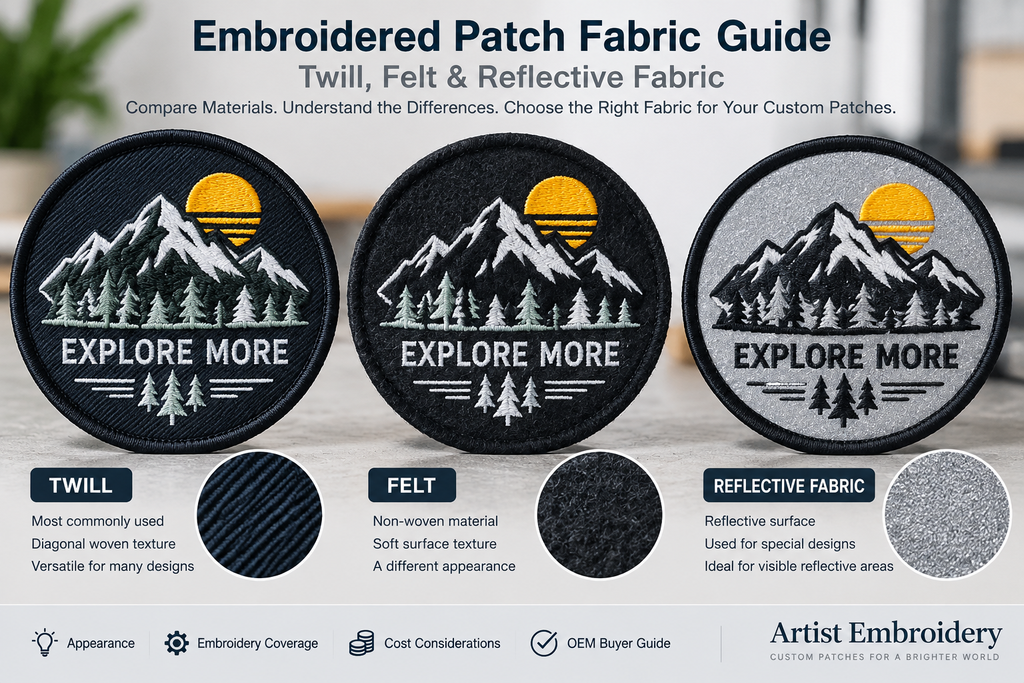
At Artist Embroidery, the three main base fabric options used for custom embroidered patches are twill, felt, and reflective fabric. Among these, twill is the most commonly used fabric for embroidered patches because it works well with a wide range of designs and applications. Its recognizable diagonal woven texture provides a clean base for embroidery and is especially useful when a design uses partial embroidery coverage, allowing the exposed fabric to contribute to the background color and overall appearance of the patch.
Felt offers a distinctly different surface and visual character from twill, making it suitable when the texture of the base material is intended to become part of the patch design. Reflective fabric, on the other hand, is selected when a reflective visual effect is required. Instead of treating these three materials as interchangeable options, OEM buyers should consider how each fabric interacts with the artwork, embroidery coverage, color arrangement, application, and overall design requirements.
Fabric selection also becomes particularly important when comparing 50%, 75%, and 100% embroidery coverage. With lower embroidery coverage, more of the base fabric remains visible, so its color and texture can have a greater influence on the finished patch. As embroidery coverage increases, more of the surface is covered by thread, changing the visual role of the underlying fabric. This relationship can also affect stitch count, production specifications, and ultimately the cost of custom embroidered patches.
For OEM buyers, understanding the differences between twill, felt, and reflective fabric makes it easier to communicate specifications clearly with an embroidery manufacturer and avoid choosing materials based only on appearance. This guide explains how each embroidered patch material is used, why twill remains the most common choice, how fabric works together with embroidery coverage, and what buyers should consider when selecting the right base fabric for their custom patches.
Why Does Fabric Matter for Embroidered Patches?
The base fabric is one of the fundamental components of an embroidered patch. Although embroidery threads create the logo, lettering, patterns, and other visible details, the embroidered patch fabric underneath provides the surface on which the design is stitched. Depending on the embroidery coverage, the fabric may remain clearly visible and become part of the finished appearance. For this reason, choosing the right fabric should be considered together with the artwork, embroidery coverage, colors, intended application, and other patch specifications.
At Artist Embroidery, the main fabric options used for custom embroidered patches are twill, felt, and reflective fabric. Twill is the most commonly used option for general embroidered patches, while felt and reflective fabric provide different appearances or functions for specific requirements. Understanding these differences helps OEM buyers communicate their expectations more accurately before sampling or mass production.
Fabric Affects the Appearance of a Patch
The most immediate difference between patch fabrics is their surface appearance. When part of the base material remains exposed, its color and texture become visible elements of the design. This is especially important for patches with lower embroidery coverage, where the fabric may form a large portion of the background.
Twill fabric has a recognizable diagonal woven texture that gives embroidered patches a clean and structured appearance. Because twill is commonly used as a visible background, manufacturers can often use the fabric color itself as part of the design instead of covering the entire surface with embroidery thread.
Felt has a different surface texture and creates a noticeably different visual effect from twill. It can therefore be selected when the material itself contributes to the desired appearance of the patch.
Reflective fabric serves another purpose. Its reflective surface can remain exposed within selected areas of a design, allowing those portions to produce a reflective visual effect when illuminated. In this case, the base fabric is not merely hidden underneath the embroidery—it becomes a functional and visible part of the patch.
For buyers, this means that two patches using the same embroidery artwork may still look different when produced on different base fabrics.
Fabric and Embroidery Coverage Work Together
Fabric selection becomes even more important when considering embroidery coverage. Coverage refers to how much of the patch surface is covered by embroidery stitches rather than exposed base fabric.
With approximately 50% embroidery coverage, a substantial portion of the base fabric remains visible. Its color and surface therefore have a strong influence on the finished appearance. A carefully selected fabric color can become the background of the design without requiring that entire area to be filled with embroidery stitches.
At approximately 75% coverage, embroidery becomes more dominant while some fabric remains visible. Both the thread and fabric contribute to the appearance, so coordinating the fabric color with the embroidered areas is still important.
With 100% embroidery coverage, most or nearly all of the visible patch surface is covered with thread. The visual importance of the underlying fabric is therefore reduced compared with lower-coverage designs.
This relationship is one reason buyers should avoid selecting fabric and embroidery coverage independently. They are interconnected specifications. In some designs, leaving an appropriate area of twill exposed can achieve the intended background while avoiding unnecessary stitches. In other designs, extensive embroidery may be necessary to achieve the required appearance.
Different Applications Require Different Fabrics
There is no single embroidered patch material that is automatically the best choice for every project. The appropriate fabric depends on what the buyer wants the finished patch to look like and how the material is intended to function within the design.
For most standard OEM embroidered patch projects, twill is the most commonly used base fabric. It works well across a wide variety of patch designs and is particularly useful when portions of the base fabric are intended to remain visible.
Felt may be chosen when its distinctive surface appearance better matches the desired design. Reflective fabric is more specialized and is generally considered when reflective areas are part of the product requirement. This makes it relevant to certain visibility-oriented applications where the reflective material needs to remain exposed rather than being completely covered by embroidery.
OEM buyers should therefore begin with the intended appearance and application rather than choosing a fabric simply because it sounds more premium or specialized. A standard twill base may be the most appropriate solution for many designs, while felt or reflective fabric can be selected when their particular characteristics are actually needed.
📊 Table: How Base Fabric Affects an Embroidered Patch
| Factor | Why It Matters |
|---|---|
| Fabric Type | Twill, felt, and reflective fabric provide different surface characteristics |
| Fabric Color | Exposed fabric can become part of the patch background |
| Embroidery Coverage | Lower coverage makes the base fabric more visible |
| Texture | The fabric surface influences the overall visual character of the patch |
| Design | Artwork should account for which areas will remain embroidered or exposed |
| Application | Specialty requirements may make felt or reflective fabric more appropriate than standard twill |
| Cost | Fabric choice and embroidery coverage can both influence production specifications and pricing |
💡 Buyer Tip: Choose the base fabric together with the embroidery coverage. If a large portion of the fabric will remain visible, its color and surface become an important part of the finished design.
📖 Extended Reading
- Embroidery Coverage: 50% vs 75% vs 100%
- Embroidered Patch Quality: What Buyers Should Check Before Ordering
- Embroidered Patch Size Guide
Twill: The Most Common Fabric for Embroidered Patches
Among the different types of embroidered patch fabric, twill is the most commonly used base fabric for custom embroidered patches. Its distinctive woven surface, versatility, and ability to work effectively with different embroidery coverage levels make it a practical choice for a wide range of OEM patch projects. From company logos and uniform patches to military, police, scout, sports, and promotional applications, twill provides a reliable foundation for many conventional embroidered patch designs.
One of the most important advantages of twill is that the fabric itself can become part of the finished design. When a patch uses partial embroidery coverage, selected areas of twill can remain exposed instead of being completely covered with stitches. The fabric color can therefore function as the background color of the patch. For OEM buyers, this makes the relationship between twill fabric, artwork, and embroidery coverage particularly important when developing production specifications.
What Is Twill Fabric?
Twill is a woven fabric characterized by its recognizable diagonal pattern on the surface. This subtle diagonal texture distinguishes it visually from felt and gives the base of an embroidered patch a clean, consistent appearance.
When used as a patch base fabric, twill provides the surface onto which embroidery threads are stitched. Depending on the artwork and embroidery coverage, the twill may either remain visible in selected areas or become largely covered by embroidery.
For example, consider a patch with a dark background and a lighter embroidered logo. Instead of filling the entire background with dark embroidery thread, a suitable dark-colored twill can sometimes be used as the visible background while embroidery is concentrated on the logo, lettering, border, and other required elements. In this type of design, the fabric is not simply a hidden structural layer—it becomes an intentional part of the finished patch.
The diagonal texture also provides buyers with an easy visual clue when examining areas without embroidery. If a substantial portion of the base remains exposed and a fine diagonal weave is visible, that surface characteristic is typical of twill.
Why Is Twill Commonly Used for Embroidered Patches?
Twill is widely used because it works well with many conventional embroidered patch designs. Rather than requiring a specialty material for every project, manufacturers can use twill as a practical base for a broad range of shapes, sizes, colors, embroidery coverage levels, and applications.
Another important advantage is its compatibility with partial embroidery coverage. Many custom patches do not need every square millimeter of the surface to be covered with thread. When the background can be represented effectively by the color of the twill, exposed fabric can become part of the artwork itself.
This can be especially useful for designs with approximately 50% or 75% embroidery coverage, because a meaningful portion of the base fabric remains visible. Instead of automatically increasing embroidery coverage simply to create a solid background, the buyer and manufacturer can evaluate whether the twill color can achieve the intended appearance.
However, this does not mean lower embroidery coverage is always preferable. Some artwork requires extensive thread coverage to create specific colors, textures, details, or visual effects. The appropriate solution depends on the artwork rather than a fixed rule.
For OEM buyers, this flexibility is one of the main reasons twill remains such an important embroidered patch material.
How Twill Works with Different Embroidery Coverage
The appearance of twill changes significantly depending on how much of the patch is covered by embroidery.
With 50% embroidery coverage, approximately half of the patch surface may remain as visible base fabric. In this situation, the twill color becomes a major design element. Choosing the correct fabric color is therefore especially important because it can influence the overall appearance almost as much as the embroidery thread itself.
At approximately 75% embroidery coverage, the embroidered areas become more dominant, but exposed twill can still contribute to the background and negative spaces within the artwork. This combination can provide a balance between visible fabric and embroidered detail.
At 100% embroidery coverage, the visible surface is almost entirely covered by thread. The twill underneath still serves as the base fabric, but its color and diagonal texture are much less visible in the finished design.
For this reason, buyers comparing different embroidery coverage options should also consider whether they want the twill fabric to remain visible. Coverage should not be treated only as a percentage or pricing specification—it directly changes how much of the fabric participates in the final appearance of the patch.
When Should Buyers Choose Twill?
For many standard custom embroidered patch projects, twill should be one of the first fabrics buyers consider. It is particularly suitable when the design uses a conventional embroidered appearance and does not require the special surface character of felt or the reflective effect of reflective fabric.
Twill is also a strong option when the artwork contains larger background areas that do not necessarily need to be filled completely with embroidery. If an available twill color matches the intended background closely enough, the exposed fabric can be incorporated directly into the design.
Typical applications can include company logo patches, uniform patches, military and police patches, scout patches, sports patches, promotional patches, and other OEM embroidered emblems. However, fabric selection should still be based on the individual artwork and product requirements rather than application category alone.
When submitting an inquiry, OEM buyers can provide the artwork, required patch size, intended application, preferred colors, embroidery coverage, border type, backing, and order quantity. The manufacturer can then evaluate whether twill is appropriate and how the exposed fabric should interact with the embroidered areas.
📊 Table: Advantages of Twill for Embroidered Patches
| Feature | Benefit for OEM Patch Production |
|---|---|
| Diagonal Woven Surface | Provides the recognizable texture of twill in exposed areas |
| Versatile Application | Suitable for many standard embroidered patch designs |
| Works with Partial Coverage | Visible twill can become part of the patch background |
| Multiple Fabric Colors | Allows the base color to coordinate with the artwork |
| Compatible with Different Coverage Levels | Can be used with 50%, 75%, 100%, or other embroidery coverage specifications |
| General-Purpose Material | A practical starting point for many OEM patch projects |
| Design Flexibility | Exposed fabric and embroidered areas can be combined within one design |
💡 Buyer Tip: If your patch has a large single-color background, ask whether the twill itself can be used as that background before specifying 100% embroidery. Depending on the artwork, this can avoid adding stitches that are not necessary to achieve the intended appearance.
📖 Extended Reading
- Embroidery Coverage: 50% vs 75% vs 100%
- Custom Embroidered Patches Cost: What Affects the Price?
- Embroidered Patch Quality: What Buyers Should Check Before Ordering
Felt Fabric for Embroidered Patches
While twill is the most commonly used embroidered patch fabric, felt provides a distinctly different surface appearance and is another material option for custom embroidered patches. Unlike twill, which has a recognizable diagonal woven pattern, felt has a more uniform, soft-looking surface without the same visible woven texture. This difference can significantly change the overall character of a patch, particularly when portions of the base fabric remain exposed.
For OEM buyers, choosing between twill and felt is therefore not simply a matter of selecting two interchangeable fabrics. The decision should consider the desired appearance of the finished patch, how much base fabric will remain visible, the artwork style, and the intended application. When the material itself is an important visual element of the design, felt can provide an alternative appearance that cannot be achieved simply by changing the color of standard twill.
What Is Felt Fabric?
Felt is a non-woven material, meaning that its fibers are bonded together rather than being constructed with the clearly visible woven structure found in twill. As a result, felt has a relatively uniform surface and does not display the diagonal weave pattern associated with twill fabric.
When felt is used as an embroidered patch material, embroidery is stitched onto the felt base while selected areas may remain exposed according to the artwork and embroidery coverage. These exposed areas allow the characteristic felt surface to become part of the finished patch.
This visual difference becomes especially noticeable in designs with lower embroidery coverage. If much of the background remains unembroidered, changing from twill to felt can alter the appearance even when the embroidery artwork and thread colors remain the same.
For this reason, felt should not simply be considered another background color option. It is better understood as a different base material that can contribute its own visual character to the patch.
How Does Felt Look Different from Twill?
The easiest way to understand the difference between felt and twill for embroidered patches is to compare their exposed surfaces.
Twill has a visible diagonal woven texture. When used with partial embroidery coverage, these fine diagonal lines remain visible in the background and contribute to the familiar appearance of many conventional embroidered patches.
Felt does not have this same diagonal weave. Instead, its surface appears more uniform and fiber-based. This gives felt patches a noticeably different material character, particularly when large areas of the base remain visible.
The difference becomes less visually prominent as embroidery coverage increases. For example, with a lower-coverage design, the buyer may immediately notice whether the exposed background is twill or felt. With 100% embroidery coverage, most of the visible surface is covered by thread, so the visual distinction between the underlying fabrics becomes less obvious from the front.
This is another reason fabric selection should be considered together with embroidery coverage. If the artwork is designed to leave a substantial amount of base material exposed, the choice between twill and felt can have a major impact on the finished appearance.
When Should Buyers Choose Felt?
Felt can be considered when the buyer specifically wants its surface appearance to become part of the patch design. Rather than selecting felt simply because it is an available alternative, buyers should first determine whether its texture supports the intended visual style.
For example, a design with large exposed background areas will display the characteristics of felt much more clearly than a fully embroidered design. In this situation, the material selection becomes an intentional part of the artwork rather than just a production specification.
By contrast, for many conventional OEM embroidered patches, twill remains the more commonly used choice. If the design does not require the particular visual character of felt, there may be no need to move away from standard twill.
OEM buyers should therefore consider three questions: How much of the base fabric will remain visible? What surface appearance is desired? Does the artwork benefit from the characteristics of felt? These questions are more useful than assuming that one fabric is universally better than the other.
📊 Table: Twill vs Felt for Embroidered Patches
| Factor | Twill | Felt |
|---|---|---|
| Fabric Structure | Woven | Non-woven |
| Surface Appearance | Visible diagonal weave | Uniform, fiber-based surface |
| Typical Role | General-purpose patch base | Alternative visual/material option |
| Common Use at Artist Embroidery | Most commonly used | Used for selected designs |
| Effect with Low Embroidery Coverage | Twill texture remains clearly visible | Felt surface becomes clearly visible |
| Effect with High Embroidery Coverage | Fabric becomes less visible | Fabric becomes less visible |
| Best Selection Approach | Suitable for many standard patch designs | Choose when the felt appearance supports the design |
💡 Buyer Tip: If you are deciding between twill and felt, compare the materials based on the areas that will remain unembroidered. The more exposed fabric your design contains, the more noticeable the difference between the two materials will be.
📖 Extended Reading
- Embroidery Coverage: 50% vs 75% vs 100%
- Embroidered Patch Quality: What Buyers Should Check Before Ordering
- Custom Embroidered Patches Cost: What Affects the Price?
Reflective Fabric for Embroidered Patches
Reflective fabric is the most specialized option among the three main embroidered patch fabrics used by Artist Embroidery. Unlike twill and felt, which are primarily selected for their surface appearance and role as a base for embroidery, reflective fabric can provide an additional visual effect when exposed to light. This makes reflective embroidered patches useful for designs in which selected areas of the patch are intended to stand out under certain lighting conditions.
The key to using reflective fabric effectively is understanding that the reflective surface must remain visible where the effect is required. If the material is completely covered with embroidery thread, the embroidery will hide the reflective area underneath. For this reason, the relationship between artwork, embroidery coverage, and fabric exposure is particularly important when developing a reflective embroidered patch.
For OEM buyers, reflective fabric should therefore be considered a design and functional material choice, rather than simply another alternative to standard twill.
What Is Reflective Fabric?
Reflective fabric is a material designed to reflect incident light back toward its source, making exposed areas appear noticeably brighter under suitable lighting conditions. When incorporated into an embroidered patch, the reflective material can serve as both the base fabric and a visible part of the finished design.
This is fundamentally different from creating a reflective-looking area using ordinary embroidery thread. Standard embroidery creates color and texture through stitches, whereas reflective fabric relies on the properties of the exposed material to produce its characteristic visual effect.
For example, an embroidered design may use thread for a logo, lettering, symbols, or borders while leaving selected sections of reflective fabric uncovered. When light reaches those exposed areas, the reflective material becomes more visually prominent.
This also means the artwork must be planned with the material in mind. The manufacturer needs to know which areas should be embroidered and which areas should remain exposed before production specifications are finalized.
How Does Embroidery Work with Reflective Fabric?
When embroidery is applied to reflective fabric, the stitches physically cover portions of the reflective surface. The more embroidery coverage a design contains, the less reflective fabric remains exposed.
For this reason, increasing embroidery coverage does not automatically make a reflective patch better. If the objective is to preserve a noticeable reflective area, covering that area with additional stitches would work against the intended design.
A well-planned reflective embroidered patch therefore uses embroidery and exposed reflective material as two separate visual elements. Embroidery can define logos, text, outlines, or decorative details, while the uncovered fabric provides the reflective effect.
This relationship is similar to using twill as a visible background in a partially embroidered patch, but the purpose is different. Exposed twill contributes color and woven texture, while exposed reflective fabric contributes a light-responsive visual effect.
OEM buyers should clearly indicate the desired reflective areas when submitting artwork. This allows the embroidery manufacturer to evaluate how the embroidery should be positioned in relation to the exposed material.
When Should Buyers Choose Reflective Fabric?
Reflective fabric should be considered when visibility under directed light is an intentional part of the patch design. If the project only requires a conventional embroidered appearance, standard twill will generally remain the more common choice.
Reflective fabric can be useful when a buyer wants selected background areas, lettering surrounds, symbols, or other design elements to respond visually when illuminated. The exact arrangement depends on the artwork and how much reflective surface needs to remain exposed.
Because reflective fabric is a specialty material, buyers should communicate this requirement early in the development process rather than treating it as a last-minute material substitution. Changing a design from twill to reflective fabric may require reconsidering which areas are embroidered and which areas remain uncovered.
It is also important to distinguish a general reflective embroidered patch from a product certified to meet a particular safety or visibility standard. If a project requires a specific reflective performance, industrial standard, certification, or test requirement, those specifications should be communicated separately and confirmed before production.
Common Applications for Reflective Embroidered Patches
Reflective embroidered patches can be considered for applications where the reflective effect adds practical or visual value. Examples may include workwear, security uniforms, outdoor equipment, motorcycle-related apparel, bags, team gear, and selected uniform applications.
However, the intended industry alone should not determine whether reflective fabric is necessary. A police, security, outdoor, or workwear patch does not automatically require reflective material. The decision should depend on the buyer’s actual design and product specifications.
For branding applications, reflective fabric can also be used as a visual feature rather than solely for visibility-related purposes. A brand may intentionally incorporate exposed reflective areas into a logo or decorative patch to create a different appearance under changing lighting conditions.
For OEM production, the most important information is therefore not simply “use reflective fabric,” but where the reflective material should remain visible, how much embroidery should cover it, and what effect the buyer expects from the finished patch.
📊 Table: Common Applications for Reflective Embroidered Patches
| Application | Potential Role of Reflective Fabric |
|---|---|
| Workwear | Adds exposed reflective areas to selected patch designs |
| Security Uniforms | Can provide a more visible visual element when specified |
| Outdoor Gear | Adds a light-responsive feature to patches on apparel or equipment |
| Motorcycle Apparel | Can incorporate reflective sections into logos or emblems |
| Bags & Accessories | Adds reflective details as part of the design |
| Team & Event Gear | Can create a distinctive appearance under directed light |
| Brand Patches | Provides a specialty visual effect beyond standard twill or felt |
💡 Buyer Tip: If your design requires a reflective effect, identify the exact areas that should remain reflective before sampling. Embroidery thread placed over those areas will cover the reflective fabric and reduce the amount of exposed reflective surface.
📖 Extended Reading
- Police Embroidered Patches OEM Guide
- Embroidery Coverage: 50% vs 75% vs 100%
- Embroidered Patch Quality: What Buyers Should Check Before Ordering
Twill vs Felt vs Reflective Fabric: What Is the Difference?
When choosing an embroidered patch fabric, OEM buyers may need to decide between twill, felt, and reflective fabric. Although all three can serve as base materials for embroidered patches, they are not simply interchangeable options. Each fabric creates a different surface appearance, and reflective fabric can also provide a distinctive light-responsive effect when selected areas remain exposed.
For most conventional embroidered patch projects, twill is the most commonly used choice at Artist Embroidery. Felt is selected when its different surface character better matches the intended design, while reflective fabric is used when exposed reflective areas are specifically required. The best choice therefore depends on the artwork, embroidery coverage, desired appearance, and intended application rather than assuming that one material is universally superior.
Appearance and Texture
The most obvious difference between the three fabrics is their surface.
Twill can be recognized by its diagonal woven texture. This texture remains visible wherever the patch is not covered by embroidery and contributes to the familiar appearance of many traditional embroidered patches. Because of this, twill works particularly well when the fabric itself is intended to form part of a solid-color background.
Felt has a more uniform, fiber-based surface without the diagonal woven pattern of twill. When felt remains exposed, the patch therefore develops a noticeably different material character. This difference is particularly easy to see in designs with lower embroidery coverage.
Reflective fabric is visually different from both. Its exposed surface is intended to react to directed light, creating a reflective visual effect. The reflective area therefore needs to remain uncovered if that effect is part of the design.
The amount of visible fabric matters. At lower embroidery coverage, the differences between twill, felt, and reflective fabric are much more noticeable. As more of the patch becomes covered by embroidery thread, the visible influence of the underlying material decreases.
Embroidery Compatibility
All three fabrics can be incorporated into embroidered patch production, but they should not necessarily be used in the same way.
Twill is highly practical for standard embroidered designs because it can work with both partial and high embroidery coverage. When the selected twill color matches the intended background, parts of the fabric can remain exposed while embroidery is concentrated on logos, lettering, borders, and other details.
Felt can also remain exposed as part of the artwork, but the reason for choosing it is usually its different surface appearance. Buyers considering felt should therefore evaluate whether that visible material character supports the desired patch style.
With reflective fabric, exposure is especially important. Embroidery placed over the fabric physically covers the reflective surface. If a buyer wants a particular area to remain reflective, that section should generally be planned as an exposed fabric area rather than filled with ordinary embroidery stitches.
This is why the artwork and embroidery coverage should be evaluated before finalizing the fabric selection.
Typical Applications
Twill embroidered patches can be used across a broad range of OEM applications, including company logos, uniforms, military and police patches, scout patches, sports patches, promotional patches, and branded apparel. Its versatility is one of the main reasons it remains the most frequently used base fabric.
Felt embroidered patches are better considered when the buyer specifically wants the appearance of felt to contribute to the design. The material can provide a different visual character from conventional twill, particularly when larger areas remain unembroidered.
Reflective embroidered patches are more specialized. They may be considered for selected workwear, security, outdoor, motorcycle, bag, uniform, or branding applications where reflective areas are intentionally incorporated into the design.
These examples should be treated as application possibilities rather than strict rules. A particular industry does not automatically require a specific fabric. The final decision should always be based on the actual artwork and product requirements.
How to Choose Between the Three Fabrics
For many buyers, the simplest starting point is to ask whether the patch requires a special material characteristic.
If the answer is no and the goal is a conventional embroidered patch, twill is generally the first option to consider. It is the most commonly used fabric at Artist Embroidery and works with a wide range of standard patch designs.
If the buyer wants a distinctly different exposed surface, felt can be evaluated. If the design requires visible reflective areas, reflective fabric becomes the relevant option.
The next question is embroidery coverage. A 50% embroidered design leaves much more fabric visible than a 100% embroidered design, making the base material significantly more important to the finished appearance. Buyers should therefore evaluate fabric type + fabric color + embroidery coverage together.
Rather than choosing the material from a list without considering the artwork, OEM buyers can submit their design and intended application to the manufacturer for evaluation. This makes it easier to determine whether standard twill is sufficient or whether felt or reflective fabric provides a meaningful benefit to the project.
📊 Table: Twill vs Felt vs Reflective Fabric for Embroidered Patches
| Factor | Twill | Felt | Reflective Fabric |
|---|---|---|---|
| Surface | Diagonal woven texture | Uniform, fiber-based texture | Reflective surface |
| Material Structure | Woven | Non-woven | Specialty reflective material |
| Main Purpose | General embroidered patch base | Alternative surface appearance | Reflective visual effect |
| Use at Artist Embroidery | Most commonly used | Selected designs | Specialty applications |
| Works with Exposed Fabric Areas | Yes | Yes | Yes — required where reflection is desired |
| Effect of Higher Embroidery Coverage | Less twill remains visible | Less felt remains visible | Less reflective surface remains exposed |
| Suitable for General OEM Patches | Excellent starting choice | Depends on desired appearance | Usually requirement-specific |
| Key Selection Factor | Versatility and design | Surface character | Reflective effect |
| Recommended When | No specialty material is required | Felt appearance supports the artwork | Reflection is intentionally part of the design |
💡 Buyer Tip: For a standard embroidered patch without a special material requirement, start by considering twill. Choose felt because you specifically want its surface appearance, and choose reflective fabric when exposed reflective areas are an intentional part of the product design.
📖 Extended Reading
- Embroidery Coverage: 50% vs 75% vs 100%
- Embroidered Patch Quality: What Buyers Should Check Before Ordering
- OEM Embroidered Patch Manufacturer: Complete Buyer Guide
How Does Fabric Affect Embroidery Coverage?
The relationship between embroidered patch fabric and embroidery coverage is one of the most important factors buyers should understand when developing a custom patch. Embroidery coverage describes how much of the visible patch surface is covered by embroidery thread. As coverage increases, more of the base fabric is hidden; as coverage decreases, more of the fabric remains visible and becomes part of the finished design.
This means fabric selection and embroidery coverage should not be treated as two unrelated specifications. A patch using 50% embroidery coverage may depend heavily on the color and texture of the base fabric, while a 100% embroidered patch relies primarily on thread to create the visible surface. The same artwork can therefore look noticeably different depending on how much fabric remains exposed.
This relationship is especially important with twill, the most commonly used base fabric at Artist Embroidery, because exposed twill can often serve directly as a background area. Felt can be used in a similar way when its characteristic surface is desired, while reflective fabric must remain exposed in the areas where the reflective effect is intended to remain visible.
50% Embroidery Coverage Leaves More Fabric Visible
With approximately 50% embroidery coverage, a significant portion of the patch surface remains unembroidered. As a result, the base fabric becomes a major visual element of the finished patch.
For a twill patch, the exposed areas show both the selected fabric color and the characteristic diagonal woven texture. If the artwork contains a large single-color background, a matching twill color may be used directly as part of the design rather than covering the entire background with embroidery thread.
This is why fabric color selection becomes especially important at lower coverage levels. If the fabric color does not coordinate well with the thread colors or artwork, the difference will be clearly visible.
The same principle applies to felt. With a large exposed area, its surface character becomes much more noticeable. For reflective fabric, leaving selected areas unembroidered is even more important because those exposed sections are what provide the reflective visual effect.
Therefore, when choosing approximately 50% coverage, buyers should pay close attention not only to the embroidery itself but also to what the exposed fabric will look like in the finished product.
75% Coverage Balances Fabric and Embroidery
At approximately 75% embroidery coverage, embroidery becomes the dominant visual element while some base fabric remains exposed. This creates a balance between stitched areas and visible material.
For twill patches, the exposed fabric can still serve as a background or negative-space element within the artwork. However, because more of the surface is embroidered than with a 50% coverage design, thread colors and stitch details become more visually prominent.
This level of coverage can be useful when a design requires substantial embroidered detail but does not need every background area to be filled with stitches. Instead of automatically moving to 100% coverage, buyers can evaluate whether the exposed base fabric can effectively represent certain areas of the artwork.
The decision should still be design-driven. 75% coverage is not automatically better than 50% or 100%. Each level produces a different relationship between fabric and embroidery, so the correct choice depends on the visual result the buyer wants to achieve.
100% Coverage Covers Most of the Base Fabric
With 100% embroidery coverage, the visible face of the patch is almost entirely covered with embroidery thread. As a result, the color and surface texture of the underlying fabric have much less influence on the appearance from the front.
This allows embroidery thread to create nearly the entire visible surface, including the background, lettering, logos, and other design elements. It can produce a highly embroidered appearance, but it also requires more stitches than a comparable design that uses exposed fabric as part of the background.
For this reason, buyers should not assume that 100% embroidery automatically means a better-quality patch. Embroidery coverage describes how much of the surface is stitched; it is not, by itself, a quality grade. A well-designed 50% or 75% embroidered patch can be entirely appropriate when exposed twill, felt, or another selected material is intentionally incorporated into the artwork.
For reflective fabric in particular, completely covering the material would also reduce or eliminate the visible reflective areas. The intended material effect should therefore be considered before specifying full embroidery coverage.
Can Fabric Color Reduce Unnecessary Embroidery?
In some designs, yes. The color of the patch base fabric can sometimes be used as part of the artwork instead of reproducing the same background area with embroidery thread.
For example, if a patch requires a large black background and an appropriate black twill is available, the manufacturer may be able to leave portions of the black fabric exposed while embroidering the logo, text, border, and other necessary details. This approach allows the material itself to provide the background color.
However, this does not mean fabric should always replace background embroidery. Some designs require embroidered backgrounds because of their intended appearance, color requirements, texture, or other production considerations. The manufacturer must evaluate the actual artwork before determining whether exposed fabric is appropriate.
Using the fabric intelligently can also affect stitch count and production cost. When a large area does not need to be filled with embroidery, fewer stitches may be required than in a fully embroidered version of the same design. This is one reason embroidery coverage is one of several factors that can influence the price of custom embroidered patches.
For OEM buyers, the goal should not simply be to maximize or minimize embroidery coverage. The better approach is to determine how much embroidery is actually required to reproduce the design effectively, while allowing the selected fabric to contribute where appropriate.
📊 Table: Fabric Visibility at 50%, 75% and 100% Embroidery Coverage
| Embroidery Coverage | Base Fabric Visibility | Role of Fabric | Typical Design Consideration |
|---|---|---|---|
| 50% | High | Major part of the visible background | Fabric color and texture are especially important |
| 75% | Moderate | Supports embroidered areas and negative space | Balance fabric exposure with embroidered detail |
| 100% | Very Low | Primarily serves as the underlying base | Thread creates almost the entire visible surface |
| Reflective Areas | Must remain exposed where reflection is required | Provides the reflective effect | Avoid covering intended reflective areas with embroidery |
💡 Buyer Tip: Do not select 100% embroidery simply because it sounds more premium. If the base fabric can effectively form part of the background, partial embroidery coverage may reproduce the design just as effectively while avoiding unnecessary stitches.
📖 Extended Reading
- Embroidery Coverage: 50% vs 75% vs 100%
- Custom Embroidered Patches Cost: What Affects the Price?
- High-Density Embroidery & Stitch Count
Does Embroidered Patch Fabric Affect Cost?
Yes, the choice of embroidered patch fabric can affect the price of a custom patch, but fabric is only one part of the overall cost calculation. OEM patch pricing is usually determined by a combination of specifications, including patch size, embroidery coverage, stitch count, number of thread colors, fabric type, border, backing, order quantity, and any special production requirements.
For this reason, buyers should avoid comparing prices based only on whether a patch uses twill, felt, or reflective fabric. Two patches made from the same base fabric can still have very different production costs if one is larger, uses higher embroidery coverage, contains more thread colors, requires a different border or backing, or is ordered in a much smaller quantity.
The most effective approach is to evaluate the complete patch specification. Fabric selection should support the artwork and intended application first, while the manufacturer evaluates how that material interacts with the other production factors that determine the final quotation.
Standard vs Specialty Fabric
The type of base fabric can influence material cost and production requirements. Twill is the most commonly used embroidered patch fabric at Artist Embroidery and serves as the standard starting point for many conventional OEM patch projects.
Felt is selected for designs where its different surface appearance is desired. Reflective fabric is a more specialized material because its exposed surface is intended to provide a reflective visual effect. Depending on the material specification and design, using a specialty fabric may result in different production costs compared with a conventional twill patch.
However, buyers should not assume that changing one material automatically produces a fixed percentage increase or decrease in price. The actual cost difference depends on the complete specification and the amount of material required.
For example, a small reflective patch with limited embroidery may have very different production requirements from a large twill patch with dense embroidery, numerous colors, and additional backing requirements. Comparing only the base fabric would therefore provide an incomplete picture of the actual manufacturing cost.
Fabric and Embroidery Coverage Affect Cost Together
The interaction between fabric and embroidery coverage can have a significant effect on production cost because coverage influences how many stitches are needed to create the visible surface.
Consider a design with a large single-color background. If a suitable twill color can remain exposed and form that background, the manufacturer may not need to cover the entire area with embroidery thread. This can reduce unnecessary stitching compared with producing the same background as a fully embroidered area.
As embroidery coverage increases from approximately 50% to 75% and toward 100%, more of the patch surface is filled with thread. Depending on the design, this generally increases stitch count and machine embroidery time, which can influence the final unit price.
In commercial embroidery production, embroidery coverage and stitch count also influence machine running time. Professional multi-head embroidery systems, such as industrial embroidery machines developed by Tajima Group, are designed for high-volume embroidery production, but the number of stitches required for each design still remains an important production consideration.
This does not mean that buyers should always choose lower embroidery coverage simply to reduce cost. The correct coverage should first reproduce the desired appearance. If a design genuinely requires a fully embroidered background, reducing the coverage only to achieve a lower price may compromise the intended result.
The goal is therefore to use the appropriate amount of embroidery for the artwork, rather than automatically requesting the highest possible coverage.
Stitch Count, Thread Colors and Other Cost Factors
Fabric and embroidery coverage are only two parts of the quotation. Stitch count is another important production factor because it directly relates to the amount of embroidery required and the machine time involved.
The number of thread colors also affects production cost. More colors generally require additional thread changes and production handling, so a patch using more thread colors will typically cost more than a comparable design using fewer colors. Professional embroidery thread suppliers such as FuFu’s Thread offer extensive color selections for machine embroidery, giving manufacturers a wide range of options when matching colors for custom embroidered patches. Buyers should still consider whether every color in the artwork is necessary, particularly when preparing complex logos or detailed designs for embroidery.
Patch size is another major factor. A larger patch generally requires more fabric and may require substantially more embroidery than a smaller version of the same design. Border type and backing options can also affect the quotation, as can special materials or production requirements.
Order quantity is particularly important in OEM manufacturing because setup and production costs are distributed across the number of pieces ordered. This is why the unit price for 100 pieces may differ from the unit price for 500, 1,000, or several thousand pieces.
Ultimately, a reliable quotation should be based on the complete production specification, not on one isolated feature such as fabric type.
📊 Table: Factors That Affect Embroidered Patch Cost
| Cost Factor | How It Can Affect Pricing |
|---|---|
| Patch Size | Larger patches generally require more material and embroidery |
| Fabric Type | Twill, felt, and reflective fabric may have different material and production requirements |
| Embroidery Coverage | Higher coverage generally requires more stitching |
| Stitch Count | More stitches increase embroidery machine time |
| Thread Colors | More colors generally increase production cost |
| Border Type | Different border constructions require different production processes |
| Backing | Backing selection adds different materials and processing steps |
| Order Quantity | Higher quantities can distribute setup costs across more pieces |
| Special Requirements | Specialty materials or specifications may add additional production requirements |
💡 Buyer Tip: When requesting a quotation, send the artwork together with the patch size, quantity, preferred fabric, embroidery coverage, thread colors, border, and backing requirements. Complete specifications allow the manufacturer to provide a more accurate OEM quotation and reduce unnecessary revisions later.
📖 Extended Reading
- Custom Embroidered Patches Cost: What Affects the Price?
- Custom Embroidered Patches MOQ: What Buyers Need to Know
- Embroidery Coverage: 50% vs 75% vs 100%
How Should OEM Buyers Choose Embroidered Patch Fabric?
Choosing the right embroidered patch fabric becomes much easier when buyers start with the actual product requirements instead of selecting a material based only on its name or appearance. For most conventional custom embroidered patches, twill is the most commonly used base fabric at Artist Embroidery, while felt and reflective fabric are selected when the design requires their particular surface characteristics or visual effects.
OEM buyers should consider the intended application, artwork, amount of exposed fabric, embroidery coverage, fabric color, and any specialty requirements together. A fabric that works well for one patch may not provide the same result for another design.
The following four-step process can help buyers determine whether twill, felt, or reflective fabric is the appropriate starting point for a custom embroidered patch project.
Step 1: Determine the Patch Application
Begin by identifying where and how the finished patch will be used. A standard company logo patch, uniform patch, scout patch, sports patch, promotional patch, or branded apparel patch may not require a specialty base material. In these cases, twill is often the first fabric worth considering.
However, the application may sometimes indicate a more specific material requirement. A design that intentionally depends on the visual character of felt may benefit from a felt base. A patch intended to incorporate visible reflective sections requires reflective fabric in the areas where that effect is desired.
Application should be treated as the starting point rather than an automatic material rule. For example, an outdoor or security patch does not necessarily need reflective fabric simply because of its industry. Reflective material should be specified when the actual product design requires the reflective effect.
By defining the intended use first, buyers can eliminate unnecessary material options and focus on the fabrics that support the actual product requirement.
Step 2: Decide How Much Fabric Should Remain Visible
Next, consider embroidery coverage and how much of the base fabric will remain visible on the front of the patch.
With approximately 50% embroidery coverage, a large portion of the base fabric can remain exposed. Fabric color and surface texture therefore become important parts of the finished design. Twill may provide both the background color and its recognizable diagonal texture, while felt creates a different surface character.
At approximately 75% coverage, embroidery becomes more dominant, but the remaining exposed fabric can still contribute to backgrounds and negative spaces.
With 100% embroidery coverage, almost the entire visible surface is created by thread. The appearance of the underlying fabric therefore becomes much less noticeable from the front.
Reflective fabric requires additional consideration. If reflection is required in a specific section of the patch, that area must remain sufficiently exposed rather than being covered completely with ordinary embroidery thread.
Determining the intended fabric exposure before production helps the buyer and manufacturer develop a more appropriate embroidery specification.
Step 3: Select Twill, Felt or Reflective Fabric
Once the application and fabric exposure are understood, buyers can compare the three main material options.
Choose twill when the project requires a versatile, conventional embroidered patch base without a specialty material requirement. Twill is the most commonly used option and is especially practical when the fabric color can serve as part of the background.
Choose felt when its non-woven, fiber-based surface is an intentional part of the desired appearance. The difference from twill will be most visible when portions of the material remain exposed.
Choose reflective fabric when the artwork intentionally includes exposed reflective sections. Because embroidery placed over the material hides the reflective surface, the artwork should clearly distinguish between embroidered areas and areas intended to remain reflective.
The objective is not to identify which fabric is universally “best.” Instead, buyers should select the material whose characteristics best support the artwork and intended finished appearance.
Step 4: Confirm the Specification with Your Manufacturer
Before approving production, buyers should provide the manufacturer with as much information as possible. A useful OEM inquiry should include the artwork, finished patch size, order quantity, preferred fabric, embroidery coverage, thread colors, border type, backing, and intended application.
If the buyer is uncertain about the fabric, it is better to provide the artwork and application information rather than selecting a material arbitrarily. An experienced embroidery manufacturer can review the design and determine whether standard twill is suitable or whether another material should be considered.
This step is particularly important for designs involving exposed fabric areas. The buyer and manufacturer should have the same understanding of which areas will be embroidered and which areas will remain as visible base material.
For reflective designs, buyers should also communicate any specific performance, testing, or certification requirements separately. A request for “reflective fabric” alone does not establish compliance with a particular safety standard.
Clear specifications before sampling help reduce misunderstandings, unnecessary revisions, and differences between the expected design and the finished embroidered patch.
📊 Table: Which Embroidered Patch Fabric Should You Choose?
| Your Requirement | Recommended Starting Point | Why |
|---|---|---|
| Standard OEM embroidered patch | Twill | Most commonly used and suitable for many conventional designs |
| Large exposed background area | Twill | Fabric color can become part of the design |
| Distinctive non-woven surface appearance | Felt | Provides a visibly different texture from twill |
| Reflective areas required | Reflective Fabric | Exposed material provides the reflective effect |
| 50% embroidery coverage | Twill / Felt / Reflective* | Fabric remains highly visible, so material selection is important |
| 75% embroidery coverage | Depends on artwork | Both embroidery and exposed fabric contribute to appearance |
| 100% embroidery coverage | Usually based on production requirements | Most of the base fabric is hidden by thread |
| Unsure which material to specify | Ask the manufacturer | Artwork and application can be evaluated before sampling |
*Reflective fabric should be used when a reflective effect is actually required.
💡 Buyer Tip: If you are unsure which embroidered patch fabric to choose, do not delay an inquiry simply because the material has not been finalized. Send your artwork, size, quantity, intended application, and other known specifications to the manufacturer first. The fabric can then be evaluated as part of the complete production requirement.
📖 Extended Reading
- How to Order Custom Embroidered Patches
- OEM Embroidered Patch Manufacturer: Complete Buyer Guide
- Embroidered Patch Quality: What Buyers Should Check Before Ordering
FAQ: About Embroidered Patch Fabric
Choosing an embroidered patch fabric can raise several questions, especially when buyers need to compare twill, felt, and reflective fabric while also considering embroidery coverage, artwork, appearance, and cost. The following frequently asked questions address some of the most common considerations for OEM buyers before sampling or mass production.
Q1. What is the most common fabric for embroidered patches?
Twill is the most commonly used fabric for embroidered patches at Artist Embroidery. Its recognizable diagonal woven texture provides a practical base for a wide variety of conventional custom patch designs.
Twill is especially useful when the patch uses partial embroidery coverage because the exposed fabric can become part of the background. Instead of filling every area with thread, an appropriate twill color may remain visible where the artwork allows.
However, twill is not the only option. Artist Embroidery also uses felt and reflective fabric for designs that require different material characteristics.
Q2. Is twill good for embroidered patches?
Yes. Twill fabric is well suited to embroidered patches and is the standard starting point for many OEM projects. It can be used with different patch sizes, shapes, colors, and embroidery coverage levels.
One of its key advantages is that exposed twill can function as part of the finished design. For example, if a patch has a large black background, black twill may sometimes provide that background without requiring the entire area to be filled with black embroidery.
Whether this approach is appropriate depends on the artwork and the appearance the buyer wants to achieve.
Q3. What is the difference between twill and felt patches?
The primary difference is the surface structure and appearance of the material. Twill is woven and has a recognizable diagonal texture, while felt is non-woven and has a more uniform, fiber-based surface.
This difference becomes especially noticeable when the patch has lower embroidery coverage because more base fabric remains visible.
If a patch is almost completely covered with embroidery thread, the difference between the underlying materials becomes less obvious from the front. Buyers should therefore consider twill versus felt together with the intended embroidery coverage.
Q4. Can you embroider directly onto reflective fabric?
Yes, embroidery can be incorporated with reflective fabric when producing a reflective embroidered patch. However, embroidery thread covers the reflective surface wherever stitches are placed.
Therefore, if a particular section needs to remain reflective, the artwork should leave sufficient reflective material exposed in that area.
The manufacturer and buyer should determine which areas are embroidered and which remain reflective before production.
Q5. What are reflective embroidered patches used for?
Reflective embroidered patches may be considered for selected workwear, security, outdoor, motorcycle, uniform, bag, accessory, team, and branding applications where a reflective visual element is desired.
However, the application alone does not mean reflective fabric is required. Buyers should select it when the reflective effect is an intentional part of the product specification.
If a project requires compliance with a particular safety, visibility, testing, or certification standard, those requirements should be communicated and confirmed separately.
Q6. Does fabric affect embroidery coverage?
Fabric does not determine the embroidery coverage percentage by itself, but fabric selection and embroidery coverage are closely connected.
With approximately 50% coverage, much more of the base fabric remains visible, so its color and surface have a strong influence on the finished patch. At 75%, both fabric and embroidery contribute to the appearance. At 100%, most of the visible surface is created by embroidery thread.
This is why buyers should consider fabric and coverage together instead of treating them as unrelated specifications.
Q7. Does the color of the base fabric matter?
Yes, especially when the design uses partial embroidery coverage.
If a large portion of twill or felt remains exposed, the base fabric color effectively becomes part of the artwork. Choosing a fabric color that coordinates with the embroidery can help achieve the intended appearance without filling every background area with stitches.
With 100% embroidery coverage, the fabric color becomes much less visible from the front because most of the surface is covered with thread.
Q8. Is twill suitable for 50% embroidery coverage?
Yes. Twill is particularly useful for designs with approximately 50% embroidery coverage when exposed fabric is intentionally incorporated into the artwork.
Because a significant portion of the surface remains visible, the twill color and diagonal texture become important design elements.
Buyers should therefore evaluate the actual exposed areas rather than selecting 50% coverage based only on price or percentage.
Q9. Does embroidered patch fabric affect the price?
Yes, fabric selection can affect the price, but it is only one component of the complete quotation.
Patch size, embroidery coverage, stitch count, number of thread colors, fabric, border, backing, quantity, and special production requirements can all influence pricing. More thread colors generally increase production cost, while higher embroidery coverage can increase stitch count and embroidery machine time.
For an accurate quotation, buyers should provide the complete patch specification rather than asking for pricing based on fabric alone.
Q10. Which fabric should I choose for my custom embroidered patches?
For a conventional embroidered patch without a specialty material requirement, twill is generally the first fabric to consider.
Choose felt when its distinctive surface appearance supports the design. Choose reflective fabric when exposed reflective sections are intentionally required.
If you are unsure, provide your artwork, patch size, quantity, intended application, and other known requirements to the manufacturer for evaluation before finalizing the fabric.
Q11. Can different fabrics be used with the same patch design?
Potentially, yes, but changing the fabric can also change the finished appearance.
A design produced on twill may display a diagonal woven background, while the same exposed area produced on felt will have a different surface character. Using reflective fabric can introduce a reflective visual effect where the material remains uncovered.
For this reason, switching fabrics should be treated as a design decision rather than simply substituting one material for another without reviewing the artwork.
Q12. Should I choose the fabric before deciding embroidery coverage?
Ideally, fabric and embroidery coverage should be evaluated together.
The amount of embroidery determines how much base material remains visible, while the selected fabric determines what those exposed areas will look like. Choosing one specification without considering the other can lead to a finished patch that differs from the buyer’s expectations.
For OEM projects, it is often more effective to provide the artwork and intended application first, then determine the appropriate combination of fabric, fabric color, and embroidery coverage with the manufacturer.
📊 Table: Quick FAQ Summary — Embroidered Patch Fabrics
| Buyer Question | Quick Answer |
|---|---|
| Most common patch fabric? | Twill |
| Twill or felt? | Twill for many standard designs; felt for its different surface appearance |
| Can reflective fabric be embroidered? | Yes, but embroidery covers the reflective surface |
| Does fabric color matter? | Yes, especially with partial embroidery coverage |
| Best fabric for 50% coverage? | Often twill, depending on the artwork and desired appearance |
| Is 100% embroidery always better? | No |
| Does fabric affect price? | Yes, together with many other production factors |
| Unsure which fabric to use? | Submit the artwork and application for manufacturer evaluation |
💡 Buyer Tip: When comparing patch samples, inspect not only the embroidered areas but also the exposed base fabric. For partial-coverage patches, the fabric color, surface, and embroidery should work together as one finished design.
📖 Extended Reading
- Embroidery Coverage: 50% vs 75% vs 100%
- Custom Embroidered Patches Cost: What Affects the Price?
- OEM Embroidered Patch Manufacturer: Complete Buyer Guide
CTA: Order Custom Embroidered Patches from Artist Embroidery
Choosing the right embroidered patch fabric is only one part of developing a custom patch for OEM production. Fabric, embroidery coverage, thread colors, patch size, border, backing, quantity, and artwork all work together to determine how the finished product will look and how it should be manufactured.
At Artist Embroidery, the main base fabric options used for custom embroidered patches include twill, felt, and reflective fabric. Among these materials, twill is the most commonly used choice for conventional embroidered patches, while felt and reflective fabric are available for designs that require their particular surface characteristics or visual effects.
OEM buyers do not necessarily need to determine every production detail before requesting a quotation. If you already have the artwork and basic project requirements, these can be reviewed together to determine an appropriate production specification.
OEM Embroidered Patch Manufacturing
Artist Embroidery specializes in OEM embroidered patch manufacturing for international buyers, brands, distributors, uniform suppliers, organizations, and other business customers requiring custom production.
Depending on the project, an embroidered patch can involve different combinations of:
- Twill, felt, or reflective fabric
- Partial or full embroidery coverage
- Multiple thread colors
- Different patch sizes and shapes
- Different border constructions
- Different backing options
- Custom OEM quantities and production requirements
Rather than selecting these specifications independently, buyers should consider how they work together. For example, using a suitable twill color as part of the background may reduce the need to embroider an entire area, while a reflective design needs enough exposed reflective fabric to preserve the intended effect.
The objective is to develop a specification that accurately represents the artwork while remaining appropriate for production.
What Information Should You Send for a Quotation?
To receive a more accurate quotation for custom embroidered patches, buyers should provide as much information as possible with the initial inquiry.
Useful information includes:
- Artwork or logo file
- Required patch dimensions
- Order quantity
- Preferred base fabric, if already determined
- Embroidery coverage, if specified
- Required thread colors
- Border preference
- Backing requirement
- Intended application
- Delivery destination
- Any special material, testing, or product requirements
If you are unsure whether to choose twill, felt, or reflective fabric, you can still submit your artwork and project details first. The design can then be evaluated according to the intended appearance, embroidery coverage, and application before the final material specification is confirmed.
Providing complete information at the beginning also helps reduce repeated quotation revisions and makes communication during sampling and production more efficient.
Start Your Custom Embroidered Patch Project
For most conventional embroidered patch projects, twill provides a practical starting point. Felt can be considered when its distinctive surface supports the design, while reflective fabric is suitable when exposed reflective areas are intentionally required.
More importantly, the fabric should work together with the artwork rather than being selected in isolation. The appropriate combination of base fabric, embroidery coverage, thread colors, border, and backing helps turn a digital design into an embroidered patch that meets the buyer’s intended specifications.
If you are preparing a new OEM embroidered patch project, send Artist Embroidery your artwork, dimensions, quantity, and application requirements for evaluation and quotation.
💡 Buyer Tip: You do not need to know every technical specification before contacting an embroidery manufacturer. Start with your artwork, size, quantity, application, and delivery destination. The remaining production details can be evaluated before sampling and mass production.
Contact us
Artist Embroidery Corporation
📞 Tel: +886-2-8245-8989
🌐 Website: artistembroidery.com
📧 Email: service@artistembroidery.com
🏢 Office: 7 F., No. 21, Qiao’an St., Zhonghe Dist., New Taipei City 235026, Taiwan
🏭 Factory: No. 12, Zhiwa 2nd Rd., Shetou Township, Changhua County 511006, Taiwan
Made in Taiwan | OEM Embroidery Manufacturing for Global B2B Buyers
About the Author
Artist Embroidery Engineering Team
This guide was prepared by the engineering and sales specialists at Artist Embroidery, a Taiwan-based OEM embroidered patch manufacturer with extensive experience serving military, law enforcement, corporate, fashion, promotional, and industrial customers worldwide.
Our team specializes in custom embroidered patch manufacturing, embroidery digitizing, quality control, material selection, and international OEM production. Every recommendation in this guide is based on real manufacturing experience and practical knowledge gained from producing custom embroidered patches for global brands and organizations.
Last Updated: September 2026
 English
  Japanese
  Chinese
  Korean
  Spanish
  French
  Russian
  Portuguese
  German