
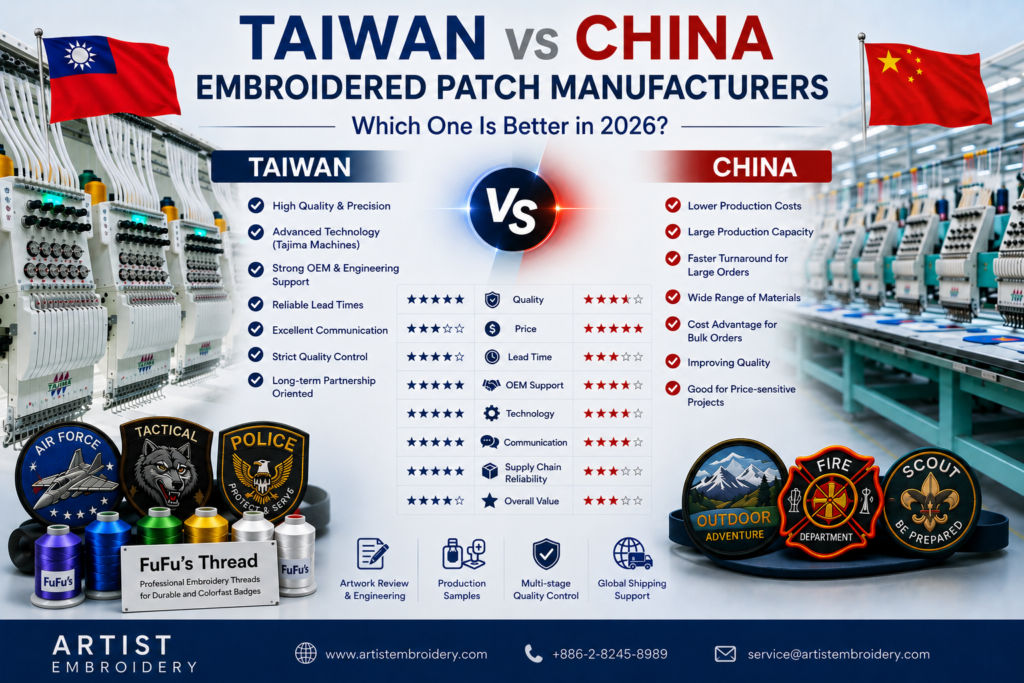
Choosing the right embroidered patch manufacturer has become more challenging than ever. While China remains one of the world’s largest manufacturing hubs, Taiwan has gained increasing recognition for premium quality, stable production, and reliable OEM services. Rising tariffs, changing global supply chains, and stricter quality expectations have also influenced how international buyers evaluate their suppliers.
In this comprehensive guide, we’ll compare Taiwan and China embroidered patch manufacturers across quality, pricing, production lead time, communication, trade risks, and long-term business value. Whether you’re sourcing military patches, sports team badges, fashion labels, promotional products, or corporate uniforms, this article will help you determine which manufacturing partner best fits your business goals in 2026.
Why Buyers Are Comparing Taiwan and China More Than Ever
For many years, China dominated the global embroidered patch industry thanks to its massive production capacity and competitive pricing. Thousands of factories across Guangdong, Zhejiang, and Fujian have supplied embroidered badges for military organizations, apparel brands, promotional companies, schools, and retailers worldwide. However, the purchasing priorities of international buyers have changed significantly over the past few years. Today, price is no longer the only deciding factor. Businesses are increasingly evaluating quality consistency, communication efficiency, intellectual property protection, production flexibility, and supply chain resilience before selecting an OEM manufacturing partner.
One of the biggest reasons behind this shift is the increasing uncertainty in global trade. Since the implementation of additional tariffs on many Chinese-made products, buyers—particularly those serving the U.S. market—have become much more cautious when selecting suppliers. Import duties, customs delays, and evolving trade regulations can significantly impact the total landed cost of embroidered patches. As a result, procurement teams are no longer comparing factories solely based on quotation prices; instead, they focus on total ownership cost, delivery reliability, and long-term business stability.
At the same time, branding has become increasingly important. Premium brands, tactical equipment manufacturers, sports organizations, universities, and government agencies often require embroidered patches with exceptional stitch precision, accurate Pantone color matching, durable backing options, and strict quality control. These requirements have made Taiwan an increasingly attractive manufacturing destination. Taiwanese factories generally emphasize craftsmanship, stable production standards, and detailed inspection procedures, allowing buyers to reduce defect rates and maintain brand consistency across multiple production runs.
Communication is another factor driving this comparison. International buyers expect quick responses, professional technical consultation, and clear production updates. Miscommunication regarding artwork revisions, embroidery density, backing selection, border finishing, or packaging can easily result in production delays or unexpected costs. Manufacturers that provide transparent communication and experienced project management often create far greater long-term value than suppliers chosen solely because of lower pricing.
Finally, many companies are diversifying their supply chains to reduce dependency on a single country. Rather than placing all production in one location, global buyers increasingly evaluate Taiwan and China side by side, balancing cost efficiency with quality assurance and supply chain security. This trend is expected to continue throughout 2026 as companies prioritize resilience, flexibility, and long-term partnerships over short-term savings.
📊 Table: Why Buyers Compare Taiwan and China in 2026
| Buying Factor | Why It Matters More Than Before |
|---|---|
| Product Quality | Protects brand reputation and reduces defects |
| Tariffs | Affects total landed cost |
| Communication | Prevents production mistakes |
| Delivery Reliability | Keeps inventory on schedule |
| Supply Chain Stability | Reduces geopolitical risks |
| OEM Experience | Ensures smoother project execution |
| Quality Control | Minimizes rework and customer complaints |
| Long-term Partnership | Supports consistent future production |
📖 Extended Reading
- How to Order Custom Embroidered Patches: A Complete OEM Guide
- Global Market Trends of Embroidered Patches
- OEM Embroidery Manufacturer: Why Choosing the Right Factory Matters
Taiwan vs China Embroidered Patch Manufacturers at a Glance
Choosing between a Taiwan embroidered patch manufacturer and a China embroidered patch manufacturer is not about determining which country is universally “better.” Instead, the decision depends on your product positioning, quality expectations, budget, order quantity, and long-term sourcing strategy. While both countries are major players in the global embroidery industry, they have developed different manufacturing strengths over decades of serving international markets.
China has built one of the world’s largest embroidery manufacturing ecosystems, capable of handling everything from promotional giveaways to large-scale retail production. Its extensive supply chain, abundant labor force, and high production capacity allow many factories to offer highly competitive pricing, especially for very large orders. Buyers looking for the lowest possible unit cost often find China attractive, particularly when ordering hundreds of thousands of embroidered patches.
Taiwan, by contrast, has established a reputation for precision manufacturing, premium craftsmanship, and dependable OEM services. Taiwanese manufacturers typically focus on producing high-value embroidered patches for military organizations, police departments, sports teams, outdoor brands, motorcycle clubs, fashion labels, universities, and corporate identity programs. Instead of competing solely on price, Taiwan emphasizes product consistency, advanced embroidery technology, strict quality control, and responsive customer service.
Another important distinction lies in manufacturing philosophy. Many Chinese factories prioritize production efficiency and high-volume output, whereas Taiwanese manufacturers often dedicate additional attention to artwork optimization, stitch planning, thread density, edge finishing, backing recommendations, and final inspection. This approach is particularly valuable for customers whose embroidered patches represent their brand image, official uniforms, or collectible products where appearance and durability are critical.
International buyers should also consider factors beyond manufacturing itself. Communication quality, engineering support, intellectual property protection, shipping reliability, customs documentation, and after-sales service all contribute to the overall purchasing experience. A supplier offering a slightly higher quotation may ultimately reduce hidden costs by minimizing production errors, shortening development cycles, and maintaining consistent quality across repeated orders.
As global supply chains continue to evolve in 2026, more buyers are shifting their evaluation criteria from “Which factory is cheaper?” to “Which manufacturing partner delivers the greatest long-term value?” Understanding the core differences between Taiwan and China is the first step toward making an informed sourcing decision.
Taiwan Embroidered Patch Manufacturers: Strengths and Ideal Applications
Taiwanese embroidered patch manufacturers are widely recognized for producing premium-quality products that require exceptional precision and consistency. Many factories have decades of OEM experience serving international clients who demand strict production standards. Industries such as military, law enforcement, emergency services, aviation, outdoor equipment, luxury apparel, and corporate branding often prefer Taiwan because product reliability is more important than achieving the absolute lowest production cost.
One of Taiwan’s greatest strengths is engineering support during the pre-production stage. Experienced teams frequently review artwork before production begins, recommending adjustments to stitch density, border construction, thread selection, backing materials, and manufacturing techniques. These recommendations help customers avoid unnecessary production problems while improving both appearance and durability.
Taiwan is also known for maintaining stable quality across multiple production runs. This consistency is particularly valuable for organizations requiring repeat orders over many years, where every embroidered patch must match previous shipments in color, dimensions, and stitch quality. Rather than treating each order as an isolated project, Taiwanese manufacturers often build long-term partnerships with their customers by documenting production specifications and continuously refining manufacturing processes.
For businesses focused on premium branding, lower defect rates, and dependable communication, Taiwan often represents a strategic investment rather than simply a production location.
China Embroidered Patch Manufacturers: Strengths and Ideal Applications
China remains one of the world’s largest embroidered patch manufacturing centers due to its enormous production capacity and mature industrial infrastructure. Thousands of factories across different provinces produce embroidered patches for promotional campaigns, retail brands, schools, events, wholesalers, and e-commerce businesses.
The country’s biggest advantage is scalability. Large factories can often process extremely high-volume orders while maintaining competitive pricing through economies of scale. Buyers with standardized products and predictable production requirements may benefit from China’s extensive manufacturing network.
China also offers significant supplier diversity. Buyers can choose from factories specializing in budget products, premium embroidery, laser-cut patches, woven labels, PVC patches, chenille patches, or mixed-product manufacturing. This flexibility makes China suitable for businesses seeking multiple product categories from a single sourcing destination.
However, supplier capabilities vary considerably. Buyers should carefully evaluate quality control systems, communication efficiency, sampling procedures, and production consistency rather than assuming all factories offer the same standards. Conducting factory audits, reviewing previous production samples, and requesting detailed specifications remain essential steps when selecting any manufacturing partner.
📊 Table: Taiwan vs China Embroidered Patch Manufacturers at a Glance
| Comparison Item | Taiwan Manufacturer | China Manufacturer |
|---|---|---|
| Product Quality | ⭐⭐⭐⭐⭐ Premium consistency | ⭐⭐⭐⭐ Varies by factory |
| Embroidery Precision | Excellent | Good to Excellent |
| Stitch Density Control | Excellent | Good |
| Color Consistency | Excellent | Moderate to Excellent |
| Quality Control | Strict inspection process | Factory dependent |
| Communication | Excellent English support | Varies significantly |
| OEM Consultation | Comprehensive technical advice | Usually production-focused |
| Minimum Order Quantity | Flexible | Often lower for mass production |
| Large Volume Capacity | High | Very High |
| Lead Time Stability | Excellent | Good |
| Price Competitiveness | Medium | High |
| Supply Chain Flexibility | High | Very High |
| Intellectual Property Awareness | Strong | Factory dependent |
| Long-term Partnership | Excellent | Depends on supplier |
| Best For | Premium brands, military, police, sports, corporate uniforms | Promotional products, wholesalers, high-volume retail |
📊 Table: Which Manufacturer Fits Your Business?
| Your Business Needs | Recommended Choice |
|---|---|
| Premium embroidered patches | Taiwan |
| Lowest purchase price | China |
| Military & tactical patches | Taiwan |
| Police & government projects | Taiwan |
| Luxury fashion brands | Taiwan |
| Promotional giveaways | China |
| Large retail orders | China |
| Long-term OEM cooperation | Taiwan |
| Strict quality consistency | Taiwan |
| Fast scaling production | China |
📖 Extended Reading
- High-Density Embroidery Stitch Count: Why It Matters for Premium Patches
- Why Choose Tajima Embroidery Machines for OEM Production
- Embroidered Badge Durability Guide: Materials, Stitching, and Testing
Quality Comparison: Which Country Produces Better Embroidered Patches?
When evaluating embroidered patch manufacturers, quality should never be measured by appearance alone. A patch that looks impressive in a product photo may reveal problems after repeated washing, outdoor exposure, or long-term use. Professional buyers understand that true quality encompasses stitch precision, material durability, color consistency, backing performance, edge finishing, and manufacturing repeatability. This is why quality comparison remains one of the most important factors when choosing between Taiwan and China embroidered patch manufacturers.
Both Taiwan and China are capable of producing high-quality embroidered patches, but the average manufacturing standard differs. Taiwan has built its reputation by emphasizing precision engineering, strict quality assurance, and consistent production across multiple orders. Chinese manufacturers, meanwhile, offer a broad spectrum of capabilities. While many top-tier factories can achieve excellent results comparable to Taiwan, quality varies significantly depending on the supplier’s equipment, workforce experience, inspection procedures, and production priorities.
For businesses whose embroidered patches represent military units, government agencies, sports organizations, luxury brands, or corporate identity programs, even small inconsistencies can affect brand perception. Uneven stitching, inaccurate thread colors, loose borders, or inconsistent dimensions may lead to customer complaints or costly reorders. Therefore, buyers should evaluate manufacturers based on their ability to deliver consistent quality—not just a competitive quotation.
The following sections examine the key quality indicators that distinguish premium OEM manufacturers and explain how Taiwan and China compare in each category.
Embroidery Precision and Stitch Density
Embroidery precision directly influences how detailed and professional an embroidered patch appears. High-quality embroidery requires accurate stitch placement, balanced thread tension, optimized stitch angles, and careful compensation for fabric movement. These technical factors determine whether small text remains readable, borders stay clean, and intricate logos retain their intended appearance.
Taiwanese manufacturers are widely recognized for producing high-density embroidery with exceptional stitch accuracy. Before production begins, experienced engineers often optimize artwork by adjusting stitch paths, density, underlay structures, and sequencing to improve both visual appearance and durability. This engineering-focused approach minimizes thread overlap, puckering, and unnecessary bulk while preserving fine design details.
Many premium Taiwanese factories also utilize advanced embroidery equipment and standardized production procedures to maintain consistent stitch quality across repeated production runs. This consistency is particularly valuable for military insignia, police patches, aviation emblems, and branded merchandise that require identical appearance over many years.
China also has numerous factories capable of producing excellent embroidery, especially among larger export-oriented manufacturers. However, production quality can vary considerably between suppliers. Some factories focus primarily on maximizing production efficiency and reducing costs, which may result in lower stitch density, simplified embroidery details, or less artwork optimization for complex designs.
For highly detailed logos, miniature lettering, or premium brand applications, embroidery precision often becomes one of Taiwan’s strongest competitive advantages.
Many premium Taiwanese OEM manufacturers invest in advanced embroidery equipment to achieve consistent stitch quality and precise detail reproduction. Industrial embroidery systems from Tajima Group, one of the world’s leading embroidery machine manufacturers, are widely recognized for their accuracy, stability, and production efficiency. Advanced equipment, combined with experienced operators and engineering expertise, plays an important role in producing high-quality embroidered patches.
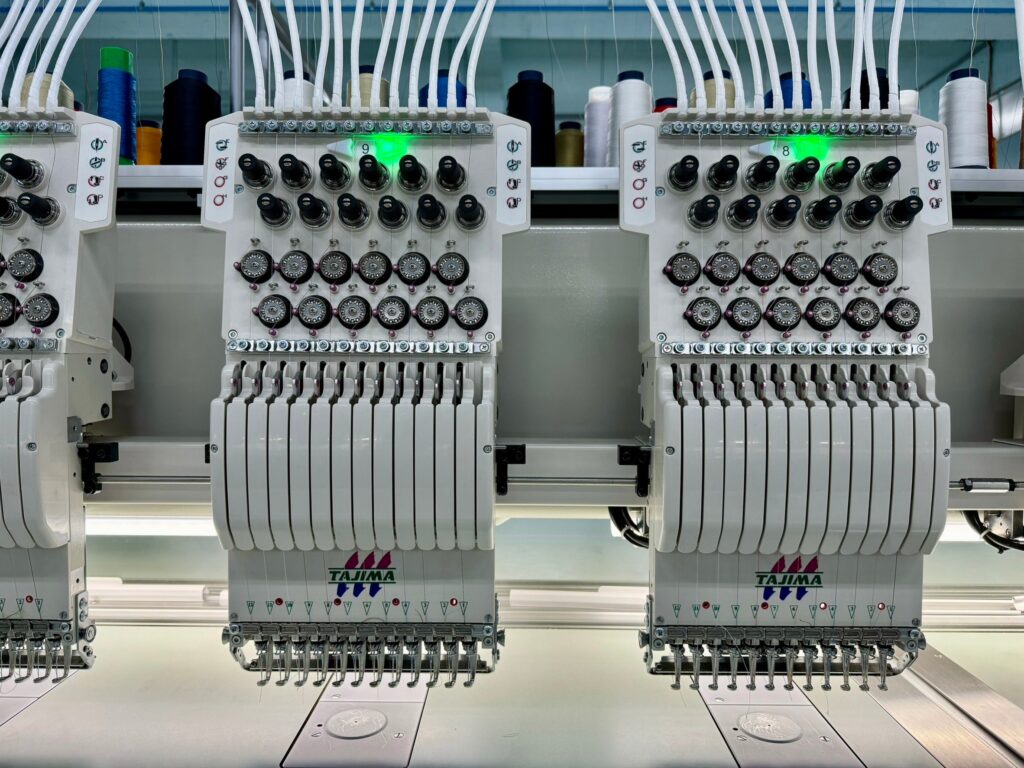
Recommended Resource
Tajima Group Official Website
Thread, Fabric, and Material Quality
Premium embroidered patches begin with premium materials. Thread strength, colorfastness, twill fabric stability, backing materials, and border construction all contribute to the finished product’s durability and professional appearance.
Taiwanese manufacturers generally source high-grade polyester embroidery threads known for excellent abrasion resistance, UV stability, and long-term color retention. Many OEM factories also cooperate with internationally recognized thread suppliers, helping ensure consistent dye lots and reliable performance under demanding environmental conditions.
Material selection extends beyond embroidery thread. Premium twill fabrics, industrial-grade hook-and-loop fasteners, heat-resistant iron-on adhesives, durable pressure-sensitive adhesives, and high-quality merrow yarns all contribute to better long-term performance. Taiwanese factories often recommend the most suitable material combinations based on the customer’s intended application rather than applying the same specifications to every project.
Chinese manufacturers likewise have access to a broad range of materials, from economy-grade options to premium imported components. The key difference lies in supplier selection. Buyers who prioritize lower pricing may receive more economical materials unless detailed specifications are clearly defined during the quotation process.
When product longevity, outdoor performance, repeated washing, or tactical use is required, selecting a manufacturer with strict material standards becomes essential.
Thread quality has a direct impact on color consistency, abrasion resistance, and long-term durability. Many professional OEM manufacturers carefully select embroidery threads that maintain vibrant colors even after repeated washing and prolonged outdoor exposure. Premium embroidery thread suppliers such as FuFu’s Thread have earned strong reputations for producing durable, colorfast embroidery threads that meet the demanding requirements of military, corporate, and premium branding applications.
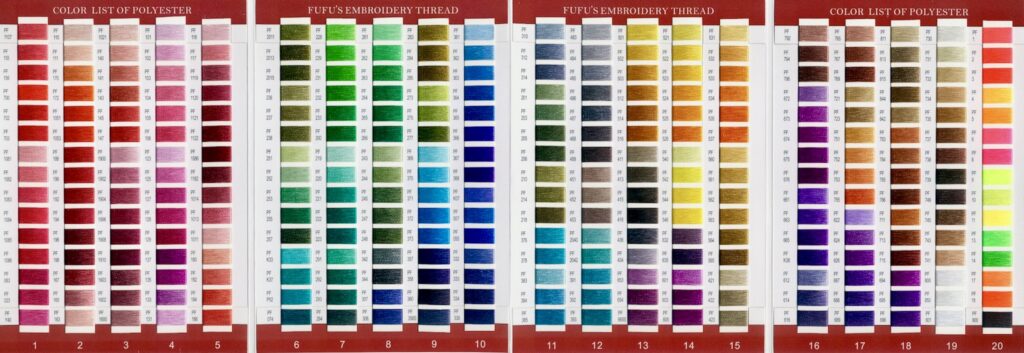
Recommended Resource
FuFu’s Thread – Professional Embroidery Threads for Durable and Colorfast Badges
Color Consistency and Brand Accuracy
For branded embroidered patches, color consistency is just as important as embroidery quality. International companies often require exact Pantone color matching to maintain brand identity across uniforms, promotional merchandise, and licensed products.
Taiwanese manufacturers typically implement standardized color management procedures that include Pantone verification, production sampling, and final inspection before shipment. These processes help minimize color variation between different production batches, ensuring that repeat orders closely match previous deliveries.
Color consistency becomes especially critical for organizations ordering embroidered patches over multiple years. Universities, military departments, government agencies, and multinational corporations expect every shipment to maintain identical brand colors regardless of production date.
While many Chinese manufacturers also provide Pantone matching services, consistency may depend more heavily on factory-specific quality systems and thread inventory management. Buyers should always request physical samples or approved color references before authorizing mass production.
Quality Control Standards and Final Inspection
Even the best embroidery equipment cannot guarantee premium products without an effective quality control system. Comprehensive inspection throughout the manufacturing process helps identify defects before products reach customers.
Taiwanese OEM manufacturers generally perform multiple inspection stages, including artwork verification, production monitoring, dimensional measurement, color inspection, border examination, backing adhesion testing, thread trimming, packaging verification, and final random sampling before shipment.
This systematic approach significantly reduces the likelihood of receiving products with missing stitches, loose threads, incorrect dimensions, uneven borders, or packaging errors. It also improves consistency across repeat orders, making Taiwan particularly attractive for buyers who prioritize long-term reliability.
Chinese factories increasingly invest in modern quality management systems as well, particularly those serving international OEM markets. However, inspection procedures can differ greatly between factories, making supplier evaluation and sample approval especially important during the sourcing process.
Rather than assuming quality based solely on country of origin, buyers should examine each manufacturer’s documented inspection procedures, sample quality, certifications, and previous production experience.
📊 Table: Quality Comparison Between Taiwan and China Embroidered Patch Manufacturers
| Quality Factor | Taiwan | China |
|---|---|---|
| Stitch Precision | ⭐⭐⭐⭐⭐ | ⭐⭐⭐⭐☆ |
| Small Text Accuracy | Excellent | Good–Excellent |
| High-Density Embroidery | Excellent | Good |
| Thread Quality | Premium-grade | Economy to Premium |
| Pantone Color Matching | Excellent | Good–Excellent |
| Color Consistency Between Orders | Excellent | Factory dependent |
| Fabric Quality | Premium | Varies |
| Border Finishing | Excellent | Good–Excellent |
| Backing Performance | Excellent | Good |
| Final Quality Inspection | Multi-stage QC | Depends on supplier |
| Repeat Order Consistency | Excellent | Moderate–Excellent |
| Overall Quality Stability | ⭐⭐⭐⭐⭐ | ⭐⭐⭐⭐☆ |
📊 Table: Recommended Manufacturing Choice Based on Quality Requirements
| Product Type | Recommended Manufacturing Location |
|---|---|
| Military Patches | Taiwan |
| Police Badges | Taiwan |
| Fire Department Patches | Taiwan |
| Corporate Uniform Patches | Taiwan |
| Premium Fashion Labels | Taiwan |
| Outdoor Equipment Brands | Taiwan |
| Motorcycle Club Patches | Taiwan |
| Promotional Giveaways | China |
| Event Souvenirs | China |
| Budget Retail Products | China |
📖 Extended Reading
- Why Choose Tajima Embroidery Machines for Superior OEM Production?
- High-Density Embroidery Stitch Count: How It Improves Patch Quality
- Embroidered Badge Durability Guide: Materials, Construction, and Testing
Price Comparison: Is China Always the Cheaper Choice?
Price is often the first factor buyers consider when sourcing custom embroidered patches, but focusing solely on the quoted unit price can be misleading. While China has long been associated with lower manufacturing costs, the true cost of importing embroidered patches extends far beyond the factory quotation. International buyers must also account for tariffs, shipping expenses, quality risks, communication efficiency, production delays, and after-sales support when evaluating suppliers.
In 2026, many procurement professionals have shifted from comparing unit price to comparing total landed cost. A manufacturer offering the lowest quotation may ultimately become the more expensive option if quality issues lead to remakes, customs delays, warranty claims, or missed delivery deadlines. Conversely, paying a slightly higher factory price to a reliable OEM supplier can significantly reduce hidden costs throughout the purchasing process.
Taiwanese manufacturers generally position themselves as premium OEM partners, offering higher production standards, comprehensive technical consultation, and lower defect rates. Chinese manufacturers continue to compete aggressively on price, especially for high-volume orders. However, recent changes in global trade policies, increasing labor costs, and higher logistics expenses have narrowed the price gap compared to previous years.
Understanding where costs originate—and which expenses are visible versus hidden—is essential for making an informed sourcing decision.
Unit Manufacturing Cost
China continues to maintain an advantage in unit manufacturing cost for many standard embroidered patches. Its large-scale production infrastructure, mature supply chain, and high manufacturing capacity enable factories to spread overhead costs across enormous production volumes. For buyers ordering tens of thousands of identical patches, this economy of scale often results in lower per-unit pricing.
Taiwanese manufacturers, meanwhile, generally operate with higher labor costs and smaller production scales. Instead of competing on the lowest quotation, they focus on delivering premium workmanship, engineering support, and production consistency. As a result, the unit price from Taiwan is often 10–30% higher than comparable quotations from China, depending on design complexity, order quantity, backing type, and finishing requirements.
However, comparing quotations without considering the included services can create an inaccurate impression. Many Taiwanese OEM manufacturers incorporate artwork optimization, engineering consultation, stricter quality inspections, and detailed production reviews into their pricing. These value-added services reduce production risks and help prevent costly mistakes before manufacturing begins.
Hidden Costs Beyond the Factory Price
Many first-time buyers discover that the factory quotation represents only a portion of the total project cost. Hidden expenses frequently arise during production, shipping, customs clearance, and after-sales support.
Quality-related issues are among the most expensive hidden costs. If embroidered patches arrive with incorrect colors, inconsistent stitching, defective backings, or dimensional inaccuracies, buyers may face replacement costs, delayed product launches, or dissatisfied customers. These indirect expenses often exceed the savings achieved through selecting the lowest quotation.
Communication efficiency also has financial value. Clear technical discussions during artwork approval can prevent misunderstandings regarding stitch density, border construction, backing materials, packaging requirements, or production specifications. Suppliers with experienced English-speaking project managers often reduce revision cycles and accelerate project completion.
Businesses should also consider inventory costs caused by delayed production or inconsistent delivery schedules. A late shipment may interrupt retail launches, postpone promotional events, or delay uniform distribution, creating financial consequences that far outweigh modest differences in manufacturing price.
Tariffs, Shipping, and Import Expenses
In today’s international market, shipping and customs costs can significantly influence the overall purchasing decision. Ocean freight, air freight, customs brokerage fees, insurance, and import duties all contribute to the final landed cost of embroidered patches.
For buyers importing into the United States, tariffs have become a particularly important consideration. Additional duties imposed on many Chinese-origin products have increased the effective purchase price for some importers. Although tariff policies continue to evolve, many companies now evaluate manufacturing locations based not only on production cost but also on trade stability and long-term sourcing strategy.
Taiwan generally benefits from a more predictable trade environment for many international buyers. While shipping costs from Taiwan may not differ dramatically from China, avoiding unexpected tariff exposure or customs complications can improve budgeting accuracy and reduce procurement risk.
Rather than asking, “Which country offers the cheapest factory price?” experienced buyers increasingly ask, “Which supplier delivers the lowest total landed cost?”
Return on Investment: Looking Beyond Price
The lowest quotation rarely guarantees the highest return on investment. Premium embroidered patches often generate greater long-term value because they strengthen brand image, reduce replacement frequency, minimize customer complaints, and improve user satisfaction.
Organizations such as military units, police departments, universities, sports clubs, motorcycle associations, and corporate brands typically expect embroidered patches to remain durable for years. Investing in higher-quality manufacturing reduces the likelihood of fading colors, loose stitching, detached backings, or premature wear.
Long-term OEM partnerships also create operational efficiencies. Experienced manufacturers maintain detailed production records, preserve approved artwork specifications, and continuously improve manufacturing processes for repeat orders. These advantages reduce engineering time, simplify reordering, and ensure consistent product quality across future production runs.
Ultimately, the best purchasing decision should balance manufacturing cost with quality, reliability, communication, and long-term business value rather than focusing exclusively on the lowest quotation.
📊 Table: Taiwan vs China Price Comparison (2026)
| Cost Factor | Taiwan | China |
|---|---|---|
| Unit Price | Medium–High | Low–Medium |
| Sample Cost | Medium | Low |
| Engineering Support | Included | Varies |
| Artwork Optimization | Included | Sometimes extra |
| Quality Inspection | Comprehensive | Factory dependent |
| Defect Risk | Low | Moderate |
| Rework Probability | Low | Moderate |
| Communication Cost | Low | Moderate |
| Long-term Value | Excellent | Good |
| Overall Cost Efficiency | ⭐⭐⭐⭐⭐ | ⭐⭐⭐⭐☆ |
📊 Table: Estimated Total Landed Cost Comparison
Example: 5,000 Custom Embroidered Patches (Illustrative Comparison Only)
| Cost Category | Taiwan | China |
|---|---|---|
| Manufacturing | Higher | Lower |
| Freight | Similar | Similar |
| Customs Risk | Lower | Higher |
| Tariff Exposure | Lower | Potentially Higher |
| Rework Cost | Low | Moderate |
| Delivery Delay Risk | Low | Moderate |
| Communication Cost | Low | Moderate |
| Total Ownership Cost | Competitive | May increase due to hidden costs |
Note: Actual costs vary depending on destination country, order quantity, product specifications, shipping method, and applicable trade regulations.
📊 Table: Which Buyer Should Prioritize Price?
| Buyer Profile | Recommended Choice |
|---|---|
| Startup with limited budget | China |
| Promotional products distributor | China |
| Wholesale importer | China |
| Premium apparel brand | Taiwan |
| Government procurement | Taiwan |
| Military & tactical equipment supplier | Taiwan |
| Corporate branding projects | Taiwan |
| Long-term OEM partnership | Taiwan |
📖 Extended Reading
- OEM Embroidery Manufacturer: Choosing the Right Production Partner
- How to Order Custom Embroidered Patches: Step-by-Step OEM Guide
- Global Market Trends of Embroidered Patches in 2026
Lead Time Comparison: Which Country Delivers Faster and More Reliably?
For many international buyers, delivery reliability is just as important as product quality or pricing. A beautifully manufactured embroidered patch has little value if it arrives after a product launch, sporting event, military deployment, trade show, or promotional campaign. As global supply chains continue to evolve in 2026, procurement teams are placing greater emphasis on production scheduling, shipping stability, and supplier responsiveness rather than simply asking which factory can offer the shortest quoted lead time.
At first glance, China appears to have an advantage due to its enormous manufacturing capacity and well-developed industrial infrastructure. Thousands of embroidery factories operate simultaneously, allowing buyers to source products from suppliers capable of handling very large production volumes. However, actual delivery performance depends on far more than factory size. Artwork approval, sampling speed, production scheduling, quality inspection, export documentation, and logistics coordination all influence whether an order arrives on time.
Taiwan, while operating on a smaller manufacturing scale, has earned a reputation for dependable production planning and consistent delivery performance. Many Taiwanese OEM manufacturers intentionally limit production capacity to maintain quality standards and realistic scheduling. Instead of accepting more orders than they can efficiently produce, experienced factories often provide conservative but reliable lead times that buyers can confidently incorporate into their procurement plans.
When comparing lead time, buyers should evaluate delivery reliability rather than advertised production speed. A supplier consistently delivering within the promised schedule often creates significantly greater business value than one offering unrealistic lead times that frequently require extensions.
Sampling and Prototype Development
The sampling stage establishes the foundation for every successful OEM project. Before mass production begins, buyers typically evaluate embroidery quality, color accuracy, backing selection, border construction, dimensions, and overall appearance through production samples.
Taiwanese manufacturers generally devote considerable attention to engineering during this stage. Artwork is reviewed, stitch density optimized, thread directions adjusted, and manufacturing recommendations provided before sample production begins. Although this engineering process may require additional preparation time, it often reduces the number of revision cycles required later.
Most Taiwan OEM factories complete production samples within 5–10 working days, depending on design complexity and material availability. Complex military insignia, highly detailed corporate logos, or patches with multiple backing options may require additional engineering time to ensure optimal results.
Chinese manufacturers also offer rapid sample production, with many factories advertising sample lead times of 3–7 working days. However, highly competitive pricing sometimes limits the amount of engineering consultation included before sampling. Buyers should carefully review artwork proofs and production specifications before approving mass production.
Mass Production Lead Time
Production capacity is one of China’s greatest strengths. Large factories equipped with hundreds of embroidery machines can efficiently manufacture high-volume orders involving tens or even hundreds of thousands of embroidered patches.
For standard production, many Chinese manufacturers quote lead times of approximately 10–20 working days, depending on order size and seasonal demand. During peak production periods, however, capacity constraints may extend actual delivery schedules.
Taiwanese manufacturers typically complete standard OEM orders within 12–20 working days after sample approval. Although production capacity is generally smaller than China’s largest factories, many Taiwanese suppliers maintain stable scheduling by carefully managing order intake and production planning.
For premium products requiring detailed embroidery, multiple inspections, or specialized finishing techniques, the difference in production time between Taiwan and China is often minimal. The emphasis shifts from manufacturing speed to production accuracy and consistency.
Rush Orders and Production Flexibility
Unexpected product launches, promotional events, and replacement orders frequently require accelerated production schedules. In these situations, manufacturing flexibility becomes a significant competitive advantage.
Taiwanese manufacturers often excel in managing urgent OEM projects because of streamlined communication, experienced production planning, and close coordination between sales, engineering, and manufacturing departments. Rather than simply increasing production speed, they carefully evaluate production capacity to determine whether rush orders can be accommodated without compromising quality.
Chinese manufacturers can also support expedited production, particularly within large factories possessing substantial machine capacity. However, availability for rush orders depends heavily on existing production schedules, seasonal demand, and factory workload.
Buyers planning urgent projects should discuss delivery requirements during the quotation stage rather than after production begins. Early communication allows manufacturers to reserve production capacity and recommend the most suitable shipping method.
Shipping Reliability and Supply Chain Stability
Production completion represents only one portion of the overall delivery timeline. Export documentation, customs clearance, freight scheduling, and international transportation all influence final delivery performance.
Taiwan has developed a strong reputation for stable export procedures and efficient international logistics. Experienced OEM manufacturers typically prepare commercial invoices, packing lists, certificates of origin, and customs documentation accurately, reducing the likelihood of customs delays.
China also possesses one of the world’s largest logistics networks, providing extensive air freight and ocean freight options. Nevertheless, during periods of high export volume, port congestion, customs inspections, or geopolitical disruptions may occasionally affect shipment schedules.
For businesses supplying government agencies, military organizations, retailers, or scheduled promotional campaigns, consistent delivery reliability often outweighs minor differences in production speed.
📊 Table: Lead Time Comparison Between Taiwan and China
| Production Stage | Taiwan | China |
|---|---|---|
| Artwork Review | Thorough engineering | Standard review |
| Sample Production | 5–10 working days | 3–7 working days |
| Sample Revision | Fast communication | Factory dependent |
| Mass Production | 12–20 working days | 10–20 working days |
| Rush Order Flexibility | Excellent | Good |
| Quality Inspection | Multi-stage | Varies |
| Shipping Documentation | Excellent | Good |
| Delivery Reliability | ⭐⭐⭐⭐⭐ | ⭐⭐⭐⭐☆ |
📊 Table: Typical OEM Production Timeline
| Stage | Estimated Time |
|---|---|
| Artwork Review | 1–2 days |
| Sample Production | 5–10 days |
| Sample Approval | 1–3 days |
| Mass Production | 10–20 days |
| Final Inspection | 1–2 days |
| Packaging | 1 day |
| International Shipping | Depends on destination |
Note: Actual lead times vary depending on order quantity, design complexity, seasonal demand, and shipping method.
📊 Table: Best Manufacturing Choice by Delivery Priority
| Priority | Recommended Choice |
|---|---|
| Fastest sample turnaround | China |
| Stable production schedule | Taiwan |
| Premium quality with reliable delivery | Taiwan |
| Very large production volume | China |
| Long-term repeat orders | Taiwan |
| Urgent OEM projects requiring close coordination | Taiwan |
| Budget-focused bulk production | China |
📖 Extended Reading
- How to Order Custom Embroidered Patches: A Complete OEM Workflow
- OEM Embroidery Manufacturer: What International Buyers Should Know
- Global Market Trends of Embroidered Patches: Supply Chain Insights
Communication & OEM Service: Why Professional Support Matters More Than Ever
For many international buyers, the success of an OEM embroidered patch project depends as much on communication as it does on manufacturing capability. Even the most advanced embroidery equipment cannot compensate for misunderstandings regarding artwork, materials, dimensions, colors, or delivery requirements. In fact, many production problems originate not from manufacturing defects but from incomplete communication during the quotation and sampling stages.
As global buyers become increasingly experienced, they are placing greater emphasis on working with manufacturers that provide responsive communication, technical expertise, and structured project management. Rather than simply requesting a quotation, procurement teams expect suppliers to act as manufacturing partners—offering professional recommendations, identifying potential production risks, and ensuring every specification is clearly confirmed before production begins.
This shift particularly benefits manufacturers that invest in engineering support, multilingual communication, and long-term customer relationships. While both Taiwan and China offer numerous capable OEM factories, differences in communication quality and service philosophy often become one of the deciding factors for premium brands, government agencies, military organizations, and companies ordering customized embroidered patches.
The following sections explore the key service differences that international buyers should evaluate before selecting an embroidery manufacturing partner.
English Communication and Project Management
Clear communication is one of the most underestimated factors in OEM manufacturing. Every embroidered patch project involves dozens of technical specifications, including dimensions, embroidery coverage, stitch density, thread colors, border type, backing material, packaging requirements, shipping instructions, and production schedules. Missing even one detail can lead to costly revisions or production delays.
Taiwanese embroidered patch manufacturers generally maintain experienced international sales teams with strong English communication skills. Many account managers have years of experience serving customers in North America, Europe, Australia, and Japan, allowing them to communicate complex technical requirements accurately and efficiently.
Beyond language proficiency, Taiwanese suppliers often provide structured project management. Each project is monitored from quotation through artwork approval, sampling, mass production, quality inspection, and shipping. Buyers typically receive timely production updates and rapid responses whenever modifications or additional information are required.
China also has many export-oriented manufacturers with professional English-speaking sales representatives. However, communication quality varies considerably between factories. Some suppliers focus primarily on quotation speed rather than technical consultation, making it important for buyers to verify project management capabilities before placing large orders.
Strong communication not only improves customer satisfaction but also reduces production risk, shortens approval cycles, and strengthens long-term business relationships.
Artwork Review and Manufacturing Consultation
Professional OEM manufacturers do far more than reproduce customer artwork. Before embroidery begins, experienced engineers carefully evaluate whether a design can be manufactured efficiently while maintaining its intended appearance.
Taiwanese manufacturers commonly review artwork to identify potential production challenges, including extremely small lettering, excessive stitch density, overlapping embroidery areas, narrow borders, or unsuitable backing selections. Rather than waiting for production problems to occur, engineers proactively recommend modifications that improve embroidery quality while preserving the original design.
For example, slight adjustments to stitch angles, underlay structures, or embroidery sequencing may significantly improve edge definition and reduce thread distortion. Likewise, selecting the appropriate border style—such as merrow, heat cut, or laser cut—can enhance both durability and visual presentation depending on the application.
Many Chinese manufacturers also provide artwork review services, particularly those specializing in export markets. However, the depth of engineering consultation often varies depending on factory experience and pricing structure. Buyers seeking highly detailed embroidered patches should ensure their supplier offers technical recommendations rather than simple production execution.
OEM Customization Capabilities
Modern embroidered patches involve much more than traditional embroidery. Buyers increasingly require specialized materials, advanced backing systems, unique packaging, and custom finishing solutions to support diverse industries and applications.
Taiwanese OEM manufacturers frequently offer comprehensive customization services, including:
- High-density embroidery
- Merrow border
- Heat-cut border
- Laser-cut border
- Hook and loop (Velcro® compatible)
- Iron-on backing
- Pressure-sensitive adhesive backing
- Sew-on backing
- Button loop attachments
- PVC combination patches
- Leather patch integration
- Custom packaging
- Barcode labeling
- Individual polybag packaging
Because many Taiwanese factories specialize exclusively in OEM manufacturing, they are accustomed to adapting production methods according to each customer’s technical requirements rather than relying on standardized production templates.
Chinese manufacturers also provide extensive customization capabilities, particularly within larger factories. However, buyers should verify whether specific finishing methods, specialty materials, or packaging options are produced in-house or outsourced, as this may influence both lead time and quality consistency.
After-Sales Service and Long-Term OEM Partnership
A reliable manufacturing partner continues providing support after products have been shipped. This aspect becomes especially important for organizations placing repeat orders over many years.
Taiwanese manufacturers generally maintain detailed production records, including approved artwork, stitch files, thread specifications, backing materials, packaging configurations, and quality standards. These records simplify future repeat orders while ensuring consistency across multiple production runs.
In addition, experienced OEM suppliers often provide prompt responses to technical questions, shipping inquiries, replacement requests, and future product development discussions. Rather than treating each purchase as an isolated transaction, they prioritize building long-term partnerships that benefit both parties.
For global buyers managing recurring procurement programs, dependable after-sales support can reduce administrative workload, simplify purchasing procedures, and improve supply chain stability.
Long-term relationships also enable manufacturers to better understand each customer’s quality expectations, branding standards, and operational requirements, resulting in smoother collaboration over time.
📊 Table: Communication & OEM Service Comparison
| Service Category | Taiwan | China |
|---|---|---|
| English Communication | ⭐⭐⭐⭐⭐ | ⭐⭐⭐⭐☆ |
| Response Speed | Excellent | Good–Excellent |
| Project Management | Dedicated account management | Factory dependent |
| Artwork Engineering | Comprehensive | Varies |
| Technical Consultation | Extensive | Moderate |
| OEM Customization | Excellent | Excellent |
| Production Updates | Frequent | Varies |
| After-sales Support | Strong | Factory dependent |
| Repeat Order Management | Excellent | Good |
| Long-term Partnership | ⭐⭐⭐⭐⭐ | ⭐⭐⭐⭐☆ |
📊 Table: OEM Services Commonly Available
| OEM Service | Taiwan | China |
|---|---|---|
| Artwork Optimization | ✔ | ✔ |
| Pantone Color Matching | ✔ | ✔ |
| High-Density Embroidery | ✔ | ✔ |
| Merrow Border | ✔ | ✔ |
| Heat Cut Border | ✔ | ✔ |
| Laser Cut Border | ✔ | ✔ |
| Velcro Backing | ✔ | ✔ |
| Iron-on Backing | ✔ | ✔ |
| Custom Packaging | ✔ | ✔ |
| Barcode Labeling | ✔ | ✔ |
| Technical Consultation | ⭐⭐⭐⭐⭐ | ⭐⭐⭐⭐☆ |
📊 Table: Which Buyers Benefit Most from Strong OEM Support?
| Buyer Type | Why Professional OEM Service Matters |
|---|---|
| Premium Fashion Brands | Consistent brand identity |
| Military Contractors | Strict specification compliance |
| Police Departments | Repeat order consistency |
| Universities | Accurate logo reproduction |
| Sports Teams | Custom colors and personalization |
| Promotional Companies | Fast revisions and flexible packaging |
| Corporate Uniform Suppliers | Stable long-term production |
| International Distributors | Reliable communication across projects |
📖 Extended Reading
- OEM Embroidery Manufacturer: Why Experience Matters
- How to Design Artwork for Embroidery
- How to Order Custom Embroidered Patches: OEM Process Explained
Tariffs, Trade Risks & Supply Chain: Why More Buyers Are Considering Taiwan in 2026
Global sourcing is no longer driven solely by manufacturing cost. In 2026, international buyers must evaluate a much broader range of factors, including tariff policies, customs compliance, geopolitical uncertainty, logistics resilience, and long-term supply chain security. These considerations have fundamentally changed how companies select embroidered patch manufacturers.
For many years, China remained the default sourcing destination because of its extensive manufacturing ecosystem and competitive pricing. However, rising trade tensions, evolving tariff regulations, and increasing pressure to diversify supply chains have encouraged procurement teams to reassess their sourcing strategies. Instead of relying on a single country, many organizations are adopting a “China Plus One” approach—maintaining existing suppliers while adding alternative manufacturing partners in locations such as Taiwan.
This shift is particularly noticeable among government agencies, military contractors, universities, outdoor equipment brands, premium apparel companies, and corporate uniform suppliers. These organizations often value delivery stability, customs predictability, and product consistency more than achieving the absolute lowest purchase price.
When evaluating Taiwan and China embroidered patch manufacturers in 2026, buyers should consider not only today’s pricing but also the long-term risks that may affect future procurement costs and delivery schedules.
Tariff Considerations for U.S. Importers
For businesses importing embroidered patches into the United States, tariff exposure has become one of the most significant sourcing considerations. Additional duties applied to certain imported products can substantially increase the final landed cost, making an initially lower factory quotation less attractive after customs clearance.
Many U.S. importers now calculate Total Landed Cost rather than comparing factory prices alone. This approach includes manufacturing expenses, international freight, insurance, customs brokerage fees, import duties, warehousing, and potential quality-related costs.
Although tariff policies may change over time, buyers increasingly seek sourcing locations that offer greater predictability and reduce exposure to unexpected trade policy adjustments. This emphasis on long-term stability has contributed to growing international interest in Taiwanese OEM manufacturers.
Companies serving government contracts, public safety organizations, educational institutions, and premium consumer brands often prefer minimizing procurement uncertainty rather than continuously adapting to changing trade regulations.
Customs Documentation and HS Code Compliance
Accurate customs documentation plays an essential role in international trade. Incorrect product classifications or incomplete documentation can result in customs delays, additional inspections, unexpected duties, or shipment holds.
Professional OEM embroidered patch manufacturers should provide complete export documentation, including:
- Commercial Invoice
- Packing List
- Certificate of Origin (when applicable)
- Product Specifications
- Country of Origin Declaration
- Shipping Documentation
For embroidered patches, product classification under the Harmonized System (HS) should always be confirmed with the importer’s customs broker or local customs authority. While embroidered patches are commonly classified within Chapter 58 of the Harmonized Tariff Schedule, the appropriate classification depends on the specific product construction, finishing process, and destination country’s customs regulations.
Experienced Taiwanese manufacturers typically work closely with international freight forwarders and customs brokers, helping buyers prepare complete export documentation and reducing unnecessary customs complications.
Supply Chain Stability and Business Continuity
Supply chain resilience has become one of the defining procurement priorities of the decade. Recent global events have demonstrated that production interruptions, shipping delays, port congestion, labor shortages, and geopolitical developments can rapidly affect international manufacturing operations.
Many multinational companies have therefore adopted supplier diversification strategies rather than concentrating production in a single country.
Taiwan offers several advantages in this regard:
- Stable manufacturing environment
- Mature export infrastructure
- Strong engineering capabilities
- Reliable international logistics
- Consistent production quality
- Experienced OEM project management
While China continues to offer exceptional production capacity, many buyers now distribute production across multiple regions to reduce operational risk.
For businesses supplying critical industries—including military, law enforcement, emergency services, aviation, and corporate uniforms—maintaining uninterrupted production is often more valuable than achieving minimal cost savings.
Why More Premium Brands Are Choosing Taiwan
Premium brands increasingly recognize that manufacturing quality directly influences customer satisfaction and brand reputation. Consumers purchasing premium apparel, tactical equipment, collectible patches, or licensed merchandise expect products to remain durable and visually consistent for many years.
Taiwanese OEM manufacturers have positioned themselves as long-term manufacturing partners by emphasizing:
- Stable product quality
- Low defect rates
- Detailed engineering consultation
- Reliable delivery schedules
- Strong intellectual property awareness
- Professional communication
- Long-term production consistency
Rather than competing solely on price, Taiwan competes on total business value.
For companies building long-term brands rather than pursuing one-time purchases, this approach often produces lower operational costs over the lifetime of the supplier relationship.
📊 Table: Taiwan vs China — Trade & Supply Chain Comparison
| Comparison Factor | Taiwan | China |
|---|---|---|
| Trade Stability | ⭐⭐⭐⭐⭐ | ⭐⭐⭐⭐☆ |
| Customs Documentation Support | Excellent | Good |
| Export Experience | Excellent | Excellent |
| Logistics Reliability | Excellent | Good–Excellent |
| Supply Chain Diversification | Excellent | Moderate |
| Intellectual Property Awareness | Strong | Factory dependent |
| Long-term Procurement Stability | Excellent | Moderate–Excellent |
| OEM Risk Management | Excellent | Good |
📊 Table: Total Landed Cost Considerations
| Cost Component | Often Overlooked? |
|---|---|
| Factory Price | ❌ No |
| Freight Cost | ❌ No |
| Import Duty | ✅ Yes |
| Customs Brokerage | ✅ Yes |
| Quality Inspection | ✅ Yes |
| Replacement Cost | ✅ Yes |
| Customer Complaints | ✅ Yes |
| Production Delays | ✅ Yes |
| Inventory Loss | ✅ Yes |
| Brand Reputation | ✅ Yes |
📊 Table: China Plus One Strategy
| Procurement Strategy | Benefits |
|---|---|
| China Only | Lowest manufacturing cost |
| Taiwan Only | Highest quality consistency |
| China + Taiwan | Better supply chain resilience |
| Multi-country sourcing | Lower geopolitical risk |
| Long-term Taiwan partnership | Stable premium production |
📊 Table: Best Manufacturing Choice Based on Business Goals
| Business Objective | Recommended Location |
|---|---|
| Lowest factory cost | China |
| Lowest total ownership cost | Taiwan |
| Premium branding | Taiwan |
| Government procurement | Taiwan |
| Tactical & Military | Taiwan |
| Promotional campaigns | China |
| High-volume retail | China |
| Supply chain diversification | Taiwan + China |
📖 Extended Reading
- Global Market Trends of Embroidered Patches
- OEM Embroidery Manufacturer: Choosing a Reliable Production Partner
- How to Order Custom Embroidered Patches
Which Manufacturer Is Best for Different Industries?
Not every embroidered patch project has the same manufacturing requirements. A promotional giveaway for a marketing campaign differs significantly from a military insignia, police shoulder patch, luxury fashion label, or corporate uniform badge. Factors such as durability, embroidery precision, color consistency, order quantity, compliance requirements, and delivery schedules all influence which manufacturing location offers the greatest value.
One of the most common sourcing mistakes is assuming that the same factory is equally suitable for every application. While both Taiwan and China produce excellent embroidered patches, each has developed distinct strengths based on decades of serving different industries and customer expectations.
Rather than asking “Which country is better?”, buyers should instead ask “Which manufacturer is better for my industry?”
The following comparisons illustrate where Taiwan and China each provide the greatest competitive advantages.
Military, Police, and Government Organizations
Military insignia, police patches, fire department emblems, and government uniforms demand exceptional manufacturing accuracy. These products often require strict adherence to official specifications regarding dimensions, stitch density, thread colors, border construction, and backing materials. Consistency is critical because replacement orders may be placed years after the initial production run.
Taiwanese embroidered patch manufacturers are particularly well suited to these applications because they emphasize precision engineering, standardized production procedures, and repeat-order consistency. Detailed production records help ensure that every future order matches previously approved specifications, reducing the risk of visual inconsistencies across uniforms.
Government procurement also places considerable importance on documentation, quality control, and delivery reliability. Manufacturers experienced in serving public-sector customers are typically better equipped to meet these expectations.
For organizations where embroidered patches represent official authority or national identity, Taiwan is often the preferred manufacturing choice.
Sports Teams, Schools, and Universities
Sports clubs, educational institutions, scouting organizations, and universities frequently order embroidered patches for uniforms, varsity jackets, achievement badges, alumni merchandise, and commemorative events.
These customers typically require:
- Accurate school or team colors
- Consistent logo reproduction
- Flexible order quantities
- Personalized names or numbers
- Reliable repeat production
Taiwan excels when visual consistency and long-term branding are priorities. School logos, athletic emblems, and graduation merchandise often remain unchanged for many years, making repeat-order accuracy especially valuable.
China, on the other hand, may be an excellent option for large-scale promotional events, orientation giveaways, fundraising campaigns, or retail merchandise requiring substantial production volumes at competitive pricing.
Fashion Brands and Premium Apparel
The fashion industry places exceptional importance on product presentation. Embroidered patches often function as premium branding elements that communicate craftsmanship, exclusivity, and attention to detail.
Luxury apparel brands frequently require:
- Extremely fine embroidery
- High stitch density
- Precise Pantone color matching
- Premium thread materials
- Clean laser-cut or heat-cut borders
- Consistent appearance across multiple collections
Taiwanese manufacturers have developed strong expertise in producing embroidered patches that complement premium garments while maintaining long-term durability and aesthetic consistency.
Fast-fashion brands producing large seasonal collections may prioritize production capacity and competitive pricing, making selected Chinese manufacturers attractive for high-volume retail programs.
Ultimately, the appropriate manufacturing location depends on whether the brand emphasizes premium craftsmanship or maximum production efficiency.
Promotional Products and Corporate Branding
Promotional products remain one of the largest markets for custom embroidered patches. Companies distribute branded patches during exhibitions, product launches, employee recognition programs, community events, and customer loyalty campaigns.
These projects typically emphasize:
- Competitive pricing
- Fast turnaround
- Flexible customization
- Attractive appearance
- Reliable delivery
China often offers advantages for high-volume promotional campaigns where standardized products can be produced efficiently at lower unit costs.
However, premium corporate branding initiatives—including executive gifts, employee uniforms, dealership programs, luxury product packaging, and international brand campaigns—frequently benefit from Taiwan’s stronger emphasis on consistency and quality assurance.
Companies investing heavily in brand reputation generally recognize that embroidered patches function as long-term brand ambassadors rather than temporary promotional items.
Outdoor, Motorcycle, Aviation, and Tactical Brands
Industries exposed to demanding environments require embroidered patches capable of maintaining their appearance under repeated use.
Outdoor equipment manufacturers, motorcycle clubs, aviation organizations, tactical gear companies, and emergency response teams often require:
- High abrasion resistance
- Excellent UV stability
- Strong backing adhesion
- Durable edge finishing
- Wash resistance
- Long-term color retention
Taiwan’s emphasis on premium materials, engineering consultation, and strict quality inspection makes it particularly well suited to these specialized markets.
For brands whose reputation depends on durability and reliability, investing in premium manufacturing frequently produces stronger customer satisfaction and fewer warranty issues over time.
📊 Table: Best Manufacturing Choice by Industry
| Industry | Taiwan | China |
|---|---|---|
| Military | ⭐⭐⭐⭐⭐ | ⭐⭐⭐⭐☆ |
| Police | ⭐⭐⭐⭐⭐ | ⭐⭐⭐⭐☆ |
| Fire Departments | ⭐⭐⭐⭐⭐ | ⭐⭐⭐⭐☆ |
| Government Agencies | ⭐⭐⭐⭐⭐ | ⭐⭐⭐⭐☆ |
| Universities | ⭐⭐⭐⭐⭐ | ⭐⭐⭐⭐☆ |
| Sports Teams | ⭐⭐⭐⭐⭐ | ⭐⭐⭐⭐☆ |
| Fashion Brands | ⭐⭐⭐⭐⭐ | ⭐⭐⭐⭐☆ |
| Luxury Apparel | ⭐⭐⭐⭐⭐ | ⭐⭐⭐☆☆ |
| Promotional Products | ⭐⭐⭐⭐☆ | ⭐⭐⭐⭐⭐ |
| Retail Merchandise | ⭐⭐⭐⭐☆ | ⭐⭐⭐⭐⭐ |
| Outdoor Equipment | ⭐⭐⭐⭐⭐ | ⭐⭐⭐⭐☆ |
| Aviation | ⭐⭐⭐⭐⭐ | ⭐⭐⭐⭐☆ |
| Motorcycle Clubs | ⭐⭐⭐⭐⭐ | ⭐⭐⭐⭐☆ |
| Corporate Uniforms | ⭐⭐⭐⭐⭐ | ⭐⭐⭐⭐☆ |
📊 Table: Recommended Supplier Based on Your Business Goals
| Business Priority | Recommended Manufacturing Location |
|---|---|
| Premium quality | Taiwan |
| Lowest manufacturing cost | China |
| High-volume production | China |
| Long-term repeat orders | Taiwan |
| Brand consistency | Taiwan |
| Luxury product positioning | Taiwan |
| Marketing giveaways | China |
| OEM technical consultation | Taiwan |
| Flexible engineering support | Taiwan |
| Fast mass production | China |
📊 Table: Questions to Ask Before Selecting a Manufacturer
| Question | Why It Matters |
|---|---|
| Who is the final end user? | Determines quality expectations |
| Will repeat orders be required? | Ensures long-term consistency |
| Is brand image important? | Influences embroidery quality requirements |
| Does the product require official approval? | Requires precise specifications |
| Is delivery deadline critical? | Affects supplier selection |
| Are tariffs a concern? | Impacts total landed cost |
| Does the project require engineering advice? | Reduces production risks |
| Is customization extensive? | Determines OEM capability |
📖 Extended Reading
- Military, Police & Firefighter Embroidered Patches Guide
- Sports Team Embroidered Badges Guide
- Company Embroidered Logo: Strengthening Brand Identity
How to Choose the Right OEM Embroidered Patch Manufacturer: A Buyer’s Checklist
Selecting an OEM embroidered patch manufacturer is one of the most important decisions in the sourcing process. The supplier you choose will directly affect product quality, delivery reliability, customer satisfaction, and your brand reputation. While many buyers naturally compare quotations first, experienced procurement professionals know that the lowest price does not always deliver the best long-term value.
A successful OEM partnership depends on far more than manufacturing capacity. Engineering support, artwork optimization, communication efficiency, quality management, production documentation, and after-sales service all play essential roles in ensuring consistent results. Choosing the right manufacturing partner can reduce production risks, improve repeat-order consistency, and strengthen your supply chain for years to come.
The following buyer’s checklist summarizes the key factors every business should evaluate before selecting an embroidered patch manufacturer in 2026.
OEM Buyer’s Checklist Before Placing an Order
Before confirming an OEM supplier, verify whether the manufacturer can meet both your technical requirements and long-term business expectations.
📊 Table: OEM Manufacturer Evaluation Checklist
| Checklist | Why It Matters |
|---|---|
| ✔ Specialized in OEM embroidered patches | Demonstrates focused manufacturing expertise |
| ✔ Provides artwork engineering review | Prevents production issues before sampling |
| ✔ Offers Pantone color matching | Ensures accurate brand identity |
| ✔ Produces production samples | Verifies quality before mass production |
| ✔ Performs multi-stage quality inspections | Reduces defect rates |
| ✔ Supports repeat-order management | Maintains long-term consistency |
| ✔ Provides realistic production schedules | Improves delivery reliability |
| ✔ Has international export experience | Simplifies customs and logistics |
| ✔ Communicates clearly in English | Prevents misunderstandings |
| ✔ Offers responsive after-sales support | Builds long-term partnerships |
A professional OEM manufacturer should confidently explain every step of its production process rather than simply providing a quotation. Suppliers who proactively review artwork, recommend suitable materials, and identify potential manufacturing challenges often help buyers avoid costly revisions and production delays.
5 Common Mistakes Buyers Make When Choosing a Manufacturer
Many sourcing problems can be avoided by recognizing common purchasing mistakes before production begins.
Mistake 1: Choosing the Lowest Price Only
A low quotation may appear attractive, but it does not reflect the total cost of ownership. Hidden expenses such as quality issues, production delays, remakes, or inconsistent repeat orders can easily exceed the initial savings.
Mistake 2: Skipping Sample Approval
Approving a production sample allows buyers to verify embroidery quality, colors, dimensions, backing options, and overall appearance before mass production. Skipping this step increases the risk of receiving products that do not meet expectations.
Mistake 3: Ignoring Communication Quality
Fast, accurate communication is essential throughout the OEM process. Misunderstandings regarding artwork, specifications, packaging, or shipping requirements can result in unnecessary delays and additional costs.
Mistake 4: Not Verifying OEM Experience
Not every embroidery factory specializes in OEM manufacturing. Buyers should confirm the supplier’s experience with custom production, engineering support, export procedures, and repeat-order management.
Mistake 5: Forgetting Long-Term Consistency
Many businesses focus only on the first order. However, successful brands often require identical embroidered patches over many years. Manufacturers should maintain detailed production records to ensure future orders match previous deliveries.
Questions Every OEM Buyer Should Ask
Before selecting a manufacturer, ask questions that reveal how the supplier manages quality and customer support—not just pricing.
📊 Table: Questions to Ask Your Manufacturer
| Question | Purpose |
|---|---|
| Do you review artwork before production? | Confirms engineering capability |
| Can you match Pantone colors? | Protects brand consistency |
| What quality inspections do you perform? | Evaluates QC standards |
| Can you provide production samples? | Verifies manufacturing quality |
| How do you manage repeat orders? | Ensures long-term consistency |
| What backing options do you offer? | Confirms customization capability |
| What is your typical lead time? | Supports production planning |
| Do you export worldwide? | Verifies international experience |
| How are quality issues handled? | Evaluates after-sales service |
| Who will manage my project? | Ensures clear communication |
Professional manufacturers should answer these questions clearly, provide supporting examples when appropriate, and explain how their production process minimizes risks throughout the project.
Choose a Manufacturing Partner—Not Just a Factory
The most successful sourcing relationships are built on trust, communication, and continuous improvement rather than one-time transactions.
An experienced OEM embroidered patch manufacturer becomes familiar with your artwork, color standards, production specifications, and packaging requirements over time. This familiarity reduces engineering work, simplifies repeat orders, improves production efficiency, and helps maintain consistent product quality across multiple years.
For businesses supplying military organizations, universities, sports teams, fashion brands, corporate clients, or promotional distributors, a long-term manufacturing partner often delivers greater value than frequently switching suppliers to obtain slightly lower quotations.
Instead of asking, “Who offers the cheapest embroidered patches?”, consider asking:
“Which manufacturer will help my business succeed over the next five years?”
That question often leads to a very different sourcing decision.
📊 Table: Taiwan vs China Supplier Scorecard
| Evaluation Item | Taiwan | China |
|---|---|---|
| Product Quality | ⭐⭐⭐⭐⭐ | ⭐⭐⭐⭐☆ |
| Engineering Support | ⭐⭐⭐⭐⭐ | ⭐⭐⭐⭐☆ |
| Communication | ⭐⭐⭐⭐⭐ | ⭐⭐⭐⭐☆ |
| Quality Control | ⭐⭐⭐⭐⭐ | ⭐⭐⭐⭐☆ |
| Production Capacity | ⭐⭐⭐⭐☆ | ⭐⭐⭐⭐⭐ |
| Price Competitiveness | ⭐⭐⭐⭐☆ | ⭐⭐⭐⭐⭐ |
| Repeat-order Consistency | ⭐⭐⭐⭐⭐ | ⭐⭐⭐⭐☆ |
| Supply Chain Stability | ⭐⭐⭐⭐⭐ | ⭐⭐⭐⭐☆ |
| Overall Business Value | ⭐⭐⭐⭐⭐ | ⭐⭐⭐⭐☆ |
📖 Extended Reading
- How to Order Custom Embroidered Patches
- OEM Embroidery Manufacturer: Choosing the Right Production Partner
- High-Density Embroidery Stitch Count: Why It Matters
Taiwan vs China Embroidered Patch Manufacturers: Final Verdict
After comparing quality, pricing, lead times, OEM services, communication, tariffs, and supply chain stability, one conclusion becomes clear: there is no universal “best” manufacturer—only the manufacturer that best matches your business objectives.
China continues to be an outstanding manufacturing destination for businesses prioritizing high-volume production and competitive pricing. Its extensive industrial ecosystem enables factories to produce large quantities of embroidered patches efficiently, making it an excellent choice for promotional products, retail merchandise, and cost-sensitive projects.
Taiwan, on the other hand, distinguishes itself through premium manufacturing quality, engineering expertise, consistent production standards, and dependable OEM partnerships. Rather than competing solely on price, Taiwanese manufacturers focus on reducing long-term procurement risks through superior craftsmanship, stable quality control, responsive communication, and reliable delivery performance.
For companies whose embroidered patches represent their brand identity, official uniforms, tactical equipment, or premium products, the overall value delivered by Taiwan often outweighs modest differences in manufacturing cost. Lower defect rates, more consistent repeat production, and stronger technical support can significantly reduce operational costs over time.
Ultimately, the decision should be based on total business value rather than factory price alone. The most successful international buyers evaluate suppliers by considering quality, communication, engineering capability, delivery reliability, and long-term partnership potential alongside manufacturing cost.
As global sourcing continues to evolve in 2026, businesses that choose manufacturing partners strategically will be better positioned to maintain product quality, strengthen supply chain resilience, and build lasting customer trust.
Quick Recommendation by Business Type
To simplify the decision-making process, the following recommendations summarize which manufacturing location is generally best suited for different purchasing priorities.
📊 Table: Taiwan vs China — Final Recommendation
| If Your Priority Is… | Recommended Choice | Why |
|---|---|---|
| Premium embroidery quality | Taiwan | Superior craftsmanship and consistency |
| Lowest factory price | China | Economies of scale for high-volume production |
| Luxury fashion brands | Taiwan | High stitch precision and premium materials |
| Promotional giveaways | China | Competitive pricing for bulk orders |
| Military & tactical patches | Taiwan | Strict quality control and repeat-order consistency |
| Police & government projects | Taiwan | Reliable documentation and manufacturing standards |
| Corporate branding | Taiwan | Strong color consistency and brand protection |
| Large retail programs | China | High production capacity |
| OEM engineering support | Taiwan | Comprehensive artwork optimization |
| Long-term manufacturing partnership | Taiwan | Stable quality and dependable communication |
📊 Table: Overall Comparison Score (2026)
| Category | Taiwan | China |
|---|---|---|
| Product Quality | ⭐⭐⭐⭐⭐ | ⭐⭐⭐⭐☆ |
| Stitch Precision | ⭐⭐⭐⭐⭐ | ⭐⭐⭐⭐☆ |
| Material Quality | ⭐⭐⭐⭐⭐ | ⭐⭐⭐⭐☆ |
| Price Competitiveness | ⭐⭐⭐⭐☆ | ⭐⭐⭐⭐⭐ |
| Lead Time | ⭐⭐⭐⭐☆ | ⭐⭐⭐⭐☆ |
| Communication | ⭐⭐⭐⭐⭐ | ⭐⭐⭐⭐☆ |
| OEM Technical Support | ⭐⭐⭐⭐⭐ | ⭐⭐⭐⭐☆ |
| Repeat Order Consistency | ⭐⭐⭐⭐⭐ | ⭐⭐⭐⭐☆ |
| Supply Chain Stability | ⭐⭐⭐⭐⭐ | ⭐⭐⭐⭐☆ |
| Overall Business Value | ⭐⭐⭐⭐⭐ | ⭐⭐⭐⭐☆ |
📊 Table: At a Glance — Which Manufacturer Should You Choose?
| Buyer Profile | Best Choice |
|---|---|
| Startup with a limited budget | China |
| Established premium brand | Taiwan |
| Government procurement | Taiwan |
| Military contractor | Taiwan |
| University & school supplier | Taiwan |
| Sports team merchandise | Taiwan |
| Promotional products distributor | China |
| Outdoor equipment brand | Taiwan |
| Motorcycle club patches | Taiwan |
| Corporate uniform supplier | Taiwan |
📖 Extended Reading
- OEM Embroidery Manufacturer: Why Experience Matters
- Global Market Trends of Embroidered Patches
- How to Order Custom Embroidered Patches
FAQ: Frequently Asked Questions
Choosing between Taiwan and China embroidered patch manufacturers often raises many practical questions beyond pricing and production capacity. Below are answers to some of the most frequently asked questions from international buyers sourcing OEM embroidered patches in 2026.
Q1. Is Taiwan or China better for embroidered patches?
There is no universal answer because the best choice depends on your sourcing priorities. Taiwan is widely recognized for premium embroidery quality, strict quality control, reliable communication, and long-term OEM partnerships. China offers outstanding production capacity and competitive pricing, making it ideal for large-volume projects where cost efficiency is the primary objective.
Q2. Why are Taiwan embroidered patch manufacturers usually more expensive?
Taiwanese manufacturers generally invest more in engineering support, premium materials, skilled technicians, quality inspections, and customer service. These additional services help reduce production errors, improve consistency, and lower long-term procurement costs, making the higher unit price a worthwhile investment for many buyers.
Q3. Can China manufacture premium embroidered patches?
Yes. Many Chinese factories are capable of producing premium embroidered patches with excellent quality. However, manufacturing standards vary significantly between suppliers. Buyers should carefully evaluate production samples, quality control procedures, communication capabilities, and previous OEM experience before selecting a factory.
Q4. Which country provides better embroidery quality?
On average, Taiwan offers more consistent embroidery quality due to standardized production procedures, advanced engineering support, and strict quality management. While excellent manufacturers also exist in China, quality consistency depends more heavily on the individual factory.
Q5. Which manufacturer has shorter lead times?
Both Taiwan and China typically require similar production schedules for standard OEM projects. China may offer slightly faster turnaround for very large production volumes, while Taiwan often provides more reliable and predictable delivery schedules with fewer unexpected delays.
Q6. Which country is better for military and police patches?
Taiwan is generally preferred for military, police, fire department, and government embroidered patches because these products require precise specifications, consistent quality, repeat-order accuracy, and dependable documentation.
Q7. Are Taiwan manufacturers suitable for large-volume orders?
Yes. Although Taiwan has fewer large-scale factories than China, many experienced OEM manufacturers are fully capable of handling substantial international production orders while maintaining excellent quality consistency.
Q8. How important is communication when choosing an OEM manufacturer?
Communication is one of the most critical factors in successful OEM manufacturing. Clear discussions regarding artwork, colors, dimensions, backing options, production schedules, and packaging requirements help prevent misunderstandings that could result in costly production errors or shipment delays.
Q9. Should I choose the lowest quotation?
Not necessarily. The lowest quotation may not represent the lowest total cost. Buyers should evaluate total landed cost, including product quality, defect rates, shipping expenses, import duties, communication efficiency, engineering support, and long-term reliability before making a decision.
Q10. What backing options do professional manufacturers usually provide?
Most professional OEM manufacturers offer a variety of backing options, including sew-on, iron-on, hook and loop (Velcro® compatible), pressure-sensitive adhesive, plastic backing, and button loop attachments. The appropriate choice depends on the intended application and end-user requirements.
Q11. What should I prepare before requesting a quotation?
Providing complete project information helps manufacturers prepare accurate quotations. Buyers should ideally include artwork, dimensions, quantity, embroidery coverage, backing type, border style, thread colors, packaging requirements, shipping destination, and expected delivery timeline.
Q12. How can I verify whether an embroidered patch manufacturer is reliable?
A reliable manufacturer should be able to provide production samples, detailed product photos, OEM experience, quality control procedures, customer references, and clear communication throughout the quotation process. Reviewing previous projects and evaluating responsiveness can also help assess reliability.
Q13. Is it better to work with one long-term supplier?
For most businesses, yes. Long-term OEM partnerships improve communication, simplify repeat orders, maintain consistent product quality, reduce engineering time, and strengthen supply chain stability. Trusted suppliers also become more familiar with your brand standards over time.
Q14. How do tariffs affect embroidered patch sourcing?
Tariffs may influence the total landed cost depending on the destination country, applicable trade regulations, product classification, and country of origin. Buyers should consult their customs broker or import specialist to understand current import requirements before placing an order.
Q15. Why do international buyers choose Artist Embroidery as their OEM partner?
Many international customers choose Artist Embroidery because we focus exclusively on OEM embroidered patch manufacturing. Our team combines advanced embroidery technology, experienced engineering support, strict quality control, responsive communication, and reliable worldwide shipping to help brands build long-term manufacturing partnerships. Whether you require military patches, sports team badges, corporate logo patches, promotional products, or premium fashion embroidery, we are committed to delivering consistent quality with every order.
📊 Table: Quick FAQ Summary
| Question | Short Answer |
|---|---|
| Taiwan or China? | Depends on your priorities |
| Better quality? | Taiwan |
| Lower price? | China |
| Better communication? | Taiwan |
| Better for military? | Taiwan |
| Better for promotional products? | China |
| Better repeat orders? | Taiwan |
| Better OEM support? | Taiwan |
| Better for premium brands? | Taiwan |
| Better for high-volume production? | China |
📖 Extended Reading
- How to Order Custom Embroidered Patches
- OEM Embroidery Manufacturer
- Embroidered Patch Backing Comparison Guide
CTA: Partner with a Trusted Taiwan OEM Embroidered Patch Manufacturer
Finding the right embroidered patch manufacturer is about more than comparing prices—it’s about choosing a partner who can consistently deliver the quality, reliability, and support your business requires. As we’ve explored throughout this guide, both Taiwan and China offer unique manufacturing strengths. The ideal choice ultimately depends on your priorities, whether that’s premium craftsmanship, cost efficiency, production capacity, or long-term supply chain stability.
At Artist Embroidery, we specialize exclusively in OEM embroidered patch manufacturing for international businesses. With decades of manufacturing experience, we help brands, distributors, government agencies, sports organizations, universities, and promotional product companies transform their designs into high-quality embroidered patches that meet demanding international standards.
Our OEM capabilities include:
- High-density embroidered patches
- Merrow, heat-cut, and laser-cut borders
- Sew-on, iron-on, hook and loop (Velcro® compatible), adhesive, and custom backing options
- Pantone color matching
- Artwork engineering review before production
- Multi-stage quality inspection
- Custom packaging solutions
- Worldwide shipping
- Professional English-speaking project support
- Consistent repeat-order management
Whether you’re sourcing a few hundred premium embroidered patches or managing an ongoing global procurement program, our team is committed to helping you achieve reliable, long-term manufacturing success.
Why Choose Artist Embroidery?
| Our Strength | Your Benefit |
|---|---|
| OEM-only manufacturing | Specialized production expertise |
| Advanced embroidery technology | Premium embroidery quality |
| Engineering artwork review | Reduced production risk |
| Strict quality control | Consistent repeat orders |
| Flexible customization | Solutions tailored to your project |
| Responsive communication | Faster and more efficient collaboration |
| Worldwide shipping | Reliable international delivery |
Ready to Start Your Next OEM Project?
If you’re looking for a reliable Taiwan embroidered patch manufacturer that values quality, communication, and long-term partnerships, we’re here to help.
Artist Embroidery Corporation
📞 Tel: +886-2-8245-8989
🌐 Website: artistembroidery.com
📧 Email: service@artistembroidery.com
🏢 Office: 7 F., No. 21, Qiao’an St., Zhonghe Dist., New Taipei City 235026, Taiwan
🏭 Factory: No. 12, Zhiwa 2nd Rd., Shetou Township, Changhua County 511006, Taiwan
 English
  Japanese
  Chinese
  Korean
  Spanish
  French
  Russian
  Portuguese
  German